As usual, I’m posting the paper as I read it at the conference. Click here to download a PDF version of the paper. Slides and visual examples appear at the end of the PDF. A streaming video of my presentation can be found here (panel #18), but I haven’t been able to open the file.
Follow the jump to read an HTML version of the paper.
John Cage squeezing a rubber duck on I’ve Got a Secret, February 24, 1960
(Yeah, yeah… I know… It’s not a Zappa paper per se. But it is highly relevant to the chapter I’m currently working on that considers Cage’s influence on Zappa and his contemporaries. More to come!)
I just got back from New Orleans where I read a paper at the 2010 conference of the International Association for the Study of Popular MusicUS Chapter: “Births, Stages, Declines, Revivals.” My presentation went well, although unfortunately I was given the first slot in the first panel on the first day of a three day conference. (8:30 AM on Friday morning!) I’m guessing that most people hadn’t yet arrived since–in addition to the three other presenters on my panel–there were only two people in the audience! Oh well.
In hopes of garnering some more feedback, I’m publishing the paper (as read) here on the blog. As usual, this remains a work in progress.
Click here to download a PDF version of the paper. (Slides and visual examples appear at the end of the PDF.) Or, follow the jump to read the html version.
Yesterday morning, I read a paper at a meeting of the Northern California Chapter of the American Musicological Society at Stanford. It went pretty well! There was a wonderful audience that provided some stimulating questions and conversation afterward.
A couple of readers (feeling teased by the abstracts I’ve posted lately) have asked me to post my papers, so I’ve decided to do just that. Keep in mind that this is a work in progress…
Click here to download a PDF version of the paper. (Slides and visual examples appear at the end of the PDF.) Or, follow the jump to read the html version.
UPDATE (2/10/2010): In hopes of providing audible examples of some of the tracks (but without infringing upon any copyrights myself) I’ve embedded the audio from two YouTube videos–one for “Status Back Baby” and another for “Fountain of Love.” Be warned, however: I did not upload the embedded media. It may be subject to changes beyond my control. The video for “Fountain of Love” has an odd mix and may not initially seem to match my transcription. You’ll have to listen hard! (A video with “In-A-Gadda-Stravinsky” could not be found.)
Several days ago I received word from the IASPM-US (the International Association for the Study of Popular Music) 2010 program committee that I had another paper accepted! This conference, entitled “Births, Stages, Declines, Revivals,” will take place in New Orleans at Loyola University April 8-11, 2010. Jump for the abstract.
Whew! Things have been pretty hectic lately! In addition to the usual chipping away at the ol’ dissertation, I’ve been preparing abstracts for paper proposals at a number of upcoming conferences. (See my post from November 15.)
Responses from conference committees have slowly (but surely!) been trickling in. Unfortunately, the Experience Music Project Pop Conference couldn’t find a place for my proposed paper on Zappa’s xenochrony. Oh well, maybe next year… On the other hand, I’ve had two abstracts accepted! Read the abstracts after the jump.
Reading through the first few years of the Los Angeles Free Press has already been very fruitful exercise! In addition to making (what I consider to be) a major breakthrough, I’ve started to find answers to some earlier questions too.
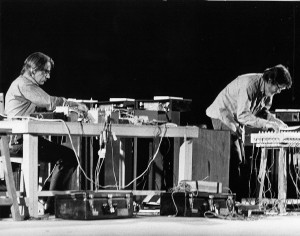
David Tudor (left) and John Cage performing at the 1971 Shiraz Art Festival. (source)
Lately–in addition to spending a lot of time writing abstracts–I’ve been thinking about where Zappa’s ideas about music come from. He’s generally considered to be a sort of musical anomaly, but I think it would be a mistake to say that his was an isolated case. Don’t get me wrong: there’s plenty about that Zappa that’s unique! But I have to wonder what influenced his (often highly polemical) opinions, particularly with regards to the status of new music in contemporary culture and the perceived division between art and pop.
Recently, one of my advisers suggested looking for a connection between Zappa and Abbie Hoffman, the outspoken yippie activist. I don’t think that Zappa had much to do with Hoffman or the yippies. If anything, he was highly critical of their motives. Posed with a question about his cynicism towards certain social movements of the late 1960s, Zappa responded:
A lot of people were really into it. They thought it was the end-all. They really thought they were going to rule the world with a flower in their hand. It was nuts. They were believing in all these Yippie leaders and whatever else these assholes were telling them. [1]
On the other hand, critical though he was, Zappa does seem to have a lot in common with the New Left and I think that much of his understanding of avant-garde art music stems from radical culture and politics.
Commenting on my post the other day (in which I provided three tables listing Zappa’s borrowings from Stravinsky), Brett writes:
I’ve heard the claim before (don’t remember where) that the melody from “Magdalena” is based on the Violin Concerto. I’m not convinced, as its just a simple scale from 1 to 5. One could claim hundreds of pieces as models. Any comments by Zappa backing that up?
Good question, Brett! I wasn’t able to find any primary sources to confirm the borrowing, but took the opportunity to listen to the two pieces again. There are a few notable differences, but I remain convinced that Zappa had the Violin Concerto in mind with “Magdalena.” Here’s why…
It’s that time of year again! The deadlines are fast approaching for a number of upcoming conferences. I’ve got my eye on three right now:
The International Association for the Study of Popular Music US Branch (IASPM-US) is holding their annual conference in New Orleans next year. (April 9-11, 2010)
The Experience Music Project/Science Fiction Museum and Hall of Fame in Seattle (EMP/SFM) will be holding a conference entitled “The Pop Machine: Music and Technology.” (April 15-18, 2010)
I’ve been working on a couple of abstracts and am getting close to final drafts. It’s a tough process: coming up with a topic and then following through with devising an argument for a paper not yet written! I’ll post the abstracts that I come up with over the next few weeks or so.
As promised in my last post, here are several tables that account for most (if not all) of Zappa’s borrowings from Stravinsky. I’ve tried to provide as much information about each instance as possible and have listed the track title, the album title, the recording date and location, the title of the borrowed composition, the borrowing strategy employed, and details regarding timing and nature of the borrowing.
(You can sort the tables by clicking on the header cells, though in some cases, that won’t accomplish anything productive!)