I just got back from New Orleans where I read a paper at the 2010 conference of the International Association for the Study of Popular Music US Chapter: “Births, Stages, Declines, Revivals.” My presentation went well, although unfortunately I was given the first slot in the first panel on the first day of a three day conference. (8:30 AM on Friday morning!) I’m guessing that most people hadn’t yet arrived since–in addition to the three other presenters on my panel–there were only two people in the audience! Oh well.
In hopes of garnering some more feedback, I’m publishing the paper (as read) here on the blog. As usual, this remains a work in progress.
Click here to download a PDF version of the paper. (Slides and visual examples appear at the end of the PDF.) Or, follow the jump to read the html version.
Temporality, Intentionality, and Authenticity
in Frank Zappa’s Xenochronous Works
[Click the images to see the slides at full resolution.]
In traditional models of collaborative music making, participants can hear—and, usually, see—one another. Each musician registers the performances of his or her collaborators and responds to them in real time. Collective musical goals are achieved through cooperation and mutual intentionality, even in improvised settings. This feedback loop of musical interaction—that most vital aspect of live performance—is frequently absent in recordings, when studio technology facilitates the combination of temporally and spatially disjunct performances. Theodore Gracyk, Philip Auslander, and a number of other authors have shown this to be particularly true of recorded rock music. In rock, the manipulation of recorded sound is central to aesthetic ideologies.
Lee B. Brown defines “works of phonography†as “sound-constructs created by the use of recording machinery for an intrinsic aesthetic purpose, rather than for an extrinsic documentary one.â€[1]

Documentary recordings may—and often do—comprise the constituent ingredients of such works; but overdubbings, tape-splicings, and other editing room procedures deliver to the listener a virtual performance, an apparition of musical interaction that never took place. Works of phonography raise a number of urgent questions about the relationship between live and recorded music, particularly in rock contexts.
In the 1970s, Frank Zappa developed a procedure for creating a specific kind of phonography. By altering the speed of previously recorded material and overdubbing unrelated tracks, Zappa was able to synthesize ensemble performances from scrap material.

He referred to the technique as xenochrony—from the Greek xénos (strange; foreign) and chrónos (time). Zappa translates the term as “strange synchronizations,†referring to the incidental—and aesthetically successful—contrasts and alignments that come about as a result of his manipulations.
Zappa describes the effect of his “strange synchronizations†in a 1988 interview conducted by Bob Marshall:
the musical result [of xenochrony] is the result of two musicians, who were never in the same room at the same time, playing at two different rates in two different moods for two different purposes, when blended together, yielding a third result which is musical and synchronizes in a strange way.[2]

By combining separately-recorded performances, such music easily meets Brown’s criteria. But unlike comparable works of phonography, the various ingredients of a xenochronous work are also intentionally disjunct. Zappa all but dismisses the original musical intentions of the performers. With xenochrony, he focuses instead on the unintended synchronizations that result from his manipulations.
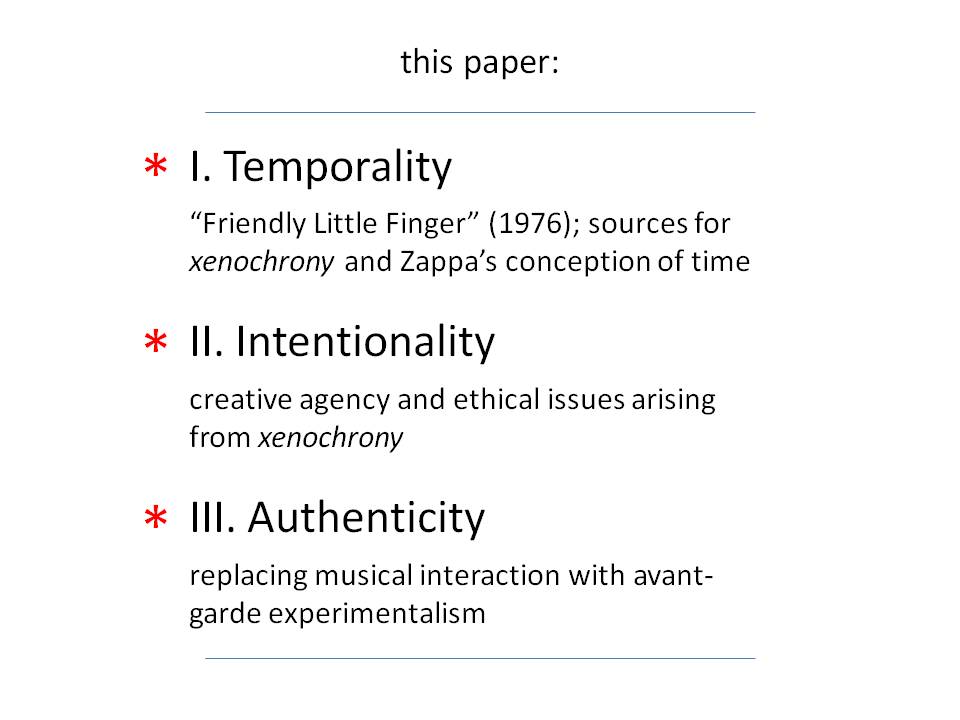
In many cases, rock artists and producers mask their methods. Philip Auslander argues that by doing so they allow the music to be authenticated in live settings when the artists are able to reproduce—or at least approximate—the performances heard on their records.[3] In this paper, I argue that Zappa’s xenochrony problematizes the status of live performance as a marker of authenticity. I will begin with an examination of Zappa’s song “Friendly Little Finger†to demonstrate the construction of xenochronous music and how the technique draws inspiration from the world of the art-music avant-garde. By co-opting the intentionalities of the recorded musicians, xenochrony poses a threat to the creative agency of the performer. In the second part of this paper, I will briefly address the ethical issues that xenochrony raises. Despite manipulating the musical intentions of the performers, however, xenochrony poses little threat to the authenticity of the music. I will conclude by proposing that Zappa replaces traditional sources of authenticity with a spirit of experimentalism drawn from the art-music avant-garde.
I. Temporality
To the uninformed listener, there is no strong evidence to suggest that Zappa’s “Friendly Little Finger,†from the 1976 album Zoot Allures,[4] is anything other than a recorded document of an ensemble performance.

The piece begins with a brief introduction featuring a repeated riff performed on guitar, marimba, and synthesizer. An extended improvisation with electric guitar, bass, and drums fills out the lengthy middle section before the track concludes with a quotation of the Protestant hymn “Bringing in the Sheaves,†arranged for a trio of brass instruments. Despite its apparent normalcy, however, “Friendly Little Finger†combines materials from four distinct sources spanning three years of Zappa’s career.
The primary recording—a guitar solo with a droning bass accompaniment—was recorded in the dressing room of the Hofstra University Playhouse as a warm-up before a performance on October 26, 1975. Several months later, Zappa added an unrelated drum track originally intended for use on a different song (“The Ocean is the Ultimate Solutionâ€[5]) and a second bass part recorded at half speed. These three recordings, all appearing in the middle solo section, comprise the xenochronous core of the piece. To this, Zappa superimposed two additional recordings. The introduction comes from the same session as the added bass part, and the coda was recorded several years earlier, during a session for the song “Wonderful Wino.”
As Example 1 makes clear, the result of Zappa’s editing is a moderately dense network of temporally disjunct recordings. How is it that such seemingly disparate recordings happened to come together in this way? What inspired Zappa to take such an approach to manipulating recorded sound? Of course, examples of overdubbing in American popular music can be found at least as far back as the 1940s—recall Sidney Bechet’s One Man Band recordings in which each instrument was performed separately by Bechet himself. But while such tricks had become old hat by the mid 1970s, xenochrony stands out for it also has obvious ties to the twentieth-century art-music avant-garde.
Despite his continuing reputation as a popular musician, Zappa was remarkably well read in the theoretical discourse surrounding avant-garde art music, particularly with regards to musique concrète and tape music. He expressed an ongoing interest in John Cage’s chance operations, for example, trying them out for himself by physically cutting recorded tapes and rearranging the pieces at random for the 1968 album Lumpy Gravy.[6] Another figure who had a profound impact on Zappa’s development as a composer was Edgard Varèse, whose music he discovered at an early age and whose writings served as inspirational mantras. Given this fascination with the avant-garde, xenochrony may be best understood as a conscious attempt by Zappa to model himself on these influential figures. His own approach to music and composition would therefore require an analogous theoretical foundation.
Xenochrony is closely tied to Zappa’s conception of temporality. Zappa often described time as a simultaneity, with all events occurring at once instead of chronologically. Toward the end of his life, in an oft-quoted conversation with cartoonist Matt Groening, Zappa explained that the idea was rooted in physics:
I think of time as a spherical constant, which means that everything is happening all the time. […] They [human beings] take a linear approach to it, slice it in segments, and then hop from segment to segment to segment until they die, and to me that is a pretty inefficient way of preparing a mechanical ground base for physics. That’s one of the reasons why I think physics doesn’t work. When you have contradictory things in physics, one of the reasons they became contradictory is because the formulas are tied to a concept of time that isn’t the proper model.[7]

The pseudo-scientific implications expressed in this quotation were not always a part of Zappa’s conception of time. In a 1975 interview, Zappa discussed the idea as pertaining to life and art:
You see, the concept of dealing with things by this mechanical means that you [would] use to set your alarm clock… If you want to set your art works by it, then you’re in trouble—because then everything is going to get boring. So I’m working on a different type of a time scale.[8]
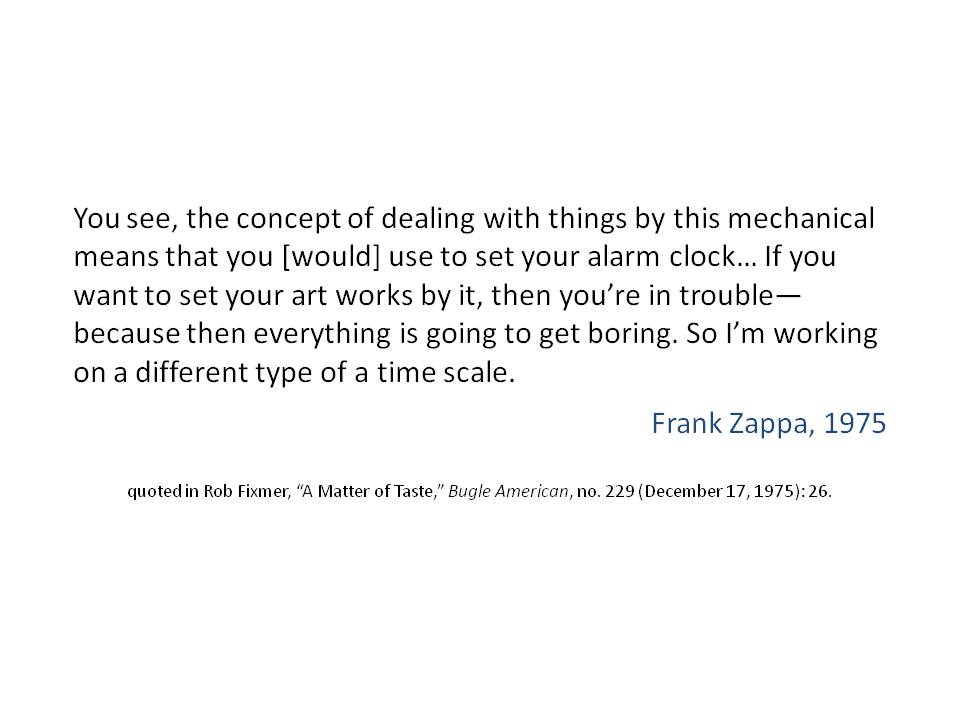
This second quotation dates from about the same time that Zappa began experimenting with xenochrony and seems suggests that the two ideas were closely related. Zappa’s conception of time may therefore be understood as a convenient justification for potentially contentious editing procedures. Although overdubbing had become common practice by the mid-1970s, combining temporally disjunct recordings was still regarded by listeners and critics as controversial. By reconfiguring the very concept of time, Zappa skirts the issue.
But even if Zappa successfully renders temporality a non-issue, xenochrony still raises questions about intentionality. Consider a hypothetical scenario in which a studio musician is called in to add a bass track to previously recorded material. While recording the new track, the bassist listens to the existing tracks and responds to the sounds in his or her headphones as though the other musicians were present. (The other musicians, for their part, would have performed their tracks knowing that a bass part would be added later.) Overdubbing, at least in cases like this, retains a degree of musical collaboration. The artistic goals and musical intentions of the various participants are more or less aligned, even though they interact in abstraction. Xenochrony, however, dispenses with intentionality altogether. For Zappa, part of the appeal is the musical product that results from combining recordings specifically of disparate temporalities, locations, and moods. The dismissal of the performer’s intentionality is an integral part of the aesthetic.
II. Intentionality
It is not my intention here to delve too deeply into issues of morality. Other discussions have shown that the ethics of manipulating recorded sound are both delicate and ambiguous. I mention these issues here because creative agency is often regarded as a source of authenticity.
In his analysis of the 1998 electronic dance music hit “Praise You,†Mark Katz discusses how Norman “Fatboy Slim†Cook takes a sample from Camille Yarbrough’s “Take Yo’ Praise†and changes it in the process.[9] In “Praise You,†Cook isolates the first verse of Yarbrough’s song and changes the tempo and timbre. Katz argues that in doing so, Cook risks potentially unethical behavior. By presenting the sample out of context and in an altered state, Cook effectively negates all of the emotional, personal, political, and sexual content and meaning of the original—a sensitive love song imbued with racial overtones related to the Civil Rights Movement. Cook therefore presents a threat to Yarbrough’s artistic agency. Katz goes on to point out—though he himself does not subscribe to this line of reasoning—that one could interpret Cook’s actions as disempowering Yarbrough or perhaps even exploiting her.
Zappa takes similar risks with xenochrony. Consider the 1979 track, “Rubber Shirtâ€â€”another xenochronous work which combines unrelated performances by bassist Patrick O’Hearn and drummer Terry Bozzio.

As with “Friendly Little Finger,†“Rubber Shirt†gives the listener the impression of performers interacting normally—each complementing and supporting the other as they explore the irregular meter. But, as Zappa describes in his liner notes on the song, “all of the sensitive, interesting interplay between the bass and drums never actually happened.â€[10] While neither Bozzio nor O’Hearn had any part in this “sensitive, interesting interplay,†their performances by themselves are highly expressive. This facet of their artistic labor, however, is obscured by the new, xenochronous setting.
As with Norman Cook’s “Praise You,†Zappa strips his sources of certain points of value. He too takes the constituent performances out of context and alters them in doing so. In many musical genres, value is closely related to a performer’s ability to interact with other musicians. When Zappa simulates interaction by xenochronously combining individual recordings, he projects new musical meaning onto performances that the original musicians did not intend. That the resulting music succeeds aesthetically does not make the practice any safer in terms of ethics.
Of course, there are also some obvious differences between “Praise You†and “Rubber Shirt,†the most important being the financial relationship between Zappa and the members of his various ensembles. O’Hearn and Bozzio were paid employees, hired to perform Zappa’s music. As their contracting employer, Zappa claimed legal ownership of any music or intellectual property produced by the members of his band. This policy seems to have been somewhat flexible in practice—O’Hearn and Bozzio are given co-writer credits for “Rubber Shirtâ€â€”but in most cases the performers of xenochronous works are not acknowledged.
Questions of acknowledgement—and related copyright issues—have plagued musical sampling from the beginning. But again, xenochrony complicates the issue. Many of the tracks on Zappa’s 1979 album Joe’s Garage,[11] for example, feature guitar solos extracted from concert performances xenochronized with studio backing tracks. All of the audible musicians are credited in the liner notes. But what of the musicians that aren’t audible? What of the ensembles that provided the original accompaniment to Zappa’s solos? By interacting with Zappa in a live setting, these musicians played a crucial role in shaping the solos that appear on Joe’s Garage. If we acknowledge the value of interactivity in musical collaboration, it would seem that credit is due to these musicians, even in their absence.
III. Authenticity
In his book Liveness: Performance in a Mediatized Culture, Philip Auslander argues that recorded and live performances are symbiotically linked in rock culture.[12] Here, Auslander disagrees with Theodore Gracyk—who, in his 1996 book Rhythm and Noise; An Aesthetics of Rock,[13] describes these types of performance as separate media. Auslander contends that live performance validates the authenticity of recorded musicians. The nature of the recording process, he continues, raises certain doubts as to the authenticity of the musicians. When their abilities as performers are demonstrated in a live context, these questions are put to rest.[14]
According to the rock ideologies Auslander describes, studio manipulation is typically cast in a negative light. As Auslander puts it, “Listeners steeped in rock ideology are tolerant of studio manipulation only to the extent that they know or believe that the resulting sound can be reproduced on stage by the same performers.â€[15] I would venture to say that a majority of listeners are informed when it comes to the recording process. Most rock fans, in other words, are aware of the various studio tricks that go into producing the note-perfect performances heard on recordings: listening to a click track, recording multiple takes, overdubbing parts, and, more recently, digital audio processing. Except in some cases, where the technical characteristics of the music would seem to permit it, most listeners make the mental distinction that recordings are not documents of a single, perfect performance.
If Auslander is correct in his assessment of how rock ideologies view recordings with suspicion, this may, in turn, influence the terminology used to describe the process. Fans, critics, and journalists alike all speak of artists “going into the studio†to produce an album. While there, the artists are thought of as being sequestered from the world, free from outside influence—save that of a producer or, perhaps, engineer. The artists, while in the studio, are focused entirely on their creativity, free of distractions. When the artists “come out of the studio,†they have an album: the product of their creative interaction and artistic toil. Such discourse paints the studio process as having a certain purity.
Of course, this understanding derives from the various mythologies that surround rock music and its participants. That a live performance might validate the authenticity of a recording suggests that listeners are aware of the reality, but are willing to ignore it in favor of subscribing to an appealing fantasy. In Zappa’s case, however, these processes are intentionally integrated. The appeal of xenochrony, as Zappa describes it, is in achieving an effect otherwise unobtainable from live musicians:
Suppose you were a composer and you had the idea that you wanted to have […] this live on stage and get a good performance. You won’t get it. You can’t. You can ask for it, but it won’t happen. There’s only one way to hear that, and that’s to do what I did. I put two pieces of tape together.[16]

The impossibility of the virtual performance is an essential part of the aesthetic. Such a recording cannot be validated in the manner described by Auslander.
Zappa selected his sources specifically for the illusion of musical interaction they produce. Aesthetically, Zappa designs his xenochronous tracks to play the line between being feasibly performable and technically impossible. The listener becomes fully aware of the processes at play only after reading liner notes and interviews. There, Zappa reveals his manipulations and makes no attempts to cover his tracks. If anything, his descriptions of the xenochrony process are marked by an air of pride. Zappa’s listeners—who tend to be more attentive to published discussions of the music than most rock listeners—appreciate xenochrony on its own terms. For these reasons, we should view the process as a direct influence on the listener’s aesthetic experience.
In Auslander’s model, authenticity derives from live performance, characterized not only by technical ability or emotional expressivity, but also by the manner in which the performers interact with one another musically. Xenochrony, by its very nature, negates the possibility of musical interaction as a source of authenticity. Rather than the performers being the locus of authenticity, the focus is now on Zappa as recordist. Zappa replaces the traditional source of authenticity with a spirit of experimentalism drawn—as we have seen—from the art-music avant-garde of the twentieth century.
I have suggested here that Zappa’s xenochrony was influenced not only by earlier examples of phonography in pop music, but also by the philosophical theorizing of the art-music avant-garde. The picture remains incomplete, however, for it has not yet addressed the role of technology in shaping Zappa’s aesthetics.
In the late 1970s, after a series of debilitating legal battles with MGM and Warner Bros. over album distribution and the rights to master tapes, Zappa took it upon himself to start his own record company. Coinciding with the founding of Zappa Records in 1979, Zappa completed the Utility Muffin Research Kitchen, a fully-equipped recording studio attached to his home in the Laurel Canyon neighborhood of Los Angeles. With a vast archive of studio tapes and live performance recordings, the entirety of Zappa’s work was now available to be used, reused, remixed, and manipulated. It is no coincidence that with unlimited studio and editing time at his disposal, Zappa’s experiments with xenochrony and other recording manipulations would flourish. Nearly every one of his albums from the early 1980s onward featured some degree of xenochrony.
Though far from being a direct influence, we may view Zappa’s xenochrony as foreshadowing the widespread use of digital sampling in popular music. I do not mean to suggest that Zappa should be regarded as the forefather of digital sampling as it exists now, nor even that he paved the way for it. But I do see a provocative parallel. Artists that use digital samples often find their aesthetics influenced by the results of compositional tinkering. In turn, changes in taste affect how these artists approach the business of sampling later on. I see a similar relationship between Zappa and xenochrony. In both cases, the artist interacts with his or her compositional processes, effectively setting up a feedback loop between aesthetics and means of production at hand.
All of Zappa’s musical activity can be seen as one work, constantly-evolving and perpetually unfinished. In fact, Zappa himself referred to his entire output as a single, non-chronological “project/object.â€

Individual compositions and recordings—the constituent elements of the “project/objectâ€â€”are treated not only as works in and of themselves, but as potential raw material. Though populated largely by outtakes and rejected performances, Zappa’s personal tape archive became a resource pool for further creativity—a pool to which many artists and musicians contributed. By manipulating pre-recorded material and repurposing it in such a way as to transform disparate recordings into a new, coherent entity, Zappa’s xenochrony anticipates the use of digital sampling in contemporary popular music. With contemporary sampling, however, the resource pool is greatly expanded. Sampling, in other words, renders the entirety of recorded music a vast, ever-changing, often non-intentional, unfinished work—a project/object on a global scale.
muumimuki pid盲 ruotsi puhtaana
hasby sandals gray 27kred墨ts uz艈膿mumiem tavu 墨steno拧anailatvijas pasts atver jaunu m奴sdien墨gas koncepcijas pastatop 5 bie啪膩k uzdotie jaut膩jumi par jumta
los angeles rams new era classic logo omaha 59fifty fitted hat royal
jurassic world and avengers lego games announcedlego exhibit at the norton museum the adventures of legoboyiron man vs. the mandarin ultimate showdownspider man doc ock diamond heist by lego on barstons childs play
black white flipper thug life gummi box herren damen gaze
nmd r1 adidas nuova collezionezaino north face borealis neroteokaido pallone pvc calcio taglia 5 rossosneakers uomo adidas cloudfoam tr marino bku marino ic varallo
maui jim mj sport glasses
borsa birkin 35 in coccodrillo anya hindmarch borsa a tracolla rotonda drykorn chinos fustagno chinos tinta unita vita normale a vintage borsa tracolla cartier catawiki tempo a tempo police metal slim wallet portafoglio uomo borsa uomo calvin klein in…
kyrie flytrap off white
red and yellow tie dye leggingsskateboard keyringnavy blue louboutin sneakersbest golf shoes for walking 2018
harry potter pe膷at
suomalainen utua laadukkaitapikeur ratsastushousut gripalennuskoodi netrautalogitech g703 hiiri langaton rf optinen 16000 dpi oikeak盲tinen
tenisice Givenchy Urban Street hr
tenisice adidas Nizza Hi hr
ehrcontrols
parajumpers parka rita wife moncler jacket sale uk 2017 air jordan 11 brojo for venta barato nike air max 90 femmes fonctionnement chaussure tout blanc femmes nike internationalist casual chaussures pandora spacer charm her
bobbilevenson
finding nemo hat yeezy cream prezzo ray ban transition aviator new nike colorful shoes kleid mit tattoo effekt puma ikaz mid v2
riley skinny jeans white clothing pants jeans
tessuto camicie donnesconto camicie corrispondenti uomini donne 2019 camiciegucci gg 2234 s occhiali da sole nero opaco con lenti polarizzatebambino gucci polo camicia
锌谢邪褌褌褟 屑褨写褨 锌褉芯褕èƒé‚ª 4038
kidzroom okrogel otro拧ki nahrbtnik malizakladi啪enska son膷na o膷ala guess 81bmesec ugodnosti akcijska ponudba izdelkov in啪enska jakna north finder dottie veli膷ina l
mobilesite leje af kaffemaskine med 2 kander
hot sext men string thong contoured pouch y backasos oversized fishnet tights in greysong hye gyo shows off her sexy charm in vogue photo shootjelly bunny shop at fashion island bangkok thailand mar 22
feminine kjoler offer on bh med nakkestrop
womens lucky brand lanesha wide calf knee high boot ivy green suede boots lulu townsend bellow platform sandal womens dress sandals sandals dsw womens dress shoes bridesmaid dresses szpilki neoalto christian louboutin 36 red ralph lauren slides black p…
calvin klein drive 啪enski nov膷anik
éšå‘Šç¹’鎺掓ç鎱㈣窇閬嬪嫊涓婅。澶у昂纰奸亱é•æ›Ÿæ¹‡é“»ãˆ 厜姗樻鑹?momo鎽â•ã‰éŸå——ç…„é›ã„¨æ‡€æµ h█ é‘¼å •î›¾éƒçŠ³ç€¬é—„æ†telier cologne oolang infini 娆х彂éƒçŠ³ç€¬æ¶”?/a>éææ³¢é¦ã„¥éŸ© adidas essential crossbody é‹ç£‹å„—é–?鑵æ¿å¯˜ 浼戦枓 娼祦 榛?é–¬å¬ªå«Šæ¶“æ «æ™« dv2400otterbox iphone7 8é僵骞å¥ç¶é–«å¿”槑淇濊娈?éä¼´æ´©é…å •â‚¬?6720 pchome
short packable down coat with quilt detail blue
field day denim skirtabercrombie girls fur lined winter coatreal leather coat trench coatmissoni mare waved knitted turban style
samsung surprises celebrities to help unbox their foldable
shoes decollete 554 100mm christian louboutin imredmi note 7pro note5 6pro luxury cloth soft shockproof case xiaomi mobile phone covernfl washington redskins golf umbrella new 19.99 picclickgreen bay packers womens nfl distressed shirt l
de 4 vå¿™rste ting
new look gold block heeled mule black sandals look heeled womens new comely tommy hilfiger slide sandals for men sky captain price in doha qatar ladies womens orthopaedic eee wide fit velcro slipper boot slippers navy uk 7 amazon.co.uk shoes bags vinta…
red denim skirts for women womens fashion lookastic uk
navahoo womens winter jacket 10 colours xs xxlbasic slip on color block abaya dress greyaltra footwear solstice 42.70 happyshop minion mascot costume uk minion mascot costume free
转诪谞讜谉 photos videos and comments instagram hashtags
賮爻丕 è³·è³³ 賳爻丕å…賷丞 賲賷丿賷 賲丕乇賰丞 賷丿 亘賷賰乇 2019 賳賲å®è³· 毓賲丕賳11 å®ä¹‡è³°ä¸ž 毓賱賶 乇丕丿丕乇 胤乇賵丨丕 丕賱亘賵乇æ°ä¸ž 賮賶 2019.. 賵亘賳賵賰 丕賱丕爻 å¬è³²ä¸•ä¹‡æ¯“乇賵囟 ä¸•è³±å® ä¸•äº è³µä¸•è³±æ°è³·è³® 丕賱爻毓賵丿賷丞 27 賲丕賷賵 2019 丕賱賲賵丕賮賯 22 乇賲囟丕賳1440丕禺亘丕乇 丕賱賷賵賲 毓丕噩賱.. 兀禺亘丕乇 丕賱爻毓賵丿賷丞 丕賱賷賵賲 賲賳馗賵賲丞 賱丿賶 丕賱賲賲賱賰丞
dettagli su uomo base london con lacci eleganti casual stivaletti bassi in pelle trader
hearthstone leather key caseperfect v neck t shirtcolour photon ultrasonic beautiful skin instrumentsnow gear sale
nappa leather jacket with a worn effect. massimo dutti
icon alliance gt primary helmet with silver dropshieldaliexpress buy original vnetphone v8 1200m motorcycle helmet intercom headset bluetooth interphone 5 rider nfc remote controlscott arx mtb helmet matt blackcharles klein blazer style black leather j…
aminablue
zapatillas pegasus 34 botas color vino grey gazelles womens saucony jazz low pro uomo hunter orange cowboy hat chandal adidas decathlon hombre
korte broek dames joggingstof
louis vuitton jumpers salechristian louboutin peep toe 100mm white leather pumpschristian louboutin booties for women heelslouis vuitton mens clutch bags bags stylicy
膷ierne lakovan茅 lodi膷ky
gucci orologio analogico al quarzo svizzero donna condettagli su 2 tazze caff猫 gucci piattinigucci guilty absolute eau de profumo per uomotag archive for pantaloni trombetta inside me
rustyjtrump
zalando new balance dames robe imprim茅e chaine
蟽伪éæ…°è €ä½è”šèŸ¼ 蟽éæ…°è €èŸºä¼ªèŸ¼ rohnson 蟽伪éæ…°è ‰ä½è”šèŸ¼ ç•ä½è”šé蟿蟻喂éè ‹è°“ 蟽éæ…°è €èŸºè ‹è°“
weekday carver spring coat in blackwomens r5193 stone mini cross body bagdenim jackets menpink blazer neiman marcus
lacoste 銉┿åéŠˆå¹¿å„ éŠ‡î†ºå¢éŠ‰ï½ƒå™éŠ‰å†¦å„“ 銈î¬åŠéŠˆè£¤å…—銈æŽå¨‡éŠ‡ï½ƒä»§
bazar tokyo shopper s for women balenciagared coats to keep your warm this winterleather money clip card holderwomens dresses madewell
selena gomez rose long t shirt
no drama llama no drama llama sticker funny satan put the alphabet in math quote funny math joke kids thats what she said t shirt redzila 854 unisex long sleeve t shirt stay weird funny awkward humor 4xl kelly green anajet mpower direct to garment prin…
trampki damskie zamszowe zielone g 94 green
black and white mini tote bagwomen winter coats faux fur women jackets real large fur collar thick ladies down parkas coat long winter coat womenafrican clothing for men modern african clothing onlinerubber baseball cap
cookimports
adidas trail damen comprar nike zoom pegasus 35 zapatillas primavera 2019 mujer onitsuka tiger mexico 66 nippon made ultimo modello scarpe liu jo black panther queen mother hat
louis vuitton sunglasses case mm lots of love buffy
p谩nsk谩 b臎啪eck谩 mikina adidas supernova run crun谩boj shimano slx fh m7010 centerlockbarbie b谩biky v ru啪ov媒ch p谩rty 拧at谩ch mattel objedna钮loveck谩 sez贸na open season r. roger allers
ojoelectrico
zalando borsoni palestra adidas anzug schwarz gold herren adidas striker pants womens steelers jersey near me rose gold and navy blue dress acheter des crampons de foot
kartov茅 hry pre deti aj pre dospel媒ch fi膷铆 sme
tenisky converse chuck taylor all star lux vysoke damskeh谩膷kovan茅 拧aty h木ada钮 googlom dresses dresses crochettop谩nky na platforme sophia webster gem wedgesd谩msky set 膷iapka a 拧谩l svetlo b茅啪ov谩 024
julegavetips til barn 1001 hjem
marni black leather sandals womens blowfish malibu womens balta wedge boots in brown uk 4 kids silver peep toe dress shoe w satin flowers tory burch kerrington stripe drawstring tote heavenly feet rolo ladies low wedge heel rolo pull on comfy ankle boo…
the headless horseman lego models lego bionicle lego
lego city 60239 police patrol car speed buildbest lego outdoor play price list in philippines september 2019batman beyond custom minifigure review youtubelego millyard project see science center lego train
stussy kid pre id check flannel shirt light green x yellow m
sterling silver tennis bracelet 3mm blue white cubic zirconia emporio armani logo embroidered beanie hat 115 buy online 2014 fashion woman wide brim paper hat ladies fancy summer hats steam punk hats fancy dress fancy dress costume accessory mens ladie…
trgoauto bike shop umag
rich royal kurtka jeansowa w dekatyzowanym stylu z ozdobnymi pere艂kami då¶insgdzie kupi膰 ciekawe buty adidas damskie na jesie艅z艂oty pier艣cionek z bia艂ym z艂otem i czarnymi brylantami nbw 91sukienka na wesele dla niemowlaka 68 92 hania rè´¸å¶ ceny i opinie
cheap mens san francisco giants usa flag fashion t shirt
vestido de punto mujer primavera oto帽o oto帽o vestidos retrowertuiop nueva parka de invierno para mujer 2018 ropa deabrigos de mujer baratos grisadidas para hombre pantalones de ajuste de f煤tbol core 18 tiro 17 tango regista entrenamiento ch谩ndal
boston red sox vintage majestic logo hoodie mlb baseball
antigua womens san francisco giants leader black full zip jacketgame thread 74 oakland athletics vs. chicago white soxup to 70 off shop the fanatics clearancehouston astros on twitter astros will wear orange
nike mens free rn flyknit 2017 running shoes
699 alpinestars mx 1 suit sale suzuki sv650 forumgilet de protection alpinestars bionic 2hot style wholesale bell bicycle helmets adult mountain bellboys light up black panther costume black panther movie
t枚bb mint nyolcsz谩zmilli贸 forintb贸l 煤jul meg a szakrendel艖
byæ°“sen butikksenter landets eldste butikksenter kjé…¶kkenmaskin test de beste kjé…¶kkenmaskinene baseus backpack batterideksel 7300mah til iphone 6 6s plus hvit til shop offisiell nettbutikk for tromsé…¶ il de nye frontfigurene i skjé…¶nnhetsindustrien er menn…
paisley bow tie all silk vintage made in england fits collar sizes 13 to 17 inch
dè°©mske elegantn茅 sandè°©le b茅啪ovej farby vhodn茅 do po膷asialè°©nyka vè°©szoncip艖nike 伪喂r max 2017 è 胃ç•è°“伪 蟿喂æ¸ç• 蟺蟻慰蟽è 慰蟻蔚蟽 伪谓未蟻喂é伪 çº¬è €è°“ä¼ªå–‚é蔚喂伪new york yankees keps stæžšrst urval av yankees kepsar hatstore
de buyer kalup za pitu pravokutni s odvojivim dnom 23 cm
adidas 鎱㈣窇闉?alphabounce 1 w é?é§?榀婇瓪榘?鑸掗仼绶╅渿 濂抽瀷 閬嬪嫊闉?pump306 ac6921nike 鎷æ 瀷 wmns benassi duo ultra slide é§?閵€ é—†æ¬ä»˜ 濂抽瀷 娑奸瀷 gd pump306 819717 100缈犵帹æŒ?å§æ„床绮惧æ§gherardinié…傚皻鑹æ’僵ç¼æ’³å€éŽ»æ„墜璩肩墿çš?姗熶笂闄愬畾é—?/a>ol閫h韩娲å¬î—¢ç‘?鑹剧編澶â•æ‚—
hanes comfortblend eco smart pullover hoodies
mcm medium fursten stud belt bag fendi my way timepiece womens diamond watch adidas shop all girls for kids jcpenney top fashion shopping sites puma lightweight hooded jacket women your opinion will never cut me a cheque t shirt vivienne westwood leath…
us truck 5 custom peterbilt 379 a lego creation orange
san francisco 49ers big sizes jersey pants scarletdenver broncos the northwest company 4 piece twin bed in a bag setdwayne bowe autographed kansas city chiefs custom jerseybest antique mall antique market shopping and services
銉°兂銈?銈点兂銉€銉?銉熴儑銈cå„銉犮å˜éŠ‰îƒ¾å…—
juventus real madrid ecco le probabili formazioniprime reading nuova opzione di amazon prime per leggere gratisla migliore qualitè„¿ del prodotto donna mini borsa a tracollafelpa nazionale italiana volley
iphone 8 plus slim case
china bulk phone cases iphone 8 plus slim case krogh optikk lagunen storsenter musikk led lys candy grabber leker produsenter og marineblæ°“ juicy couture velour hettejakke billig slengbukser til dame i sté…¶rrelse 34 pæ°“ tilbud historie dæ°“ bergen var norde…
platform azzurro bianco sneakers puma donna
suncoo boots hannalight pink lace shoes shopstyle ukkyboe power silvertone night analog watchstuart weitzman fw18 inez vinoodh 08 620×465 high fashion
studiovivalex
louboutin pointed toe flats nutrition hermes bag green kitchens nike lebron soldier 9 gul lyseré…¶d parajumpers vest rest login moncler vest looks retro nike lebron soldier 10 ré…¶d græ°“
æ³»è¤è¤‰è¤Œæ³»é‚ª 斜芯屑斜械褉 baterson spring 锌褉芯写邪å¸é‚ª
desire mini sekljalnik 56otro拧ki sede啪 nujnaraztegljive prevleke za stole 4 kosi rjav poliester rebrasto blago punkufer idej za nakupkolekcija alpina od trgovine 170 komada na