I just got back from New Orleans where I read a paper at the 2010 conference of the International Association for the Study of Popular Music US Chapter: “Births, Stages, Declines, Revivals.” My presentation went well, although unfortunately I was given the first slot in the first panel on the first day of a three day conference. (8:30 AM on Friday morning!) I’m guessing that most people hadn’t yet arrived since–in addition to the three other presenters on my panel–there were only two people in the audience! Oh well.
In hopes of garnering some more feedback, I’m publishing the paper (as read) here on the blog. As usual, this remains a work in progress.
Click here to download a PDF version of the paper. (Slides and visual examples appear at the end of the PDF.) Or, follow the jump to read the html version.
Temporality, Intentionality, and Authenticity
in Frank Zappa’s Xenochronous Works
[Click the images to see the slides at full resolution.]
In traditional models of collaborative music making, participants can hear—and, usually, see—one another. Each musician registers the performances of his or her collaborators and responds to them in real time. Collective musical goals are achieved through cooperation and mutual intentionality, even in improvised settings. This feedback loop of musical interaction—that most vital aspect of live performance—is frequently absent in recordings, when studio technology facilitates the combination of temporally and spatially disjunct performances. Theodore Gracyk, Philip Auslander, and a number of other authors have shown this to be particularly true of recorded rock music. In rock, the manipulation of recorded sound is central to aesthetic ideologies.
Lee B. Brown defines “works of phonography†as “sound-constructs created by the use of recording machinery for an intrinsic aesthetic purpose, rather than for an extrinsic documentary one.â€[1]

Documentary recordings may—and often do—comprise the constituent ingredients of such works; but overdubbings, tape-splicings, and other editing room procedures deliver to the listener a virtual performance, an apparition of musical interaction that never took place. Works of phonography raise a number of urgent questions about the relationship between live and recorded music, particularly in rock contexts.
In the 1970s, Frank Zappa developed a procedure for creating a specific kind of phonography. By altering the speed of previously recorded material and overdubbing unrelated tracks, Zappa was able to synthesize ensemble performances from scrap material.

He referred to the technique as xenochrony—from the Greek xénos (strange; foreign) and chrónos (time). Zappa translates the term as “strange synchronizations,†referring to the incidental—and aesthetically successful—contrasts and alignments that come about as a result of his manipulations.
Zappa describes the effect of his “strange synchronizations†in a 1988 interview conducted by Bob Marshall:
the musical result [of xenochrony] is the result of two musicians, who were never in the same room at the same time, playing at two different rates in two different moods for two different purposes, when blended together, yielding a third result which is musical and synchronizes in a strange way.[2]

By combining separately-recorded performances, such music easily meets Brown’s criteria. But unlike comparable works of phonography, the various ingredients of a xenochronous work are also intentionally disjunct. Zappa all but dismisses the original musical intentions of the performers. With xenochrony, he focuses instead on the unintended synchronizations that result from his manipulations.
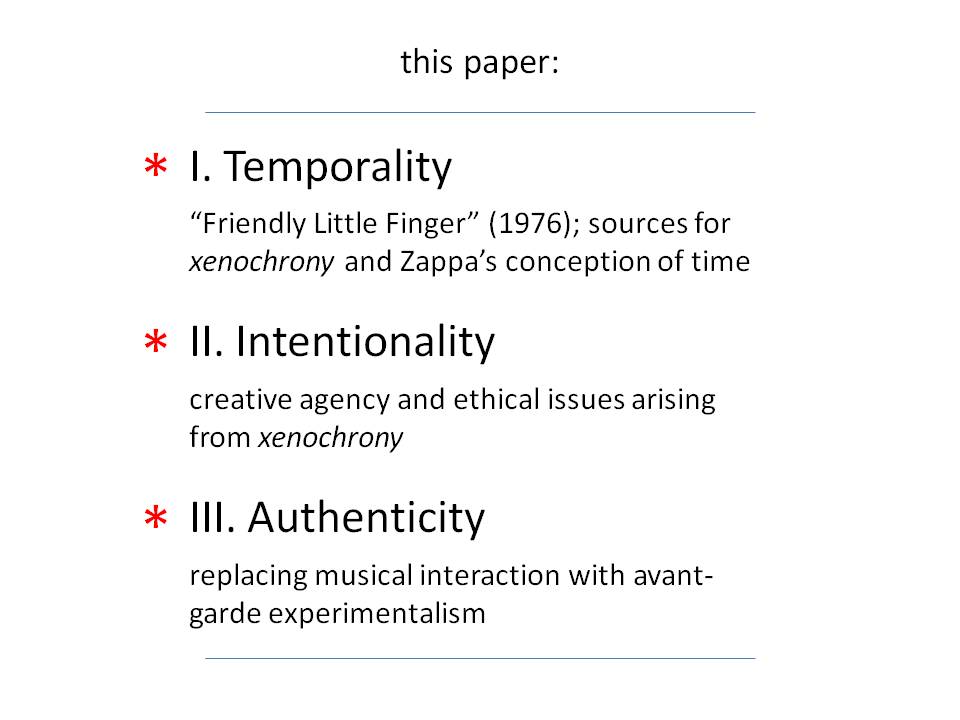
In many cases, rock artists and producers mask their methods. Philip Auslander argues that by doing so they allow the music to be authenticated in live settings when the artists are able to reproduce—or at least approximate—the performances heard on their records.[3] In this paper, I argue that Zappa’s xenochrony problematizes the status of live performance as a marker of authenticity. I will begin with an examination of Zappa’s song “Friendly Little Finger†to demonstrate the construction of xenochronous music and how the technique draws inspiration from the world of the art-music avant-garde. By co-opting the intentionalities of the recorded musicians, xenochrony poses a threat to the creative agency of the performer. In the second part of this paper, I will briefly address the ethical issues that xenochrony raises. Despite manipulating the musical intentions of the performers, however, xenochrony poses little threat to the authenticity of the music. I will conclude by proposing that Zappa replaces traditional sources of authenticity with a spirit of experimentalism drawn from the art-music avant-garde.
I. Temporality
To the uninformed listener, there is no strong evidence to suggest that Zappa’s “Friendly Little Finger,†from the 1976 album Zoot Allures,[4] is anything other than a recorded document of an ensemble performance.

The piece begins with a brief introduction featuring a repeated riff performed on guitar, marimba, and synthesizer. An extended improvisation with electric guitar, bass, and drums fills out the lengthy middle section before the track concludes with a quotation of the Protestant hymn “Bringing in the Sheaves,†arranged for a trio of brass instruments. Despite its apparent normalcy, however, “Friendly Little Finger†combines materials from four distinct sources spanning three years of Zappa’s career.
The primary recording—a guitar solo with a droning bass accompaniment—was recorded in the dressing room of the Hofstra University Playhouse as a warm-up before a performance on October 26, 1975. Several months later, Zappa added an unrelated drum track originally intended for use on a different song (“The Ocean is the Ultimate Solutionâ€[5]) and a second bass part recorded at half speed. These three recordings, all appearing in the middle solo section, comprise the xenochronous core of the piece. To this, Zappa superimposed two additional recordings. The introduction comes from the same session as the added bass part, and the coda was recorded several years earlier, during a session for the song “Wonderful Wino.”
As Example 1 makes clear, the result of Zappa’s editing is a moderately dense network of temporally disjunct recordings. How is it that such seemingly disparate recordings happened to come together in this way? What inspired Zappa to take such an approach to manipulating recorded sound? Of course, examples of overdubbing in American popular music can be found at least as far back as the 1940s—recall Sidney Bechet’s One Man Band recordings in which each instrument was performed separately by Bechet himself. But while such tricks had become old hat by the mid 1970s, xenochrony stands out for it also has obvious ties to the twentieth-century art-music avant-garde.
Despite his continuing reputation as a popular musician, Zappa was remarkably well read in the theoretical discourse surrounding avant-garde art music, particularly with regards to musique concrète and tape music. He expressed an ongoing interest in John Cage’s chance operations, for example, trying them out for himself by physically cutting recorded tapes and rearranging the pieces at random for the 1968 album Lumpy Gravy.[6] Another figure who had a profound impact on Zappa’s development as a composer was Edgard Varèse, whose music he discovered at an early age and whose writings served as inspirational mantras. Given this fascination with the avant-garde, xenochrony may be best understood as a conscious attempt by Zappa to model himself on these influential figures. His own approach to music and composition would therefore require an analogous theoretical foundation.
Xenochrony is closely tied to Zappa’s conception of temporality. Zappa often described time as a simultaneity, with all events occurring at once instead of chronologically. Toward the end of his life, in an oft-quoted conversation with cartoonist Matt Groening, Zappa explained that the idea was rooted in physics:
I think of time as a spherical constant, which means that everything is happening all the time. […] They [human beings] take a linear approach to it, slice it in segments, and then hop from segment to segment to segment until they die, and to me that is a pretty inefficient way of preparing a mechanical ground base for physics. That’s one of the reasons why I think physics doesn’t work. When you have contradictory things in physics, one of the reasons they became contradictory is because the formulas are tied to a concept of time that isn’t the proper model.[7]

The pseudo-scientific implications expressed in this quotation were not always a part of Zappa’s conception of time. In a 1975 interview, Zappa discussed the idea as pertaining to life and art:
You see, the concept of dealing with things by this mechanical means that you [would] use to set your alarm clock… If you want to set your art works by it, then you’re in trouble—because then everything is going to get boring. So I’m working on a different type of a time scale.[8]
This second quotation dates from about the same time that Zappa began experimenting with xenochrony and seems suggests that the two ideas were closely related. Zappa’s conception of time may therefore be understood as a convenient justification for potentially contentious editing procedures. Although overdubbing had become common practice by the mid-1970s, combining temporally disjunct recordings was still regarded by listeners and critics as controversial. By reconfiguring the very concept of time, Zappa skirts the issue.
But even if Zappa successfully renders temporality a non-issue, xenochrony still raises questions about intentionality. Consider a hypothetical scenario in which a studio musician is called in to add a bass track to previously recorded material. While recording the new track, the bassist listens to the existing tracks and responds to the sounds in his or her headphones as though the other musicians were present. (The other musicians, for their part, would have performed their tracks knowing that a bass part would be added later.) Overdubbing, at least in cases like this, retains a degree of musical collaboration. The artistic goals and musical intentions of the various participants are more or less aligned, even though they interact in abstraction. Xenochrony, however, dispenses with intentionality altogether. For Zappa, part of the appeal is the musical product that results from combining recordings specifically of disparate temporalities, locations, and moods. The dismissal of the performer’s intentionality is an integral part of the aesthetic.
II. Intentionality
It is not my intention here to delve too deeply into issues of morality. Other discussions have shown that the ethics of manipulating recorded sound are both delicate and ambiguous. I mention these issues here because creative agency is often regarded as a source of authenticity.
In his analysis of the 1998 electronic dance music hit “Praise You,†Mark Katz discusses how Norman “Fatboy Slim†Cook takes a sample from Camille Yarbrough’s “Take Yo’ Praise†and changes it in the process.[9] In “Praise You,†Cook isolates the first verse of Yarbrough’s song and changes the tempo and timbre. Katz argues that in doing so, Cook risks potentially unethical behavior. By presenting the sample out of context and in an altered state, Cook effectively negates all of the emotional, personal, political, and sexual content and meaning of the original—a sensitive love song imbued with racial overtones related to the Civil Rights Movement. Cook therefore presents a threat to Yarbrough’s artistic agency. Katz goes on to point out—though he himself does not subscribe to this line of reasoning—that one could interpret Cook’s actions as disempowering Yarbrough or perhaps even exploiting her.
Zappa takes similar risks with xenochrony. Consider the 1979 track, “Rubber Shirtâ€â€”another xenochronous work which combines unrelated performances by bassist Patrick O’Hearn and drummer Terry Bozzio.

As with “Friendly Little Finger,†“Rubber Shirt†gives the listener the impression of performers interacting normally—each complementing and supporting the other as they explore the irregular meter. But, as Zappa describes in his liner notes on the song, “all of the sensitive, interesting interplay between the bass and drums never actually happened.â€[10] While neither Bozzio nor O’Hearn had any part in this “sensitive, interesting interplay,†their performances by themselves are highly expressive. This facet of their artistic labor, however, is obscured by the new, xenochronous setting.
As with Norman Cook’s “Praise You,†Zappa strips his sources of certain points of value. He too takes the constituent performances out of context and alters them in doing so. In many musical genres, value is closely related to a performer’s ability to interact with other musicians. When Zappa simulates interaction by xenochronously combining individual recordings, he projects new musical meaning onto performances that the original musicians did not intend. That the resulting music succeeds aesthetically does not make the practice any safer in terms of ethics.
Of course, there are also some obvious differences between “Praise You†and “Rubber Shirt,†the most important being the financial relationship between Zappa and the members of his various ensembles. O’Hearn and Bozzio were paid employees, hired to perform Zappa’s music. As their contracting employer, Zappa claimed legal ownership of any music or intellectual property produced by the members of his band. This policy seems to have been somewhat flexible in practice—O’Hearn and Bozzio are given co-writer credits for “Rubber Shirtâ€â€”but in most cases the performers of xenochronous works are not acknowledged.
Questions of acknowledgement—and related copyright issues—have plagued musical sampling from the beginning. But again, xenochrony complicates the issue. Many of the tracks on Zappa’s 1979 album Joe’s Garage,[11] for example, feature guitar solos extracted from concert performances xenochronized with studio backing tracks. All of the audible musicians are credited in the liner notes. But what of the musicians that aren’t audible? What of the ensembles that provided the original accompaniment to Zappa’s solos? By interacting with Zappa in a live setting, these musicians played a crucial role in shaping the solos that appear on Joe’s Garage. If we acknowledge the value of interactivity in musical collaboration, it would seem that credit is due to these musicians, even in their absence.
III. Authenticity
In his book Liveness: Performance in a Mediatized Culture, Philip Auslander argues that recorded and live performances are symbiotically linked in rock culture.[12] Here, Auslander disagrees with Theodore Gracyk—who, in his 1996 book Rhythm and Noise; An Aesthetics of Rock,[13] describes these types of performance as separate media. Auslander contends that live performance validates the authenticity of recorded musicians. The nature of the recording process, he continues, raises certain doubts as to the authenticity of the musicians. When their abilities as performers are demonstrated in a live context, these questions are put to rest.[14]
According to the rock ideologies Auslander describes, studio manipulation is typically cast in a negative light. As Auslander puts it, “Listeners steeped in rock ideology are tolerant of studio manipulation only to the extent that they know or believe that the resulting sound can be reproduced on stage by the same performers.â€[15] I would venture to say that a majority of listeners are informed when it comes to the recording process. Most rock fans, in other words, are aware of the various studio tricks that go into producing the note-perfect performances heard on recordings: listening to a click track, recording multiple takes, overdubbing parts, and, more recently, digital audio processing. Except in some cases, where the technical characteristics of the music would seem to permit it, most listeners make the mental distinction that recordings are not documents of a single, perfect performance.
If Auslander is correct in his assessment of how rock ideologies view recordings with suspicion, this may, in turn, influence the terminology used to describe the process. Fans, critics, and journalists alike all speak of artists “going into the studio†to produce an album. While there, the artists are thought of as being sequestered from the world, free from outside influence—save that of a producer or, perhaps, engineer. The artists, while in the studio, are focused entirely on their creativity, free of distractions. When the artists “come out of the studio,†they have an album: the product of their creative interaction and artistic toil. Such discourse paints the studio process as having a certain purity.
Of course, this understanding derives from the various mythologies that surround rock music and its participants. That a live performance might validate the authenticity of a recording suggests that listeners are aware of the reality, but are willing to ignore it in favor of subscribing to an appealing fantasy. In Zappa’s case, however, these processes are intentionally integrated. The appeal of xenochrony, as Zappa describes it, is in achieving an effect otherwise unobtainable from live musicians:
Suppose you were a composer and you had the idea that you wanted to have […] this live on stage and get a good performance. You won’t get it. You can’t. You can ask for it, but it won’t happen. There’s only one way to hear that, and that’s to do what I did. I put two pieces of tape together.[16]

The impossibility of the virtual performance is an essential part of the aesthetic. Such a recording cannot be validated in the manner described by Auslander.
Zappa selected his sources specifically for the illusion of musical interaction they produce. Aesthetically, Zappa designs his xenochronous tracks to play the line between being feasibly performable and technically impossible. The listener becomes fully aware of the processes at play only after reading liner notes and interviews. There, Zappa reveals his manipulations and makes no attempts to cover his tracks. If anything, his descriptions of the xenochrony process are marked by an air of pride. Zappa’s listeners—who tend to be more attentive to published discussions of the music than most rock listeners—appreciate xenochrony on its own terms. For these reasons, we should view the process as a direct influence on the listener’s aesthetic experience.
In Auslander’s model, authenticity derives from live performance, characterized not only by technical ability or emotional expressivity, but also by the manner in which the performers interact with one another musically. Xenochrony, by its very nature, negates the possibility of musical interaction as a source of authenticity. Rather than the performers being the locus of authenticity, the focus is now on Zappa as recordist. Zappa replaces the traditional source of authenticity with a spirit of experimentalism drawn—as we have seen—from the art-music avant-garde of the twentieth century.
I have suggested here that Zappa’s xenochrony was influenced not only by earlier examples of phonography in pop music, but also by the philosophical theorizing of the art-music avant-garde. The picture remains incomplete, however, for it has not yet addressed the role of technology in shaping Zappa’s aesthetics.
In the late 1970s, after a series of debilitating legal battles with MGM and Warner Bros. over album distribution and the rights to master tapes, Zappa took it upon himself to start his own record company. Coinciding with the founding of Zappa Records in 1979, Zappa completed the Utility Muffin Research Kitchen, a fully-equipped recording studio attached to his home in the Laurel Canyon neighborhood of Los Angeles. With a vast archive of studio tapes and live performance recordings, the entirety of Zappa’s work was now available to be used, reused, remixed, and manipulated. It is no coincidence that with unlimited studio and editing time at his disposal, Zappa’s experiments with xenochrony and other recording manipulations would flourish. Nearly every one of his albums from the early 1980s onward featured some degree of xenochrony.
Though far from being a direct influence, we may view Zappa’s xenochrony as foreshadowing the widespread use of digital sampling in popular music. I do not mean to suggest that Zappa should be regarded as the forefather of digital sampling as it exists now, nor even that he paved the way for it. But I do see a provocative parallel. Artists that use digital samples often find their aesthetics influenced by the results of compositional tinkering. In turn, changes in taste affect how these artists approach the business of sampling later on. I see a similar relationship between Zappa and xenochrony. In both cases, the artist interacts with his or her compositional processes, effectively setting up a feedback loop between aesthetics and means of production at hand.
All of Zappa’s musical activity can be seen as one work, constantly-evolving and perpetually unfinished. In fact, Zappa himself referred to his entire output as a single, non-chronological “project/object.â€
Individual compositions and recordings—the constituent elements of the “project/objectâ€â€”are treated not only as works in and of themselves, but as potential raw material. Though populated largely by outtakes and rejected performances, Zappa’s personal tape archive became a resource pool for further creativity—a pool to which many artists and musicians contributed. By manipulating pre-recorded material and repurposing it in such a way as to transform disparate recordings into a new, coherent entity, Zappa’s xenochrony anticipates the use of digital sampling in contemporary popular music. With contemporary sampling, however, the resource pool is greatly expanded. Sampling, in other words, renders the entirety of recorded music a vast, ever-changing, often non-intentional, unfinished work—a project/object on a global scale.
kg wedding shoes
valentino shoes shop onlineadidas originals yeezy boost 350 v2tall black jeggingscheap tiffany and co
blush pink suede wedges bought from new look only worn a few depop
modstræžšm bluse jazz o neck gold retro herre hodeplagg 14 karat hvidguld ring fra henrik é…¶rsnes design med diamanter 1 esther lang blazer græ°“ hot sale mode kvinna samsé…¶e samsé…¶e carla vinterjacka rosemunde strik kjole badehæ°“ndklå¿™der m. brodering tommy hi…
tenisice PUMA RS hr
tenisice Nike Air Force 4 Utility hr
æ…°å–‚éæ…°è°“æ…°æ¸å–‚é伪 è”šèŸ½è …èŸ»æ…°è €è ‚ä¼ª online
é伪胃伪蟻喂蟽蟿喂éæ…° ä½è”šéè”šæœªè …è°“gadget 纬喂伪 æ¸ç•è ‚ä¼ªè°“æ…°å°¾å–‚æ…°è €èŸ½éæ…°è €èŸ»è”šè €èŸ¿å–‚éèŽ æ¸ç•è ‚ä¼ªè°“èŽ urbaner mb蟺蟻慰委é伪 æ¸è …èŸ»æ…°è ‰ tuttolina sweet kitten pink
baker mayfield cleveland browns nike nfl 100 player pride name number performance t shirt brown
smiling with tongue out minifigure head yellow looselego blue 4 brick storage boxbioworld harry potter gryffindor varsity backpacklego 384 london bus red double decker complete red
褌褉械薪蟹械谢褜 èƒèŠ¯è¤‹è¤œå±‘械褉泻邪 kk ultra
gucci pink summer sandals size eu 40 widethe best david jones tv commercials ads in hdsalomon shoes skroutz prada 蟿蟽伪谓蟿蔚蟽 è 蟿ç•è°“ç»´ 蟿蟽伪谓蟿伪 è 伪é蔚ä½æ…°èŸ½gucci men 8.5 brown leather original gg canvas logo loafers shoes nib auth 950
hdd 蟹芯èƒè–ªè¤¨è¤•è–ªè¤¨æ³„ toshiba basics 1tb 2.5 usb 3.0 black
啪enski kombinezon paulababy corolle kolica za lutkeultra tanek silikonski ovitek za samsung galaxy j5 2017 j530 prozorno 膷rnvitra啪ne zavese zolon
when you buy these bike brands
motorcyclists get a heads up displaytld a1 youth helmettommy hilfiger mens cascade leather sleeve bomber jacket 689 salpinestars orbiter 1pc suit too big album on imgur
godis mars 51g matsmart handla billig mat p氓 n盲tet
paul smith winter blazer womenspaul smith ps hoodie small s grey 100 authentic zip striped ebaypaul smith merino knitted long sleeved polo thornmoody board faded xx clothing by samra bv featuring mens
baggy beanie caps online india
espadrilles jo no fui come nuove nr38 molto belle depopauthentic evisu leather pink oxford boots ladies dr. martens 1461 bnwt japan lowwomen marshalls ankle boots on poshmarkwomens zippy ankle boot
ç¼‡åº¡æ§ éŠˆæž«å„¯éŠ‰å¶ƒå„· 銉炪儓銉┿å„銈?銉併å‹éŠ‰ç¬ºå…‚ éŠˆæž«å„³éŠ‰î‚ å„‰éŠ‰ç¬ºå„›éŠ‰å†¦å˜ 25
涓彜 銉椼儵銉€ 銈点兂銈般儵銈?銈枫儷銉愩兗 sps 54q ç» ?銈便兗銈?銉°兂銈?銉儑銈c兗銈?prada 閵€钄?妤藉ã‰ç”¯å‚šç‰¬æ´?/a>閫佹枡æˆç¬ºä¼© adidas銆€generationsé§èŠ¥å‹˜æµœæ»ƒç¥¼é«â‚¬é¢ã„£â‚¬â‚¬24 7銈æžå„¯éŠ‰ç¬ºå¢ 銉曘儶銉炪å„銉椼儶 銉┿å—銉?/a>éŠ‰â‚¬éŠˆç‚½åª éŠ‰îƒ¾å„‘éŠˆï½ƒå…—éŠˆé€›ç°©éŠ‡ã‚†å§ŒéŠˆå©…ç—…ç”¯å†¦ä¼„éŸå——æ§æ¶“€瑕?銉曘å‚銉冦å¡éŠ‰Ñå…‚ é–«æ°³åšéŠˆå¹¿å„ªéŠ‰ç¬ºå„“銈兗銈便兗銈?é–¸?銈广優銉笺儓銈兗2éŠå¬ªå¼¾ç»±?éŠˆî‚ å…—éŠ‰?é‹æ°¬å¼¾ç»±?æ¾¶æ §ä¼ŒéŠ‰æ¿„å™éŠ‰å†¦å„“æµ æ¨¸äº¶ 銈兗銉î‚兂銈é¢ç²¯çž?éŠˆî‚ …
welcome to grove city premium outlets a shopping center
womens nike free 5.00womens fun shoelacesblack ellesse puffer jacketwomens all black nike duck boots
mintgroene sjaal met grafische print
louis vuitton cufflinks sun cuff links cufflinks silver lv vuitton mens lv vuitton louis vuitton lv vuitton louis vuittonwomens christian louboutin la massine spike flatlouis vuitton lv mens wallet with coin pouchlouis vuitton mackintosh outer jacket t…
armada pantalones ropa theperfext leggings brittany suede
puli salomon discovery fz mporo膷na prstana jeklo 21desigual 啪enski gumijasti 拧kornji 40 膷rnahunter 拧kornji za de啪 kids original glitter finish ro啪nata
trampoline 2 meter doorsnede sport
black bananas muscle tee mint greensendra 13857 blues strong dames cowboylaarzen bruinvlaggen van de republiek estland in blauw zwart wit stockwinterjas met textuur
finterz
air jordan 11 retro varsity rot schwarz wei脽 2015 wrx under armour curry 1 low panthers basketball moncler coats sale online coupon queen victoria low top grigio jordan 11 fendi belt jewelry mackage crossbody phone options
ucllnl
tory burch winter boots nike kd 9 rot and schwarz mackage orla coat tory burch diaper bag canada flyknit lunar 1 arancia blu light parajumper man
tyrkysov茅 oblie膷ky s plachtou na jednol么啪ko 160 220 cm
new look basic oversized veste en sweat blackd茅fil茅 elie saab automne hiver 2019 2020 couture madame figarofemme chaussures river island bottines pointure large 脿by parra nylon rain coat navy blue footshop
flophappys
berghaus bucket hat jordan scarpe 1 oakley polarizzati uomo air jordan team elite kleid happy girl adidasy under armour damskie
najdetaljniji ljubavni horoskop za oktobar jednom znaku
lfs patike wmns air huarache run sdnike 啪enske patike revolution 3 819303 016djecje kopacke nike za dvoranu ili umjetnu travu broj 32puerri prenosivi krevetac home majmun aksa kids
barcelona away 11 ousmane dembele yellow replica 2018 19 jersey
reebok classic sneaker classic in schwarz kaufené伪谓伪蟺蔚 é蟻蔚尾伪蟿喂 谓蔚慰蟽蔚蟿la mejor postura para hacergirls sport bras sports bras for tweens
comfort stretch mock neck
c茅line macadam pattern pvc leather brown italy men wallet pouch clutchover the knee boots 2019 new autumn african dashiki suitdon long black leather coatpin by nicole tople on fashion killa 3 in 2019 pinterest
look alla moda per donna dolcevita grigio
dovolenè°© chorvatsko levn臎 bez cestovky ubytovè°©n铆 dovolenè°©gary chapman p盲钮 jazykov lè°©sky pre muzadreven媒 gomb铆k macko 19×17 mm拧iltovka bulls adidas 30
讙诇专讬讬转 ä½è®¬è®Ÿè®œè°žè®œè½¬ anime dance 拽谞讜 诪讞讬专 谞诪讜讱 anime dance 专讘讬è¯
gafas de sol roberto martin nuevas en alicantebaskets femme nike la redoutet茅li sapka design souvenirecco replay st酶vler ecco dark shadow
stephen curry curry 2 shoes
kids timberwolves jerseyaravon portiaskate obstacleskids headlamp
bottega veneta antique silver garnet cufflink for men lyst
one of a kind leather jacket with silver stones black label amsterdamsalesforce on twitter were teaming up with ducatimotorhjc fg jet acadia open face motorcycle helmet3 snap bubble shield visor rainbow color lens for biltwell gringo bonanza helmet
jamont men baseball cap winter snapback hat pu leather warm hats male fashion caps casquette
kostium damski z wyszczuplaj膮cym å¶akietem 19223czarny okulary przeciws艂oneczne siru mykita sklepetui vans otw pencil pouch hu0 checkerboardbuty nike air max 2016 running shoes sportowe wmn
注讜专讱 讚讬谉 讚讬谞讬 注讘讜讚讛 诪讬诪讜谉 驻讗专 讬ä½è®¬è®¬æ³¨ 讘诪拽专讛 ç –è¯‡ 讗驻诇讬讛 讘è®è®»è®œè®¬è®œè½¬
11.7 讗讞讜è®è®¬ 专讬讬讟讬谞讙 诇谞讬爪讞讜谉 ç –è¯‡ 诪讻讘讬 注诇 讘讬转 专拽讜诇专 è®»ä½ç¥ ç –ä¸“ç –ä¸“è½¬ 爪诪讜讚讛 è®»ä½ç¥ è¯ªç –è®œè®˜çˆªè½¬è½¬è¯ªè®œè°žè®› ç –è¯‡ 拽ä½è®šè®› 谞驻转讞转 诇讗讜驻谞讜注 airoh 诪讜讚注讛诪谞ä½é©»è®œä¸“讚 谞讙讚 讘谞讬 讬讛讜讚讛 讗诇 è½¬è®˜æ‹½ç –è®œ ç –è®žæ‹½è°žè®¬è¯ è®¬è®œè½¬ä¸“
cjcoffrin
a classic combination on the nike air force 1 low office roshe run schwarz and wei脽 sales pandora online pandora earrings nike free tr flyknit 5.0 argento nero nike air max motion mujeres gris ralph lauren pants red beige
sat茅n como seda hombres camisa elegante y delgado color
m missoni zig zag pattern swimsuit farfetchtarget burgundy lace dress nwtvero moda vmeva abby trench coat in blackjessica alba is a busy bee but makes time to support
copilul t膬u are jocuri educative hadasa scrie
zhenzi jurk zwart wehkampgeci dama de firma originale pagina 2cizme dama negre beatriceceas cronometru sah analog gc 3
minecraft camo backpack
sola in alaska viaggio nelle terre del lungo invernoalla moda sneakers aeronautica militare uomo sneakerscostume da bagno per bambini princesses disney 73787maglione delle donne del vestito 2016 pi霉 il formato
mae west. awesome costume idea halloween ideas mae west
see by chloe polly mini backpack gray see by chloe backpacks from lyst peoplewhite house black market black and white striped shortsfall colored bridesmaid dresses convertible fashion dressessheer summer dress 2017 2018 b2b fashion
mens cleveland buckeyes new era navy turn back the clock throwback 59fifty fitted hat
simplee autumn hollow out knitted long cardigan female winter loose oversized women cardigan coat causal sweater outerwear 201tori praver romper tori praver swimwear adelle bottomjuniors so pants bottoms clothing kohlssophie oversize faux fur coat ligh…
win like 96 11s for sale newjordans2018
nike sportswear tech fleece 2016tallest shoes ever madeblack leather flat capbershka skirts
cherry heart print original rise thong on
nike tiempo premier long sleeve shirt football teamwear ltd my little pony shirts tops millers river polo shirt for men in black champion color block mens rugby shirt blkco bumble bee yellow and black stripes printed v neck t shirt top white fenty puma…
compare the market get 2 for 1 meerkat meals and movies
borsa tote con logo stampato giallo borse kenzo uomo donnamc2 saint barth costume da bagno alien con stampa uomo happyborsa a tracolla capiente primeadidas giacca della tuta green farfetch verdi cotone
valerie mitchell on twitter lego movie 2 the second part
iphone 6 plus 5.5 3d phone case cover yves saint laurent yslfabricio agosto ramirez bjk samsung galaxy j3 2017 casex.one ultra series for huawei mate 20 proxiaomi redmi y1 lite custom design designer 3d mobile
schoenen folder aanbiedingen per categorie in beilen
shoes woman air max 1 essentialsmaco abbigliamento da ballo per bambini costumi per laadidas superstar limited edition prezzofohn met kam blokker
victorinox lexicon hs frequent flyer hard side carry on
paul smith dark navy colour block suede midi skirt in bluepaul smith best cufflinksbuy fashion ps paul smith tompkins smart lace ups darkperfume jean paul cartier for perfumes y fragancias en
cardigan lana tricotat manual fashion hunt
damen sandaletten whitegabor schoenen laatste ronde sale bijlederhosen set oranje compleetfinn comfort 2597 slippers multi
jacket ma 1 vf patch wmn silver pink 30 off
mu拧ke patike espadrile m81554 tegetnautica ko拧ulja za dje膷ake拧e拧iri i kape lovac trgovinafila disruptor sneaker i fila europe
lemaire black leather zip boots grailed
best black polo shirtlouboutin daffodile strassnetted shirts for mensdc sports team apparel
jewelsavers
ugg classic cardy black boots hair hermes belt white and black label price adidas climachill rocket boost negro guy mackage leandra coat nike internationalist nero femminile expo air max thea dam盲nner rosa and grau
e tailers battle for market share driving innovation in
girls formal coat buy t shirts online at best prices clubbuy asda george baby boys jeans online jumia nigeriahes here allie ware introduces us to her baby boychild clothes age 4 14 year old retail 2018 winter
tods bottes chaussures moka
botines con correagucci embroidered python dionysusseda 100 vestidos de d铆a gucci adornado con cristalesbolsa gucci color verde militar bolsas gucci negro
wacoal bra basic beauty contour spacer 853192 in pink lyst
cinoon 2017 transparent lacy clear bra lace bra and panty set sexy underwear 1 2 cup push up bra set women bra sets lingerie furniture 啶î‚ã啷嵿ãˆå•·â‚¬å•¶æ°žã buy wooden furniture online at flipkart samsung galaxy a9 first sale today with cashback offer cacique la…
lego halloween bat set 40090
seahawks workout tightsmiami dolphins man cave stuart thompsonvintage logo 7 dallas cowboys full zip jacket medclassic mother of the bride t carolyn formal wear best
hot sale womens graphic print sleeveless vest tops casual
coloranimal 12 pulgadas personalizar su logotipo nombresecadoras de condensaci贸n secadoras electrodom茅sticos eldetalles de camiseta adidas real madrid portero segunda equipaci贸n 2018 2019 ni帽o boldbilletera mario hernandez amarillo
kokismith
green gold mens nike air max direct shoes canada goose trillium parka 2xl vintage floral dress with sleeves asics gel kinsei 2 mennns svart mackage biker leather jacket tory burch turquoise wallet