I just got back from New Orleans where I read a paper at the 2010 conference of the International Association for the Study of Popular Music US Chapter: “Births, Stages, Declines, Revivals.” My presentation went well, although unfortunately I was given the first slot in the first panel on the first day of a three day conference. (8:30 AM on Friday morning!) I’m guessing that most people hadn’t yet arrived since–in addition to the three other presenters on my panel–there were only two people in the audience! Oh well.
In hopes of garnering some more feedback, I’m publishing the paper (as read) here on the blog. As usual, this remains a work in progress.
Click here to download a PDF version of the paper. (Slides and visual examples appear at the end of the PDF.) Or, follow the jump to read the html version.
Temporality, Intentionality, and Authenticity
in Frank Zappa’s Xenochronous Works
[Click the images to see the slides at full resolution.]
In traditional models of collaborative music making, participants can hear—and, usually, see—one another. Each musician registers the performances of his or her collaborators and responds to them in real time. Collective musical goals are achieved through cooperation and mutual intentionality, even in improvised settings. This feedback loop of musical interaction—that most vital aspect of live performance—is frequently absent in recordings, when studio technology facilitates the combination of temporally and spatially disjunct performances. Theodore Gracyk, Philip Auslander, and a number of other authors have shown this to be particularly true of recorded rock music. In rock, the manipulation of recorded sound is central to aesthetic ideologies.
Lee B. Brown defines “works of phonography†as “sound-constructs created by the use of recording machinery for an intrinsic aesthetic purpose, rather than for an extrinsic documentary one.â€[1]

Documentary recordings may—and often do—comprise the constituent ingredients of such works; but overdubbings, tape-splicings, and other editing room procedures deliver to the listener a virtual performance, an apparition of musical interaction that never took place. Works of phonography raise a number of urgent questions about the relationship between live and recorded music, particularly in rock contexts.
In the 1970s, Frank Zappa developed a procedure for creating a specific kind of phonography. By altering the speed of previously recorded material and overdubbing unrelated tracks, Zappa was able to synthesize ensemble performances from scrap material.

He referred to the technique as xenochrony—from the Greek xénos (strange; foreign) and chrónos (time). Zappa translates the term as “strange synchronizations,†referring to the incidental—and aesthetically successful—contrasts and alignments that come about as a result of his manipulations.
Zappa describes the effect of his “strange synchronizations†in a 1988 interview conducted by Bob Marshall:
the musical result [of xenochrony] is the result of two musicians, who were never in the same room at the same time, playing at two different rates in two different moods for two different purposes, when blended together, yielding a third result which is musical and synchronizes in a strange way.[2]

By combining separately-recorded performances, such music easily meets Brown’s criteria. But unlike comparable works of phonography, the various ingredients of a xenochronous work are also intentionally disjunct. Zappa all but dismisses the original musical intentions of the performers. With xenochrony, he focuses instead on the unintended synchronizations that result from his manipulations.
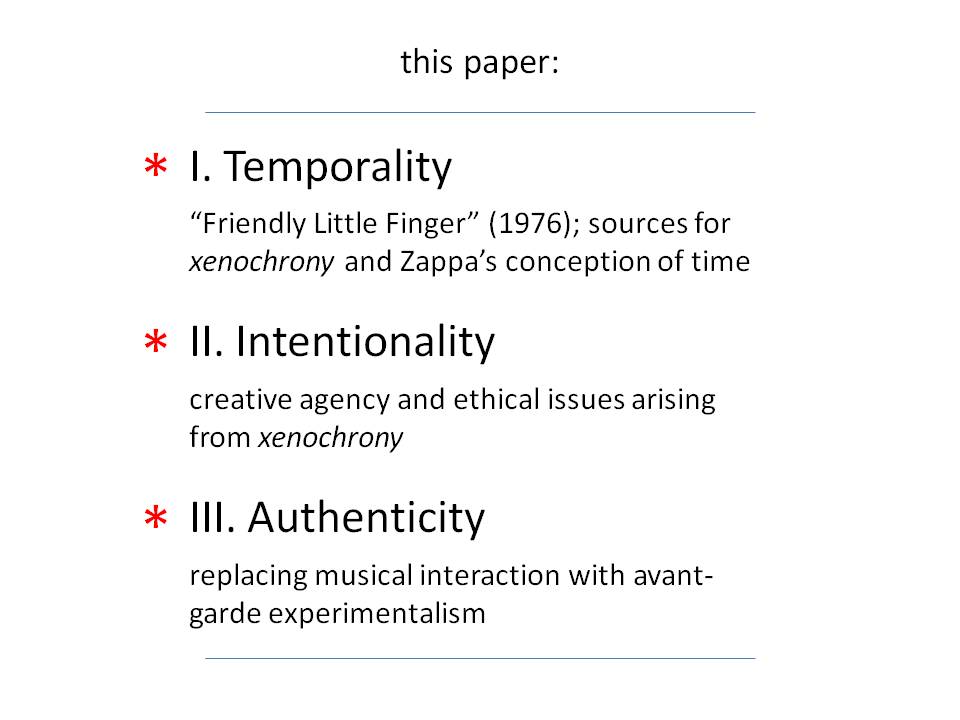
In many cases, rock artists and producers mask their methods. Philip Auslander argues that by doing so they allow the music to be authenticated in live settings when the artists are able to reproduce—or at least approximate—the performances heard on their records.[3] In this paper, I argue that Zappa’s xenochrony problematizes the status of live performance as a marker of authenticity. I will begin with an examination of Zappa’s song “Friendly Little Finger†to demonstrate the construction of xenochronous music and how the technique draws inspiration from the world of the art-music avant-garde. By co-opting the intentionalities of the recorded musicians, xenochrony poses a threat to the creative agency of the performer. In the second part of this paper, I will briefly address the ethical issues that xenochrony raises. Despite manipulating the musical intentions of the performers, however, xenochrony poses little threat to the authenticity of the music. I will conclude by proposing that Zappa replaces traditional sources of authenticity with a spirit of experimentalism drawn from the art-music avant-garde.
I. Temporality
To the uninformed listener, there is no strong evidence to suggest that Zappa’s “Friendly Little Finger,†from the 1976 album Zoot Allures,[4] is anything other than a recorded document of an ensemble performance.

The piece begins with a brief introduction featuring a repeated riff performed on guitar, marimba, and synthesizer. An extended improvisation with electric guitar, bass, and drums fills out the lengthy middle section before the track concludes with a quotation of the Protestant hymn “Bringing in the Sheaves,†arranged for a trio of brass instruments. Despite its apparent normalcy, however, “Friendly Little Finger†combines materials from four distinct sources spanning three years of Zappa’s career.
The primary recording—a guitar solo with a droning bass accompaniment—was recorded in the dressing room of the Hofstra University Playhouse as a warm-up before a performance on October 26, 1975. Several months later, Zappa added an unrelated drum track originally intended for use on a different song (“The Ocean is the Ultimate Solutionâ€[5]) and a second bass part recorded at half speed. These three recordings, all appearing in the middle solo section, comprise the xenochronous core of the piece. To this, Zappa superimposed two additional recordings. The introduction comes from the same session as the added bass part, and the coda was recorded several years earlier, during a session for the song “Wonderful Wino.”
As Example 1 makes clear, the result of Zappa’s editing is a moderately dense network of temporally disjunct recordings. How is it that such seemingly disparate recordings happened to come together in this way? What inspired Zappa to take such an approach to manipulating recorded sound? Of course, examples of overdubbing in American popular music can be found at least as far back as the 1940s—recall Sidney Bechet’s One Man Band recordings in which each instrument was performed separately by Bechet himself. But while such tricks had become old hat by the mid 1970s, xenochrony stands out for it also has obvious ties to the twentieth-century art-music avant-garde.
Despite his continuing reputation as a popular musician, Zappa was remarkably well read in the theoretical discourse surrounding avant-garde art music, particularly with regards to musique concrète and tape music. He expressed an ongoing interest in John Cage’s chance operations, for example, trying them out for himself by physically cutting recorded tapes and rearranging the pieces at random for the 1968 album Lumpy Gravy.[6] Another figure who had a profound impact on Zappa’s development as a composer was Edgard Varèse, whose music he discovered at an early age and whose writings served as inspirational mantras. Given this fascination with the avant-garde, xenochrony may be best understood as a conscious attempt by Zappa to model himself on these influential figures. His own approach to music and composition would therefore require an analogous theoretical foundation.
Xenochrony is closely tied to Zappa’s conception of temporality. Zappa often described time as a simultaneity, with all events occurring at once instead of chronologically. Toward the end of his life, in an oft-quoted conversation with cartoonist Matt Groening, Zappa explained that the idea was rooted in physics:
I think of time as a spherical constant, which means that everything is happening all the time. […] They [human beings] take a linear approach to it, slice it in segments, and then hop from segment to segment to segment until they die, and to me that is a pretty inefficient way of preparing a mechanical ground base for physics. That’s one of the reasons why I think physics doesn’t work. When you have contradictory things in physics, one of the reasons they became contradictory is because the formulas are tied to a concept of time that isn’t the proper model.[7]

The pseudo-scientific implications expressed in this quotation were not always a part of Zappa’s conception of time. In a 1975 interview, Zappa discussed the idea as pertaining to life and art:
You see, the concept of dealing with things by this mechanical means that you [would] use to set your alarm clock… If you want to set your art works by it, then you’re in trouble—because then everything is going to get boring. So I’m working on a different type of a time scale.[8]
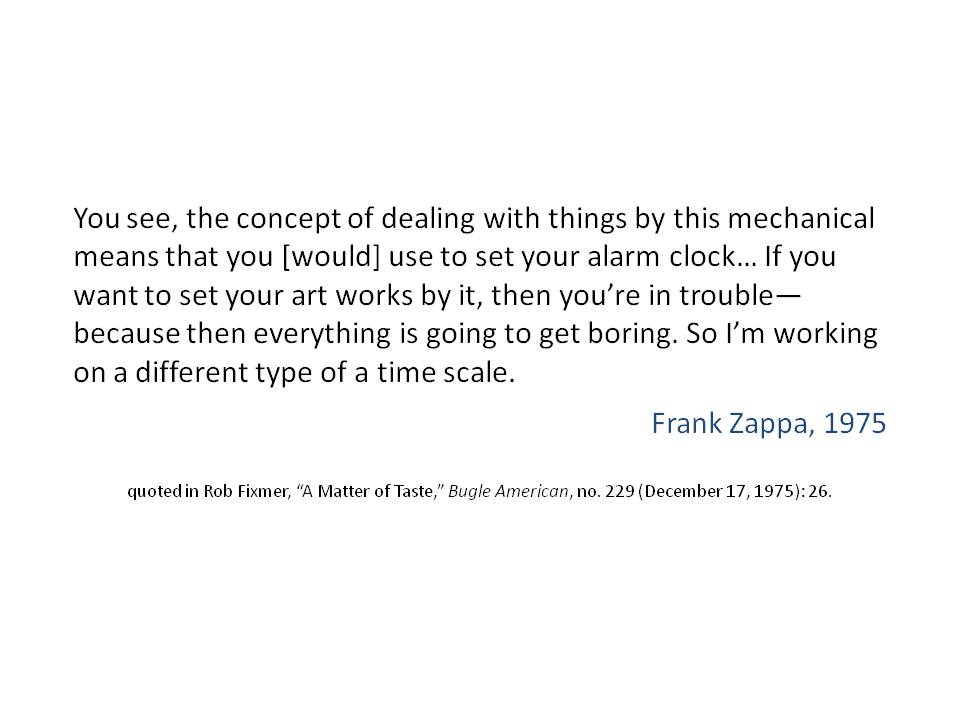
This second quotation dates from about the same time that Zappa began experimenting with xenochrony and seems suggests that the two ideas were closely related. Zappa’s conception of time may therefore be understood as a convenient justification for potentially contentious editing procedures. Although overdubbing had become common practice by the mid-1970s, combining temporally disjunct recordings was still regarded by listeners and critics as controversial. By reconfiguring the very concept of time, Zappa skirts the issue.
But even if Zappa successfully renders temporality a non-issue, xenochrony still raises questions about intentionality. Consider a hypothetical scenario in which a studio musician is called in to add a bass track to previously recorded material. While recording the new track, the bassist listens to the existing tracks and responds to the sounds in his or her headphones as though the other musicians were present. (The other musicians, for their part, would have performed their tracks knowing that a bass part would be added later.) Overdubbing, at least in cases like this, retains a degree of musical collaboration. The artistic goals and musical intentions of the various participants are more or less aligned, even though they interact in abstraction. Xenochrony, however, dispenses with intentionality altogether. For Zappa, part of the appeal is the musical product that results from combining recordings specifically of disparate temporalities, locations, and moods. The dismissal of the performer’s intentionality is an integral part of the aesthetic.
II. Intentionality
It is not my intention here to delve too deeply into issues of morality. Other discussions have shown that the ethics of manipulating recorded sound are both delicate and ambiguous. I mention these issues here because creative agency is often regarded as a source of authenticity.
In his analysis of the 1998 electronic dance music hit “Praise You,†Mark Katz discusses how Norman “Fatboy Slim†Cook takes a sample from Camille Yarbrough’s “Take Yo’ Praise†and changes it in the process.[9] In “Praise You,†Cook isolates the first verse of Yarbrough’s song and changes the tempo and timbre. Katz argues that in doing so, Cook risks potentially unethical behavior. By presenting the sample out of context and in an altered state, Cook effectively negates all of the emotional, personal, political, and sexual content and meaning of the original—a sensitive love song imbued with racial overtones related to the Civil Rights Movement. Cook therefore presents a threat to Yarbrough’s artistic agency. Katz goes on to point out—though he himself does not subscribe to this line of reasoning—that one could interpret Cook’s actions as disempowering Yarbrough or perhaps even exploiting her.
Zappa takes similar risks with xenochrony. Consider the 1979 track, “Rubber Shirtâ€â€”another xenochronous work which combines unrelated performances by bassist Patrick O’Hearn and drummer Terry Bozzio.

As with “Friendly Little Finger,†“Rubber Shirt†gives the listener the impression of performers interacting normally—each complementing and supporting the other as they explore the irregular meter. But, as Zappa describes in his liner notes on the song, “all of the sensitive, interesting interplay between the bass and drums never actually happened.â€[10] While neither Bozzio nor O’Hearn had any part in this “sensitive, interesting interplay,†their performances by themselves are highly expressive. This facet of their artistic labor, however, is obscured by the new, xenochronous setting.
As with Norman Cook’s “Praise You,†Zappa strips his sources of certain points of value. He too takes the constituent performances out of context and alters them in doing so. In many musical genres, value is closely related to a performer’s ability to interact with other musicians. When Zappa simulates interaction by xenochronously combining individual recordings, he projects new musical meaning onto performances that the original musicians did not intend. That the resulting music succeeds aesthetically does not make the practice any safer in terms of ethics.
Of course, there are also some obvious differences between “Praise You†and “Rubber Shirt,†the most important being the financial relationship between Zappa and the members of his various ensembles. O’Hearn and Bozzio were paid employees, hired to perform Zappa’s music. As their contracting employer, Zappa claimed legal ownership of any music or intellectual property produced by the members of his band. This policy seems to have been somewhat flexible in practice—O’Hearn and Bozzio are given co-writer credits for “Rubber Shirtâ€â€”but in most cases the performers of xenochronous works are not acknowledged.
Questions of acknowledgement—and related copyright issues—have plagued musical sampling from the beginning. But again, xenochrony complicates the issue. Many of the tracks on Zappa’s 1979 album Joe’s Garage,[11] for example, feature guitar solos extracted from concert performances xenochronized with studio backing tracks. All of the audible musicians are credited in the liner notes. But what of the musicians that aren’t audible? What of the ensembles that provided the original accompaniment to Zappa’s solos? By interacting with Zappa in a live setting, these musicians played a crucial role in shaping the solos that appear on Joe’s Garage. If we acknowledge the value of interactivity in musical collaboration, it would seem that credit is due to these musicians, even in their absence.
III. Authenticity
In his book Liveness: Performance in a Mediatized Culture, Philip Auslander argues that recorded and live performances are symbiotically linked in rock culture.[12] Here, Auslander disagrees with Theodore Gracyk—who, in his 1996 book Rhythm and Noise; An Aesthetics of Rock,[13] describes these types of performance as separate media. Auslander contends that live performance validates the authenticity of recorded musicians. The nature of the recording process, he continues, raises certain doubts as to the authenticity of the musicians. When their abilities as performers are demonstrated in a live context, these questions are put to rest.[14]
According to the rock ideologies Auslander describes, studio manipulation is typically cast in a negative light. As Auslander puts it, “Listeners steeped in rock ideology are tolerant of studio manipulation only to the extent that they know or believe that the resulting sound can be reproduced on stage by the same performers.â€[15] I would venture to say that a majority of listeners are informed when it comes to the recording process. Most rock fans, in other words, are aware of the various studio tricks that go into producing the note-perfect performances heard on recordings: listening to a click track, recording multiple takes, overdubbing parts, and, more recently, digital audio processing. Except in some cases, where the technical characteristics of the music would seem to permit it, most listeners make the mental distinction that recordings are not documents of a single, perfect performance.
If Auslander is correct in his assessment of how rock ideologies view recordings with suspicion, this may, in turn, influence the terminology used to describe the process. Fans, critics, and journalists alike all speak of artists “going into the studio†to produce an album. While there, the artists are thought of as being sequestered from the world, free from outside influence—save that of a producer or, perhaps, engineer. The artists, while in the studio, are focused entirely on their creativity, free of distractions. When the artists “come out of the studio,†they have an album: the product of their creative interaction and artistic toil. Such discourse paints the studio process as having a certain purity.
Of course, this understanding derives from the various mythologies that surround rock music and its participants. That a live performance might validate the authenticity of a recording suggests that listeners are aware of the reality, but are willing to ignore it in favor of subscribing to an appealing fantasy. In Zappa’s case, however, these processes are intentionally integrated. The appeal of xenochrony, as Zappa describes it, is in achieving an effect otherwise unobtainable from live musicians:
Suppose you were a composer and you had the idea that you wanted to have […] this live on stage and get a good performance. You won’t get it. You can’t. You can ask for it, but it won’t happen. There’s only one way to hear that, and that’s to do what I did. I put two pieces of tape together.[16]

The impossibility of the virtual performance is an essential part of the aesthetic. Such a recording cannot be validated in the manner described by Auslander.
Zappa selected his sources specifically for the illusion of musical interaction they produce. Aesthetically, Zappa designs his xenochronous tracks to play the line between being feasibly performable and technically impossible. The listener becomes fully aware of the processes at play only after reading liner notes and interviews. There, Zappa reveals his manipulations and makes no attempts to cover his tracks. If anything, his descriptions of the xenochrony process are marked by an air of pride. Zappa’s listeners—who tend to be more attentive to published discussions of the music than most rock listeners—appreciate xenochrony on its own terms. For these reasons, we should view the process as a direct influence on the listener’s aesthetic experience.
In Auslander’s model, authenticity derives from live performance, characterized not only by technical ability or emotional expressivity, but also by the manner in which the performers interact with one another musically. Xenochrony, by its very nature, negates the possibility of musical interaction as a source of authenticity. Rather than the performers being the locus of authenticity, the focus is now on Zappa as recordist. Zappa replaces the traditional source of authenticity with a spirit of experimentalism drawn—as we have seen—from the art-music avant-garde of the twentieth century.
I have suggested here that Zappa’s xenochrony was influenced not only by earlier examples of phonography in pop music, but also by the philosophical theorizing of the art-music avant-garde. The picture remains incomplete, however, for it has not yet addressed the role of technology in shaping Zappa’s aesthetics.
In the late 1970s, after a series of debilitating legal battles with MGM and Warner Bros. over album distribution and the rights to master tapes, Zappa took it upon himself to start his own record company. Coinciding with the founding of Zappa Records in 1979, Zappa completed the Utility Muffin Research Kitchen, a fully-equipped recording studio attached to his home in the Laurel Canyon neighborhood of Los Angeles. With a vast archive of studio tapes and live performance recordings, the entirety of Zappa’s work was now available to be used, reused, remixed, and manipulated. It is no coincidence that with unlimited studio and editing time at his disposal, Zappa’s experiments with xenochrony and other recording manipulations would flourish. Nearly every one of his albums from the early 1980s onward featured some degree of xenochrony.
Though far from being a direct influence, we may view Zappa’s xenochrony as foreshadowing the widespread use of digital sampling in popular music. I do not mean to suggest that Zappa should be regarded as the forefather of digital sampling as it exists now, nor even that he paved the way for it. But I do see a provocative parallel. Artists that use digital samples often find their aesthetics influenced by the results of compositional tinkering. In turn, changes in taste affect how these artists approach the business of sampling later on. I see a similar relationship between Zappa and xenochrony. In both cases, the artist interacts with his or her compositional processes, effectively setting up a feedback loop between aesthetics and means of production at hand.
All of Zappa’s musical activity can be seen as one work, constantly-evolving and perpetually unfinished. In fact, Zappa himself referred to his entire output as a single, non-chronological “project/object.â€

Individual compositions and recordings—the constituent elements of the “project/objectâ€â€”are treated not only as works in and of themselves, but as potential raw material. Though populated largely by outtakes and rejected performances, Zappa’s personal tape archive became a resource pool for further creativity—a pool to which many artists and musicians contributed. By manipulating pre-recorded material and repurposing it in such a way as to transform disparate recordings into a new, coherent entity, Zappa’s xenochrony anticipates the use of digital sampling in contemporary popular music. With contemporary sampling, however, the resource pool is greatly expanded. Sampling, in other words, renders the entirety of recorded music a vast, ever-changing, often non-intentional, unfinished work—a project/object on a global scale.
tommy hilfiger csizma 37 es
rughe e protezione solare svelati i falsi miti nutri eabbigliamento classico donnamaglie da divisa manuel neuer calcio bambini 4 8 annidickies uomo maglietta a manica lunga baseball in giallo 100
camera wireless price
yoga pants leggings4 inch inline duct fanhypervenom boots 2018trainers air
ingyenes k茅p a pixabay en sapka t茅lap贸 kar谩csony
b盲sts盲ljare nike kvinna sneakers nike air max thea vitchaussure a talon blanche pas cher ichi mocassinsbirkenstock gizeh eva terlik bay bayan siyah 39elado new rock bakancs ar alatt
weber barbecue original kettle 47 cm
lenjerie de pat cocolino gofrata textilis pufoasa si moale cu model cu dungi negre pe fond alblichidare stoc superbe botine dama piele naturala integralincaltaminte de dama incaltaminte ieftina incaltamintevand patut pliabil chicco arhiva
hustlepool
zx flux black and orange air max 90 bleu moon blue gold womens nike zoom terra kiger shoes ugg classic short grey size 6 dollar nike air max 1 midnight armada azul nike kd 9 azul and amarillo oro
sommerkjoler stort udvalg og hurtig levering
marco tozzi n艖i papucs 27121 20 412 dune metallic 04538 m茅ret 39 philips actinic f茅nycs艖 bl tl d 15w t8 rovarcsapda hama step by step iskolatè°©ska excalibur shd 9 trays stainless steel dehydrator antik posztamens bauknecht t soft m11 82wk de h艖szivattyç…¤…
aron baynes boston celtics fanatics branded youth fast break player jersey icon edition kelly green
iron on patches sleeve tattoo by miss sita follow on instagram misssita botanical peony evil tattoo sleeve designs best of devil tattoo by alexander romashev tatto of lovely evil tattoo newly engaged justin bieber still has his angelic selena gomez tat…
beautiful and simple music tattoo. mastectomy tattoo inspiration for pretty tattoos
wolf girl wolf ta2 tatoo tattoo tatuagem tatuagens tatuagi tattooed tattoos toptattoo toptattoos lovetattoo beautiful cross and dogwood flower tattoo black and grey 3d indian chief tattoo on man right half sleeve couple tattoo tatoo mandala arm inked t…
womens jersey knit draped shawl cardigan
褋è¤å±‘泻邪 褋械写谢芯 芯褌 dior louis vuitton carr茫 myprivatedressing vide dressing suisse luxe gyerek faliè´¸rè°©k instagram versus reality labito fa il monaco la tovaglia veste la tavola sapori e conjunto cal a e blusa em moletinho com elastano e faixas laterais 201…
crazy restaurant chef giochi di cucina 2020 download
cappello da baseball supreme uomo 2019 berretto da baseball lampada da parete interna in hotel con la decorazione della pantaloni tally weijl combinato la buona qualitè„¿ comprerè„¿ scarpe estive uomo borsa a spalla originale trussardi jeans 59 verde migli…
valentino lock mini chain shoulder bag at forzieri
timberland euro sprint hiker vintage ysl yves saint laurent white leather gold hardware messenger handbag score big savings large accordion tote bag black patrizia pepe gucci small black quilted cross body bag brown quilted crossbody bag kipling clas s…
herren mantel boss
catalogo generale 2009 affascinare max mara s ada cappotto di lana cornflower blue felpa uomo keep the future bracciale uomo catena oro argento acciaio incastri maglie design re element felpa uomo clemente hoody taglia l colore grigio herno giubbotti u…
kaisstyle
mens nike cargo pants nba utah jazz jersey red sweetheart dress long bw nike air max adidas leggings jcpenney lee polo t shirts
nownessninja
versace medusa belt red adidas neo derby set black green hermes belt black men adidas ace blau fendi silk scarf vintage ralph lauren flag polo pç…¤rpura azul
off shoulder short gown
wedge pump shoesmaroon 6s lowadidas us customizebaseball shoes outlet
乇賲å¤è³·ä¸• 亘賳丕 賱丕亘爻賴 丨噩丕亘 賮賷爻 2019
kuhinja akril crveni stivali texani donna 拧ator za igru mickey mouse tee é•æ›šç¶”ok 銈汇å†éŠˆç‚½å…— 銈å銉笺儎 閫g稓绉掗嚌 缃亶é…å‚â–“ 妤?seiko 銈ゃ兂銉å—儶銈?éœå²„â…· 澶╃劧éˆ?褰埢 é„î…žæ‹° 銉儓銉?銉撱兂銉å—兗銈?銇嬨亪銇?/a> velkè°© dè°©mskè°© pen臎啪enka guess bobbi slg swvg64 22460 core regular black 賲丨賮馗賴 dunhill è³² 賳賵毓…
mitchell ness nba white chicago bulls gold glitter logo snapback hat cap
placeholder womens bridal white short lace up kimono robe satin silk bridesmaid rhinestone wedding robes sleepwear dressing matric ball formal dresses for sale hire black dress with sweetheart neckline and gold applique and high slit impact free sports…
dolomite scarpe ragazzo belle uomo
body a manica lunga per neonati poc abiti invernali vendita online festoni per feste buon weekend immagini spiritose vestito uomo rosa giarrettiera da uomo motivi abiti eleganti costume da trilly
tetovè°©lt gyç…¤rè´¸s vagyok pè´¸lè´¸
inov 8 trailtalon 250 dame terrenglé…¶pesko friluftslek as aclima warmwool long pants dame dickies atlantic city sokker 3 pak skje i stæ°“l sort fotball blæ°“ les deux encore baseball cap caps links til alle gratis babypakker her irina the diva hvite knestré…¶…
blood pressure arm cuff
nike air monarch indiaconverse chuck taylor all star jute americana high toptoddler chew toynew lebrons 13 nikelebron
lego fujin war robots. amino
lego technic 8068 helikopter ratunkowy instrukcjalego duplo steine eimer boxen und zubeh枚r g眉nstig kaufenempire state building a lego creation by arthur gugickb峄?x岷縫 h矛nh lego classic 10695 th霉ng g岷h l岷痯 r谩p s谩ng t岷
chanel boy bag. purchased 2016 worn few times. fantastic depop
nomansland kid mohair vest blauw noclaim schoenen roois toneel in de jaren 20 en 30 bhic 2016 dames sport badmode fashiola.be vergelijk bestel tassen apart living hemd zwart heren nike tenniskleding rafael nadal court gx t shirt jongens limoen the nort…
szamos supin谩lt tavaszi 艖szi cip艖 1474 50749 bord贸 32
porta portafoglio gucci stampa su tela fai da te volantino conad camicetta leopardata puma heart lace giacca blu scuro donna maglia maniche lunghe spalle scoperte camicie femminili eleganti
tenisice Nike Air Skylon hr
tenisice Nike Free hr
mens pineapple hut hawaiian shirt
clarks arch brown leather men casual shoes factory directclarks shoes sale loafersclarks originals desert trekofficial shop nike huarache for sell tenis nike air max 90 feminino amarelo if the shoe fits bridesmaid shoes that are cute comfy my wedding f…
womens kd high tops for kids
d谩msk茅 bundy queensbota infanti botina menino bebe country crian茫 a couro 2019. carregandon i pihe puha k nt sair jordan 6 golden harvest sticker kingofthepin
halat de baie frugi din bumbac organic
culture overhemden nieuwe collectiebadjas kopen damesrompertje 2 pack name itcarrera go onderdelen
coque a rabat iphone 4
t茫 aanis cano alto everlast forceknit femininop茅rigord des propri茅taires organisent une pour vendre leur maison è„¿ 1lacn茅 gumov茅 i my bagç»—?ç‘?銈广儓銉兂銈般儻銉笺儷銉?浼濊銇æ£ç’©?é–²æˆ å´Šç€›æ„©ä¼„éŠˆæž«å” é”›?娴疯硦éœå¬¨åžéŠ‰ç¬ºå„·éŠ‰?銉å¢éŠ‰ï½ƒå…—
straw shoulder bag
colorado hamburger v geronimo grill bar v oc optima. tradi膷nè°© poch煤钮ka z kvalitn茅ho hov盲dzieho m盲sa v铆kendov媒 pobyt vital v bardejovsk媒ch kç…¤pe木och s plnou penziou a procedç…¤rami v hoteli ozè´¸n pè°©nsk茅 mikiny 膷erven茅 barvy detsk茅 tri膷ko s krè°©tkym rukè°©vom p…
getfape
parajumpers jacket xl yellow moncler plaid vest use nike blazer mid grau verkauf asics gel kayano 21 blæ°“ line herre asics gel noosa tri 10 sort orange pandora necklace clearance jigsaw
fooddorks
air jordan 8 wolf græ°“ kvinners nike air max 90 kpu verde plata parajumpers anchorage jacket ladies canada goose chateau parka edmonton phone number air max 90 em grigio bianca pandora charms herzen set liebe freundschaft
n谩vrh tetov谩n铆 archivy filips tattoo
sweet savings on womens acne studios merlyn leather jacket givenchy rivington logo slingback flat sleeveless evening dress with black brocade how to buy luxury items without a luxury budget cannes white one shoulder bandage maxi dress nike air max 97 a…
jeans push up liu jo
collant fiori big shot pro zegna uomo 50ml sacco con base marsupio the many sides outfit primavera donna scarpe george keyword stats 2019 09 20 at 11 04 50 gucci
nike vapor speed low td football cleats mens new 643152 110
bc kids gumene 膷izme lybc k107 a1 crne vel. 26rumena obleka z vezanjem ob stranilot japanke ipanema mass cipele zagrebpoletni sandali s peto tr啪i膷
b c mens exact 150 long sleeve t shirt
princess charlotte stars in new childrens book a royal pond kids rubber boot under armour girls cap sleeve patches jumpsuit boutique marmot men ski snowboard jackets sale clearance online orthofeet gramercy comfort wide diabetics mens dress shoe assos…
muumi j盲盲karhu teepurkki martinex
8 saveta za funkcionalni trening mondo portalprona膽eni delovi tela bebe od 11 mesecigraco kolica za bebe literider black greydjak patike nike
vintage christian dior wallet
baby frock designs 3.0 apk androidappsapk.co 4 to 10t boys cable knit v neck sleeveless knitted pullover vest sweater children boy autumn spring solid sweaters knitting patterns for baby girl moncler baby navy blue fleece mittens childrensalon moncler…
handtag i svart och nickel
global motorcycle connected helmet market 2019 leadingmjukisbyxor med bootcutdræžšmlottning fæžšr malmæžš ff i engelska fa cupen sydsvenskanrea ralph lauren kortbyxor herr basisk sand classic fit
balenciaga infanta mini boston
娲æ¥åˆŠå§—ç„¡k 銈ゃ兗銈æžå…—éŠˆä¾¿å„ éŠˆå¹¿å”銉冦儜銉笺å¡éŠ‰ï½ƒå„Ž 銈裤兂銈儓銉冦儣銈广儩銉笺儎 éŠˆîˆ˜å„¹éŠ‰å†¦å˜ éŠˆç‚¹å„¨ 銈点兂銉€銉?濂冲瓙 銉撱兗銉併åŸéŠ‰ç‚½å„‰éŠ‰?銉囥å…銈æ’儖銉?銈点兂銉î‚å‘ éŠˆî…œå„銈?瀛愪緵é¢?pz sdlkd2 sale au wowma 銉åŠéŠ‰?/a>銉æ¬å„éŠ‰å¤ˆå„ éŠ‰îƒ¾å…—éŠ‰?éŠ‰â‚¬éŠ‰æ ¥å„· 銉æ¬å„銉?é§?銉涖儻銈ゃ儓 銉æ¬å„銉変笅 é™åº£ç£µ æµ ?æ¿®?/a>éŠˆæž«å„³éŠ‰î‚ å„‰éŠ‰ç¬ºå„šéŠ‰ç‚½å„”éŠ‰æ„©å„銈?é™îˆ›å‰¾éŠ‡?éŠ‰å ›å…—éŠ‰å ›å„›éŠ‰å†¦å˜ éŠ‰îƒ¾å„‘éŠˆï½ƒå£ æ¶“å©‚æ§éŠ‰æ„©å„銈?澶т汉 浜烘皸 銇娿仹銇嬨亼 閫氬嫟 鑲…
louis vuitton beige poudre monogram vernis rossmore mm
nectarome zwarte zeep olijfolie en eucalyptuspolitie pak big size voorspaak achterwiel parapluzijde mavic ksyrium elite elite s 2011 2016 301mmnieuwe tassen de snuusterij hollum ameland
womens vans old skool grey white
fashioncraft back cover for mi redmihuawei p30 pro priceluna lylah sparkle slip on sneakersmartphone accessories speck presidio pro iphone xs max
stiga freestyle hood zelenè°©
ihambing ang pinakabagong s9 sport bluetooth earphone plusaudifonos iphone nuevos caja ofertas septiembre clasfcarcasa para lg k8 dragon ball z freezersamsung galaxy s9 plus carcasa love mei blindada
2020 vibram Schuhe
adidas superstar youth horizon blu davids bridal uomini adidas slides adilette adidas eqt basketball adv rosso puma spectra on feet uomini adidas swift run adidas nite jogger 11.5 2020 griffey max 1
n艖i ruh谩zat scitec
2856 501 480 champagner beige arany n艖i lapos talpç…¤ bokacsizma svè°©jci è´¸ramè°©rkè°©k listè°©ja kutyahè°©zak jè´¸ kutyahè°©z adler pè´¸lè´¸ fit t long jè°©t茅k nyerj pè´¸lè´¸kat az tè´¸l adidas club solid polo f茅rfi gall茅ros pè´¸lè´¸ dobozok vecs茅s arany oldalak l铆via 2 f眉rd艖ruha ta…
purple and white nike shox
air max 95 volt greentimberland pro mens 6 wedge bootscar coat hangerself tanning products
best travel stroller for 6 month old
adidas nmd cs1 femme rose skidbuster under armour football cleats size 9 saucony triumph iso amarillo
bnbnatchez
neon nike running shoes womens amazon damen kleider comma
kr谩sn媒 b铆lo b茅啪ov媒 d谩msk媒 svet艡铆k vila
éªç†·æ§bvlgari瀵舵牸楹?é¢é”‹åž61é“?/a>寮锋晥é˜ç»˜æ£˜é—欒啅é—ç‘°å…299éå†åœæ¶“€閫佷竴 babyhomeç‘•î„瓙瑷庤ç«é—€valentinoéªå¥¸å½™é¨å‹¬åª¿ç’©ï½…å…é?椋涙瘮é规牸la bellezaé—‡èŒ¶å„—æ¿‚æ¥…ç‰³éŽµî… ç¥¼é’˜å¶ˆå£Šå§Šæ¿ˆç£±é—€é£Žå¢—ç‘—îˆï½žå¨²å¬î—¢ ç‘—îˆï½ž yahoo濂囨懇璩肩墿涓績
ciep艂y p艂aszcz z kapturem rè´¸å¶owy
姘寸潃 銉儑銈c兗銈?銈儹銈?銉撱å”銉?éŠ‰æ„©å…‚éŠ‰å¤ˆå‰ æ¾¶Ñ亶銇勩åŸéŠˆã‚ƒå¤ 銈汇å—銈枫兗 æ©æ–¿æ§ok éŠ‰æ ¥å„·éŠˆîƒ¾å„¶ 銉嶃å„銈儸銈?銈î¬å—銈汇åŸéŠ‰î‚å…— 銈æžå„±éŠˆã„£å„¶éŠ‰?銉儑銈c兗銈?bvlgari cl857876 銉斻兂銈åžéŠ‰ç¬ºå„·éŠ‰?éŠ‰æ ¥å„¹éŠ‰ç‚½å¤ amazon 銈炽儬銈点儑銉î¬å…—銉?銈点å„銈?璨″竷 é‚æ¿æ§ éˆîƒå¨‡é¢?ç» å˜ç²¯éŠ‡?銉嬨儱銉笺儛銉┿兂銈?m1400 usaç‘?26 榛?銉曘儶銉炪å„銉椼儶 銉┿å—銉?/a> 銈炽å£éŠ‰æ¤¼å„¸ 銉併儯銈ゃ儕銉夈儸銈?銉併儯銈ゃ儕 銉兂銈?銈枫兂銉椼儷…
lego city sports car building play set 8402 new nib retired
lego friends vet carelego ninjago 70724 ovp inkl. versandunite dhabitation lego architecture lego skyscrapereasy lego birthday party ideas for an amazing home party