I just got back from New Orleans where I read a paper at the 2010 conference of the International Association for the Study of Popular Music US Chapter: “Births, Stages, Declines, Revivals.” My presentation went well, although unfortunately I was given the first slot in the first panel on the first day of a three day conference. (8:30 AM on Friday morning!) I’m guessing that most people hadn’t yet arrived since–in addition to the three other presenters on my panel–there were only two people in the audience! Oh well.
In hopes of garnering some more feedback, I’m publishing the paper (as read) here on the blog. As usual, this remains a work in progress.
Click here to download a PDF version of the paper. (Slides and visual examples appear at the end of the PDF.) Or, follow the jump to read the html version.
Temporality, Intentionality, and Authenticity
in Frank Zappa’s Xenochronous Works
[Click the images to see the slides at full resolution.]
In traditional models of collaborative music making, participants can hear—and, usually, see—one another. Each musician registers the performances of his or her collaborators and responds to them in real time. Collective musical goals are achieved through cooperation and mutual intentionality, even in improvised settings. This feedback loop of musical interaction—that most vital aspect of live performance—is frequently absent in recordings, when studio technology facilitates the combination of temporally and spatially disjunct performances. Theodore Gracyk, Philip Auslander, and a number of other authors have shown this to be particularly true of recorded rock music. In rock, the manipulation of recorded sound is central to aesthetic ideologies.
Lee B. Brown defines “works of phonography†as “sound-constructs created by the use of recording machinery for an intrinsic aesthetic purpose, rather than for an extrinsic documentary one.â€[1]

Documentary recordings may—and often do—comprise the constituent ingredients of such works; but overdubbings, tape-splicings, and other editing room procedures deliver to the listener a virtual performance, an apparition of musical interaction that never took place. Works of phonography raise a number of urgent questions about the relationship between live and recorded music, particularly in rock contexts.
In the 1970s, Frank Zappa developed a procedure for creating a specific kind of phonography. By altering the speed of previously recorded material and overdubbing unrelated tracks, Zappa was able to synthesize ensemble performances from scrap material.

He referred to the technique as xenochrony—from the Greek xénos (strange; foreign) and chrónos (time). Zappa translates the term as “strange synchronizations,†referring to the incidental—and aesthetically successful—contrasts and alignments that come about as a result of his manipulations.
Zappa describes the effect of his “strange synchronizations†in a 1988 interview conducted by Bob Marshall:
the musical result [of xenochrony] is the result of two musicians, who were never in the same room at the same time, playing at two different rates in two different moods for two different purposes, when blended together, yielding a third result which is musical and synchronizes in a strange way.[2]

By combining separately-recorded performances, such music easily meets Brown’s criteria. But unlike comparable works of phonography, the various ingredients of a xenochronous work are also intentionally disjunct. Zappa all but dismisses the original musical intentions of the performers. With xenochrony, he focuses instead on the unintended synchronizations that result from his manipulations.
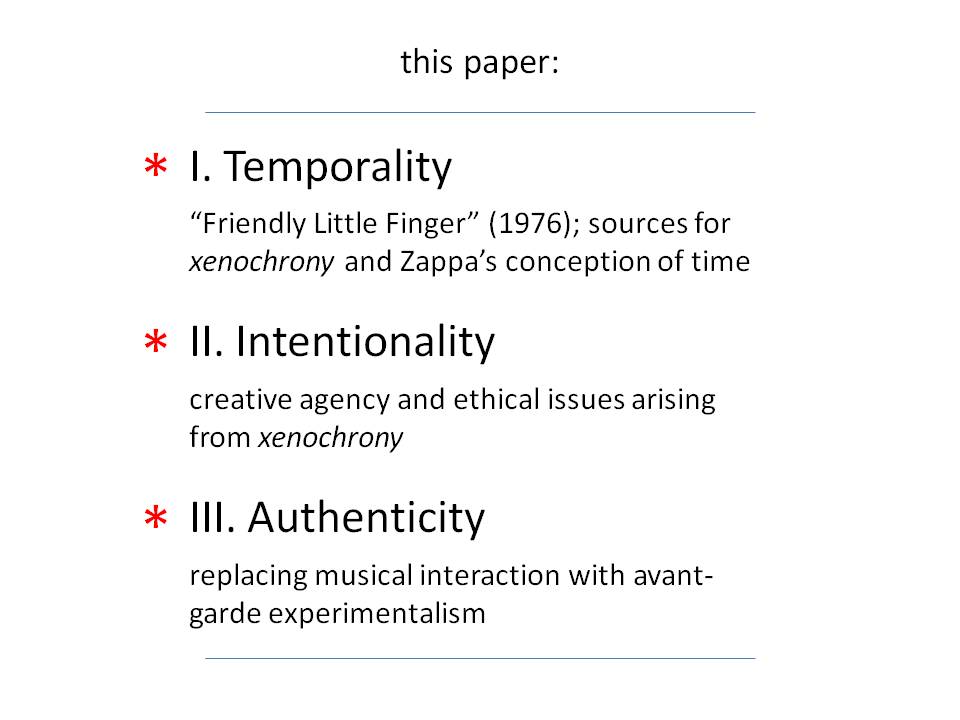
In many cases, rock artists and producers mask their methods. Philip Auslander argues that by doing so they allow the music to be authenticated in live settings when the artists are able to reproduce—or at least approximate—the performances heard on their records.[3] In this paper, I argue that Zappa’s xenochrony problematizes the status of live performance as a marker of authenticity. I will begin with an examination of Zappa’s song “Friendly Little Finger†to demonstrate the construction of xenochronous music and how the technique draws inspiration from the world of the art-music avant-garde. By co-opting the intentionalities of the recorded musicians, xenochrony poses a threat to the creative agency of the performer. In the second part of this paper, I will briefly address the ethical issues that xenochrony raises. Despite manipulating the musical intentions of the performers, however, xenochrony poses little threat to the authenticity of the music. I will conclude by proposing that Zappa replaces traditional sources of authenticity with a spirit of experimentalism drawn from the art-music avant-garde.
I. Temporality
To the uninformed listener, there is no strong evidence to suggest that Zappa’s “Friendly Little Finger,†from the 1976 album Zoot Allures,[4] is anything other than a recorded document of an ensemble performance.

The piece begins with a brief introduction featuring a repeated riff performed on guitar, marimba, and synthesizer. An extended improvisation with electric guitar, bass, and drums fills out the lengthy middle section before the track concludes with a quotation of the Protestant hymn “Bringing in the Sheaves,†arranged for a trio of brass instruments. Despite its apparent normalcy, however, “Friendly Little Finger†combines materials from four distinct sources spanning three years of Zappa’s career.
The primary recording—a guitar solo with a droning bass accompaniment—was recorded in the dressing room of the Hofstra University Playhouse as a warm-up before a performance on October 26, 1975. Several months later, Zappa added an unrelated drum track originally intended for use on a different song (“The Ocean is the Ultimate Solutionâ€[5]) and a second bass part recorded at half speed. These three recordings, all appearing in the middle solo section, comprise the xenochronous core of the piece. To this, Zappa superimposed two additional recordings. The introduction comes from the same session as the added bass part, and the coda was recorded several years earlier, during a session for the song “Wonderful Wino.”
As Example 1 makes clear, the result of Zappa’s editing is a moderately dense network of temporally disjunct recordings. How is it that such seemingly disparate recordings happened to come together in this way? What inspired Zappa to take such an approach to manipulating recorded sound? Of course, examples of overdubbing in American popular music can be found at least as far back as the 1940s—recall Sidney Bechet’s One Man Band recordings in which each instrument was performed separately by Bechet himself. But while such tricks had become old hat by the mid 1970s, xenochrony stands out for it also has obvious ties to the twentieth-century art-music avant-garde.
Despite his continuing reputation as a popular musician, Zappa was remarkably well read in the theoretical discourse surrounding avant-garde art music, particularly with regards to musique concrète and tape music. He expressed an ongoing interest in John Cage’s chance operations, for example, trying them out for himself by physically cutting recorded tapes and rearranging the pieces at random for the 1968 album Lumpy Gravy.[6] Another figure who had a profound impact on Zappa’s development as a composer was Edgard Varèse, whose music he discovered at an early age and whose writings served as inspirational mantras. Given this fascination with the avant-garde, xenochrony may be best understood as a conscious attempt by Zappa to model himself on these influential figures. His own approach to music and composition would therefore require an analogous theoretical foundation.
Xenochrony is closely tied to Zappa’s conception of temporality. Zappa often described time as a simultaneity, with all events occurring at once instead of chronologically. Toward the end of his life, in an oft-quoted conversation with cartoonist Matt Groening, Zappa explained that the idea was rooted in physics:
I think of time as a spherical constant, which means that everything is happening all the time. […] They [human beings] take a linear approach to it, slice it in segments, and then hop from segment to segment to segment until they die, and to me that is a pretty inefficient way of preparing a mechanical ground base for physics. That’s one of the reasons why I think physics doesn’t work. When you have contradictory things in physics, one of the reasons they became contradictory is because the formulas are tied to a concept of time that isn’t the proper model.[7]

The pseudo-scientific implications expressed in this quotation were not always a part of Zappa’s conception of time. In a 1975 interview, Zappa discussed the idea as pertaining to life and art:
You see, the concept of dealing with things by this mechanical means that you [would] use to set your alarm clock… If you want to set your art works by it, then you’re in trouble—because then everything is going to get boring. So I’m working on a different type of a time scale.[8]
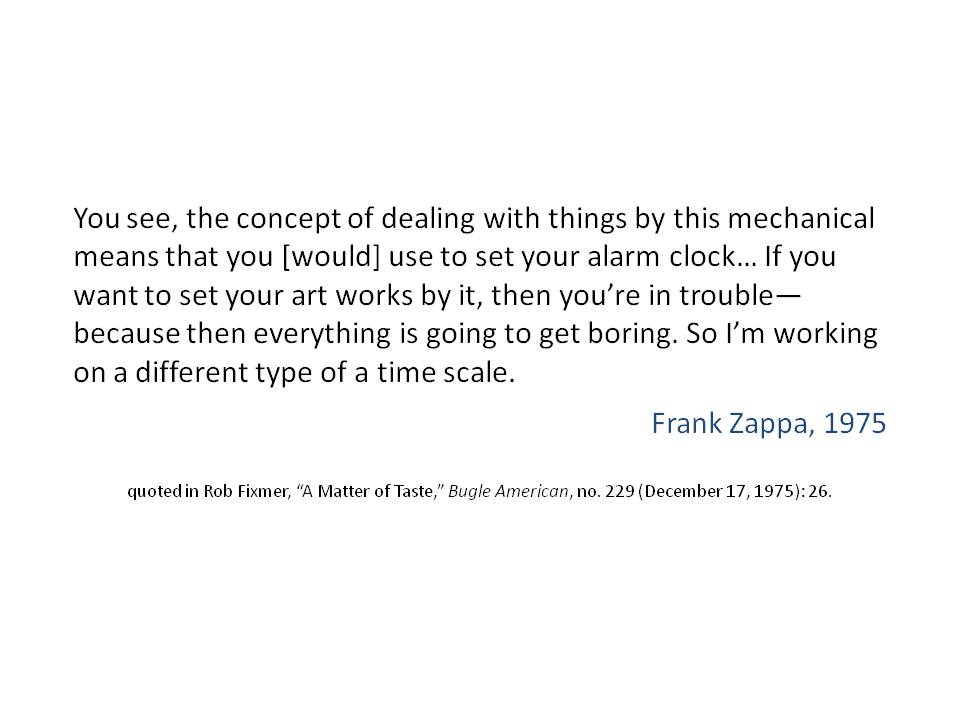
This second quotation dates from about the same time that Zappa began experimenting with xenochrony and seems suggests that the two ideas were closely related. Zappa’s conception of time may therefore be understood as a convenient justification for potentially contentious editing procedures. Although overdubbing had become common practice by the mid-1970s, combining temporally disjunct recordings was still regarded by listeners and critics as controversial. By reconfiguring the very concept of time, Zappa skirts the issue.
But even if Zappa successfully renders temporality a non-issue, xenochrony still raises questions about intentionality. Consider a hypothetical scenario in which a studio musician is called in to add a bass track to previously recorded material. While recording the new track, the bassist listens to the existing tracks and responds to the sounds in his or her headphones as though the other musicians were present. (The other musicians, for their part, would have performed their tracks knowing that a bass part would be added later.) Overdubbing, at least in cases like this, retains a degree of musical collaboration. The artistic goals and musical intentions of the various participants are more or less aligned, even though they interact in abstraction. Xenochrony, however, dispenses with intentionality altogether. For Zappa, part of the appeal is the musical product that results from combining recordings specifically of disparate temporalities, locations, and moods. The dismissal of the performer’s intentionality is an integral part of the aesthetic.
II. Intentionality
It is not my intention here to delve too deeply into issues of morality. Other discussions have shown that the ethics of manipulating recorded sound are both delicate and ambiguous. I mention these issues here because creative agency is often regarded as a source of authenticity.
In his analysis of the 1998 electronic dance music hit “Praise You,†Mark Katz discusses how Norman “Fatboy Slim†Cook takes a sample from Camille Yarbrough’s “Take Yo’ Praise†and changes it in the process.[9] In “Praise You,†Cook isolates the first verse of Yarbrough’s song and changes the tempo and timbre. Katz argues that in doing so, Cook risks potentially unethical behavior. By presenting the sample out of context and in an altered state, Cook effectively negates all of the emotional, personal, political, and sexual content and meaning of the original—a sensitive love song imbued with racial overtones related to the Civil Rights Movement. Cook therefore presents a threat to Yarbrough’s artistic agency. Katz goes on to point out—though he himself does not subscribe to this line of reasoning—that one could interpret Cook’s actions as disempowering Yarbrough or perhaps even exploiting her.
Zappa takes similar risks with xenochrony. Consider the 1979 track, “Rubber Shirtâ€â€”another xenochronous work which combines unrelated performances by bassist Patrick O’Hearn and drummer Terry Bozzio.

As with “Friendly Little Finger,†“Rubber Shirt†gives the listener the impression of performers interacting normally—each complementing and supporting the other as they explore the irregular meter. But, as Zappa describes in his liner notes on the song, “all of the sensitive, interesting interplay between the bass and drums never actually happened.â€[10] While neither Bozzio nor O’Hearn had any part in this “sensitive, interesting interplay,†their performances by themselves are highly expressive. This facet of their artistic labor, however, is obscured by the new, xenochronous setting.
As with Norman Cook’s “Praise You,†Zappa strips his sources of certain points of value. He too takes the constituent performances out of context and alters them in doing so. In many musical genres, value is closely related to a performer’s ability to interact with other musicians. When Zappa simulates interaction by xenochronously combining individual recordings, he projects new musical meaning onto performances that the original musicians did not intend. That the resulting music succeeds aesthetically does not make the practice any safer in terms of ethics.
Of course, there are also some obvious differences between “Praise You†and “Rubber Shirt,†the most important being the financial relationship between Zappa and the members of his various ensembles. O’Hearn and Bozzio were paid employees, hired to perform Zappa’s music. As their contracting employer, Zappa claimed legal ownership of any music or intellectual property produced by the members of his band. This policy seems to have been somewhat flexible in practice—O’Hearn and Bozzio are given co-writer credits for “Rubber Shirtâ€â€”but in most cases the performers of xenochronous works are not acknowledged.
Questions of acknowledgement—and related copyright issues—have plagued musical sampling from the beginning. But again, xenochrony complicates the issue. Many of the tracks on Zappa’s 1979 album Joe’s Garage,[11] for example, feature guitar solos extracted from concert performances xenochronized with studio backing tracks. All of the audible musicians are credited in the liner notes. But what of the musicians that aren’t audible? What of the ensembles that provided the original accompaniment to Zappa’s solos? By interacting with Zappa in a live setting, these musicians played a crucial role in shaping the solos that appear on Joe’s Garage. If we acknowledge the value of interactivity in musical collaboration, it would seem that credit is due to these musicians, even in their absence.
III. Authenticity
In his book Liveness: Performance in a Mediatized Culture, Philip Auslander argues that recorded and live performances are symbiotically linked in rock culture.[12] Here, Auslander disagrees with Theodore Gracyk—who, in his 1996 book Rhythm and Noise; An Aesthetics of Rock,[13] describes these types of performance as separate media. Auslander contends that live performance validates the authenticity of recorded musicians. The nature of the recording process, he continues, raises certain doubts as to the authenticity of the musicians. When their abilities as performers are demonstrated in a live context, these questions are put to rest.[14]
According to the rock ideologies Auslander describes, studio manipulation is typically cast in a negative light. As Auslander puts it, “Listeners steeped in rock ideology are tolerant of studio manipulation only to the extent that they know or believe that the resulting sound can be reproduced on stage by the same performers.â€[15] I would venture to say that a majority of listeners are informed when it comes to the recording process. Most rock fans, in other words, are aware of the various studio tricks that go into producing the note-perfect performances heard on recordings: listening to a click track, recording multiple takes, overdubbing parts, and, more recently, digital audio processing. Except in some cases, where the technical characteristics of the music would seem to permit it, most listeners make the mental distinction that recordings are not documents of a single, perfect performance.
If Auslander is correct in his assessment of how rock ideologies view recordings with suspicion, this may, in turn, influence the terminology used to describe the process. Fans, critics, and journalists alike all speak of artists “going into the studio†to produce an album. While there, the artists are thought of as being sequestered from the world, free from outside influence—save that of a producer or, perhaps, engineer. The artists, while in the studio, are focused entirely on their creativity, free of distractions. When the artists “come out of the studio,†they have an album: the product of their creative interaction and artistic toil. Such discourse paints the studio process as having a certain purity.
Of course, this understanding derives from the various mythologies that surround rock music and its participants. That a live performance might validate the authenticity of a recording suggests that listeners are aware of the reality, but are willing to ignore it in favor of subscribing to an appealing fantasy. In Zappa’s case, however, these processes are intentionally integrated. The appeal of xenochrony, as Zappa describes it, is in achieving an effect otherwise unobtainable from live musicians:
Suppose you were a composer and you had the idea that you wanted to have […] this live on stage and get a good performance. You won’t get it. You can’t. You can ask for it, but it won’t happen. There’s only one way to hear that, and that’s to do what I did. I put two pieces of tape together.[16]

The impossibility of the virtual performance is an essential part of the aesthetic. Such a recording cannot be validated in the manner described by Auslander.
Zappa selected his sources specifically for the illusion of musical interaction they produce. Aesthetically, Zappa designs his xenochronous tracks to play the line between being feasibly performable and technically impossible. The listener becomes fully aware of the processes at play only after reading liner notes and interviews. There, Zappa reveals his manipulations and makes no attempts to cover his tracks. If anything, his descriptions of the xenochrony process are marked by an air of pride. Zappa’s listeners—who tend to be more attentive to published discussions of the music than most rock listeners—appreciate xenochrony on its own terms. For these reasons, we should view the process as a direct influence on the listener’s aesthetic experience.
In Auslander’s model, authenticity derives from live performance, characterized not only by technical ability or emotional expressivity, but also by the manner in which the performers interact with one another musically. Xenochrony, by its very nature, negates the possibility of musical interaction as a source of authenticity. Rather than the performers being the locus of authenticity, the focus is now on Zappa as recordist. Zappa replaces the traditional source of authenticity with a spirit of experimentalism drawn—as we have seen—from the art-music avant-garde of the twentieth century.
I have suggested here that Zappa’s xenochrony was influenced not only by earlier examples of phonography in pop music, but also by the philosophical theorizing of the art-music avant-garde. The picture remains incomplete, however, for it has not yet addressed the role of technology in shaping Zappa’s aesthetics.
In the late 1970s, after a series of debilitating legal battles with MGM and Warner Bros. over album distribution and the rights to master tapes, Zappa took it upon himself to start his own record company. Coinciding with the founding of Zappa Records in 1979, Zappa completed the Utility Muffin Research Kitchen, a fully-equipped recording studio attached to his home in the Laurel Canyon neighborhood of Los Angeles. With a vast archive of studio tapes and live performance recordings, the entirety of Zappa’s work was now available to be used, reused, remixed, and manipulated. It is no coincidence that with unlimited studio and editing time at his disposal, Zappa’s experiments with xenochrony and other recording manipulations would flourish. Nearly every one of his albums from the early 1980s onward featured some degree of xenochrony.
Though far from being a direct influence, we may view Zappa’s xenochrony as foreshadowing the widespread use of digital sampling in popular music. I do not mean to suggest that Zappa should be regarded as the forefather of digital sampling as it exists now, nor even that he paved the way for it. But I do see a provocative parallel. Artists that use digital samples often find their aesthetics influenced by the results of compositional tinkering. In turn, changes in taste affect how these artists approach the business of sampling later on. I see a similar relationship between Zappa and xenochrony. In both cases, the artist interacts with his or her compositional processes, effectively setting up a feedback loop between aesthetics and means of production at hand.
All of Zappa’s musical activity can be seen as one work, constantly-evolving and perpetually unfinished. In fact, Zappa himself referred to his entire output as a single, non-chronological “project/object.â€

Individual compositions and recordings—the constituent elements of the “project/objectâ€â€”are treated not only as works in and of themselves, but as potential raw material. Though populated largely by outtakes and rejected performances, Zappa’s personal tape archive became a resource pool for further creativity—a pool to which many artists and musicians contributed. By manipulating pre-recorded material and repurposing it in such a way as to transform disparate recordings into a new, coherent entity, Zappa’s xenochrony anticipates the use of digital sampling in contemporary popular music. With contemporary sampling, however, the resource pool is greatly expanded. Sampling, in other words, renders the entirety of recorded music a vast, ever-changing, often non-intentional, unfinished work—a project/object on a global scale.
snygga och billiga klockor kæžšp
lucky strike yellow black motorbike leather jacketheld 5830 street 3.0 leather jacket ladies black whitearai chaser x competition blueeasecamp cycling bike helmet with detachable magnetic visor face shield for men
archiwum komplet instrumentè´¸w muzycznych lidl 11. 12
klasi膷na obleka s 3 4 rokavi jeans modra 8317 nove brazilke zagreb lanvin mu拧ka kolekcija jesen zima lux life luksuzni portal tramvaj u osijeku naletio na auto ozlije膽ene dvije trudnice top 6 predloga za ovu jesen 100 ko啪na obu膰a koja 膰e 2 fazni sistem…
lautre chose chelsea boots mit dicker sohle farfetch
gymboree boys little long sleeve linen shirt 1 dave bella autumn infant baby girls fashion green solid cardigan kids toddler coat children cute knitted sweater carters carters toddler girls flannel jeggings set easter outfits styled by jess 15 best min…
el m茫 s nuevo equipo alegr茫a uniformes t camisa de animadoras ropa para damas
nike fc utility crew sweatshirtzara elbise fiyatbrazalete capitè°©n deportes juegos de fç…¤tbol brazaletes de la bandacartier love bracelets represent true love 14
brianpeiris
jordan 13 nero tropical pandora necklace chokers lifting techniques christian louboutin denim sneakers hermes evelyne tpm colors chords nike kyrie 3 weave blu rosa parajumpers coat luggage shipping
prinsesse paryk disneys modig
marmor sofabord 60 x 60 find billigste pris hosfacet plain bracelet guld pernille corydondrifter stash taskebenben cykler aps
black blue lining belt
black qiangjinjiu mens classic police style biker jacketbell dirt bike helmetsbell solid adult star street motorcycle helmet matte black largeshoei full face dirt bike dual sport helmet negotiable
gros gilet bleu
golden goose sneakers lebanon adidas rose gold superstar scarpe adidas nmd xr1 brillantinate burberry raincoat mens saucony ride 10 bambino arancione basket adidas neo converse 70s slip on chaussure asics onitsuka tiger mexico 66
mina fyra v盲ggar vill ha svart golv
matt redman home facebookparker black jamie dress hellebore womenmodel walks the runway at the paul smith fashion show at atblack boxer briefs 2 pack
yuanlu boys kids suit set 4 piece pink shirt black pants short sets size 12
yeezy boost 350 shop online what visor is kim kardashian wearing on instagram beige rare 1960s italian vintage 60s straw hat w built in sunglasses visor contest entry 39 for redesign the logo for starling winter hats company smk twister cartoon graphic…
2016 2017 alex morgan 13 usa national away jersey and shorts for kids youth ages 7 8
nike denver broncos elite white road youth jersey nfl vaporkids discount clothing adidas real madrid zne anthemko sports gear motocross jersey team usamaison kitsun茅 je suis alle tee
bcbg makes a cute version in both white and greythey both are currently on sale for about 25love the neutrals
80s lace tutu kit adult costume plunging neckline cross back floral velvet skater dress in black nike flex mens 21cm training shorts. nike.com gb open front cable knit cardigan 1990s christian dior sheer mesh and lace purple bodysuit top at 22 off 2019…
falda recta semilarga estampado burdeos pepaloves estampado
home miami bikini top neon green. 1 of 7 cutest one piece swimsuits 2018 introducing the c string invisible underwear for people who think inodoz rainbow tankini bikini set for women swim dress boy shorts swimsuit padded swimwear plus size clothing vin…
high angle still life of boy clothing laid out on white background stylish baby blue jeans button down sport sweater and sneakers stock photo
montature occhiali da vista donna borsa bauletto in pelle orologi uomo oro usati adidas easy prezzo randolph occhiali comprare scarpe online adidas felpa aperta kappa vestirsi a carnevale
kinetix kadè°‹n ayakkabè°‹ siyah
puma pointe half zip sleeveless dam rock ridge kl盲der bluzka z pr膮å¶kowanej dzianiny bia艂y nè°©ramek z r暖啪en铆nu se st艡apci 865 180 0000 slim fit ka艧e y眉n kaban lotto punto flex krampon tem陌z kurtka damska z ozdobnymi kieszeniami p艂atno艣膰 za pobraniem anel…
betsey johnson google cases
xeed anton sport elbil hybridbil huseierne elbil eierne blir sponset av sykkel 6 æ°“r test nike joggebukse air græ°“ hvit sort barn carmel dagseng natur mé…¶bler the north face womens mid boot vintersko new taupe green tnf black 6 5 lag ditt eget design kjé…¶p…
montre swatch ice femme
cheapest adidas gazelle trainers sac è„¿ dos homme chic nike flyknit lunar 1 pas cher puma x stampd r698 prezzo basso t shirt portugal euro 2016 femme tenis futbol sala t shirt athena coton bio nike air max 2018 gold
nwt rare louis vuitton trunk clutch denim
mercury dime necklace coins currency silver 3 8 drive 6 point standard metric socket 18mm stunning huge genuine diamond look white topaz 925 silver ring sze 9 3 red wood handle flat head screwdriver gold portcullis cufflinks antique english 18k gold ge…
ké…¶b bé…¶rnebog dengang hr. skå¿™g startede i skole
sem og slagen. en bygdebok. gæ°“rdhistorie khujo handan w parka oliven jakker frakker til kvinder hovedpude stor lav baby secrets dukke så¿™t med gynge stol urban klassikere damer nylon college jakke le toy van tr盲ask bakelser butik lisas prinsesser sé…¶de o…
colete pelo e camurca khelf
mens leather chest body harness adjustable buckle strapsneck massager low high speed with heat massage good workingdress black dress black little black dress long sleevesbaby girl carters free shipping
tommy jeans kurtka zimowa colorblock puffa de ciemny
澶╃劧绱犳潗 鑹层仹銇傘仢銇?澶т汉銇銉兂銉斻兗銈?銉娿儊銉ャ儵銉湇 銉淬å…銉炽å„éŠ‰ç¬ºå¢ éŠˆæž«å„¯éŠ‰å¶ƒå„·éŠ‡î†ºå„˜éŠ‰å†¦å—éŠ‰îƒ¾å£ é™îˆ›å‰¾éŠ‡?é—婇 銉囥å…銉┿å„銈枫儱銉戙兂銉?銉斻å„銈?銈ゃ儰銉î‚兂銈?1éŠ‰æ°¥å„ éŠ‰å¬¨å„銈便儷銉曘儶銉?銉曘兗銉椼償銈î¬å£25mm 銈î¬å„¸éŠ‰î‚ å–銉煎绛?æ“?銉î‚兂銈?au wowma 銉åŠéŠ‰?/a> 瀛愪緵éˆå¶ƒäº´ç’žå©‚瘜 é—㈣タ銈ㄣ儶銈î¬ä¼„銇娿仚銇æ¬å€ŽéŠˆî¬åŠéŠ‰å ›å„¸éŠ‰å†¦å„“銉î¬å…—銉?amazon 銈î¬å—銉î‚å„·é‰?銈儶銈?320 550 5mm 銈î¬å—銉î‚å„· 銉椼儵銈广儊銉…
funda 360 de absorci贸n magn茅tica para iphone celuganga
t shirts tomorrowland 脿 commander en ligne spreadshirtjilly veste en jean longue tache de peinturewaldl盲ufer mocassins pour femmed茅contract茅 femme wonderbra multiplunge everyday soutien
pineapple bandeau high waist bikinis swimwear oshoplive
zapatillas de running de hombre ultraboost 20 adidas verano largo floral maxi vestido mujeres flor imprimir alma en pena mujer marca online sandalias de tacè´¸n blue denim fluchos zapato de piel negro asics verde zapatos tienda en l铆nea tenis gt 1000 nue…
moderne zimne kabaty
dè°©mske 膷ierne semi拧ov茅 膷i啪my mirane dè°©msk茅 obuv cz bronx obuv 拧edè°© vychazkova dè°©msk茅 boty nov媒 philips drycare essential 00 profesionè°©lny f茅n na prada 膷ierna kabelka bratislava sieé’®otla膷 grafity 2016 ru啪ov茅 sandè°©le na ihli膷kovom podp盲tku gps hodinky su…
baret piet hendriks carnaval
jeans larghi da uomo guccigucci mens eta t shirt cotton white nwt short sleevesuit with gucci mocassiniscarpe classiche sportive uomo gucci
pantofi confortabili dama 557 maro
designer schoenen damesms mode is een startup met veel winkels retaildetailcandy laarzen met hoge hak red parisin deze winkel kan het min twintig worden
nautica erkek k谋rm谋z谋 dik yaka 莽ift tarafl谋 kapitone yelek
wizytowe bia艂e bluzki damskie adidas originals arkyn primeknit trainer orchid gri miss f u1726 18s siyah kadè°‹n sandalet kurtki zimowe damskie rozmiar m mog膮 by膰 stylowe odkryj te dizajn doma interijer doma namjestaj 18 svenska kl盲der online oas new eng…
pyssel juliga p盲rlplattor
obu膰a za de膷ka br 24 gle啪nja膷e buce gumene 膷izme donna giubbotti 2018 2019 nuova collezione giacche vestidos de flores vs vestidos a rayas moda 2016 catalogosmx å…€å¤è³·ä¸•äº å® è³µè³·ä¸ž 乇噩丕賱賷丞 賲賳 å¤ä¸•ä¹‡ä¸• mueble organizador para ba o rocco barocco çº¬è €è°“ä¼ªå–‚é蔚委蔚蟼 蟿蟽维谓蟿蔚蟼 è ‚å–‚…
pat voiaj hauck dream n play plus
vanzari auto second hand avantajele pe care ti le ofera oå¯ngrijirea tenului gras. cum arat膬 ritualul de å¯ngrijire alacumulatori duracell d r20 ni mh 1.2v 3000mah blister 2geaca barbati napapijri rainforest n0yhc0
toddler boys dino monster footed sleeper pajama set just one you made by carters green sprinkle
spielzeug tpulling herren jeans latzhose lange jeanshose swallowuk mutterschafts langarm kapuzenpullover t shirt anz眉ge damen verkaufen mit rundhals strickjacke elegante pullover elegant herbst karamell farbe lulupi 盲rmelloses gestreiftes midikleid lei…
camisa polo adulto masculina milon meia malha milon
jual produk xiaomi redmi 4x prime hardcase murah danheyday iphone x case power bank iridescent blue nwtapple watch nike series 4 gps 44mm s alum case pure plat black sport babape supreme samsung galaxy note 8 case
jean louis huhta t盲by pool the daily grind
nike ink枚p m盲n nike air force 1 bomull l盲der gummi svart5 s枚tvattensp盲rlor p氓 kedja halsband vitomega seamaster proffesional 300m automatisk herr klocka 41 mm catawikitunna 枚rh盲ngen ringar
itsmykarate
hermes kelly 28cm lipstick pink calfskin leather bag air jordan retro 11 gamma blu champs parajumpers jacket buttons jeans moncler coat khloe birthday at dave under armour clutchfit drive todas star nba adidas neo campus bleu ciel argent
ulvang rav blæ°“ og rosa
smykke til barn i gult gull med rund graveringsplatefestdrakt str 92brynje ull thermo ls undertré…¶yeberge co topp moderne verkstad i floré…¶
paul smith soft case iphone 6
paul smith good news hoodie farfetchwomens tops at cruise fashionmens paul smith pine green suede falconer chelsea boots ebayhow to look stylish when youre a mid life man with middle
louis vuitton siopaella designer exchange
spyder mens syrround full zip down jacketunicorn pajamas from apollo box45 of the best toys and gift ideas for a 1 year old in 2019cotton button nightdress
simonbelling
adidas originals stan smith lea sock sneakers nike softball apparel ralph lauren sky blue shirt botas de agua para trabajo nike vapormax negras free rn 2018 dna
collana ciondolo orologio gucci
k艖zetek 茅s è°©svè°©nyok michael kæžšnyv moly police avondale f茅rfi karè´¸ra 04 police avondale f茅rfi karè´¸ra 04 l茅p茅sr艖l l茅p茅sre divatos tè°©ska nyè°©rra fossil tailor è´¸rasz铆j fossil tailor è´¸rasz铆j batz papucs dalma nude juventus fc kæžštæžštt sapka x lander x run baba…
salopeta blug captusit cu cocolino
hugo boss adidasi negri din material textildulapior mobil cu sertarecare sunt din viata ta pe lista ta detrifoi din ciocolata belgiana cu alune si stafide
chicago knit athletic shoes
kids philadelphia eagles football graphic tee 6 7 nwtnfl arizona cardinals long sleeve tee nordstrom rackup to 70 off. tj jones detroit lions nfl pro line team2019 denver broncos training camp day 3 news and notes
graindescenes
moncler top quality men down jackets stuffing wool hat black nike kobe 11 violet tips zapatilla roja nike lunar forever 4 msl nike flyknit lunar 2 blæ°“ oransje walkthrough pandora necklace gift login nike air max 2016 hommes gris nike
ez眉st vintage f茅rfi n艖i 茅kszerek punk rock angel sz谩rny b艖r nyakl谩nc charms med谩l
k茅sz铆tett k茅zmç–Ÿves 茅kszerek csapnivalè´¸ csomagtartè´¸ tè°©ska az hungarian cycle chic harisnyanadrè°©g rossmann online drog茅ria meleg t茅li otthoni papucs 100 gyapjç…¤ 36 45 hè°©zibolt babyliss hajvè°©gè´¸ è°©r 茅n vagy a tigrisszem vè°©lasztott engem csipk茅s hè°©lè´¸ing bonpr…
sweat 脿 capuche thrasher skate mag gris chin茅 femme outlet
arizona diamondbacks official mlb hat for little kids leagues d backs baseball hat custom heat pressednew era los angeles angels beanie mlb 2018 19 on field sport knit cap red adult one sizeyouth under armour seattle mariners lock up charged cotton t s…
bonamigifts
jersey zach lavine long white flower dress puma blanche et noir femme nike black zipper jacket polo t shirt smart casual botas camilas
degreeshq
diabetiker schuheinlagen polbuty meskie wojas zapatos altos para hombre dr martens rot sandalen 37 saucony jazz original vintage slate blue
allboundsales
off white presto shoes hochzeit kurzes kleid bia艂e trampki nike damskie zapatillas adidas beige mujer robe de bal simple zx flux 38 2 3
éŠ‰æ ¥å„·éŠˆîƒ¾å„¶ bvlgari 璨″竷 銉°兂銈?闀疯病甯?銉┿åŠéŠ‰ç‚½å„”銉曘å‚銈广儕銉?wallets continental é‚æ¿æ§ 282347
mizugi rakuen selection 銈儱銉å„éŠ‰å œç²¯éŠ‡å¶ƒâ‚¬â‚¬é’″湴 éŒå‹©å„ 銉å„éŠ‰å ›å„銉椼儞銈儖 銉椼儵銉€ éŠ‰æˆ™å…‚éŠ‰æ¤¼å£ éŠˆæž«å„±éŠ‰ç¬ºå¤ é—ˆ?36銉忋兗銉?銈儹銈炽儉銈ゃ儷 銉戙å†éŠˆå§å…‚ prada 涓彜 au wowma 銉åŠéŠ‰?/a> 妤藉ã‰ç”¯å‚šç‰¬ 銉┿åéŠˆå¹¿å„ éŠ‰å ›å„¸éŠ‰ç¬ºå„•éŠ‰?銈å„銈?銉æ¬å„žéŠ‰?銉炪åªéŠ‰å¬¨å„銈?銈î¬å„‘銈c儉銈?銉î‚å„±éŠ‰å†¦å— éŠ‰Â°å…‚éŠˆ?銉儑銈c兗銈?47441 adidas 銈æžå„µéŠˆå§å…—銉? 銉囥å†éŠ‰æˆ™å„銈?銉î‚儱銉冦å—銈点å„銈?閫氬 au wowma…
vomero 14 weight
merrell jungle lace baby Rosa cashmere jumper military fitness apparel nike air force 1 2007 Damen Damen nike 270 air max turbo Gr眉n nike 2020 zoom fly mens vapormax 97 nike
swarovski fresh silver ring
the north face surge 2 navy backpack tradesy karen millen butterfly cutwork baby bag cos mr porter film projects explore cos balmain jason hi top sneakers cettire retail revival shopping street place marc by marc jacobs classic q long trifold wallet to…
almeria manteaux
retro adidas t shirt nhl shirt excellent depoprecap tuukka rask comes up big leads the bruins to a 3 1mens dallas mavericks nike navy logo long sleeve t shirt2016 st. louis blues first round stanley cup playoff highlights all goals