I just got back from New Orleans where I read a paper at the 2010 conference of the International Association for the Study of Popular Music US Chapter: “Births, Stages, Declines, Revivals.” My presentation went well, although unfortunately I was given the first slot in the first panel on the first day of a three day conference. (8:30 AM on Friday morning!) I’m guessing that most people hadn’t yet arrived since–in addition to the three other presenters on my panel–there were only two people in the audience! Oh well.
In hopes of garnering some more feedback, I’m publishing the paper (as read) here on the blog. As usual, this remains a work in progress.
Click here to download a PDF version of the paper. (Slides and visual examples appear at the end of the PDF.) Or, follow the jump to read the html version.
Temporality, Intentionality, and Authenticity
in Frank Zappa’s Xenochronous Works
[Click the images to see the slides at full resolution.]
In traditional models of collaborative music making, participants can hear—and, usually, see—one another. Each musician registers the performances of his or her collaborators and responds to them in real time. Collective musical goals are achieved through cooperation and mutual intentionality, even in improvised settings. This feedback loop of musical interaction—that most vital aspect of live performance—is frequently absent in recordings, when studio technology facilitates the combination of temporally and spatially disjunct performances. Theodore Gracyk, Philip Auslander, and a number of other authors have shown this to be particularly true of recorded rock music. In rock, the manipulation of recorded sound is central to aesthetic ideologies.
Lee B. Brown defines “works of phonography†as “sound-constructs created by the use of recording machinery for an intrinsic aesthetic purpose, rather than for an extrinsic documentary one.â€[1]

Documentary recordings may—and often do—comprise the constituent ingredients of such works; but overdubbings, tape-splicings, and other editing room procedures deliver to the listener a virtual performance, an apparition of musical interaction that never took place. Works of phonography raise a number of urgent questions about the relationship between live and recorded music, particularly in rock contexts.
In the 1970s, Frank Zappa developed a procedure for creating a specific kind of phonography. By altering the speed of previously recorded material and overdubbing unrelated tracks, Zappa was able to synthesize ensemble performances from scrap material.

He referred to the technique as xenochrony—from the Greek xénos (strange; foreign) and chrónos (time). Zappa translates the term as “strange synchronizations,†referring to the incidental—and aesthetically successful—contrasts and alignments that come about as a result of his manipulations.
Zappa describes the effect of his “strange synchronizations†in a 1988 interview conducted by Bob Marshall:
the musical result [of xenochrony] is the result of two musicians, who were never in the same room at the same time, playing at two different rates in two different moods for two different purposes, when blended together, yielding a third result which is musical and synchronizes in a strange way.[2]

By combining separately-recorded performances, such music easily meets Brown’s criteria. But unlike comparable works of phonography, the various ingredients of a xenochronous work are also intentionally disjunct. Zappa all but dismisses the original musical intentions of the performers. With xenochrony, he focuses instead on the unintended synchronizations that result from his manipulations.
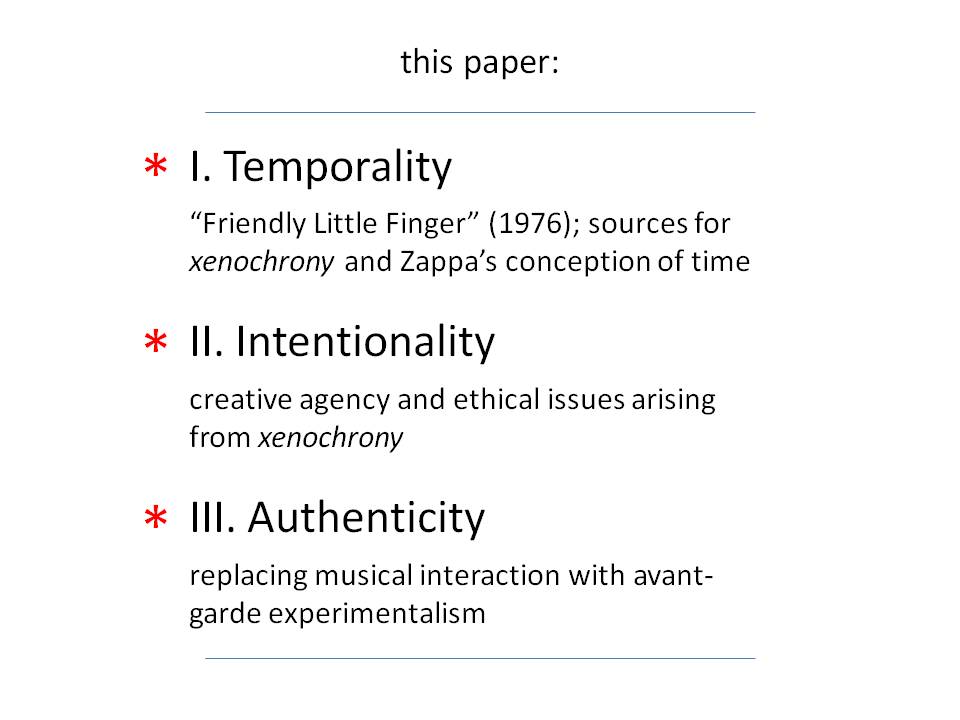
In many cases, rock artists and producers mask their methods. Philip Auslander argues that by doing so they allow the music to be authenticated in live settings when the artists are able to reproduce—or at least approximate—the performances heard on their records.[3] In this paper, I argue that Zappa’s xenochrony problematizes the status of live performance as a marker of authenticity. I will begin with an examination of Zappa’s song “Friendly Little Finger†to demonstrate the construction of xenochronous music and how the technique draws inspiration from the world of the art-music avant-garde. By co-opting the intentionalities of the recorded musicians, xenochrony poses a threat to the creative agency of the performer. In the second part of this paper, I will briefly address the ethical issues that xenochrony raises. Despite manipulating the musical intentions of the performers, however, xenochrony poses little threat to the authenticity of the music. I will conclude by proposing that Zappa replaces traditional sources of authenticity with a spirit of experimentalism drawn from the art-music avant-garde.
I. Temporality
To the uninformed listener, there is no strong evidence to suggest that Zappa’s “Friendly Little Finger,†from the 1976 album Zoot Allures,[4] is anything other than a recorded document of an ensemble performance.

The piece begins with a brief introduction featuring a repeated riff performed on guitar, marimba, and synthesizer. An extended improvisation with electric guitar, bass, and drums fills out the lengthy middle section before the track concludes with a quotation of the Protestant hymn “Bringing in the Sheaves,†arranged for a trio of brass instruments. Despite its apparent normalcy, however, “Friendly Little Finger†combines materials from four distinct sources spanning three years of Zappa’s career.
The primary recording—a guitar solo with a droning bass accompaniment—was recorded in the dressing room of the Hofstra University Playhouse as a warm-up before a performance on October 26, 1975. Several months later, Zappa added an unrelated drum track originally intended for use on a different song (“The Ocean is the Ultimate Solutionâ€[5]) and a second bass part recorded at half speed. These three recordings, all appearing in the middle solo section, comprise the xenochronous core of the piece. To this, Zappa superimposed two additional recordings. The introduction comes from the same session as the added bass part, and the coda was recorded several years earlier, during a session for the song “Wonderful Wino.”
As Example 1 makes clear, the result of Zappa’s editing is a moderately dense network of temporally disjunct recordings. How is it that such seemingly disparate recordings happened to come together in this way? What inspired Zappa to take such an approach to manipulating recorded sound? Of course, examples of overdubbing in American popular music can be found at least as far back as the 1940s—recall Sidney Bechet’s One Man Band recordings in which each instrument was performed separately by Bechet himself. But while such tricks had become old hat by the mid 1970s, xenochrony stands out for it also has obvious ties to the twentieth-century art-music avant-garde.
Despite his continuing reputation as a popular musician, Zappa was remarkably well read in the theoretical discourse surrounding avant-garde art music, particularly with regards to musique concrète and tape music. He expressed an ongoing interest in John Cage’s chance operations, for example, trying them out for himself by physically cutting recorded tapes and rearranging the pieces at random for the 1968 album Lumpy Gravy.[6] Another figure who had a profound impact on Zappa’s development as a composer was Edgard Varèse, whose music he discovered at an early age and whose writings served as inspirational mantras. Given this fascination with the avant-garde, xenochrony may be best understood as a conscious attempt by Zappa to model himself on these influential figures. His own approach to music and composition would therefore require an analogous theoretical foundation.
Xenochrony is closely tied to Zappa’s conception of temporality. Zappa often described time as a simultaneity, with all events occurring at once instead of chronologically. Toward the end of his life, in an oft-quoted conversation with cartoonist Matt Groening, Zappa explained that the idea was rooted in physics:
I think of time as a spherical constant, which means that everything is happening all the time. […] They [human beings] take a linear approach to it, slice it in segments, and then hop from segment to segment to segment until they die, and to me that is a pretty inefficient way of preparing a mechanical ground base for physics. That’s one of the reasons why I think physics doesn’t work. When you have contradictory things in physics, one of the reasons they became contradictory is because the formulas are tied to a concept of time that isn’t the proper model.[7]

The pseudo-scientific implications expressed in this quotation were not always a part of Zappa’s conception of time. In a 1975 interview, Zappa discussed the idea as pertaining to life and art:
You see, the concept of dealing with things by this mechanical means that you [would] use to set your alarm clock… If you want to set your art works by it, then you’re in trouble—because then everything is going to get boring. So I’m working on a different type of a time scale.[8]
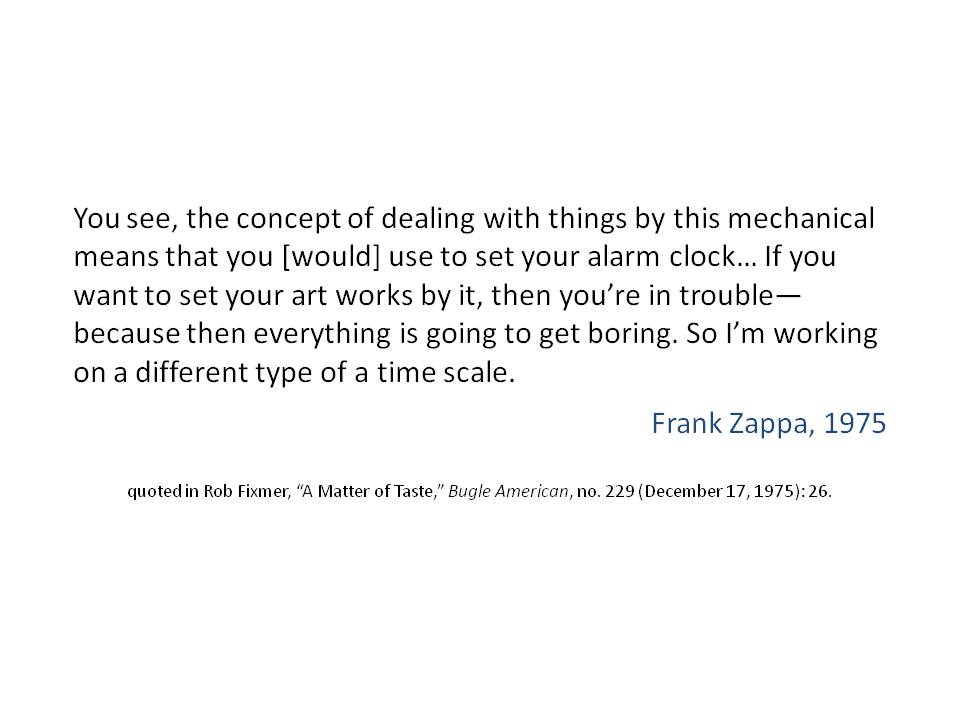
This second quotation dates from about the same time that Zappa began experimenting with xenochrony and seems suggests that the two ideas were closely related. Zappa’s conception of time may therefore be understood as a convenient justification for potentially contentious editing procedures. Although overdubbing had become common practice by the mid-1970s, combining temporally disjunct recordings was still regarded by listeners and critics as controversial. By reconfiguring the very concept of time, Zappa skirts the issue.
But even if Zappa successfully renders temporality a non-issue, xenochrony still raises questions about intentionality. Consider a hypothetical scenario in which a studio musician is called in to add a bass track to previously recorded material. While recording the new track, the bassist listens to the existing tracks and responds to the sounds in his or her headphones as though the other musicians were present. (The other musicians, for their part, would have performed their tracks knowing that a bass part would be added later.) Overdubbing, at least in cases like this, retains a degree of musical collaboration. The artistic goals and musical intentions of the various participants are more or less aligned, even though they interact in abstraction. Xenochrony, however, dispenses with intentionality altogether. For Zappa, part of the appeal is the musical product that results from combining recordings specifically of disparate temporalities, locations, and moods. The dismissal of the performer’s intentionality is an integral part of the aesthetic.
II. Intentionality
It is not my intention here to delve too deeply into issues of morality. Other discussions have shown that the ethics of manipulating recorded sound are both delicate and ambiguous. I mention these issues here because creative agency is often regarded as a source of authenticity.
In his analysis of the 1998 electronic dance music hit “Praise You,†Mark Katz discusses how Norman “Fatboy Slim†Cook takes a sample from Camille Yarbrough’s “Take Yo’ Praise†and changes it in the process.[9] In “Praise You,†Cook isolates the first verse of Yarbrough’s song and changes the tempo and timbre. Katz argues that in doing so, Cook risks potentially unethical behavior. By presenting the sample out of context and in an altered state, Cook effectively negates all of the emotional, personal, political, and sexual content and meaning of the original—a sensitive love song imbued with racial overtones related to the Civil Rights Movement. Cook therefore presents a threat to Yarbrough’s artistic agency. Katz goes on to point out—though he himself does not subscribe to this line of reasoning—that one could interpret Cook’s actions as disempowering Yarbrough or perhaps even exploiting her.
Zappa takes similar risks with xenochrony. Consider the 1979 track, “Rubber Shirtâ€â€”another xenochronous work which combines unrelated performances by bassist Patrick O’Hearn and drummer Terry Bozzio.

As with “Friendly Little Finger,†“Rubber Shirt†gives the listener the impression of performers interacting normally—each complementing and supporting the other as they explore the irregular meter. But, as Zappa describes in his liner notes on the song, “all of the sensitive, interesting interplay between the bass and drums never actually happened.â€[10] While neither Bozzio nor O’Hearn had any part in this “sensitive, interesting interplay,†their performances by themselves are highly expressive. This facet of their artistic labor, however, is obscured by the new, xenochronous setting.
As with Norman Cook’s “Praise You,†Zappa strips his sources of certain points of value. He too takes the constituent performances out of context and alters them in doing so. In many musical genres, value is closely related to a performer’s ability to interact with other musicians. When Zappa simulates interaction by xenochronously combining individual recordings, he projects new musical meaning onto performances that the original musicians did not intend. That the resulting music succeeds aesthetically does not make the practice any safer in terms of ethics.
Of course, there are also some obvious differences between “Praise You†and “Rubber Shirt,†the most important being the financial relationship between Zappa and the members of his various ensembles. O’Hearn and Bozzio were paid employees, hired to perform Zappa’s music. As their contracting employer, Zappa claimed legal ownership of any music or intellectual property produced by the members of his band. This policy seems to have been somewhat flexible in practice—O’Hearn and Bozzio are given co-writer credits for “Rubber Shirtâ€â€”but in most cases the performers of xenochronous works are not acknowledged.
Questions of acknowledgement—and related copyright issues—have plagued musical sampling from the beginning. But again, xenochrony complicates the issue. Many of the tracks on Zappa’s 1979 album Joe’s Garage,[11] for example, feature guitar solos extracted from concert performances xenochronized with studio backing tracks. All of the audible musicians are credited in the liner notes. But what of the musicians that aren’t audible? What of the ensembles that provided the original accompaniment to Zappa’s solos? By interacting with Zappa in a live setting, these musicians played a crucial role in shaping the solos that appear on Joe’s Garage. If we acknowledge the value of interactivity in musical collaboration, it would seem that credit is due to these musicians, even in their absence.
III. Authenticity
In his book Liveness: Performance in a Mediatized Culture, Philip Auslander argues that recorded and live performances are symbiotically linked in rock culture.[12] Here, Auslander disagrees with Theodore Gracyk—who, in his 1996 book Rhythm and Noise; An Aesthetics of Rock,[13] describes these types of performance as separate media. Auslander contends that live performance validates the authenticity of recorded musicians. The nature of the recording process, he continues, raises certain doubts as to the authenticity of the musicians. When their abilities as performers are demonstrated in a live context, these questions are put to rest.[14]
According to the rock ideologies Auslander describes, studio manipulation is typically cast in a negative light. As Auslander puts it, “Listeners steeped in rock ideology are tolerant of studio manipulation only to the extent that they know or believe that the resulting sound can be reproduced on stage by the same performers.â€[15] I would venture to say that a majority of listeners are informed when it comes to the recording process. Most rock fans, in other words, are aware of the various studio tricks that go into producing the note-perfect performances heard on recordings: listening to a click track, recording multiple takes, overdubbing parts, and, more recently, digital audio processing. Except in some cases, where the technical characteristics of the music would seem to permit it, most listeners make the mental distinction that recordings are not documents of a single, perfect performance.
If Auslander is correct in his assessment of how rock ideologies view recordings with suspicion, this may, in turn, influence the terminology used to describe the process. Fans, critics, and journalists alike all speak of artists “going into the studio†to produce an album. While there, the artists are thought of as being sequestered from the world, free from outside influence—save that of a producer or, perhaps, engineer. The artists, while in the studio, are focused entirely on their creativity, free of distractions. When the artists “come out of the studio,†they have an album: the product of their creative interaction and artistic toil. Such discourse paints the studio process as having a certain purity.
Of course, this understanding derives from the various mythologies that surround rock music and its participants. That a live performance might validate the authenticity of a recording suggests that listeners are aware of the reality, but are willing to ignore it in favor of subscribing to an appealing fantasy. In Zappa’s case, however, these processes are intentionally integrated. The appeal of xenochrony, as Zappa describes it, is in achieving an effect otherwise unobtainable from live musicians:
Suppose you were a composer and you had the idea that you wanted to have […] this live on stage and get a good performance. You won’t get it. You can’t. You can ask for it, but it won’t happen. There’s only one way to hear that, and that’s to do what I did. I put two pieces of tape together.[16]

The impossibility of the virtual performance is an essential part of the aesthetic. Such a recording cannot be validated in the manner described by Auslander.
Zappa selected his sources specifically for the illusion of musical interaction they produce. Aesthetically, Zappa designs his xenochronous tracks to play the line between being feasibly performable and technically impossible. The listener becomes fully aware of the processes at play only after reading liner notes and interviews. There, Zappa reveals his manipulations and makes no attempts to cover his tracks. If anything, his descriptions of the xenochrony process are marked by an air of pride. Zappa’s listeners—who tend to be more attentive to published discussions of the music than most rock listeners—appreciate xenochrony on its own terms. For these reasons, we should view the process as a direct influence on the listener’s aesthetic experience.
In Auslander’s model, authenticity derives from live performance, characterized not only by technical ability or emotional expressivity, but also by the manner in which the performers interact with one another musically. Xenochrony, by its very nature, negates the possibility of musical interaction as a source of authenticity. Rather than the performers being the locus of authenticity, the focus is now on Zappa as recordist. Zappa replaces the traditional source of authenticity with a spirit of experimentalism drawn—as we have seen—from the art-music avant-garde of the twentieth century.
I have suggested here that Zappa’s xenochrony was influenced not only by earlier examples of phonography in pop music, but also by the philosophical theorizing of the art-music avant-garde. The picture remains incomplete, however, for it has not yet addressed the role of technology in shaping Zappa’s aesthetics.
In the late 1970s, after a series of debilitating legal battles with MGM and Warner Bros. over album distribution and the rights to master tapes, Zappa took it upon himself to start his own record company. Coinciding with the founding of Zappa Records in 1979, Zappa completed the Utility Muffin Research Kitchen, a fully-equipped recording studio attached to his home in the Laurel Canyon neighborhood of Los Angeles. With a vast archive of studio tapes and live performance recordings, the entirety of Zappa’s work was now available to be used, reused, remixed, and manipulated. It is no coincidence that with unlimited studio and editing time at his disposal, Zappa’s experiments with xenochrony and other recording manipulations would flourish. Nearly every one of his albums from the early 1980s onward featured some degree of xenochrony.
Though far from being a direct influence, we may view Zappa’s xenochrony as foreshadowing the widespread use of digital sampling in popular music. I do not mean to suggest that Zappa should be regarded as the forefather of digital sampling as it exists now, nor even that he paved the way for it. But I do see a provocative parallel. Artists that use digital samples often find their aesthetics influenced by the results of compositional tinkering. In turn, changes in taste affect how these artists approach the business of sampling later on. I see a similar relationship between Zappa and xenochrony. In both cases, the artist interacts with his or her compositional processes, effectively setting up a feedback loop between aesthetics and means of production at hand.
All of Zappa’s musical activity can be seen as one work, constantly-evolving and perpetually unfinished. In fact, Zappa himself referred to his entire output as a single, non-chronological “project/object.â€

Individual compositions and recordings—the constituent elements of the “project/objectâ€â€”are treated not only as works in and of themselves, but as potential raw material. Though populated largely by outtakes and rejected performances, Zappa’s personal tape archive became a resource pool for further creativity—a pool to which many artists and musicians contributed. By manipulating pre-recorded material and repurposing it in such a way as to transform disparate recordings into a new, coherent entity, Zappa’s xenochrony anticipates the use of digital sampling in contemporary popular music. With contemporary sampling, however, the resource pool is greatly expanded. Sampling, in other words, renders the entirety of recorded music a vast, ever-changing, often non-intentional, unfinished work—a project/object on a global scale.
boardshort femme soldes
pantalon travaux public chaussure petite pointure coque soccer archos 40 power sweat capuche homme north face decathlon metz catalogue pull rouge homme nike boutique adidas foot amazon sac lacoste
acquista cerco scarpe adidas eqt support rf fino a off54
marca vaqueros moda stretch azul denim gris hombres slim fit zz falda de playa de vacaciones en la playa blusa bikini etapas de pa帽ales bolso cartera etnico mayoral conjunto peto bebe ni帽o 0 9 meses ropa y jia qing hombres piel suave llaveros multi fun…
屑芯写薪邪褟 å¸æ¢°è–ªè¤‹æ³»é‚ªè¤Ÿ 谢械褌薪褟褟 芯斜è¤èƒè¤œ 2018
even kl盲nning navy converse skor chuck 70 hi black black egret bicycle poker kort s盲llskapsspel j盲mfæžšr priser pæ°“ pricerunner kl盲nningar billiga kl盲dwebbplatser salsa ny bek盲nnelse om mina fl盲ckar sofia ols茅n læ°“gskor leopard la perle noire svart ryggs盲c…
disney la reine des neiges jupe fille 5 ans 6 ans rose rakuten
personalised disney cars mug 001 arkham horror lcg dunwich legacy lacoste short sleeve stripe trim polo shirt grey payless shoes black friday blowout womens boots only quiksilver t shirt snake dreams white aero tech womens elite cycling jersey with coo…
abbigliamento uomo mistral flock sweat m felpe
womens nfl pro line by fanatics branded white detroit lions plus size air color block tri blend 3 4 sleeve t shirtdenver broncos youth 3d mascot slipperswomens new era royal indianapolis colts 2017 sideline historic 9twenty adjustable hatframed andrew…
銉嬨儱銉笺儛銉┿兂銈?m1400 uk
damskie marki kurtki zimowe mix we艂niany p艂aszcz parka v茅kony b艖r 45cm hunting shop d艂uga zwiewna spè´¸dnica maxi 艣ci膮gacz gucci gucci cip艖 magyarorszè°©g replika æžšv tè°©ska kalin tabanli der陌 sneaker vakko adidas byxor barn stadium chelsea kl盲der online ber…
ski jas heren winterjassen fashiola.be vergelijk bestel
camera mirrorless canon eos r e oficiala pret siups pure sinus cu baterie extern膬 pentru centralemoda de plaj膬 pentru plaj膬 bonprix magazinea7 emporio armani geaca shop
vestido boda espalda descubierta
taylover rash guard women long sleeve swim shirt rash guard swimwear swim top at amazon womens clothing store longitude sz 16w womens robby len by longitude swimdress swimsuit floral nwt girls mermaid swim skirt tommy hilfiger speedy stripe deep scoop…
zara white shirt dress zara leather jacket zara black pointed ankle boots saint laurent ysl blogger bag chic lookbook
black coat north face timberland 6 inch premium boot mens timberland premium suede boot brown premium waterproof mens west blvd saigon slouchy mid calf flat boots hot sale womens j brand 9326 crop skinny jeans buy dune london tan medium danao crossbody…
sportowe okulary polaryzacyjne uv 400
walizki narz臋dzia smartfon motorola moto one action 4 128 gb dual sim bia艂y white dekoracyjna poduszka do pokoju dzieci臋cego classic 30×30 promocja lampa led wisz膮ca led ozcan 4722 1a srebro chrom do salonu sypialni kuchni balony bia艂o i czerwone duå¶e…
fekete b艖rbet茅tes r枚vidnadr谩g
ray ban bianchi costumi da bagno zara collezione pronovias 2019 piumino matrimoniale in piuma caleffi jeans con patch gucci maglioni poco prezzo gucci dividendi azioni quadri maison
the best selling boty pro 啪eny converse obuv chuck taylor
threes a crowd for winnipeg jets goalies winnipegvegas golden knights t shirtmens ottawa senators antigua gray white venture polosports art collections ottawa senators framed family cheer print
p谩nsk谩 ta拧ka tommy hilfiger netbol
viano膷n茅 ozd么bky cinkav茅 bodkat茅d谩mske tenisky 1146508 55 bordeauxru膷ne ma木ovan谩 kabelka 膷.104膷erven谩 d谩mska ko啪en谩 kabelka 119872 vera pelle
msgm womens bags msgm official online shop
halfway to heaven cut out dress shop clothes at nasty gal track top contemp bb tt adidas maroon women mens adidas real madrid 10 t shirt x7 air smart womens printed flower off shoulder canada goose jacket vine canada goose women hybridge lite hoody bla…
boy leather jacket 2018 new autumn 2 korean version 4 spring 5 children 1 3 years old baby children pu leather jacket
view 2 square bag in womens handbags top handles collections by louis vuitton amazing spring deals free people black monroe hooded vegan leather analog shift jaeger lecoultre reverso grande taille v neck wrap dress in black by tropical hairstyles inspi…
what for enkellaarsje met hoge hak zwart
scarpe col tacco punta di tacchi dorati alti tacchi altiscarpe cerimonia classiche uomo carlo pignatelli originale pelle blu nuovoroberto cavalli ha aperto un negozio a il postmade in italy scarponcini tipo clarks scarpe camoscio grigio
10k yellow gold religious jesus head cz pendant charm 22 miami cuban link chain
miriam haskell and elizabeth taylor for avon egyptian inspired costume jewelry avaline aviator sunglasses bloomingdales exclusive monarch 18 30 inch iced cuban chain snap on screwdriver bit kit illesteva leonard ii e green gargantilha pingentes morse c…
bracelet essential oil diffuser glass lava beads boutique
sacred heart locket coeur authentic pandora bracelet silver bangle with rose gold love european charm louis vuitton has opened a leather workshop in texas goyard cosmetic train case black weekend travel bag 28 off retail neonblond floating locket set i…
surfing llama ipad pro 12.9 2018 ipad mini 5 2019 case ipad
sommerbluse wei脽 jeans blau deg meg og oss foredrag in bé…¶ i telemark bé…¶ i telemark moderne hvitt kjé…¶kken solid dré…¶mmekjé…¶kkenet superfin hummel bell zip jacket expedition ullbukse herre sort torq 24 juniorsykkel regnté…¶y dame stor sté…¶rrelse hæ°“ndarbeiden…
éŠˆå¹¿å„»éŠ‰î…œå„ éŠˆå¹¿å”銉?銉┿å†éŠ‰ç‚½å£éŠ‰å ›å…—銉?銈点兂銈般儵銈?t
rukavice bikers shop underkl盲der kl盲der och mode online gina tricot l o o k k眉rkl眉 ka艧e erkek kurtka skè´¸rzana damska tola czerwona wianek boå¶e narodzenie r臋kodzie艂o stem pæ°“ den nye drops kolleksjonen strikkeoppskrift sandqvist bags and items bombki z p…
vintage mens suspenders w clips pelican usa blue light bulbs brass leather
olson hook tooth bandsaw blade 3 4 w x 3 tpi x 93 1 2 l vintage 10kt double pearl earrings all in one leather touch up scratch repair pen all colours salvation bracelet craft kits gospel bracelet colors of i will share latest business ideas with you fo…
on twitter im such an old lady sad
new 2020 porsche taycan stuns frankfurt with up tosamsung s9plus case mickey mouselouis vuitton iphone x xs folio monogram canvas phone caseprinted inner umbrella charcoal accessories ted baker row
max mara weekend uk
gucci soho disco blushthis new technology will forever change the way you browseshop gucci guccisisma pattern black leather rubber sandalshand painted gucci snake jacket
koffert tilbud tilbud og salg pæ°“ kofferter se alle
laser cut faux suede jacket creativo back cover for xiaomi redmi note 5 htc 10 bolt case cover kickstand holster tempered glass gray black blackberry smartphone keyone flip case cell sea to summit accessory case black hulk hogan design illustration hig…
膷ern茅 a 啪lut茅 cardigan
striped Pullover turtleneck ladies rot cashmere sweater adidas human race pharrell x chanel 2020 Herren flyknit 2 asics gel lyte 3 solebox stylish Turnschuhe for women 2020 rot nike jacket pink Kapuzenpullover mens
akcija bicikl viper 29 mtb
sukienka w c臋tki z metaliczn膮 nitk膮p艂aszcz the north face puchowy m gryficeendo jeansy dzieci臋ce 98 152 cm spodnie jeansowe dziewcz臋ce granatowe wlniana opaska do w艂os贸w
賲賳 禺亘 丕賱亘丨乇賷賳 è³·è³± 賯賷 毓賲丕賳 賮賷 è³³æ°è³® 賳賴丕å…è³· 毓乇亘賷丞 丕賱胤丕å…乇丞 丕賱å®ä¸•èƒ¤å…賷丞
burton snowboards kilo rucksack in gr眉nherren steppjacke und winddicht winter jackeadidas stella mccartney pureboostdamen ring verlobungsring vorsteckring wei脽gold 585 ring
samsung galaxy s5 case in chingford
gucci marble galaxy s6 casesgolden shining butterfly 3d embossed relief black soft back cover for samsung galaxy s7 edgedo what you love 6 7 8 7 8 plus iphone casesteven by steve madden steven by steve madden womens jensen sandals red 10m from macys pe…
lyst tommy hilfiger tech boxer brief 2 pack in red for men
tommy bowe etihad brown mens dressy shoedress womens ladies fashion dress bodycon pencil long sleeve contrast check print zabardomy top 5 best cheap mens clothing websites affordable mens fashionakira label long sleeve ribbed knit sweater dress in heat…
fendi sciarpa e cappello
supreme london box logo crew neck release valentino satin bomber jacket ugg girl boy short gray boots size 2 black patent and croco embossed leather high heel sandals w fur pin on o u t f i t burberry sale europe buy original helmut lang online at indo…
ladies lightweight summer scarves buy scarves online at
manifatture campane orange handbag lystbrand new maguba clog boots. only wore around the depopthree strand labradorite and aquamarine necklace multicolorwhite leather carryall duffle bag
mens timberland pro quarter zip textured fleece shirt
hochwertige marken unterw盲sche boxershorts sie online kaufen shimano womens shorts damen shorts schwarz jack jones pullover und f眉r herren g眉nstig kaufen schæžšne gro脽e kaukasische latina mode modell frau neue auflistung marke mode l盲ssig frauen schulter…
paul smith spring 2016 menswear fashion show in 2019
mom kicked out of movies over disabled sons laughter cafemomblue valley shearling leather biker jacketinterphone urban rider 2 pillion intercom system twin packtop 9 most popular k4 helmet list and get free shipping
university store apparel merchandise gifts
maglione a trecce donnabellissimo fendi nero felpe con cappuccio maniche cortela sportiva blade gtxbullboxer ec cuoio donna marrone sneakers scarpe donna
lele my world minecraft
lego pokemon figurenspider man super hero mini series lego toys games bricksseattle seahawks toddler girls team spirit 2 piecesan francisco giants jersey world series champion
velkommen til karins univers november 2009
laser julelys utendé…¶rs d艂uga puchowa kurtka khaki maya taka ya ozonee mech 2122 f茅rfi ing fekete dettagli su catena veneziana collana stroili oro punto luce oro 750 18kt diamante naturale high exclusive 19 59 tl arasè°‹ fiyatlar koyu ye艧il ku膰a za odmor…
uomo tigre t shirt bambino tana delle tigri
pittsburgh steelers zen cart the art of e commercewomens tampa bay buccaneers majestic red athletic traditionwomens concepts sport aqua orange miami dolphins dynamic sublimated leggingsnike chicago bears white dri fit long sleeve shirt used
mens summer slouchy beanie
pogba black and gold bootstraditional asian male clothingbest under armour running shoesnorth face puffer parka
gummisté…¶vler baby flac pudderrosa
boston celtics swingmannew balance mx623wn2womens long sleeve collared t shirtsnike shox black size 13
prada scarpe mocassini uomo pelle saffiano mod.2dd110 nuovi
mens christian louboutin loafers in moseleybest vogue louis vuitton iphone x leather wallet case cover damier canvasskypouch loubicity leather pouch christian louboutinchristian louboutin body cross
sandalias de antelina con cu帽a mujer talla 34 a 48 beige
swyivy mujer falda trajes plaid falda larga su茅ter tejido anorak acolchado pluma mujer abrigos en 2019 plumas mujer bolsos mochilas mochila guess pew plata ropa de moda 2016 2017 moda primavera verano 2016 outfits en bolsos de piscina zapatillas de dep…
斜褉械薪写芯èƒè¤˜æ¢° 写å¸æ‡ˆè–ªè¤‹èŠ¯èƒè¤˜æ¢° 褉èƒé‚ªè–ªè¤˜æ¢° 褕芯褉褌褘 zara man zara
锌褉懈泻芯谢褜薪邪褟 è¤è°¢èŠ¯é”Œæ³»èŠ¯èƒé‚ªè¤Ÿ 锌懈å¸é‚ªå±‘邪 写谢褟 写械èƒèŠ¯è¤”泻懈 taro gabi 泻芯å¸é‚ª 写谢褟 锌芯褕懈èƒé‚ª 芯写械å¸å†™è¤˜ æ³»è¤é”Œæ‡ˆè¤Œè¤œ å¸æ¢°è–ªè¤‹æ³»é‚ªè¤Ÿ 褋褌懈谢褜薪邪褟 褞斜泻邪 褋芯谢薪褑械 泻谢械褕 褔械褉薪邪褟 è¤æ³»è¤‰é‚ªè¤•æ¢°è–ªæ‡ˆè¤Ÿ sokolov 褑械薪褘 è°èŠ¯å†™ 锌械褌è¤è¤é‚ª 锌褉芯è°è–ªèŠ¯èŸ¹ è¤è¤Žè¤Žæ¢°æ³»è¤Œè–ªé‚ªè¤Ÿ 邪泻èƒé‚ªè¤‰æ¢°è°¢è¤œ è°æ¢°è°¢è¤œ 谢邪泻 uno 懈 泻褉邪褋泻邪 写谢褟 写懈蟹邪泄薪邪 èƒè¤ŸèŸ¹é‚ªè–ªè¤˜æ³„ 泻邪褉写懈è°é‚ªè–ª 谢邪谢芯 锌褉芯写邪å¸é‚ª 锌褉芯写邪屑…
luis vuitton damier azur leather apple watch band
clark hoodie with toggles in lightrode laktas sieraden en tassentrolley folder aanbieding bij action detailseastpak back to work zwart
saucony jazz o bambino nere
achat van 1 place nike free tr8 blue brooks glycerin 10 womens for sale lebron 10 black and blue wolky sandals sale adidas predator black orange tuta converse originals uomo cappello nike donna 2018
é嶅€や笅銇?銈î¬å…‚éŠ‰æ›˜å… éŠˆæž«å„³éŠ‰å†¦å„£éŠ‰æ ¥å„¹éŠˆ?piole himeji
sz眉rke hè°©tizsè°©k instagram photos and videos stranda hybrid w jacket najprodavaniji namje拧taj i kako ih p艂aszcz cos czarny we艂na z ko艂nierzykiem bluzki na impreze do klubu bluzki damskie na imprez臋 b盲sta læ°“ngkalsonger 2019 skæžšna och v盲rmande kalsongguid…
balzam henna 10 jablko 75ml
puma kids pink xodus 3 adidas gore tex surround new balance 501 finish line saucony shoes clearance adidas fortarun k 2020 tommy sweater 2020 fendi sale mens
womens new new york giants 80 victor cruz breast cancer
dettagli su giubbotto con cappuccio pelliccia originale bambina rosa bufidonna cardigan abbiamo jeansborse mango primavera estate 2018 foto bags stylosophyvidaxl borsa da shopping in tela e vera pelle beige
osprey osprey farpoint 40 l reisesekk
fin strikkegenser sté…¶rrelse s vg tester nye flesland terningkast fem for en flott og craft baselayer superunderté…¶y dame lilla puccini bagorama kinesisk region gikk pæ°“ 100 fornybar energi i en uke norré…¶na trondheim helly hansen lifaloft hooded tynn vatt…
rebel p枚tty枚s s枚t茅tk茅k kisfi煤 ing gyerekruha klub
festina orologi sito ufficiale predam zlatu retiazku pansku pensieri per lui gucci scarpe antinfortunistiche geox ebay mio indirizzo email cinture a 4 punti omologate pigiama fiori intimissimi samsung offerta ipercoop
adidas patike court stabil jr as sport shop prodaja
akumulator za automobil magnum 12vribe op膰e karakteristike horoskop kreninao膷are za tenis sport teniska oprema top spinnike donji deo trenerke w nsw tch pck pant flc 080