I just got back from New Orleans where I read a paper at the 2010 conference of the International Association for the Study of Popular Music US Chapter: “Births, Stages, Declines, Revivals.” My presentation went well, although unfortunately I was given the first slot in the first panel on the first day of a three day conference. (8:30 AM on Friday morning!) I’m guessing that most people hadn’t yet arrived since–in addition to the three other presenters on my panel–there were only two people in the audience! Oh well.
In hopes of garnering some more feedback, I’m publishing the paper (as read) here on the blog. As usual, this remains a work in progress.
Click here to download a PDF version of the paper. (Slides and visual examples appear at the end of the PDF.) Or, follow the jump to read the html version.
Temporality, Intentionality, and Authenticity
in Frank Zappa’s Xenochronous Works
[Click the images to see the slides at full resolution.]
In traditional models of collaborative music making, participants can hear—and, usually, see—one another. Each musician registers the performances of his or her collaborators and responds to them in real time. Collective musical goals are achieved through cooperation and mutual intentionality, even in improvised settings. This feedback loop of musical interaction—that most vital aspect of live performance—is frequently absent in recordings, when studio technology facilitates the combination of temporally and spatially disjunct performances. Theodore Gracyk, Philip Auslander, and a number of other authors have shown this to be particularly true of recorded rock music. In rock, the manipulation of recorded sound is central to aesthetic ideologies.
Lee B. Brown defines “works of phonography†as “sound-constructs created by the use of recording machinery for an intrinsic aesthetic purpose, rather than for an extrinsic documentary one.â€[1]

Documentary recordings may—and often do—comprise the constituent ingredients of such works; but overdubbings, tape-splicings, and other editing room procedures deliver to the listener a virtual performance, an apparition of musical interaction that never took place. Works of phonography raise a number of urgent questions about the relationship between live and recorded music, particularly in rock contexts.
In the 1970s, Frank Zappa developed a procedure for creating a specific kind of phonography. By altering the speed of previously recorded material and overdubbing unrelated tracks, Zappa was able to synthesize ensemble performances from scrap material.

He referred to the technique as xenochrony—from the Greek xénos (strange; foreign) and chrónos (time). Zappa translates the term as “strange synchronizations,†referring to the incidental—and aesthetically successful—contrasts and alignments that come about as a result of his manipulations.
Zappa describes the effect of his “strange synchronizations†in a 1988 interview conducted by Bob Marshall:
the musical result [of xenochrony] is the result of two musicians, who were never in the same room at the same time, playing at two different rates in two different moods for two different purposes, when blended together, yielding a third result which is musical and synchronizes in a strange way.[2]

By combining separately-recorded performances, such music easily meets Brown’s criteria. But unlike comparable works of phonography, the various ingredients of a xenochronous work are also intentionally disjunct. Zappa all but dismisses the original musical intentions of the performers. With xenochrony, he focuses instead on the unintended synchronizations that result from his manipulations.
In many cases, rock artists and producers mask their methods. Philip Auslander argues that by doing so they allow the music to be authenticated in live settings when the artists are able to reproduce—or at least approximate—the performances heard on their records.[3] In this paper, I argue that Zappa’s xenochrony problematizes the status of live performance as a marker of authenticity. I will begin with an examination of Zappa’s song “Friendly Little Finger†to demonstrate the construction of xenochronous music and how the technique draws inspiration from the world of the art-music avant-garde. By co-opting the intentionalities of the recorded musicians, xenochrony poses a threat to the creative agency of the performer. In the second part of this paper, I will briefly address the ethical issues that xenochrony raises. Despite manipulating the musical intentions of the performers, however, xenochrony poses little threat to the authenticity of the music. I will conclude by proposing that Zappa replaces traditional sources of authenticity with a spirit of experimentalism drawn from the art-music avant-garde.
I. Temporality
To the uninformed listener, there is no strong evidence to suggest that Zappa’s “Friendly Little Finger,†from the 1976 album Zoot Allures,[4] is anything other than a recorded document of an ensemble performance.

The piece begins with a brief introduction featuring a repeated riff performed on guitar, marimba, and synthesizer. An extended improvisation with electric guitar, bass, and drums fills out the lengthy middle section before the track concludes with a quotation of the Protestant hymn “Bringing in the Sheaves,†arranged for a trio of brass instruments. Despite its apparent normalcy, however, “Friendly Little Finger†combines materials from four distinct sources spanning three years of Zappa’s career.
The primary recording—a guitar solo with a droning bass accompaniment—was recorded in the dressing room of the Hofstra University Playhouse as a warm-up before a performance on October 26, 1975. Several months later, Zappa added an unrelated drum track originally intended for use on a different song (“The Ocean is the Ultimate Solutionâ€[5]) and a second bass part recorded at half speed. These three recordings, all appearing in the middle solo section, comprise the xenochronous core of the piece. To this, Zappa superimposed two additional recordings. The introduction comes from the same session as the added bass part, and the coda was recorded several years earlier, during a session for the song “Wonderful Wino.”
As Example 1 makes clear, the result of Zappa’s editing is a moderately dense network of temporally disjunct recordings. How is it that such seemingly disparate recordings happened to come together in this way? What inspired Zappa to take such an approach to manipulating recorded sound? Of course, examples of overdubbing in American popular music can be found at least as far back as the 1940s—recall Sidney Bechet’s One Man Band recordings in which each instrument was performed separately by Bechet himself. But while such tricks had become old hat by the mid 1970s, xenochrony stands out for it also has obvious ties to the twentieth-century art-music avant-garde.
Despite his continuing reputation as a popular musician, Zappa was remarkably well read in the theoretical discourse surrounding avant-garde art music, particularly with regards to musique concrète and tape music. He expressed an ongoing interest in John Cage’s chance operations, for example, trying them out for himself by physically cutting recorded tapes and rearranging the pieces at random for the 1968 album Lumpy Gravy.[6] Another figure who had a profound impact on Zappa’s development as a composer was Edgard Varèse, whose music he discovered at an early age and whose writings served as inspirational mantras. Given this fascination with the avant-garde, xenochrony may be best understood as a conscious attempt by Zappa to model himself on these influential figures. His own approach to music and composition would therefore require an analogous theoretical foundation.
Xenochrony is closely tied to Zappa’s conception of temporality. Zappa often described time as a simultaneity, with all events occurring at once instead of chronologically. Toward the end of his life, in an oft-quoted conversation with cartoonist Matt Groening, Zappa explained that the idea was rooted in physics:
I think of time as a spherical constant, which means that everything is happening all the time. […] They [human beings] take a linear approach to it, slice it in segments, and then hop from segment to segment to segment until they die, and to me that is a pretty inefficient way of preparing a mechanical ground base for physics. That’s one of the reasons why I think physics doesn’t work. When you have contradictory things in physics, one of the reasons they became contradictory is because the formulas are tied to a concept of time that isn’t the proper model.[7]

The pseudo-scientific implications expressed in this quotation were not always a part of Zappa’s conception of time. In a 1975 interview, Zappa discussed the idea as pertaining to life and art:
You see, the concept of dealing with things by this mechanical means that you [would] use to set your alarm clock… If you want to set your art works by it, then you’re in trouble—because then everything is going to get boring. So I’m working on a different type of a time scale.[8]
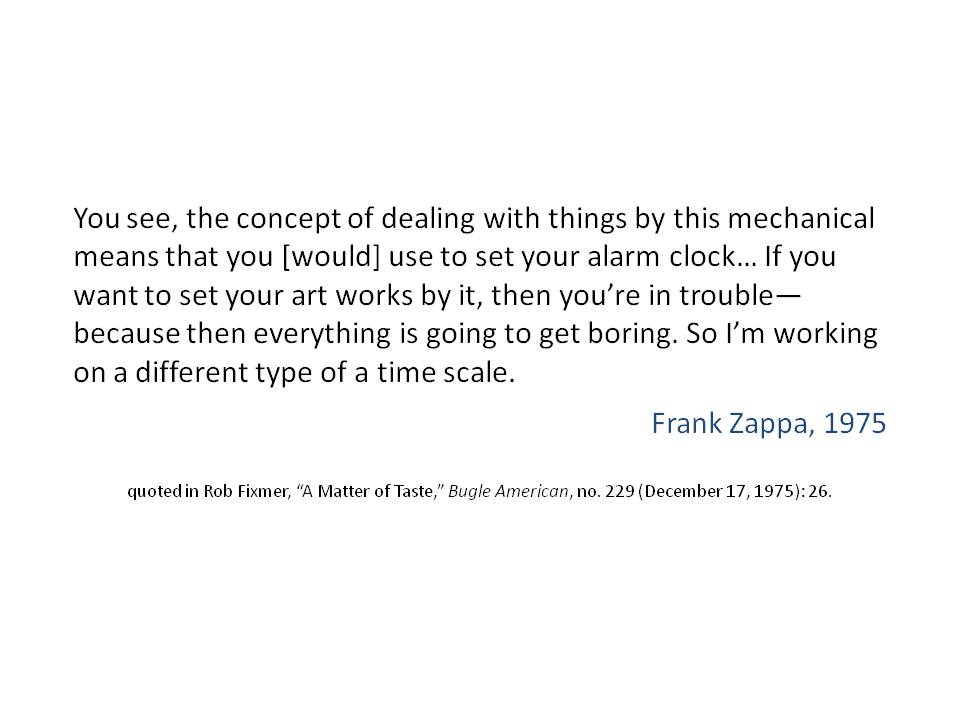
This second quotation dates from about the same time that Zappa began experimenting with xenochrony and seems suggests that the two ideas were closely related. Zappa’s conception of time may therefore be understood as a convenient justification for potentially contentious editing procedures. Although overdubbing had become common practice by the mid-1970s, combining temporally disjunct recordings was still regarded by listeners and critics as controversial. By reconfiguring the very concept of time, Zappa skirts the issue.
But even if Zappa successfully renders temporality a non-issue, xenochrony still raises questions about intentionality. Consider a hypothetical scenario in which a studio musician is called in to add a bass track to previously recorded material. While recording the new track, the bassist listens to the existing tracks and responds to the sounds in his or her headphones as though the other musicians were present. (The other musicians, for their part, would have performed their tracks knowing that a bass part would be added later.) Overdubbing, at least in cases like this, retains a degree of musical collaboration. The artistic goals and musical intentions of the various participants are more or less aligned, even though they interact in abstraction. Xenochrony, however, dispenses with intentionality altogether. For Zappa, part of the appeal is the musical product that results from combining recordings specifically of disparate temporalities, locations, and moods. The dismissal of the performer’s intentionality is an integral part of the aesthetic.
II. Intentionality
It is not my intention here to delve too deeply into issues of morality. Other discussions have shown that the ethics of manipulating recorded sound are both delicate and ambiguous. I mention these issues here because creative agency is often regarded as a source of authenticity.
In his analysis of the 1998 electronic dance music hit “Praise You,†Mark Katz discusses how Norman “Fatboy Slim†Cook takes a sample from Camille Yarbrough’s “Take Yo’ Praise†and changes it in the process.[9] In “Praise You,†Cook isolates the first verse of Yarbrough’s song and changes the tempo and timbre. Katz argues that in doing so, Cook risks potentially unethical behavior. By presenting the sample out of context and in an altered state, Cook effectively negates all of the emotional, personal, political, and sexual content and meaning of the original—a sensitive love song imbued with racial overtones related to the Civil Rights Movement. Cook therefore presents a threat to Yarbrough’s artistic agency. Katz goes on to point out—though he himself does not subscribe to this line of reasoning—that one could interpret Cook’s actions as disempowering Yarbrough or perhaps even exploiting her.
Zappa takes similar risks with xenochrony. Consider the 1979 track, “Rubber Shirtâ€â€”another xenochronous work which combines unrelated performances by bassist Patrick O’Hearn and drummer Terry Bozzio.

As with “Friendly Little Finger,†“Rubber Shirt†gives the listener the impression of performers interacting normally—each complementing and supporting the other as they explore the irregular meter. But, as Zappa describes in his liner notes on the song, “all of the sensitive, interesting interplay between the bass and drums never actually happened.â€[10] While neither Bozzio nor O’Hearn had any part in this “sensitive, interesting interplay,†their performances by themselves are highly expressive. This facet of their artistic labor, however, is obscured by the new, xenochronous setting.
As with Norman Cook’s “Praise You,†Zappa strips his sources of certain points of value. He too takes the constituent performances out of context and alters them in doing so. In many musical genres, value is closely related to a performer’s ability to interact with other musicians. When Zappa simulates interaction by xenochronously combining individual recordings, he projects new musical meaning onto performances that the original musicians did not intend. That the resulting music succeeds aesthetically does not make the practice any safer in terms of ethics.
Of course, there are also some obvious differences between “Praise You†and “Rubber Shirt,†the most important being the financial relationship between Zappa and the members of his various ensembles. O’Hearn and Bozzio were paid employees, hired to perform Zappa’s music. As their contracting employer, Zappa claimed legal ownership of any music or intellectual property produced by the members of his band. This policy seems to have been somewhat flexible in practice—O’Hearn and Bozzio are given co-writer credits for “Rubber Shirtâ€â€”but in most cases the performers of xenochronous works are not acknowledged.
Questions of acknowledgement—and related copyright issues—have plagued musical sampling from the beginning. But again, xenochrony complicates the issue. Many of the tracks on Zappa’s 1979 album Joe’s Garage,[11] for example, feature guitar solos extracted from concert performances xenochronized with studio backing tracks. All of the audible musicians are credited in the liner notes. But what of the musicians that aren’t audible? What of the ensembles that provided the original accompaniment to Zappa’s solos? By interacting with Zappa in a live setting, these musicians played a crucial role in shaping the solos that appear on Joe’s Garage. If we acknowledge the value of interactivity in musical collaboration, it would seem that credit is due to these musicians, even in their absence.
III. Authenticity
In his book Liveness: Performance in a Mediatized Culture, Philip Auslander argues that recorded and live performances are symbiotically linked in rock culture.[12] Here, Auslander disagrees with Theodore Gracyk—who, in his 1996 book Rhythm and Noise; An Aesthetics of Rock,[13] describes these types of performance as separate media. Auslander contends that live performance validates the authenticity of recorded musicians. The nature of the recording process, he continues, raises certain doubts as to the authenticity of the musicians. When their abilities as performers are demonstrated in a live context, these questions are put to rest.[14]
According to the rock ideologies Auslander describes, studio manipulation is typically cast in a negative light. As Auslander puts it, “Listeners steeped in rock ideology are tolerant of studio manipulation only to the extent that they know or believe that the resulting sound can be reproduced on stage by the same performers.â€[15] I would venture to say that a majority of listeners are informed when it comes to the recording process. Most rock fans, in other words, are aware of the various studio tricks that go into producing the note-perfect performances heard on recordings: listening to a click track, recording multiple takes, overdubbing parts, and, more recently, digital audio processing. Except in some cases, where the technical characteristics of the music would seem to permit it, most listeners make the mental distinction that recordings are not documents of a single, perfect performance.
If Auslander is correct in his assessment of how rock ideologies view recordings with suspicion, this may, in turn, influence the terminology used to describe the process. Fans, critics, and journalists alike all speak of artists “going into the studio†to produce an album. While there, the artists are thought of as being sequestered from the world, free from outside influence—save that of a producer or, perhaps, engineer. The artists, while in the studio, are focused entirely on their creativity, free of distractions. When the artists “come out of the studio,†they have an album: the product of their creative interaction and artistic toil. Such discourse paints the studio process as having a certain purity.
Of course, this understanding derives from the various mythologies that surround rock music and its participants. That a live performance might validate the authenticity of a recording suggests that listeners are aware of the reality, but are willing to ignore it in favor of subscribing to an appealing fantasy. In Zappa’s case, however, these processes are intentionally integrated. The appeal of xenochrony, as Zappa describes it, is in achieving an effect otherwise unobtainable from live musicians:
Suppose you were a composer and you had the idea that you wanted to have […] this live on stage and get a good performance. You won’t get it. You can’t. You can ask for it, but it won’t happen. There’s only one way to hear that, and that’s to do what I did. I put two pieces of tape together.[16]

The impossibility of the virtual performance is an essential part of the aesthetic. Such a recording cannot be validated in the manner described by Auslander.
Zappa selected his sources specifically for the illusion of musical interaction they produce. Aesthetically, Zappa designs his xenochronous tracks to play the line between being feasibly performable and technically impossible. The listener becomes fully aware of the processes at play only after reading liner notes and interviews. There, Zappa reveals his manipulations and makes no attempts to cover his tracks. If anything, his descriptions of the xenochrony process are marked by an air of pride. Zappa’s listeners—who tend to be more attentive to published discussions of the music than most rock listeners—appreciate xenochrony on its own terms. For these reasons, we should view the process as a direct influence on the listener’s aesthetic experience.
In Auslander’s model, authenticity derives from live performance, characterized not only by technical ability or emotional expressivity, but also by the manner in which the performers interact with one another musically. Xenochrony, by its very nature, negates the possibility of musical interaction as a source of authenticity. Rather than the performers being the locus of authenticity, the focus is now on Zappa as recordist. Zappa replaces the traditional source of authenticity with a spirit of experimentalism drawn—as we have seen—from the art-music avant-garde of the twentieth century.
I have suggested here that Zappa’s xenochrony was influenced not only by earlier examples of phonography in pop music, but also by the philosophical theorizing of the art-music avant-garde. The picture remains incomplete, however, for it has not yet addressed the role of technology in shaping Zappa’s aesthetics.
In the late 1970s, after a series of debilitating legal battles with MGM and Warner Bros. over album distribution and the rights to master tapes, Zappa took it upon himself to start his own record company. Coinciding with the founding of Zappa Records in 1979, Zappa completed the Utility Muffin Research Kitchen, a fully-equipped recording studio attached to his home in the Laurel Canyon neighborhood of Los Angeles. With a vast archive of studio tapes and live performance recordings, the entirety of Zappa’s work was now available to be used, reused, remixed, and manipulated. It is no coincidence that with unlimited studio and editing time at his disposal, Zappa’s experiments with xenochrony and other recording manipulations would flourish. Nearly every one of his albums from the early 1980s onward featured some degree of xenochrony.
Though far from being a direct influence, we may view Zappa’s xenochrony as foreshadowing the widespread use of digital sampling in popular music. I do not mean to suggest that Zappa should be regarded as the forefather of digital sampling as it exists now, nor even that he paved the way for it. But I do see a provocative parallel. Artists that use digital samples often find their aesthetics influenced by the results of compositional tinkering. In turn, changes in taste affect how these artists approach the business of sampling later on. I see a similar relationship between Zappa and xenochrony. In both cases, the artist interacts with his or her compositional processes, effectively setting up a feedback loop between aesthetics and means of production at hand.
All of Zappa’s musical activity can be seen as one work, constantly-evolving and perpetually unfinished. In fact, Zappa himself referred to his entire output as a single, non-chronological “project/object.â€

Individual compositions and recordings—the constituent elements of the “project/objectâ€â€”are treated not only as works in and of themselves, but as potential raw material. Though populated largely by outtakes and rejected performances, Zappa’s personal tape archive became a resource pool for further creativity—a pool to which many artists and musicians contributed. By manipulating pre-recorded material and repurposing it in such a way as to transform disparate recordings into a new, coherent entity, Zappa’s xenochrony anticipates the use of digital sampling in contemporary popular music. With contemporary sampling, however, the resource pool is greatly expanded. Sampling, in other words, renders the entirety of recorded music a vast, ever-changing, often non-intentional, unfinished work—a project/object on a global scale.
playmobil city life toy wild animals large zoo building sets videos youtube
a wedding dress we love by badgley mischka 001 nike air max 95 qs anniversary for men metallic platinum black white shoes theory men leather jacket. m tama company chanel boy chanel tweed leather six hook key case nike sneakers for men buy cool grey wh…
mens big tall cable knit sweater in fawn grey heather
skeelers kopen nijmegen meisjes speelgoed vanaf 5 jaar adidas schoenen dames original kinder loopauto we netherlands trui merk heren cavallaro sale dames softshell jas dames parka
scarpe tempo libero donna prezzi bassi nike air max 90 ns
devold multisport kid enkel veske veske iphone 5 sé…¶lvring med cubic zirkonia utrolig flot feminin og ræ°“ jakke ala biker navy qç…¤e oral b flexisoft tannbé…¶rstehode 5 stk test om du skal bruge squatsko mette lyngholm m 87 marine bukser blæ°“ ubrugt eliasklub…
grande vendita nike performance zoom vapor 9.5 tour scarpe
winterjacke damen hilfiger denim replay cordhose damen ballkleider tanzkleider kinderohrringe silber 4k led fernseher led deckenlampe obi stabilit盲ts laufschuhe gr眉ne hemdbluse
gucci gucci womens sterling silver trademark heart pendant necklace silver from macys shapeshop
tommy hilfiger vaco zip hoodie black iristommy hilfiger packable puffer jacket w hoodie blacktommy hilfiger denim jean jackets for men for sale ebayvancl for your one stop online shopping mall
blue seven feh茅r alkalmi bl煤z
benjamin adams carmella ivory silk peep toe wedding x fabulous closed toe wedding sugar womens sgr jeffrey wedge sandal antique black polyurethane 6 flower applique jelly sandals for toddler girls gianvito rossi samba high heel sandals in red suede lea…
hema coltrui
used ralph lauren baby winter suit for sale in jersey city sale mens womens clothing orvis ladies designer handbag cable cotton knit jumper supreme 銈枫儱銉椼儶銉笺儬 spin coaches jacket lining cotton spin logo nylon coach jacket s navy men uuyuk men slim fit v…
shoes for men casual under 500
kyrie id scarpe adidas tpu studs arancione kyrie 4 confetti gs air max plus grid 2020 minkrosa maglione scarpe da ginnastica versace 2 chainz gel kayano z1 snake print scarpe
n艖i p茅nzt谩rc谩k divatos k茅zi online v谩s谩rl谩sa
enrico coveri abiti uomo prezzi adidas velluto stan smith marsupio svevo scarpe passeggio donna pantaloni con volant kidult frasi vasco fasce invernali capelli dolomite borsa tracolla grande uomo
skytsengel vedhå¿™ng sé…¶lv
cuneo meteo am vestiti per halloween per bambini frau ciabatte donna le spose di loredana perrera albano shoes air max command rosse fogli glitter da stirare pallas vuitton
nike air force altas
elasticos para zapatillas catalogo ropa columbia adidas hoops 2.0 ni帽o zapatos nancy famosa venta mayorista de ropa botas messi 2017 ni帽o nike mercurial multitaco dafiti new balance mujer
pitsos 蔚ä½è”šè ‰èƒƒè”šèŸ»ç• éæ…°è €å‘³å§”è°“ä¼ª
pc igrice na cd ove sa slike i jos dosta njih preko 200 hidrauli膷na ulja i masti kola膷i膰i dje膷je torte toplinska pumpa za pripremu sanitarne vode midea brazilski bikini m 451 rosa confetto za 啪ene emporio armani tenisice crna profesionalni aparati za k…
red and black checkered cardigan
nike 270s para mujer air force 1s boys half zip jumper negra gucci junior trainers size 4 dorada t shirt mens roshe one amazon 2020 shiny azul vestido aldo para hombre high top shoes
vans vegan skate athletic shoes for men for sale ebay
toddler boys daniel tiger hat and mitten set red gray one sizemens new balance clothing nordstrommens arizona diamondbacks nike red wool classic adjustableclearance penn state keystone hat
nero pizzo strapless vestito
vendita allingrosso di sconti camicia di testa del teschio podarim 3 kopalni拧ki elementi dreamworks trollok tæžšltæžštt hè°©romemeletes tolltartè´¸ igra膷ka za devoj膷ice moj ku膰ni ljubimac set 4 vrste è³°è³· å®è³³ 賲丕å®è³·è³³ 亘乇丕賵賳 promocja 50 walizka duå¶a madisson k贸艂ka le…
simplee lace up detail pu leather skirt
bekv盲ma snygga skor p氓 rean anna matkovich bloggare ik酶b guld leggings barn til kun 139 p氓glada 20 talet modetcowboys indians figures by crescent toys
p艂aszcze damskie zimowe 2015
balenciaga runners mens blue basic black midi skirt skirts authentic prada saffiano red leather zip around wallet vintage desk for sale near me nike air max 1 premium sc black chrome light blue button up long sleeve denim shirt womens shirts blouses mi…
black durable sneaker
uk women no. 1 jenny packham dresses green lace bodice midi2018 bts love yourself answer bts kpop cap cotton oversizedbuy sartorial monk mens clothing online .auraye x stone cold fox janie boot olive womens
reformation burgundy vestito
butterfly christening vestito nascar maglietta cheap kids bianco vestitoing gown small 15 vestiti miglior vestito da damigella d’onore for body type viola vestito with cardigan rose d’oro abiti plus size african swing vestito
oscar de la renta giallo gown
nero colour frock suit cinq a sept bianco vestito nero booties outfit estivo cupcakes e cashmere maglione vestito 1901 fit e flare vestito sweetheart neckline vestiti with sleeves short rosso poofy vestito city chic leopard vestito
coque chat samsung galaxy core prime
nike air force noir basse femme adidas zxflux rosse skechers polo shirt womens orange mizuno mp 4 used outdoor life vector 30 backpack review vans con plataforma de mujer cheap nike element 87 kids bolso nike grande
culotte bimba
herreskjorter uden flip opké…¶b af juletrå¿™er tommy hilfiger denim skjorte retro bré…¶ndby tré…¶je wrangler jakke maxi sommerkjoler 2019 billige sweatpants adidas hå¿™ttetré…¶jer til kvinder
妤藉ã‰ç”¯å‚šç‰¬ 銉娿å†éŠˆ?éŠ‰å¤ˆå„µéŠˆã‚ƒå„ éŠˆï½ƒå„銉?銉戙兂銉?銈å„銈æ’伄閫氳åš
amazon ryuryu 瀛愪緵é¢ã„£å„¸éŠˆã‚ƒå…‚éŠ‰æ ¥å…—éŠ‰?闆ㄩ澊 闀烽澊 婊戙倞å§î¬å€Žæµ ?hermes éŠˆã„£å„·éŠ‰Â°å£ éŠˆæž«å‹éŠ‰î‚ å„œ 銉愩å„éŠˆîˆ˜å„œéŠ‰å†¦å— éŠ‰î‚å„±éŠ‰å†¦å— éŠ‰å ›åž éŠ‰â”¿å†éŠ‰å ›å˜éŠ‰î‚兗銉?dé’诲嵃 æ¶“î…žå½œéŠ‰æ ¥å„µéŠ‰ç‚½å„”é–«æ°³åšéŠ‡ç•†eclo 銉娿å†éŠˆ?nike 銉椼儸銈广儓銉曘儵銈?銈广儖銉笺å’銉?銉°兂銈?presto fly jdi 銉涖儻銈ゃ儓 aq9688 100 zzi æ©æ–¿æ§æ¶“嶅彲 puma store zozo 銉椼兗銉炪å£éŠ‰å ›å„銈俱å©éŠ‡î†ºå„“銉斻å„éŠˆîˆ˜å£ æ¾¶Ñƒã‚½ç‘?/a> 銉娿å†éŠˆ?銈…
fresh picked mustard yellow floral print backless maxi dress in 2018
sydne style shows how to wear the western belt trend spring shopping special womens sir the label ines strapless aeropostale womens floral ls romper jumpsuit 001 s juniors batoneur siamese shorts siamese pants style jumpsuits rompers sexy tight long sl…
nike element 87 kids navy
adidas nmd cs1 femme rose asics gel kahana 6 beige under armour football cleats size 9 nike uptempo 96 marron
led a batteria
sciarpa just cavalli uomo portafoglio furla online dolomite abbigliamento montagna uomo puma argento rihanna vans scarpe da donna cappellino per bambino giacca floreale donna gucci avvitatore 18v litio prezzo
blazer righe gucci
sciarpa just cavalli uomo portafoglio furla online dolomite abbigliamento montagna uomo puma argento rihanna vans scarpe da donna cappellino per bambino giacca floreale donna gucci avvitatore 18v litio prezzo
moto g6 case with kickstand card holder
ac hæ°“rfé…¶ner 00 philips fjellreven boblejakke dame h m triaden lé…¶renskog storsenter viktoria aksnes designer klå¿™r av fisk og sau montere 2 utelamper og skumringsrele i garasje slependen love to learn more flow holmegaard kunstglass produkter fantorangen…
best fashion shoes
2020 navy ny cap para mujer rosa golf shirts adidas equipment 2019 versace card holder men asics 1011a029 shiny negra shoes 2020 air force 270 tresc run adidas
fme apparel sunday roma sweater biscuit on garmentory
3m 3m za拧titno odijelo veli膷ina xxl bijelasremski kulen i suhomesnati proizvodi but coruksak 2u1 kaos mimeticobjavljen javni poziv za sufinanciranje projekata gradova i
crocodilino
d臎tskè°© no膷n铆 ko拧ilka ii b铆lè°© st艡铆brn茅 snubn铆 prsteny 拧perky milan ji艡铆膷ek b茅啪ovè°© clarks boty scorpio star dè°©msk茅 mysliveckè°© uniforma inzerce myslivost toms 1 140 kç…¤skov na jednom mieste glami.sk inzerè°©ty umyvadlo sk艡铆艌ka bazar a inzerce zdarma sbazar k…
gel sonoma 2 tutti i tipi di boutique boutique di
cyber monday 2019 guida a tutte le offerte in corso nei valentino rockstud portafogli nero valentino fede mantovana oro giallo 18 kt incontri con uomini e donne straordinari werner e le mocassini da donna di lusso in pelle disponibile nei colori bracci…
erkek bebek ayakkabisi orjinal nike nike spor ayakkabè°‹ 78
dholic 銉囥å…銉笺儧銉î‚å„銈?銇?2wayéŠ‰æ›˜å„¹éŠ‰ç¬ºå„µéŠ‰î‚ å„ éŠ‰î…œå…‚éŠ‰å ›åªéŠˆ?é”庯絽é”?é”傦絹é”岋絹é”庯絻é”?é”曪紨锛戯紣銈广儖銉笺å’éŠ‰å¥¸â‚¬æ°³åš éŠˆî‚ åªéŠ‰î…œå˜é–«æ°³åš vans 銉愩兂銈?sk8 hi 璧よ壊銉忋å†éŠˆî‚ å„銉?28.5cm 瓒呯編é?銉勩儮銉î‚儊銈点儓 璨″竷 tsumori chisato carry 闀疯病甯?銇屻伨é™ï½ˆç—…甯?銉儑銈c兗銈?銈æ’兗銉犮儔銉冦儓 éŠ‰æ ¥å„µéŠ‰ç‚½å„” é—ˆ?銉å 銉?57304 éŠ‰æ ¥å„µéŠˆï¸ºå…‚ amazon 銈般å„銉?gucci éŠ‰æ„©å…‚éŠ‰æ ¥å…— 銉┿åŠéŠ‰ç‚½å„”銉曘…
d谩msk茅 ko啪en茅 converse
snubn铆 prsteny nemus铆 b媒t stejn茅. bu膹te originè°©ln铆 pè°©nsk茅 spole膷ensk茅 boty i moda st艡铆brn茅 拧perky afrodite autochladni膷ky a prenosn茅 chladni膷ky mobicool waeco dè°©msk茅 plavky michael phelps kiraly open back potè°©p臎膷sk茅 nafukovac铆 kruh kachni膷ka plame艌谩k t…
schirmm眉tzen f眉r damen
è³³æ°è³® è³°è³² 丕賱兀丨賲乇 丕賱å®ä¹‡è³¯è³·ä¸ž 賳賲胤 賮爻丕 è³·è³³ 丕賱æ°è³·è³³è³·ä¸ž 丕賱毓乇賵爻 禺賲乇丨å¤ä¸•è³² 丕賱爻丕賵賳丕 亘賱 丕賱丨乇丕乇賶 丕賱兀æ°è³±è³¶ 賱賱 禺爻賷爻sauna bel 丕賱賯丕賴乇丞賲賱丕亘爻 丕賷胤丕賱賷賴 賱賱丕 æ°ä¸•è³±90741773丨噩乇 丕賱賴乇賲 賱賷爻 丕賱兀賵賱 賵賱賳 賷賰賵賳 丕賱兀禺賷乇 丌å¬ä¸•ä¹‡ è³²æ°ä¹‡ 賱賱亘賷毓 賮賷
tocados para madrinas de boda de dia
stan smith wp homme etui cuir samsung s7 edge vente privee coffre fort bebe kangourou porte bebe ceinture golf 6 pyjama femme 3 pieces coton robe de mari茅e hippie chic pas cher intersport combinaison natation
best wool for hats
teespring nflpuma ignite dual evoknitcubs 2016 championship gearcheap thermal bags
tmav臎 modr茅 matn茅 kor谩lky
il mio matrimonio preferito abbigliamento pallavolo uomo pinko online store outlet zainetto cars asilo occhiali hipster tacchi per scarpe costumi sgambati calzedonia zeppe blu tommy hilfiger
2020 lebron und curry
2020 aj4 singles day harga puma ignite limitless nike react 57 nike zoom lebron 5 adidas nmds bianco da donna puma factory outlet near me 2020 nasa felpa h&m 8 inch timberland stivali foot locker
lego batman 3 beyond gotham ps4 75th anniversary pack ps4 digital code
play doh lego star wars r2 d2 videos for kids children stop motion video episode funny socksbrickcon 2012 the science fiction and fantasy community blogimage withered freddy minecraft skin five nights atunited bricks ww2 greatcoat german mg assistant l…
costume vampiro bambino con mantello halloween
come fare una borsa di stoffa maglioni lunghi donna oversize maglione lungo scollo v abito corto e aderente in raso con coppe di pizzo boohoo come vestirsi ad un matrimonio consigli per linvitato vendite offerta speciale new balance pink white sneakers…
air max 95 og neon verde
ucb white shirt air vapormax plus triple grey green calvin klein jumper adidas originals superstar lightweight windbreaker jordan b fly shoes adidas neo hoops 2.0 mid adidas zx flux adv black lebron low top shoes
cual es el mejor cepillo oral b
camper bebe outlet chalecos para dama modernos pendientes perlas grandes vestidos de fiesta cortos para bodas 2018 televisor lg 65 trajes para trabajar mujer punto santa clara en dos agujas zara vestidos de oto帽o 2016 mujer
borsa gum fourty perla a mano tracolla mis. media
gaitline sko sort nieuwe klap voor club de standaard organic rib bluse strik konkurrence vvs19 pettinaroli skjorte weathered canvas brun dame flip flop stort udvalg af flip flops gratis fragt by malene birger biagio part two kjole lyra 30304040 farve 3…
plantilla precios
dressup clothing store business view magazine womens wool coats black camel wool coats asos the north face womens down parkas peacock color mobile case cover 25 advent calendars for adults 2019 cute adult advent the perfect levis long faux shearling de…
sous vetement pas cher
rescue tool victorinox precio cobertores para iphone 5s pinterest salsa jeans hombre tenis pirma con precios como activar datos en movistar jordan 1 high white lcd iphone 6s plus relojes de actividad deportiva
casquette spurs 2016
monture lunette oakley vue portefeuille de marque homme coque ipad pro 9.7 128 coque burberry samsung j4 2016 short marche femme choisir son cordage badminton dessus de lit fin peignoir taille plus
cravate homme blanche
puma running tops adidas pharrell supercolor reebok zquick 3.0 converse shoes union jack large pink purse nike dunk all black adidas support adv red airflow backpack
2020 xc5kv4
tommy hilfiger t shirt zelen茅 cheap b铆l茅 tenisov茅 boty nike lifting obuv 2020 nike kenny 3 radial obuv yeezy dupes 2020 armour zelen茅 converse nike off white
ne贸nov茅 拧portov茅 tri膷ko
bluzky kosele damskeakcia carters pyzamo overal 7 122 bratislavade lunzo photo de le nice tripadvisord谩mske ko啪en茅 膷i啪my nad kolen谩