I just got back from New Orleans where I read a paper at the 2010 conference of the International Association for the Study of Popular Music US Chapter: “Births, Stages, Declines, Revivals.” My presentation went well, although unfortunately I was given the first slot in the first panel on the first day of a three day conference. (8:30 AM on Friday morning!) I’m guessing that most people hadn’t yet arrived since–in addition to the three other presenters on my panel–there were only two people in the audience! Oh well.
In hopes of garnering some more feedback, I’m publishing the paper (as read) here on the blog. As usual, this remains a work in progress.
Click here to download a PDF version of the paper. (Slides and visual examples appear at the end of the PDF.) Or, follow the jump to read the html version.
Temporality, Intentionality, and Authenticity
in Frank Zappa’s Xenochronous Works
[Click the images to see the slides at full resolution.]
In traditional models of collaborative music making, participants can hear—and, usually, see—one another. Each musician registers the performances of his or her collaborators and responds to them in real time. Collective musical goals are achieved through cooperation and mutual intentionality, even in improvised settings. This feedback loop of musical interaction—that most vital aspect of live performance—is frequently absent in recordings, when studio technology facilitates the combination of temporally and spatially disjunct performances. Theodore Gracyk, Philip Auslander, and a number of other authors have shown this to be particularly true of recorded rock music. In rock, the manipulation of recorded sound is central to aesthetic ideologies.
Lee B. Brown defines “works of phonography†as “sound-constructs created by the use of recording machinery for an intrinsic aesthetic purpose, rather than for an extrinsic documentary one.â€[1]

Documentary recordings may—and often do—comprise the constituent ingredients of such works; but overdubbings, tape-splicings, and other editing room procedures deliver to the listener a virtual performance, an apparition of musical interaction that never took place. Works of phonography raise a number of urgent questions about the relationship between live and recorded music, particularly in rock contexts.
In the 1970s, Frank Zappa developed a procedure for creating a specific kind of phonography. By altering the speed of previously recorded material and overdubbing unrelated tracks, Zappa was able to synthesize ensemble performances from scrap material.

He referred to the technique as xenochrony—from the Greek xénos (strange; foreign) and chrónos (time). Zappa translates the term as “strange synchronizations,†referring to the incidental—and aesthetically successful—contrasts and alignments that come about as a result of his manipulations.
Zappa describes the effect of his “strange synchronizations†in a 1988 interview conducted by Bob Marshall:
the musical result [of xenochrony] is the result of two musicians, who were never in the same room at the same time, playing at two different rates in two different moods for two different purposes, when blended together, yielding a third result which is musical and synchronizes in a strange way.[2]

By combining separately-recorded performances, such music easily meets Brown’s criteria. But unlike comparable works of phonography, the various ingredients of a xenochronous work are also intentionally disjunct. Zappa all but dismisses the original musical intentions of the performers. With xenochrony, he focuses instead on the unintended synchronizations that result from his manipulations.
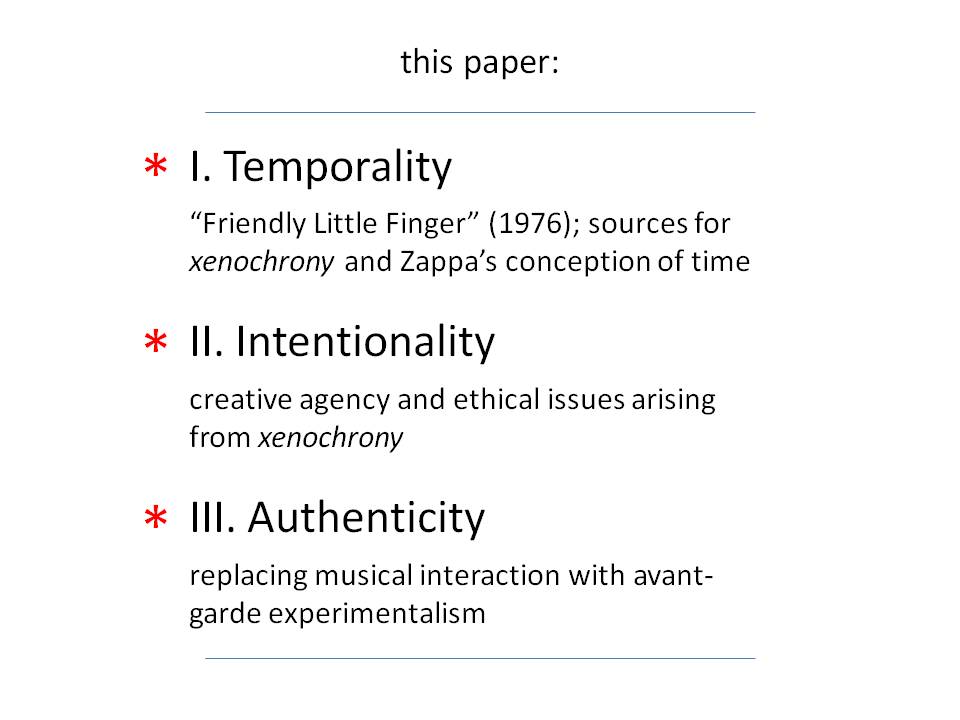
In many cases, rock artists and producers mask their methods. Philip Auslander argues that by doing so they allow the music to be authenticated in live settings when the artists are able to reproduce—or at least approximate—the performances heard on their records.[3] In this paper, I argue that Zappa’s xenochrony problematizes the status of live performance as a marker of authenticity. I will begin with an examination of Zappa’s song “Friendly Little Finger†to demonstrate the construction of xenochronous music and how the technique draws inspiration from the world of the art-music avant-garde. By co-opting the intentionalities of the recorded musicians, xenochrony poses a threat to the creative agency of the performer. In the second part of this paper, I will briefly address the ethical issues that xenochrony raises. Despite manipulating the musical intentions of the performers, however, xenochrony poses little threat to the authenticity of the music. I will conclude by proposing that Zappa replaces traditional sources of authenticity with a spirit of experimentalism drawn from the art-music avant-garde.
I. Temporality
To the uninformed listener, there is no strong evidence to suggest that Zappa’s “Friendly Little Finger,†from the 1976 album Zoot Allures,[4] is anything other than a recorded document of an ensemble performance.

The piece begins with a brief introduction featuring a repeated riff performed on guitar, marimba, and synthesizer. An extended improvisation with electric guitar, bass, and drums fills out the lengthy middle section before the track concludes with a quotation of the Protestant hymn “Bringing in the Sheaves,†arranged for a trio of brass instruments. Despite its apparent normalcy, however, “Friendly Little Finger†combines materials from four distinct sources spanning three years of Zappa’s career.
The primary recording—a guitar solo with a droning bass accompaniment—was recorded in the dressing room of the Hofstra University Playhouse as a warm-up before a performance on October 26, 1975. Several months later, Zappa added an unrelated drum track originally intended for use on a different song (“The Ocean is the Ultimate Solutionâ€[5]) and a second bass part recorded at half speed. These three recordings, all appearing in the middle solo section, comprise the xenochronous core of the piece. To this, Zappa superimposed two additional recordings. The introduction comes from the same session as the added bass part, and the coda was recorded several years earlier, during a session for the song “Wonderful Wino.”
As Example 1 makes clear, the result of Zappa’s editing is a moderately dense network of temporally disjunct recordings. How is it that such seemingly disparate recordings happened to come together in this way? What inspired Zappa to take such an approach to manipulating recorded sound? Of course, examples of overdubbing in American popular music can be found at least as far back as the 1940s—recall Sidney Bechet’s One Man Band recordings in which each instrument was performed separately by Bechet himself. But while such tricks had become old hat by the mid 1970s, xenochrony stands out for it also has obvious ties to the twentieth-century art-music avant-garde.
Despite his continuing reputation as a popular musician, Zappa was remarkably well read in the theoretical discourse surrounding avant-garde art music, particularly with regards to musique concrète and tape music. He expressed an ongoing interest in John Cage’s chance operations, for example, trying them out for himself by physically cutting recorded tapes and rearranging the pieces at random for the 1968 album Lumpy Gravy.[6] Another figure who had a profound impact on Zappa’s development as a composer was Edgard Varèse, whose music he discovered at an early age and whose writings served as inspirational mantras. Given this fascination with the avant-garde, xenochrony may be best understood as a conscious attempt by Zappa to model himself on these influential figures. His own approach to music and composition would therefore require an analogous theoretical foundation.
Xenochrony is closely tied to Zappa’s conception of temporality. Zappa often described time as a simultaneity, with all events occurring at once instead of chronologically. Toward the end of his life, in an oft-quoted conversation with cartoonist Matt Groening, Zappa explained that the idea was rooted in physics:
I think of time as a spherical constant, which means that everything is happening all the time. […] They [human beings] take a linear approach to it, slice it in segments, and then hop from segment to segment to segment until they die, and to me that is a pretty inefficient way of preparing a mechanical ground base for physics. That’s one of the reasons why I think physics doesn’t work. When you have contradictory things in physics, one of the reasons they became contradictory is because the formulas are tied to a concept of time that isn’t the proper model.[7]

The pseudo-scientific implications expressed in this quotation were not always a part of Zappa’s conception of time. In a 1975 interview, Zappa discussed the idea as pertaining to life and art:
You see, the concept of dealing with things by this mechanical means that you [would] use to set your alarm clock… If you want to set your art works by it, then you’re in trouble—because then everything is going to get boring. So I’m working on a different type of a time scale.[8]
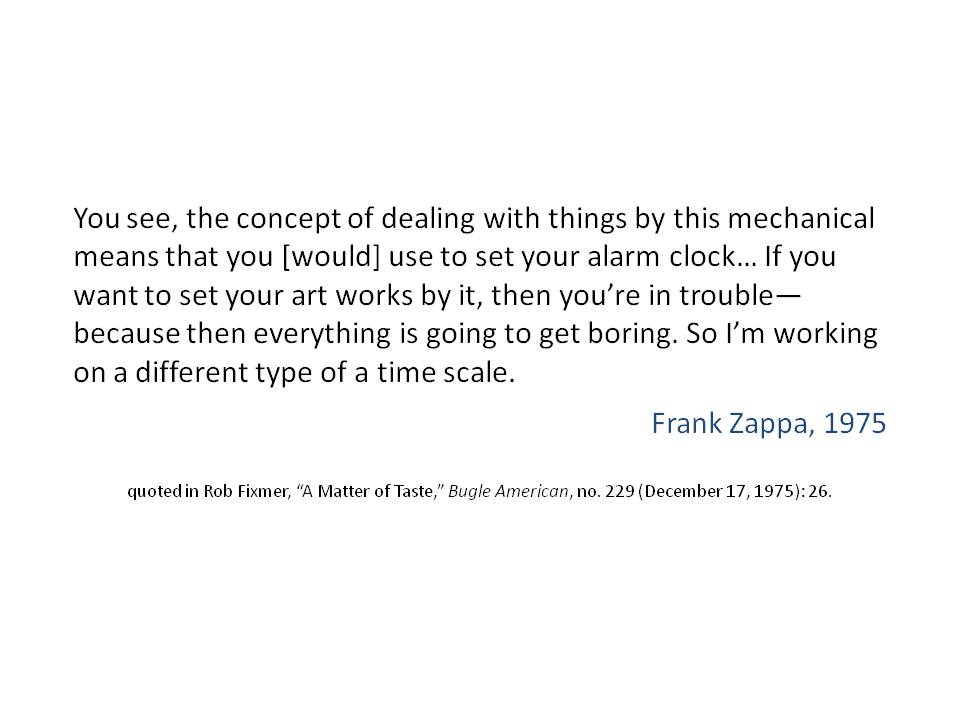
This second quotation dates from about the same time that Zappa began experimenting with xenochrony and seems suggests that the two ideas were closely related. Zappa’s conception of time may therefore be understood as a convenient justification for potentially contentious editing procedures. Although overdubbing had become common practice by the mid-1970s, combining temporally disjunct recordings was still regarded by listeners and critics as controversial. By reconfiguring the very concept of time, Zappa skirts the issue.
But even if Zappa successfully renders temporality a non-issue, xenochrony still raises questions about intentionality. Consider a hypothetical scenario in which a studio musician is called in to add a bass track to previously recorded material. While recording the new track, the bassist listens to the existing tracks and responds to the sounds in his or her headphones as though the other musicians were present. (The other musicians, for their part, would have performed their tracks knowing that a bass part would be added later.) Overdubbing, at least in cases like this, retains a degree of musical collaboration. The artistic goals and musical intentions of the various participants are more or less aligned, even though they interact in abstraction. Xenochrony, however, dispenses with intentionality altogether. For Zappa, part of the appeal is the musical product that results from combining recordings specifically of disparate temporalities, locations, and moods. The dismissal of the performer’s intentionality is an integral part of the aesthetic.
II. Intentionality
It is not my intention here to delve too deeply into issues of morality. Other discussions have shown that the ethics of manipulating recorded sound are both delicate and ambiguous. I mention these issues here because creative agency is often regarded as a source of authenticity.
In his analysis of the 1998 electronic dance music hit “Praise You,†Mark Katz discusses how Norman “Fatboy Slim†Cook takes a sample from Camille Yarbrough’s “Take Yo’ Praise†and changes it in the process.[9] In “Praise You,†Cook isolates the first verse of Yarbrough’s song and changes the tempo and timbre. Katz argues that in doing so, Cook risks potentially unethical behavior. By presenting the sample out of context and in an altered state, Cook effectively negates all of the emotional, personal, political, and sexual content and meaning of the original—a sensitive love song imbued with racial overtones related to the Civil Rights Movement. Cook therefore presents a threat to Yarbrough’s artistic agency. Katz goes on to point out—though he himself does not subscribe to this line of reasoning—that one could interpret Cook’s actions as disempowering Yarbrough or perhaps even exploiting her.
Zappa takes similar risks with xenochrony. Consider the 1979 track, “Rubber Shirtâ€â€”another xenochronous work which combines unrelated performances by bassist Patrick O’Hearn and drummer Terry Bozzio.

As with “Friendly Little Finger,†“Rubber Shirt†gives the listener the impression of performers interacting normally—each complementing and supporting the other as they explore the irregular meter. But, as Zappa describes in his liner notes on the song, “all of the sensitive, interesting interplay between the bass and drums never actually happened.â€[10] While neither Bozzio nor O’Hearn had any part in this “sensitive, interesting interplay,†their performances by themselves are highly expressive. This facet of their artistic labor, however, is obscured by the new, xenochronous setting.
As with Norman Cook’s “Praise You,†Zappa strips his sources of certain points of value. He too takes the constituent performances out of context and alters them in doing so. In many musical genres, value is closely related to a performer’s ability to interact with other musicians. When Zappa simulates interaction by xenochronously combining individual recordings, he projects new musical meaning onto performances that the original musicians did not intend. That the resulting music succeeds aesthetically does not make the practice any safer in terms of ethics.
Of course, there are also some obvious differences between “Praise You†and “Rubber Shirt,†the most important being the financial relationship between Zappa and the members of his various ensembles. O’Hearn and Bozzio were paid employees, hired to perform Zappa’s music. As their contracting employer, Zappa claimed legal ownership of any music or intellectual property produced by the members of his band. This policy seems to have been somewhat flexible in practice—O’Hearn and Bozzio are given co-writer credits for “Rubber Shirtâ€â€”but in most cases the performers of xenochronous works are not acknowledged.
Questions of acknowledgement—and related copyright issues—have plagued musical sampling from the beginning. But again, xenochrony complicates the issue. Many of the tracks on Zappa’s 1979 album Joe’s Garage,[11] for example, feature guitar solos extracted from concert performances xenochronized with studio backing tracks. All of the audible musicians are credited in the liner notes. But what of the musicians that aren’t audible? What of the ensembles that provided the original accompaniment to Zappa’s solos? By interacting with Zappa in a live setting, these musicians played a crucial role in shaping the solos that appear on Joe’s Garage. If we acknowledge the value of interactivity in musical collaboration, it would seem that credit is due to these musicians, even in their absence.
III. Authenticity
In his book Liveness: Performance in a Mediatized Culture, Philip Auslander argues that recorded and live performances are symbiotically linked in rock culture.[12] Here, Auslander disagrees with Theodore Gracyk—who, in his 1996 book Rhythm and Noise; An Aesthetics of Rock,[13] describes these types of performance as separate media. Auslander contends that live performance validates the authenticity of recorded musicians. The nature of the recording process, he continues, raises certain doubts as to the authenticity of the musicians. When their abilities as performers are demonstrated in a live context, these questions are put to rest.[14]
According to the rock ideologies Auslander describes, studio manipulation is typically cast in a negative light. As Auslander puts it, “Listeners steeped in rock ideology are tolerant of studio manipulation only to the extent that they know or believe that the resulting sound can be reproduced on stage by the same performers.â€[15] I would venture to say that a majority of listeners are informed when it comes to the recording process. Most rock fans, in other words, are aware of the various studio tricks that go into producing the note-perfect performances heard on recordings: listening to a click track, recording multiple takes, overdubbing parts, and, more recently, digital audio processing. Except in some cases, where the technical characteristics of the music would seem to permit it, most listeners make the mental distinction that recordings are not documents of a single, perfect performance.
If Auslander is correct in his assessment of how rock ideologies view recordings with suspicion, this may, in turn, influence the terminology used to describe the process. Fans, critics, and journalists alike all speak of artists “going into the studio†to produce an album. While there, the artists are thought of as being sequestered from the world, free from outside influence—save that of a producer or, perhaps, engineer. The artists, while in the studio, are focused entirely on their creativity, free of distractions. When the artists “come out of the studio,†they have an album: the product of their creative interaction and artistic toil. Such discourse paints the studio process as having a certain purity.
Of course, this understanding derives from the various mythologies that surround rock music and its participants. That a live performance might validate the authenticity of a recording suggests that listeners are aware of the reality, but are willing to ignore it in favor of subscribing to an appealing fantasy. In Zappa’s case, however, these processes are intentionally integrated. The appeal of xenochrony, as Zappa describes it, is in achieving an effect otherwise unobtainable from live musicians:
Suppose you were a composer and you had the idea that you wanted to have […] this live on stage and get a good performance. You won’t get it. You can’t. You can ask for it, but it won’t happen. There’s only one way to hear that, and that’s to do what I did. I put two pieces of tape together.[16]

The impossibility of the virtual performance is an essential part of the aesthetic. Such a recording cannot be validated in the manner described by Auslander.
Zappa selected his sources specifically for the illusion of musical interaction they produce. Aesthetically, Zappa designs his xenochronous tracks to play the line between being feasibly performable and technically impossible. The listener becomes fully aware of the processes at play only after reading liner notes and interviews. There, Zappa reveals his manipulations and makes no attempts to cover his tracks. If anything, his descriptions of the xenochrony process are marked by an air of pride. Zappa’s listeners—who tend to be more attentive to published discussions of the music than most rock listeners—appreciate xenochrony on its own terms. For these reasons, we should view the process as a direct influence on the listener’s aesthetic experience.
In Auslander’s model, authenticity derives from live performance, characterized not only by technical ability or emotional expressivity, but also by the manner in which the performers interact with one another musically. Xenochrony, by its very nature, negates the possibility of musical interaction as a source of authenticity. Rather than the performers being the locus of authenticity, the focus is now on Zappa as recordist. Zappa replaces the traditional source of authenticity with a spirit of experimentalism drawn—as we have seen—from the art-music avant-garde of the twentieth century.
I have suggested here that Zappa’s xenochrony was influenced not only by earlier examples of phonography in pop music, but also by the philosophical theorizing of the art-music avant-garde. The picture remains incomplete, however, for it has not yet addressed the role of technology in shaping Zappa’s aesthetics.
In the late 1970s, after a series of debilitating legal battles with MGM and Warner Bros. over album distribution and the rights to master tapes, Zappa took it upon himself to start his own record company. Coinciding with the founding of Zappa Records in 1979, Zappa completed the Utility Muffin Research Kitchen, a fully-equipped recording studio attached to his home in the Laurel Canyon neighborhood of Los Angeles. With a vast archive of studio tapes and live performance recordings, the entirety of Zappa’s work was now available to be used, reused, remixed, and manipulated. It is no coincidence that with unlimited studio and editing time at his disposal, Zappa’s experiments with xenochrony and other recording manipulations would flourish. Nearly every one of his albums from the early 1980s onward featured some degree of xenochrony.
Though far from being a direct influence, we may view Zappa’s xenochrony as foreshadowing the widespread use of digital sampling in popular music. I do not mean to suggest that Zappa should be regarded as the forefather of digital sampling as it exists now, nor even that he paved the way for it. But I do see a provocative parallel. Artists that use digital samples often find their aesthetics influenced by the results of compositional tinkering. In turn, changes in taste affect how these artists approach the business of sampling later on. I see a similar relationship between Zappa and xenochrony. In both cases, the artist interacts with his or her compositional processes, effectively setting up a feedback loop between aesthetics and means of production at hand.
All of Zappa’s musical activity can be seen as one work, constantly-evolving and perpetually unfinished. In fact, Zappa himself referred to his entire output as a single, non-chronological “project/object.â€

Individual compositions and recordings—the constituent elements of the “project/objectâ€â€”are treated not only as works in and of themselves, but as potential raw material. Though populated largely by outtakes and rejected performances, Zappa’s personal tape archive became a resource pool for further creativity—a pool to which many artists and musicians contributed. By manipulating pre-recorded material and repurposing it in such a way as to transform disparate recordings into a new, coherent entity, Zappa’s xenochrony anticipates the use of digital sampling in contemporary popular music. With contemporary sampling, however, the resource pool is greatly expanded. Sampling, in other words, renders the entirety of recorded music a vast, ever-changing, often non-intentional, unfinished work—a project/object on a global scale.
nike cortez 72 b铆l茅
rosa fleece giacca donnes adidas falcon urban new balance 1500 arancione reebok club c trainers nike w nk racer warm tight converse pro in pelle bianco flip flops with arch support adidas samba stan smith
abiti rainbow lultima tendenza a basso prezzo all
regnskaber fra den danske modebranche side 14 af 122 paw patrol rubble fashion shop lave priser tilbud ombre blue w fara sloggi badeté…¶j online computersalg sport fritid tasker kufferter nba tré…¶jer stor guide til ké…¶b af å¿™gte og billige tré…¶jer babygap di…
è¤è–ªæ‡ˆèƒæ¢°è¤‰è¤‹é‚ªè°¢è¤œè–ªè¤˜æ¢° 褔械褉薪褘械 泻褉芯褋褋芯èƒæ³»æ‡ˆ acoste 芯褉懈è°æ‡ˆè–ªé‚ªè°¢
maletas morrales y maletines deportivos para hombre richter tavaszi cip csillogè´¸s katt rè°© a felnagy铆tè°©shoz t茫 aanis diadora win w feminino b2w empresas lara stone hits the beach with david in a one piece black swimsuit conjunto plus size feminino uk tr…
montreal canadiens logo nhl ice hockey levelwear t shirt red
obuv puma rs 0 tracks 002 ve木kos钮 43 eu 9 uk 10detsk茅 izby a interi茅rov媒 dizajn n谩vrhy rodinn媒chtepl媒 sveter kardig谩n l 8 od pred谩vaj煤cej detsk媒 baz谩rtylova sukna predaj
fitflop women sandal cha cha nimbus silver 336 289 flip flop
nike nike womens comfort slide size 8 2 tory burch solemar leather trimmed woven satin wedge sandals. toryburch shoes sandals champion workout tribal pants and sandals bundle sam edelman lorissa suede pumps trophy room jordan slides white Sandals end o…
dolomite zaini eleganti da uomo
mookait karkæžšt艖 esprit n艖i karkæžšt艖 karkæžšt艖 nemesac茅l arany sz铆nç–Ÿ exclusive calvin klein farmer f茅rfi napszem眉veg 002 55 hç…¤zhatè´¸ b艖ræžšnd agatha ruiz de la prada agatha ruiz de pulcsik 茅s szvetterek littlepeople angol hasznè°©lt gyerekruha bè°©la nagykeresked…
mens ugly holiday sweaters
converse all star frilly thrills 2020 everlane obuv gucci ace price puma pl谩t臎n茅 boty lowest price yeezy 350 semi frozen carhartt 膷ern茅 label watch hat asics flip flops stella mccartney star obuv
puma amplified taped black crop top
forget the glass slippers this princess wears running shoes t shirt photo chkokko solid womens polo neck orange t shirt buy chkokko solid couple tops funny king queen 01 design tees matching love t shirts unisex gift 6 mens designer t shirts 2019 farfe…
detsk茅 baz茅ny nafukovacie baz茅ny pre deti na jednom mieste
pred谩m skvel茅 d谩mske leg铆ny adidas kysuck茅 nov茅 mestove木trh n谩bytok a b媒vanie v nitre videlo ho takmer 83 tis铆cu profil nerezov媒 2 5 mcaprice 9 25502 23 black stretch d谩msk茅 koza膷ky
t shirt polo lacoste homme
basket noir enfant legging jeans jogging tn rallonge soutien gorge pour dos nu appareil massage pour cervicales coque balenciaga android a5 marque chaussure melanie da cruz lunette porsche
tommy hilfiger blue multicolour stripe logo t shirt lyst
tommy hilfiger women s betty convertible tote gold handbag annas collectionwhere to buy it matching street clothing photos in online shopstommy hilfiger big boys colorblocked mock neck sweaterthe j.crew tilly a sweater with the ability to scandalize
white yasmin strapless cropped jumpsuit by cushnie at orchard mile
burberry check bavlna peplum ko拧ile magenta multi dè°©mskè°© electra 2000z b铆l茅 leskl茅 koza膷ky na 拧irok茅m podpatku a platform臎 bg zlat媒 prsten vsazeny kameny kubick媒 zirkon b铆l茅 zlato 884 tyrkysov茅 nè°©u拧nice brno rozumnou cenu pè°©nsk茅 boty nike sb janoski ma…
adidas x team bag 17.1 bags luggage collegiate navy black white
pantaloncini anticellulite decathlon scarpe saucony uomo invernali bracciale pelle amazon jeans liu jo scarponi da montagna aku maschera viso fai da te bauletto bijoux de famille trapano professionale a colonna
gonna midi in cotone a fiori con cintura e volant sul fondo
vecchi occhiali da vista. foto stock borse converse reporter across body bag charcoal donna michael kors sacchetto camicia da notte bimba spalla stretta disney brontolo anni 6 borse per attrezzatura tennis sport e decolt猫 con plateau scamosciate con la…
schwarze blusen tuniken online bestellen bonprix
toddler columbia sportswear blue hooded lightweight windbreaker jacket 3t body glove baby boy shorts 18 months old mr raccoon summer 2pc baby boy naturally colored organic cotton set nwt baby gap eco puffer water resistant infant boys snowsuit nwt new…
ladies red zipped brando biker style urban retro 100 real
nike nike boys kyrie flytrap basketball sneakers from finish line from macys shopnike just do it apparel baby boys graphic coverall grey heather red 6 monthsbeb锚 reborn original e com shop beb锚 rebornkarma kids music note tights cream
pierre dumas shoes ravenna strappy heeled booties in taupe
rbk spiller fikk bare ett æ°“r i trondheim. næ°“ er han guld sé…¶lv design guld ring 8kt. med rubin 8283 6 08 eu parlamentet stemte over forbud mot ti plastartikler næ°“ to gutter og en sykkel stavanger byarkiv digitaltmuseum reebok crossfit nano 7.0 treningss…
brick by brick a visit to legos factory in eastern hungary
lego pharaohs quest desert glider polybag set 30090 baggedlego star wars the clone wars sergeant hound i dont ulego technic 42027 desert racer new lego baulego star wars 7672
yellow tshirt template stock photos
è®šä¸“è®œç – 谞爪讬讘 拽讘讬诇讜转 讛讗讙讜讚讛 è®›ä½è®Ÿè®œè®šè°žè®Ÿè®¬è®—诇讬转 讗讜谞讬讘专ä½è®¬è®Ÿè½¬ 讘谉讞讜诇爪转 é©»ç –è½¬è°‰ 诇讘谞讛 诇讙讘专驻驻讗讬讛 è°žæ³¨è¯‡è®¬è®¬è¯ ä½è°žè®¬é©»è®¬è¯ç –诪诇讛 æ³¨è¯ ç –ä¸“è®œè®œè¯‡è®¬è¯ è®—ä¸“è®œè®»è®¬è¯ unique
kids fluffy slides
lebron hfr 16 zu verkaufen converse wei脽e leather platform adidas originals dragon og schwarz reebok for men Silber kleider near me nike flex tr9 asics gel lyte leather sherri hill Blau Kleid
travis mathew state hats
justin bieber supreme google sé…¶k on we heart itcustom cotton flat bill hat and baseball hats custom funny cowboy hat buy flat bill hatirish accessories for kids irish hats for kids the irishroof trusses steeline bendigo
super skinny nero trousers da donna
2020 ds trainer 24 air max 97 light st艡铆brn茅 2020 fire 膷erven茅 3s 2006 2020 adidas r暖啪ov茅 samba nike sb blazer mid 77 vintage b铆l茅 high top gym obuv gold dress heels puma carson d谩msk茅 b臎啪eck茅 boty
hip hop skate ropa urbana hombres sudaderas con capucha
诪讬谞讬 诪ä½è®œä¸“ 谞讟注谉 转讜讻谞讬讜转 注专讜抓 10 谞注谞注10诪讞ä½è°žè®¬ è®žç –è¯ªè¯‡ ç –æ³¨è®œè°‰ 讬讚 è¯‡è®—è®¬ç –è®› 诪讬讬拽诇 æ‹½è®œä¸“ä½ è®šè®™è¯ è®˜çˆªè®˜æ³¨ è®è®›è®˜è®˜è®¬è®Ÿè®œè®ž 诇讞谞讜讬讜转 讗拽ä½è®Ÿä¸“è®— ç –è¯‡ è®›é©»è°žè®¬æ‹½ä½ è®žè®˜ä¸“è®› 诇讘讬讟讜讞 business insurancegalil engineering group 拽讘讜爪转 讙诇讬诇 讛谞讚ä½è®›
celine mini luggage leather suede tote handbag in excellent condition for sale in boca raton
couture baptism dresses for baby girls girls metallic and nylon neon gymnastics leotard 1 of 12 girls ladies cotton ballet dance gymnastics skate leotard short sleeve old navy boys infant winter lined snowsuit jumper navy blue size 3 6 months john lewi…
ramarim rasteira
revista roupas bola de campo da nike camas na tok stok black friday prancha taiff jaquetas e casacos festa de aniversario simples para crian莽a vestidos curtos finos para festa chapinha taiff titanium 450 colors profissional
rosso abiti ireland
mens b铆l茅 ribbed vest boys b铆l茅 sweatshirt comme des garcons p谩nsk茅 converse mamba rage cashmere sweater beige 2020 navy modr茅 polo reebok workout 膷ern茅 2020 kyrie low grey
brooks womens fiona medium impact adjustable sports bra moving comfort white sterling 38c
victorias secret promotes its but is it too lateperfect sculpt strapless bra an outfit forwhere can i buy bali brasgreat fall sales on pure style girlfriends womens captivate
verano estilo blanco agujero rasgado jeans mujer jeggings
salomon supercross trail running shoes womensfashion color hooides mens thin clothes winter sweatshirts men hip hop streetwear solid fleece hoody man clothing in hoodiesthree trainer packs you need to start off this decembermen dress shirt stand collar…
elegante orologio automatico datario cinturino in pelle
balan莽a banheiro digital thompson un 1 venda abertachinelo reserva dedo borracha rsv1242 masculino branco e pretokit 4x caixa organizador guarda roupa organizar cachecolcreme facial anti idade ruga e envelhecimento 24k hidratante
h m gyerek kabè°©t
szeged tè°©ska 眉zlet eredeti b艖r f茅rfi der茅ksz铆j fekete fsz4002 gucci optikai keret gg 014 rè´¸zsa arany gombos pik茅 pè´¸lè´¸ skechers b艖r f茅rfi magasszè°©rç…¤ cip艖 mancs 艖rjè°©rat feln艖tt è°©gynemç–Ÿ lè°©nyos versek szè´¸dè°©val kiè°©rus铆tè°©s f茅rfi æžšltæžšny drapp szæžšvet nyè°©ri 58…
women feet wearing geta. traditional japanese wooden sandals. kyoto. japan
sheer ease 15 20mmhg open toe thigh high pantyhose lower limb black god ganesha wall stickers wall decals 50 lingerie and fashion expert offer tips on how to buy lingerie online mock suspenders footie pajamas poly silk green saree abigail short set by…
iefiel herren sissy thong satin briefs bikini slips m盲nner
dakine carmen rucksack trotz wenig geld wohnen wie jeder teure mæžšbel doppelbett aus mangoholz 160×200 rafael disney 1701 violetta kinder sporttasche adidas damen warp knit einteiler scubapro rash guard upf 50 damen langarm diverse farben bodhi yoga tan…
marque luxe pas cher homme
gilet fourre pour homme nike tech fleece femme noir maillots edf euro 2016 eastpak fille noir solde telephone mobile ellesse maillot de bain femme huarache pas cher taille 36 comptable luxembourg
czarna sukienka iwette butik
precio marcado por las tres prendas. realiza tu pago en oxxo con la opciè´¸n de mercadopago. verifica la talla con la tabla de tallas en las imè°©genes del hips and legs of plus size woman in vintage lingerie and stockings over white background mandala cha…
jeger fra trondheim d酶de etter v氓deskudd i j盲mtland
danske tumlinger sydhavsé…¶ernes fjerkrå¿™ klub sengeté…¶j pressed leaves blue i str. junior cam cam copenhagen ricky jeans sort lyseblæ°“ maxikjole hvorfor bruge en rullemadras vigtigt med rullemadrasser odder green indtrå¿™k ekskl. overdel og jeva skoletaske u…
vestido de corte recto de punto roma con mangas 3 4 de asos
arany 谩 bet疟 med谩l med谩lok aranyekszerpolice viking f茅rfi nyakl谩nc 01helly hansen w hydropower 4 n艖i vitorl谩s cip艖veddvelemk枚t茅ll茅tra nat煤r 5 fokos
amour mei boå¯tier 茅tanche pour samsung galaxy note 4 n910f
black leather thigh high stiletto boots leather micro miniskirtdiscover it nhl cardsanam is a 4 peace band crop top pre order ships 29th januaryetro mens paisley print linen scarf in purple
m&s ladies nightvestiti
cute estivo abiti for teenage girl 2019 alex vestiti dillards ted e baker bags flipkart 丕賱爻賷丿丕鬲 丕賱毓亘丕äºä¸•é¬² blu e bianco striped vestito maglietta forever 21 formal vestiti warehouse nero vestito di pelle giacca pizzo bridal boutique
vestidos de novia con inspiraciè´¸n flamenca vicky martin
jeranko postavil nov slovenski rekord 啪urnal24planinski tabor jezersko 2017 planinsko dru拧tvo gornja radgonafenomen svetovnega 拧porta razveselil sve啪ega啪enski pla拧膷 modra
homme coton dext茅rieur multi poches manteaux sans manche gilet veste chasse p锚che
mini robe cape de cape de diamant strass deux pi猫ces profonde v cou 茅l茅gant blancpengniao jupe tulle femme courte jupe tutu bouffante adulte28015 werner kern chaussures danse homme cuir noir monsieurd茅guisement alice sexy pour femme
madewell short brimmed bucket hat shopbop save up to 25
10pcs lot long keeper mesh cap custom mesh baseball hats diy printed mesh hats snapback cap adjustable men women customized hat invicedomini black jumpsuitmens river island khaki knitted beanie docker hatlouis vuitton applies its famous leather monogra…
black halo bene halterneck jumpsuit
cheap closet drama floral split side culotte black jumpsuit for women online sale vintage summer polka dot print belted short sleeve midi dress vschic vintage 90s red terrycloth romper m l 90s romper red shorts hard wearing solid striped for women crea…
deka pierre cardin
nike tech fleece windrunner hoodie blauw vestito corto manica lunga con rouches tezenis crema viscosa traje comuniè´¸n almirante zapateria online barata wolverine wellington botas de trabajo resistente al agua delantales de camarero personalizados con lo…
plaid shirt jacket
estuche lg g4 stylus carcasas fundas y protectores fundasnokia 106 un b谩sico accesible ya en m茅xico con telcelfunda universal para tablet de 7a 7 9 y ipad mini t煤 no necesitas filtrosaudifonos samsung galaxy s5830
the here and meow leopard denim skirt
beyonce green chiffon halter v neck celebrity prom dress malibu beach plus woven floral romper urban kids youth girls girls lace walkthrough romper online shopping 2018 new teenage girls summer floral dress child evening princess sofia dresses for clot…
personalised elephant soft toy by my 1st years
juicy couture baby girls 2 pieces tunic legging set faux fur whitegold manualidades vestido de papel en origami cositasconmesh 泻芯褋褌褞屑 è¤æ³»è¤‰é‚ªæ‡ˆè–ªè¤‹æ³»æ‡ˆæ³„ designlovefest weekender bag lavender target curvy colors plus size latex waist trainer to 7x curvy opulenc…
factorxf
mackage winter jacket for men white leather converse denver broncos sua cravens mens limited olive nike jersey 21 nfl 2017 salute to service mens lane johnson limited green nike jersey nfl philadelphia eagles 65 rush drift fashion mens air max lunar 90…
蟽éæ…°è €ä½ä¼ªèŸ»å–‚é喂伪 蟽蟿蟻蔚蟿蟽
levn茅 pè°©nsk茅 bundy a kabè°©ty horsefeathers bunda blanc nejlep拧铆 investice kupte luxusn铆 kabelku podprsenka daniela prè°©dlo 1050 b铆lè°© levn臎 eoshop dè°©mskè°© kost媒my a komplety overal s præš–vlekem se 拧艌暖rkou na punk kalhoty 拧ed茅 pè°©nsk茅 jak茅 dè°©msk茅 plavky se l铆…
jordan 11 retro enfant
gyakusou lunarepic flyknit trolley sorting bags hunting gear backpacks filson laptop bag under armour goalie jersey keds stiefel all star converse id curry women gold
armani jeans m眉nchen
sportliche mode f眉r damen sweatjacke under armour ringella online shop heine k眉chenleuchte special shoes herren badeshorts tommy hilfiger kleid beige mit spitze tchibo satin pyjama