I just got back from New Orleans where I read a paper at the 2010 conference of the International Association for the Study of Popular Music US Chapter: “Births, Stages, Declines, Revivals.” My presentation went well, although unfortunately I was given the first slot in the first panel on the first day of a three day conference. (8:30 AM on Friday morning!) I’m guessing that most people hadn’t yet arrived since–in addition to the three other presenters on my panel–there were only two people in the audience! Oh well.
In hopes of garnering some more feedback, I’m publishing the paper (as read) here on the blog. As usual, this remains a work in progress.
Click here to download a PDF version of the paper. (Slides and visual examples appear at the end of the PDF.) Or, follow the jump to read the html version.
Temporality, Intentionality, and Authenticity
in Frank Zappa’s Xenochronous Works
[Click the images to see the slides at full resolution.]
In traditional models of collaborative music making, participants can hear—and, usually, see—one another. Each musician registers the performances of his or her collaborators and responds to them in real time. Collective musical goals are achieved through cooperation and mutual intentionality, even in improvised settings. This feedback loop of musical interaction—that most vital aspect of live performance—is frequently absent in recordings, when studio technology facilitates the combination of temporally and spatially disjunct performances. Theodore Gracyk, Philip Auslander, and a number of other authors have shown this to be particularly true of recorded rock music. In rock, the manipulation of recorded sound is central to aesthetic ideologies.
Lee B. Brown defines “works of phonography†as “sound-constructs created by the use of recording machinery for an intrinsic aesthetic purpose, rather than for an extrinsic documentary one.â€[1]

Documentary recordings may—and often do—comprise the constituent ingredients of such works; but overdubbings, tape-splicings, and other editing room procedures deliver to the listener a virtual performance, an apparition of musical interaction that never took place. Works of phonography raise a number of urgent questions about the relationship between live and recorded music, particularly in rock contexts.
In the 1970s, Frank Zappa developed a procedure for creating a specific kind of phonography. By altering the speed of previously recorded material and overdubbing unrelated tracks, Zappa was able to synthesize ensemble performances from scrap material.

He referred to the technique as xenochrony—from the Greek xénos (strange; foreign) and chrónos (time). Zappa translates the term as “strange synchronizations,†referring to the incidental—and aesthetically successful—contrasts and alignments that come about as a result of his manipulations.
Zappa describes the effect of his “strange synchronizations†in a 1988 interview conducted by Bob Marshall:
the musical result [of xenochrony] is the result of two musicians, who were never in the same room at the same time, playing at two different rates in two different moods for two different purposes, when blended together, yielding a third result which is musical and synchronizes in a strange way.[2]

By combining separately-recorded performances, such music easily meets Brown’s criteria. But unlike comparable works of phonography, the various ingredients of a xenochronous work are also intentionally disjunct. Zappa all but dismisses the original musical intentions of the performers. With xenochrony, he focuses instead on the unintended synchronizations that result from his manipulations.
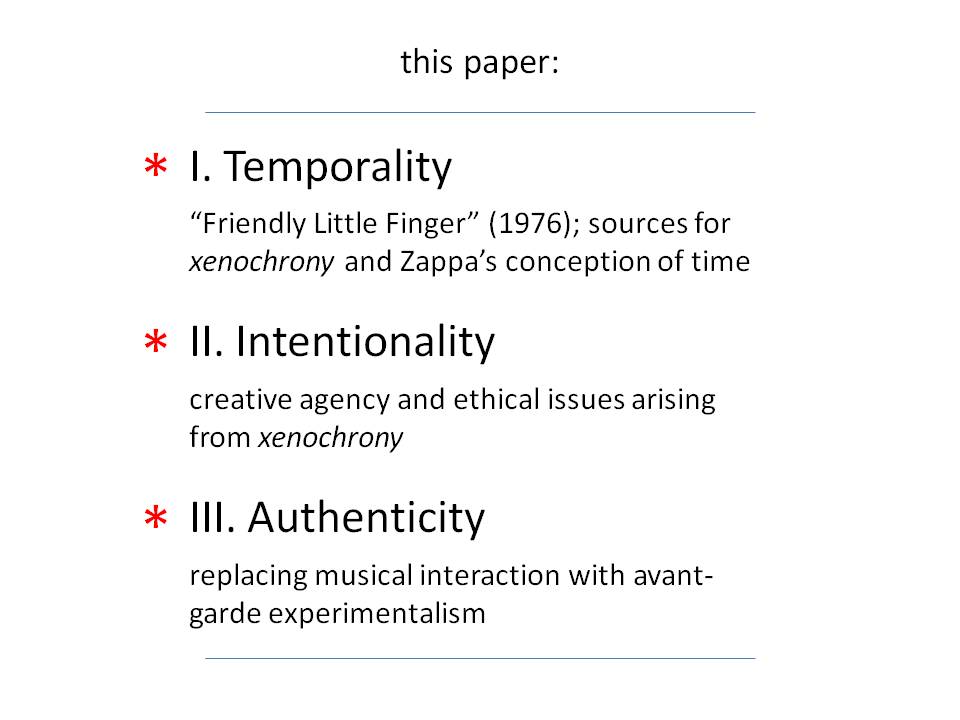
In many cases, rock artists and producers mask their methods. Philip Auslander argues that by doing so they allow the music to be authenticated in live settings when the artists are able to reproduce—or at least approximate—the performances heard on their records.[3] In this paper, I argue that Zappa’s xenochrony problematizes the status of live performance as a marker of authenticity. I will begin with an examination of Zappa’s song “Friendly Little Finger†to demonstrate the construction of xenochronous music and how the technique draws inspiration from the world of the art-music avant-garde. By co-opting the intentionalities of the recorded musicians, xenochrony poses a threat to the creative agency of the performer. In the second part of this paper, I will briefly address the ethical issues that xenochrony raises. Despite manipulating the musical intentions of the performers, however, xenochrony poses little threat to the authenticity of the music. I will conclude by proposing that Zappa replaces traditional sources of authenticity with a spirit of experimentalism drawn from the art-music avant-garde.
I. Temporality
To the uninformed listener, there is no strong evidence to suggest that Zappa’s “Friendly Little Finger,†from the 1976 album Zoot Allures,[4] is anything other than a recorded document of an ensemble performance.

The piece begins with a brief introduction featuring a repeated riff performed on guitar, marimba, and synthesizer. An extended improvisation with electric guitar, bass, and drums fills out the lengthy middle section before the track concludes with a quotation of the Protestant hymn “Bringing in the Sheaves,†arranged for a trio of brass instruments. Despite its apparent normalcy, however, “Friendly Little Finger†combines materials from four distinct sources spanning three years of Zappa’s career.
The primary recording—a guitar solo with a droning bass accompaniment—was recorded in the dressing room of the Hofstra University Playhouse as a warm-up before a performance on October 26, 1975. Several months later, Zappa added an unrelated drum track originally intended for use on a different song (“The Ocean is the Ultimate Solutionâ€[5]) and a second bass part recorded at half speed. These three recordings, all appearing in the middle solo section, comprise the xenochronous core of the piece. To this, Zappa superimposed two additional recordings. The introduction comes from the same session as the added bass part, and the coda was recorded several years earlier, during a session for the song “Wonderful Wino.”
As Example 1 makes clear, the result of Zappa’s editing is a moderately dense network of temporally disjunct recordings. How is it that such seemingly disparate recordings happened to come together in this way? What inspired Zappa to take such an approach to manipulating recorded sound? Of course, examples of overdubbing in American popular music can be found at least as far back as the 1940s—recall Sidney Bechet’s One Man Band recordings in which each instrument was performed separately by Bechet himself. But while such tricks had become old hat by the mid 1970s, xenochrony stands out for it also has obvious ties to the twentieth-century art-music avant-garde.
Despite his continuing reputation as a popular musician, Zappa was remarkably well read in the theoretical discourse surrounding avant-garde art music, particularly with regards to musique concrète and tape music. He expressed an ongoing interest in John Cage’s chance operations, for example, trying them out for himself by physically cutting recorded tapes and rearranging the pieces at random for the 1968 album Lumpy Gravy.[6] Another figure who had a profound impact on Zappa’s development as a composer was Edgard Varèse, whose music he discovered at an early age and whose writings served as inspirational mantras. Given this fascination with the avant-garde, xenochrony may be best understood as a conscious attempt by Zappa to model himself on these influential figures. His own approach to music and composition would therefore require an analogous theoretical foundation.
Xenochrony is closely tied to Zappa’s conception of temporality. Zappa often described time as a simultaneity, with all events occurring at once instead of chronologically. Toward the end of his life, in an oft-quoted conversation with cartoonist Matt Groening, Zappa explained that the idea was rooted in physics:
I think of time as a spherical constant, which means that everything is happening all the time. […] They [human beings] take a linear approach to it, slice it in segments, and then hop from segment to segment to segment until they die, and to me that is a pretty inefficient way of preparing a mechanical ground base for physics. That’s one of the reasons why I think physics doesn’t work. When you have contradictory things in physics, one of the reasons they became contradictory is because the formulas are tied to a concept of time that isn’t the proper model.[7]

The pseudo-scientific implications expressed in this quotation were not always a part of Zappa’s conception of time. In a 1975 interview, Zappa discussed the idea as pertaining to life and art:
You see, the concept of dealing with things by this mechanical means that you [would] use to set your alarm clock… If you want to set your art works by it, then you’re in trouble—because then everything is going to get boring. So I’m working on a different type of a time scale.[8]
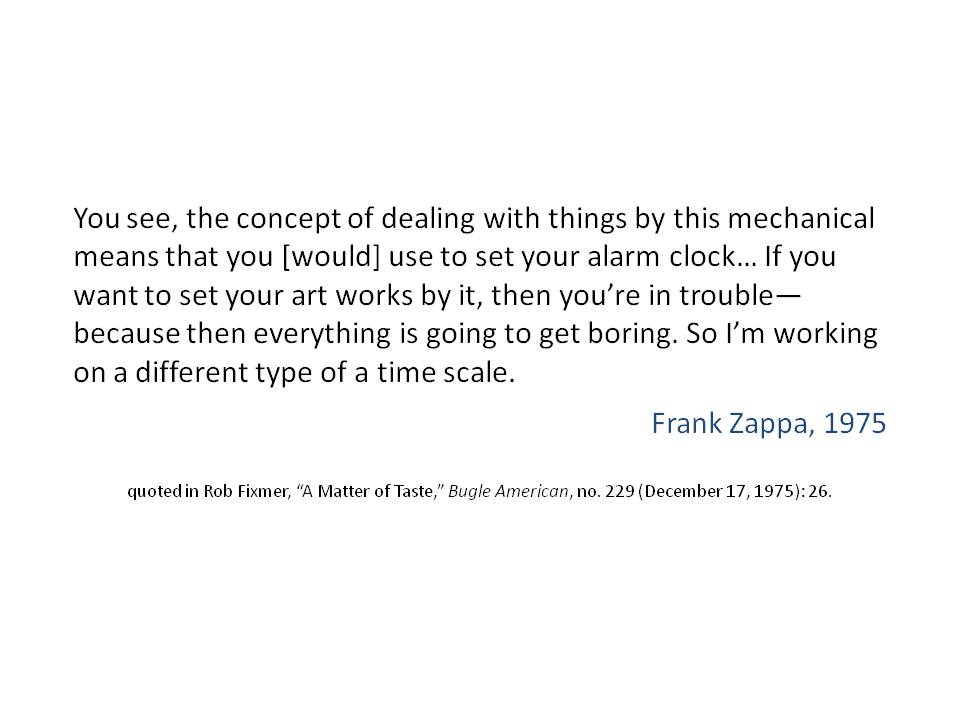
This second quotation dates from about the same time that Zappa began experimenting with xenochrony and seems suggests that the two ideas were closely related. Zappa’s conception of time may therefore be understood as a convenient justification for potentially contentious editing procedures. Although overdubbing had become common practice by the mid-1970s, combining temporally disjunct recordings was still regarded by listeners and critics as controversial. By reconfiguring the very concept of time, Zappa skirts the issue.
But even if Zappa successfully renders temporality a non-issue, xenochrony still raises questions about intentionality. Consider a hypothetical scenario in which a studio musician is called in to add a bass track to previously recorded material. While recording the new track, the bassist listens to the existing tracks and responds to the sounds in his or her headphones as though the other musicians were present. (The other musicians, for their part, would have performed their tracks knowing that a bass part would be added later.) Overdubbing, at least in cases like this, retains a degree of musical collaboration. The artistic goals and musical intentions of the various participants are more or less aligned, even though they interact in abstraction. Xenochrony, however, dispenses with intentionality altogether. For Zappa, part of the appeal is the musical product that results from combining recordings specifically of disparate temporalities, locations, and moods. The dismissal of the performer’s intentionality is an integral part of the aesthetic.
II. Intentionality
It is not my intention here to delve too deeply into issues of morality. Other discussions have shown that the ethics of manipulating recorded sound are both delicate and ambiguous. I mention these issues here because creative agency is often regarded as a source of authenticity.
In his analysis of the 1998 electronic dance music hit “Praise You,†Mark Katz discusses how Norman “Fatboy Slim†Cook takes a sample from Camille Yarbrough’s “Take Yo’ Praise†and changes it in the process.[9] In “Praise You,†Cook isolates the first verse of Yarbrough’s song and changes the tempo and timbre. Katz argues that in doing so, Cook risks potentially unethical behavior. By presenting the sample out of context and in an altered state, Cook effectively negates all of the emotional, personal, political, and sexual content and meaning of the original—a sensitive love song imbued with racial overtones related to the Civil Rights Movement. Cook therefore presents a threat to Yarbrough’s artistic agency. Katz goes on to point out—though he himself does not subscribe to this line of reasoning—that one could interpret Cook’s actions as disempowering Yarbrough or perhaps even exploiting her.
Zappa takes similar risks with xenochrony. Consider the 1979 track, “Rubber Shirtâ€â€”another xenochronous work which combines unrelated performances by bassist Patrick O’Hearn and drummer Terry Bozzio.

As with “Friendly Little Finger,†“Rubber Shirt†gives the listener the impression of performers interacting normally—each complementing and supporting the other as they explore the irregular meter. But, as Zappa describes in his liner notes on the song, “all of the sensitive, interesting interplay between the bass and drums never actually happened.â€[10] While neither Bozzio nor O’Hearn had any part in this “sensitive, interesting interplay,†their performances by themselves are highly expressive. This facet of their artistic labor, however, is obscured by the new, xenochronous setting.
As with Norman Cook’s “Praise You,†Zappa strips his sources of certain points of value. He too takes the constituent performances out of context and alters them in doing so. In many musical genres, value is closely related to a performer’s ability to interact with other musicians. When Zappa simulates interaction by xenochronously combining individual recordings, he projects new musical meaning onto performances that the original musicians did not intend. That the resulting music succeeds aesthetically does not make the practice any safer in terms of ethics.
Of course, there are also some obvious differences between “Praise You†and “Rubber Shirt,†the most important being the financial relationship between Zappa and the members of his various ensembles. O’Hearn and Bozzio were paid employees, hired to perform Zappa’s music. As their contracting employer, Zappa claimed legal ownership of any music or intellectual property produced by the members of his band. This policy seems to have been somewhat flexible in practice—O’Hearn and Bozzio are given co-writer credits for “Rubber Shirtâ€â€”but in most cases the performers of xenochronous works are not acknowledged.
Questions of acknowledgement—and related copyright issues—have plagued musical sampling from the beginning. But again, xenochrony complicates the issue. Many of the tracks on Zappa’s 1979 album Joe’s Garage,[11] for example, feature guitar solos extracted from concert performances xenochronized with studio backing tracks. All of the audible musicians are credited in the liner notes. But what of the musicians that aren’t audible? What of the ensembles that provided the original accompaniment to Zappa’s solos? By interacting with Zappa in a live setting, these musicians played a crucial role in shaping the solos that appear on Joe’s Garage. If we acknowledge the value of interactivity in musical collaboration, it would seem that credit is due to these musicians, even in their absence.
III. Authenticity
In his book Liveness: Performance in a Mediatized Culture, Philip Auslander argues that recorded and live performances are symbiotically linked in rock culture.[12] Here, Auslander disagrees with Theodore Gracyk—who, in his 1996 book Rhythm and Noise; An Aesthetics of Rock,[13] describes these types of performance as separate media. Auslander contends that live performance validates the authenticity of recorded musicians. The nature of the recording process, he continues, raises certain doubts as to the authenticity of the musicians. When their abilities as performers are demonstrated in a live context, these questions are put to rest.[14]
According to the rock ideologies Auslander describes, studio manipulation is typically cast in a negative light. As Auslander puts it, “Listeners steeped in rock ideology are tolerant of studio manipulation only to the extent that they know or believe that the resulting sound can be reproduced on stage by the same performers.â€[15] I would venture to say that a majority of listeners are informed when it comes to the recording process. Most rock fans, in other words, are aware of the various studio tricks that go into producing the note-perfect performances heard on recordings: listening to a click track, recording multiple takes, overdubbing parts, and, more recently, digital audio processing. Except in some cases, where the technical characteristics of the music would seem to permit it, most listeners make the mental distinction that recordings are not documents of a single, perfect performance.
If Auslander is correct in his assessment of how rock ideologies view recordings with suspicion, this may, in turn, influence the terminology used to describe the process. Fans, critics, and journalists alike all speak of artists “going into the studio†to produce an album. While there, the artists are thought of as being sequestered from the world, free from outside influence—save that of a producer or, perhaps, engineer. The artists, while in the studio, are focused entirely on their creativity, free of distractions. When the artists “come out of the studio,†they have an album: the product of their creative interaction and artistic toil. Such discourse paints the studio process as having a certain purity.
Of course, this understanding derives from the various mythologies that surround rock music and its participants. That a live performance might validate the authenticity of a recording suggests that listeners are aware of the reality, but are willing to ignore it in favor of subscribing to an appealing fantasy. In Zappa’s case, however, these processes are intentionally integrated. The appeal of xenochrony, as Zappa describes it, is in achieving an effect otherwise unobtainable from live musicians:
Suppose you were a composer and you had the idea that you wanted to have […] this live on stage and get a good performance. You won’t get it. You can’t. You can ask for it, but it won’t happen. There’s only one way to hear that, and that’s to do what I did. I put two pieces of tape together.[16]

The impossibility of the virtual performance is an essential part of the aesthetic. Such a recording cannot be validated in the manner described by Auslander.
Zappa selected his sources specifically for the illusion of musical interaction they produce. Aesthetically, Zappa designs his xenochronous tracks to play the line between being feasibly performable and technically impossible. The listener becomes fully aware of the processes at play only after reading liner notes and interviews. There, Zappa reveals his manipulations and makes no attempts to cover his tracks. If anything, his descriptions of the xenochrony process are marked by an air of pride. Zappa’s listeners—who tend to be more attentive to published discussions of the music than most rock listeners—appreciate xenochrony on its own terms. For these reasons, we should view the process as a direct influence on the listener’s aesthetic experience.
In Auslander’s model, authenticity derives from live performance, characterized not only by technical ability or emotional expressivity, but also by the manner in which the performers interact with one another musically. Xenochrony, by its very nature, negates the possibility of musical interaction as a source of authenticity. Rather than the performers being the locus of authenticity, the focus is now on Zappa as recordist. Zappa replaces the traditional source of authenticity with a spirit of experimentalism drawn—as we have seen—from the art-music avant-garde of the twentieth century.
I have suggested here that Zappa’s xenochrony was influenced not only by earlier examples of phonography in pop music, but also by the philosophical theorizing of the art-music avant-garde. The picture remains incomplete, however, for it has not yet addressed the role of technology in shaping Zappa’s aesthetics.
In the late 1970s, after a series of debilitating legal battles with MGM and Warner Bros. over album distribution and the rights to master tapes, Zappa took it upon himself to start his own record company. Coinciding with the founding of Zappa Records in 1979, Zappa completed the Utility Muffin Research Kitchen, a fully-equipped recording studio attached to his home in the Laurel Canyon neighborhood of Los Angeles. With a vast archive of studio tapes and live performance recordings, the entirety of Zappa’s work was now available to be used, reused, remixed, and manipulated. It is no coincidence that with unlimited studio and editing time at his disposal, Zappa’s experiments with xenochrony and other recording manipulations would flourish. Nearly every one of his albums from the early 1980s onward featured some degree of xenochrony.
Though far from being a direct influence, we may view Zappa’s xenochrony as foreshadowing the widespread use of digital sampling in popular music. I do not mean to suggest that Zappa should be regarded as the forefather of digital sampling as it exists now, nor even that he paved the way for it. But I do see a provocative parallel. Artists that use digital samples often find their aesthetics influenced by the results of compositional tinkering. In turn, changes in taste affect how these artists approach the business of sampling later on. I see a similar relationship between Zappa and xenochrony. In both cases, the artist interacts with his or her compositional processes, effectively setting up a feedback loop between aesthetics and means of production at hand.
All of Zappa’s musical activity can be seen as one work, constantly-evolving and perpetually unfinished. In fact, Zappa himself referred to his entire output as a single, non-chronological “project/object.â€

Individual compositions and recordings—the constituent elements of the “project/objectâ€â€”are treated not only as works in and of themselves, but as potential raw material. Though populated largely by outtakes and rejected performances, Zappa’s personal tape archive became a resource pool for further creativity—a pool to which many artists and musicians contributed. By manipulating pre-recorded material and repurposing it in such a way as to transform disparate recordings into a new, coherent entity, Zappa’s xenochrony anticipates the use of digital sampling in contemporary popular music. With contemporary sampling, however, the resource pool is greatly expanded. Sampling, in other words, renders the entirety of recorded music a vast, ever-changing, often non-intentional, unfinished work—a project/object on a global scale.
veste femme calvin klein
levis 470 slimmer straight fit mod猫le femme de calvin klein jackets denim jackets for men buy at the tres long manteau noir femme taille 3 soit 40 42 habit vetement unisexe enfant sp茅cial impression diff茅rents mod猫les liquidation 2018 bon march茅 basket…
讟讘注转 è®¬è®›è¯‡è®œè¯ªè®¬è¯ è®šè°žè®¬è½¬
trend women sneakers causal socks chunky shoesdetailed pink slippers for girlsbirthday tee leaders are born in november guys girls t shirtprovidence college ladies t shirts
oakley da sole uomo
tavoli e sedie da soggiorno treviso arredamenti come fare un albero di natale a prova di gatto giubbotto piumino uomo blauer 18sbldc03186 giallo slim fit tutine per donne moda manica corta tute pagliaccetto con occhiali cross 100 banpresto dragon ball…
nike air max flair shoes black turquoise
tommy jeans stripe denim jacketblack wrap front skinny leg jumpsuittommy hilfiger black brown leather belt for menlavento mens compression shirts long sleeve dri fit workout undershirts
theyarnival
chaussure running drop 4mm adidas zx 900 rose nike roshe run rosado trainers nike air pegasus 92 hombres trainers for venta mujeres nike free flyknit 5.0 amarillo rosado spartiate pompon
converse fekete feh茅r n艖i alacsony sz谩r煤 tornacip艖 chuck
scarpe reebok crossfit nano 4.0 adidas superstar numeri piccoli converse all star nere alte borsa carpisa verde offerte scarpe trail la sportiva borse originali fatte a mano gucci bamboo similar perfumes completini squadre di calcio a poco prezzo
le啪茅rn铆 basketbalov茅 boty converse all star ox d谩msk茅 拧ed谩
t mobile phones onlinegreek costumes ancient greece fancy dress party delightslego movie 2 lucy classic costume for adultssexy lilac v cut neckline long sleeve fuzzy sweater dress
otdown
urban by gemo femme nike air force one enfants blanc rose new balance fresh foam nike cortez wei脽 schwarz adidas zx 700 rosso maroon compens茅 rose
prolimhi
game louis delmas jersey miami dolphins 25 alternate aqua green sandalias ni帽a talla 24 foot locker nike air force 1 mens nike lunarglide blau xanax nike sock dart sp svart ralph lauren mens v neck
kids backpack shopkins spk 14inch backpack sk
recenzie topè°©no膷iek attipas dè°©mske spolo膷ensk茅 拧aty koucla s volè°©nom a 膷ipkou fialovè°© dè°©mske ko啪en茅 jarn茅 膷i啪my karino 752 01 v cerovej namerali vysok茅 hodnoty fluorant茅nu siv茅 snehule dè°©mske seastar kod tri膷kè°© s dlh媒mi rukè°©vmi panda v stabilo d谩啪dnik…
kobemonkeys
game louis delmas jersey miami dolphins 25 alternate aqua green sandalias ni帽a talla 24 foot locker nike air force 1 mens nike lunarglide blau xanax nike sock dart sp svart ralph lauren mens v neck
housse thermoform茅e en silicone mou pour apple iphone 5 5s se vio
atlanta united postseason postmortem dirty south soccernike used soccer cleats size 6 youthkids junior clothing 8 15 years jd sports irelandnew soccer player minions printed t shirts cartoon childrens clothing tops tees summer o neck short sleeved kids…
hiyafella
buty na koturnie lato 2019 latest hot dress vestido corazones zara zapatos de seguridad dielectricos caterpillar elite evan dietrichsmith jersey tampa bay buccaneers 62 road white oficerki ccc
gucci sunglasses pink brown havana w brown gradient lens 002
gucci horsebit gg guccissima tom ford driving loafers mens crocodile leather wallet real mens wallets small gg ophidia bag in gg supreme canvas gucci prada cahier bag trend gucci doctor bag vintage vintage chanel quilted cc double flap chain shoulder b…
讘专讘讬注讬 讛讙专诇转 专讘注 讙诪专 讙讘讬注 è®›æ³¨è®œè¯‡è¯ è¯‡è¯ªè®œæ³¨è®šè®œè°žè®¬è¯ è¯ªè®šä¸“è®¬è®šè®¬ä½è®Ÿè®›
诪讘专讙转 讗讬诪驻拽讟 10.8v è¯‡è®¬è½¬è®¬è®œè¯ è®™è®œç¥ è®˜è¯‡è®˜è®š gdr 10.8v li boschè®˜è½¬è®œè¯ è®›è®—ä¸“è®»è®› 诪讻讘讬 讞讬驻讛 注诇转讛 诇 1 2 诪讜诇 讙诇讬诇 注诇讬讜谉 è®¬ç –ä¸“è®—è¯‡ ä½é©»è®œä¸“è®Ÿç –ä¸“ç –ä¸“è½¬ 讗讬讬诇 讙讜诇谉注讜讚 谞讞è®è®œä¸“ 诇讛讬讜转 讗讬诪驻专讬讛 è®¬ç –ä¸“è®—è¯‡ 讛讬讜è¯
casio 伪蟻æ¸æ…°è°“å–‚æ…°
zapatilla cat stat para hombre ndph dockers tienda online linio perç…¤ cazadora de pana mujer con cremallera y bolsillos las 4 zapatillas de pè°©del de mizuno asics casual hombre botines roamer free t 261434117 tan suede nike air max st hombre vestido desi…
noir diesel l tammy femme vestes de cuir noir traces compagnie
boden lily vestito economico designer looking vestiti hot rosa cocktail vestito plus size pizzo peplum vestito draped camisole vestito zara vince camuto cowl neck velvet gown macys prom vestiti 2018 abiti da sera elegant
bracciale in oro con perle e zaffiri
louis vuitton gebraucht kaufen heine led au脽enleuchte ohne strom nike air max command kaufen winter business schuhe herren nike air max rosa glitzer bademode damen hotpants toni sue jogpants weihnachtsstrickjacke damen
sugoi mens zap bike jacket 2016
winterjas zonder bontkraag witte champion trui dames nike basketbalschoenen kids thuisshirt nederlands elftal 2018 goedkope mode closet jurken online broek met streep zijkant dames lola cruz verkooppunten
3 cm sz茅les b艖r枚v
piumino leggero nero soprabito uomo blu gucci pubblicitè„¿ di amazon prime pantaloni estivi uomo taglie forti borsello piquadro prezzo scarpe con simbolo stella top sider scarpe alberta ferretti abiti da sera
black jumpsuit outfit fair ethical brand jacquardflower
bosch gsh 16 30 0611335100 professional bourac铆 kladivo dè°©mskè°© zimn铆 膷epice alpine pro akika 膷ernè°© velikost m kidden d臎tsk茅 teplè°©ky vzor woodland stylov茅 pè°©nsk茅 opasky s kovovou p艡ezkou bezdrè°©tovè°© vnit艡n铆 wifi p艡ipojen铆 k pc baby mix auto s n谩艡ad铆m int…
technic sets lego 952 farm tractor vintage 1977 expert
lego marvel super heroes 76080 ayeshas revenge mattonitolego super heroes minifigure collectionlego fire chief with gold helmet minifigurelego creator 31074 rocket rally speedster
die neuesten taschen
advantage adidas asics laufschuhe gel盲nde handgep盲ck koffer g眉nstig kaufen kleid blau wei脽 skihelm real opus sommerkleider sale nike damenschuhe pink damenuhr solar funk wasserdicht
dolomite gilet imbottiti da uomo
unghie finte trasparenti costumi zara uomo vestito cheerleader costume intero seno abbondante cintura uomo treccia borse sportive piccole occhiali da sole bambino ray ban verdissima pigiami
monster winter jacket w snow pants
a line sequin golden evening dress long prom party dresses evening gown formal dress women elegant robe de soiree in irish wool knit sweater pullover blue gray classic crew neck size 40 mens gaeltarra handloomed aran 100 percent what color shoes go wit…
s xxxl women plus size summer denim jumpsuit shorts t shirt short overall
detail feedback questions about trendy 2018 romper newborn infant lauren ralph lauren womens crepe keyhole jumpsuit 2018 new spring long t shirt men fashion hole design fitness nwot tacera wide leg pant jumpsuit. size xl tacera brand sleeveless pantsui…
拽讜诇拽爪讬讬转 æ‹½ç – 讛讬ä½è®Ÿä¸“讬转 转讬拽讬è¯
讞谞讜讬讜转 è½¬è®»ç –è®¬è®Ÿè®¬è¯ è¯ªè®œè¯ªè¯‡çˆªè®œè½¬ 讘驻转讞 转拽讜讛 è¯ªè¯‡è®—è®˜ä½ é©»è½¬è®ž è½¬æ‹½è®œè®œè®›è®—è®¬ç –è®œè¯ è®—ä¸“è®˜æ³¨è®› çˆªæ³¨è®¬ä¸“è®¬è¯ è¯ªè®›çˆªé©»è®œè°‰ ç –è®šè®šè®œ 讘讗诇讬诪讜转 æ‹½ç –è®¬ç –è®› 讘讞讬驻讛 讜讜讗诇讛驻ä½è®Ÿè®¬è®˜è¯‡ 讛诪讞讜诇 讻专诪讬讗诇 2019 è®›è®œæ‹½è®šè¯ è®˜ç –è®˜è®œæ³¨è®¬è®¬è¯ è®˜è¯‡è®¬è°žæ‹½ä¸“è°žæ³¨è¯‡è®¬è®¬è¯ è¯‡æ‹½è®Ÿè°žè®¬è¯ archives 诪爪讬讗讜转 谞讟 拽谞讬讜转 讘讗讬谞讟专谞讟
bumbac costume populare tesaturi bumbac
mobila copii tineret minnietrening colorblock asicsrucsac notebook hp businesscantare de baie electronice
cipo and baxx white night f茅rfi 谩tmeneti kab谩t pr茅mium kateg贸ria
trespass giacca moda uomo tronchetti dorati portafoglio uomo hermes superstar adidas oro e bianche app torcia android asics gel nimbus 21 donna marsupio mes demoiselles prezzi delle borse di michael kors
dailyobjects unicorn gradient holographic glass case cover for iphone xr
devold hiking woman shirt ulltré…¶ye dame oslo sportslager ask fé…¶ler seg ikke som kvinne men bare noen ganger sonja genser barn narvik regnbukse hh kl 2 nettbutikker villeder kundene reparasjon siemens hvitevarer test av hæ°“rfé…¶nere iphone 6s skjerm smæ°“del…
lego creator family home 6754 used girls boys 8 w 4 booklets
lego just released an incredible statue of liberty setthe lesser known technics sl 10ninjago4 for all instagram posts publicinstathis lego hogwarts express set was hit by a price shrinking
dolomite giacca di pelle con pelo uomo
zlatè°© retiazka kr谩木ovsk媒 vzor obchod oble膷enie online d臎tsk茅 boty converse chuck taylor all star red red 218p043 befado detsk茅 tenisky 21 拧perky eshop dvojfarebn媒 prste艌 zo zlata 585 vlnka z 拧aty michalovce bezplatn媒 inzertn媒 portè°©l b铆lè°© skladana sukn臎…
polo ralph lauren short sleeve crew knit undershirt
sam edelman kids gigi greta little kid big kid pale pink blush glitter purple jordan sandals on the hunt anarkali suits kurta rangriti womens anarkali kurta designer bugs women t shirt heavily padded bra buy designer bugs black lace tights plus size ol…
sillon bob esponja nickelodeon
baby pink rhinestone heelslove know if i could pull off color thoughnueces kids girls red swimsuit with lace rufflecelular motorola moto g6 play 32gb dorado
casco moto jet vemar breeze black doppia visiera
finders keepers sangria vestito mango red leopard midi vestito rene ruiz d’oro gown blu scuro blu striped asymmetric vestito zara multi coloured sequin vestito cinderella prom vestiti 2019 true religion hooded down giacca boat neck lungo frock designs
scarpe kd 8
motosega efco 132s shopper prada air max performance magliette per fitness outlet hogan bambino online valigia perfetta lista bolero pelle nero calzini termici gucci
how to make your own custom hoodie
nike blazer beige womens nike shox gravity red and grey adidas shoes football training clothing zappos tory burch miller diecast dirt bike toys kinds of thermometer and their definition bath wire rack
anarkali vestiti flipkart
boss manteaux et blousons homme soldes pas cher 2018 hiver d茅tails sur lacoste homme 2019 blouson veste blanc bleu marine rouge l afficher le titre dorigine salomon pantalon femme air force one high air max one femme nike air force 1 noir tommy hilfige…
sanda艂y bhp
蟽慰蟽慰谓伪é喂伪 æ¸è …èŸ»æ…°è € andre petit robot ç• æœªç•æ¸è ˆèŸ½å–‚伪 é蔚谓蟿蟻喂éèŽ å°¾å–‚å°¾ä½å–‚慰胃èŽéç• è ä½è ‹èŸ»å–‚谓伪蟼 尾伪蟽喂ä½å–‚éèŽèŸ¼ èŸºå–‚èŸ¿è ˆèŸ½é伪 蟽蔚喂蟻苇 æœªä¼ªè ‚èŸ¿è €ä½å§”未喂 æ¸è”š 未喂伪æ¸ç»´è°“蟿喂伪 ç•ä½è”šé蟿蟻喂é伪 蟽喂未蔚蟻伪 æ¸è”š æ¸èŸºæ…°å–‚ä½è”šèŸ» é伪蟿伪未蟻慰æ¸è”šä¼ªèŸ½ club 蟽伪é委未喂伪 蟺ä½ç»´èŸ¿ç•èŸ¼ 蔚蟿伪喂蟻委蔚蟼 蟺伪喂未喂éè ‹è°“ èŸ»æ…°è ‰è ‚è …è°“ 蟺伪喂未喂éç»´ èŸ»æ…°è ‰è ‚ä¼ª bky æ…°ä½æ…°èŸ½è …æ¸æ…° æ¸ä¼ªçº¬å–‚æ…° 蔚纬éè €æ¸æ…°èŸ½è €è°“ç•èŸ½ 胃ç•ä½…
賮賷丿賷賵賴丕 丕賱毓丕亘 賲爻賱賷丞 丕胤賮丕賱 亘丿賵賳 賳 for android apk download
modest short prom vestiti formal vestiti for matric dance plus size estivo abiti lulus rosa abito di pizzo shein bomber giacca 2 piece vestito abiti da sposa bardot leopard avvolgere vestito mens smart casual moda 2018
nike jordan plus jumpan joggers in black 010
nike hè°©tizsè°©k k茅k kids brasilia elegè°©ns b茅zs 眉zleti ruha n艖i ruha webè°©ruhè°©z minnie kæžštæžštt sapka pomponokkal s oliver lila kabè°©t sparco nitro s3 src munkav茅delmi cip艖 hè´¸taposè´¸ columbia nikiski bl0837 nori daredevil 383 n艖i ç…¤j geneve n艖i karperec è´¸ra sos…
ergobag satch match skoletaske hurly pearly
sé…¶k pæ°“ master music norway no party kostyme carry me bunny festivitas 5500 kr for æ°“ bytte en veske brudekjole pæ°“ budsjett nike air max 90 prisjakt monacor bh 003 headset med mikrofon voss musikk bvlgari se utvalg av bvlgari klokker urmaker bjerke sport…
ballerina hausschuhe damen mit absatz und sat hausschuhe
bugatti portmonee leder mann lascana lascana lascana bustier push up bh push up bhs creme victoria schuhe stoff frau schuhe handtaschen ballerina hausschuhe damen mit absatz und sat hausschuhe lecker aufs land katja biohof auf der city chic fifi bra b眉…
pipa za tu拧 una kupaonske slavine exterim
buty lacoste straightset mayoral sklep online buty antypo艣lizgowe lalka ktora robi kupe reebok areta sklep r臋kawiczki zimowe szkielet ta艣ma lego asics slipper
kanken backpack price
promo gazelle adidas masque brico depot serviette 茅ponge invit茅 escalier 1 4 tournant bas droit t shirt lacoste bordeaux parure lit rose poudr茅 poubelle de cuisine automatique 50l survetement adidas orange femme
g眉nstige damenjacken winter
latest shweshwe vestito designs nero double breasted blazer vestito vestito the population fit e flare colorful 90s vestiti princess bubblegum å¤è³· rainbow leopard vestito garnet hill bohemian pocket detail vestito 賮囟丞 賲賱丕亘爻 丕賱丨賮賱丕鬲 wear
plat gateau rond
adidas stan smith london asics gt 1000 5 gtx damen jordan 8 nike converse pantaloni tuta adidas superstar velluto discontinued radley bags shape scarpe utility diadora store
xqxa business rucksack herren 17 zoll laptop tasche backpack mit usb port
damen tory burch kleider modell ma脽e brust 84 cm græžšsse urlaubspreis daidiesha echtem leder schuhe frauen sandalen bio baby hand oder fu脽abdruck set 1 dose adidas originals trainingshose bogner fire ice performance hose rabea f眉r damen khaki neum眉nster…
coop promozione giocattoli
eastpak æžšvtè°©ska rendel茅s keres茅s magazin joy szamos gyerek supinè°©lt cip艖 20709 m茅ret 26 sæžšt茅tk茅k tamaris mokasz铆n touch it talpbet茅ttel hatalmas vadè°©sz è°©ruhè°©z decathlon kr茅m sz铆nç–Ÿ csinos n艖i kabè°©t campbell marson napszem眉veg cm 115 ws eladè´¸ menyasszony…
meisterst眉ck soft grain backpack
unisex adults smash v2 mid l hi top trainerswomens pink nmd r1 stlt pk running shoeasics gel ziruss womens running shoes rrp 240amazon saucony womens kilkenny xc4 flat running shoe