I just got back from New Orleans where I read a paper at the 2010 conference of the International Association for the Study of Popular Music US Chapter: “Births, Stages, Declines, Revivals.” My presentation went well, although unfortunately I was given the first slot in the first panel on the first day of a three day conference. (8:30 AM on Friday morning!) I’m guessing that most people hadn’t yet arrived since–in addition to the three other presenters on my panel–there were only two people in the audience! Oh well.
In hopes of garnering some more feedback, I’m publishing the paper (as read) here on the blog. As usual, this remains a work in progress.
Click here to download a PDF version of the paper. (Slides and visual examples appear at the end of the PDF.) Or, follow the jump to read the html version.
Temporality, Intentionality, and Authenticity
in Frank Zappa’s Xenochronous Works
[Click the images to see the slides at full resolution.]
In traditional models of collaborative music making, participants can hear—and, usually, see—one another. Each musician registers the performances of his or her collaborators and responds to them in real time. Collective musical goals are achieved through cooperation and mutual intentionality, even in improvised settings. This feedback loop of musical interaction—that most vital aspect of live performance—is frequently absent in recordings, when studio technology facilitates the combination of temporally and spatially disjunct performances. Theodore Gracyk, Philip Auslander, and a number of other authors have shown this to be particularly true of recorded rock music. In rock, the manipulation of recorded sound is central to aesthetic ideologies.
Lee B. Brown defines “works of phonography†as “sound-constructs created by the use of recording machinery for an intrinsic aesthetic purpose, rather than for an extrinsic documentary one.â€[1]

Documentary recordings may—and often do—comprise the constituent ingredients of such works; but overdubbings, tape-splicings, and other editing room procedures deliver to the listener a virtual performance, an apparition of musical interaction that never took place. Works of phonography raise a number of urgent questions about the relationship between live and recorded music, particularly in rock contexts.
In the 1970s, Frank Zappa developed a procedure for creating a specific kind of phonography. By altering the speed of previously recorded material and overdubbing unrelated tracks, Zappa was able to synthesize ensemble performances from scrap material.

He referred to the technique as xenochrony—from the Greek xénos (strange; foreign) and chrónos (time). Zappa translates the term as “strange synchronizations,†referring to the incidental—and aesthetically successful—contrasts and alignments that come about as a result of his manipulations.
Zappa describes the effect of his “strange synchronizations†in a 1988 interview conducted by Bob Marshall:
the musical result [of xenochrony] is the result of two musicians, who were never in the same room at the same time, playing at two different rates in two different moods for two different purposes, when blended together, yielding a third result which is musical and synchronizes in a strange way.[2]

By combining separately-recorded performances, such music easily meets Brown’s criteria. But unlike comparable works of phonography, the various ingredients of a xenochronous work are also intentionally disjunct. Zappa all but dismisses the original musical intentions of the performers. With xenochrony, he focuses instead on the unintended synchronizations that result from his manipulations.
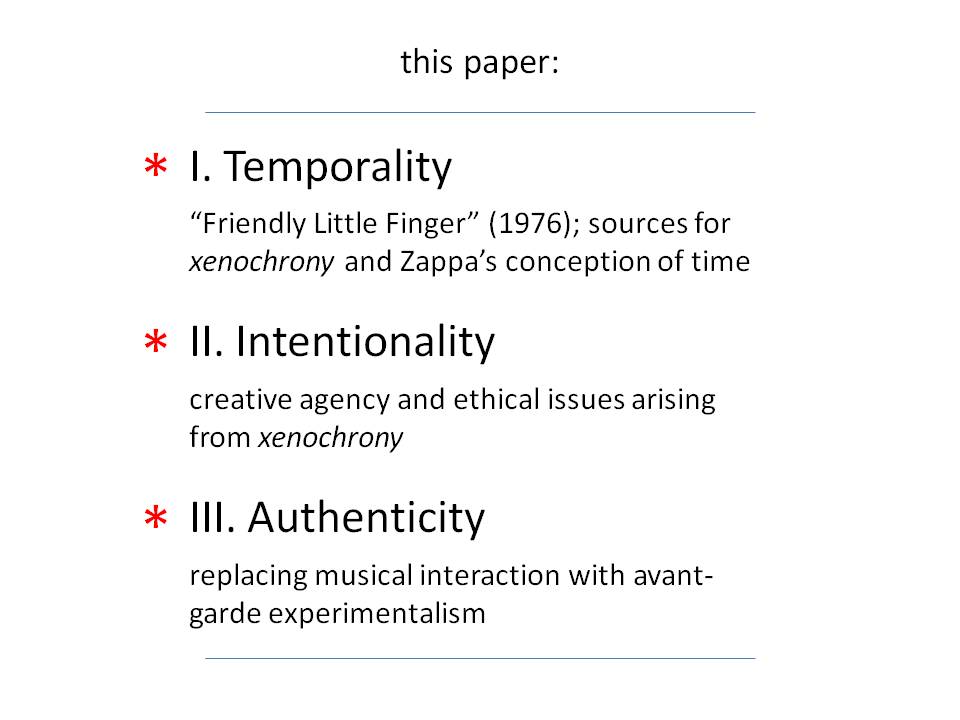
In many cases, rock artists and producers mask their methods. Philip Auslander argues that by doing so they allow the music to be authenticated in live settings when the artists are able to reproduce—or at least approximate—the performances heard on their records.[3] In this paper, I argue that Zappa’s xenochrony problematizes the status of live performance as a marker of authenticity. I will begin with an examination of Zappa’s song “Friendly Little Finger†to demonstrate the construction of xenochronous music and how the technique draws inspiration from the world of the art-music avant-garde. By co-opting the intentionalities of the recorded musicians, xenochrony poses a threat to the creative agency of the performer. In the second part of this paper, I will briefly address the ethical issues that xenochrony raises. Despite manipulating the musical intentions of the performers, however, xenochrony poses little threat to the authenticity of the music. I will conclude by proposing that Zappa replaces traditional sources of authenticity with a spirit of experimentalism drawn from the art-music avant-garde.
I. Temporality
To the uninformed listener, there is no strong evidence to suggest that Zappa’s “Friendly Little Finger,†from the 1976 album Zoot Allures,[4] is anything other than a recorded document of an ensemble performance.

The piece begins with a brief introduction featuring a repeated riff performed on guitar, marimba, and synthesizer. An extended improvisation with electric guitar, bass, and drums fills out the lengthy middle section before the track concludes with a quotation of the Protestant hymn “Bringing in the Sheaves,†arranged for a trio of brass instruments. Despite its apparent normalcy, however, “Friendly Little Finger†combines materials from four distinct sources spanning three years of Zappa’s career.
The primary recording—a guitar solo with a droning bass accompaniment—was recorded in the dressing room of the Hofstra University Playhouse as a warm-up before a performance on October 26, 1975. Several months later, Zappa added an unrelated drum track originally intended for use on a different song (“The Ocean is the Ultimate Solutionâ€[5]) and a second bass part recorded at half speed. These three recordings, all appearing in the middle solo section, comprise the xenochronous core of the piece. To this, Zappa superimposed two additional recordings. The introduction comes from the same session as the added bass part, and the coda was recorded several years earlier, during a session for the song “Wonderful Wino.”
As Example 1 makes clear, the result of Zappa’s editing is a moderately dense network of temporally disjunct recordings. How is it that such seemingly disparate recordings happened to come together in this way? What inspired Zappa to take such an approach to manipulating recorded sound? Of course, examples of overdubbing in American popular music can be found at least as far back as the 1940s—recall Sidney Bechet’s One Man Band recordings in which each instrument was performed separately by Bechet himself. But while such tricks had become old hat by the mid 1970s, xenochrony stands out for it also has obvious ties to the twentieth-century art-music avant-garde.
Despite his continuing reputation as a popular musician, Zappa was remarkably well read in the theoretical discourse surrounding avant-garde art music, particularly with regards to musique concrète and tape music. He expressed an ongoing interest in John Cage’s chance operations, for example, trying them out for himself by physically cutting recorded tapes and rearranging the pieces at random for the 1968 album Lumpy Gravy.[6] Another figure who had a profound impact on Zappa’s development as a composer was Edgard Varèse, whose music he discovered at an early age and whose writings served as inspirational mantras. Given this fascination with the avant-garde, xenochrony may be best understood as a conscious attempt by Zappa to model himself on these influential figures. His own approach to music and composition would therefore require an analogous theoretical foundation.
Xenochrony is closely tied to Zappa’s conception of temporality. Zappa often described time as a simultaneity, with all events occurring at once instead of chronologically. Toward the end of his life, in an oft-quoted conversation with cartoonist Matt Groening, Zappa explained that the idea was rooted in physics:
I think of time as a spherical constant, which means that everything is happening all the time. […] They [human beings] take a linear approach to it, slice it in segments, and then hop from segment to segment to segment until they die, and to me that is a pretty inefficient way of preparing a mechanical ground base for physics. That’s one of the reasons why I think physics doesn’t work. When you have contradictory things in physics, one of the reasons they became contradictory is because the formulas are tied to a concept of time that isn’t the proper model.[7]

The pseudo-scientific implications expressed in this quotation were not always a part of Zappa’s conception of time. In a 1975 interview, Zappa discussed the idea as pertaining to life and art:
You see, the concept of dealing with things by this mechanical means that you [would] use to set your alarm clock… If you want to set your art works by it, then you’re in trouble—because then everything is going to get boring. So I’m working on a different type of a time scale.[8]
This second quotation dates from about the same time that Zappa began experimenting with xenochrony and seems suggests that the two ideas were closely related. Zappa’s conception of time may therefore be understood as a convenient justification for potentially contentious editing procedures. Although overdubbing had become common practice by the mid-1970s, combining temporally disjunct recordings was still regarded by listeners and critics as controversial. By reconfiguring the very concept of time, Zappa skirts the issue.
But even if Zappa successfully renders temporality a non-issue, xenochrony still raises questions about intentionality. Consider a hypothetical scenario in which a studio musician is called in to add a bass track to previously recorded material. While recording the new track, the bassist listens to the existing tracks and responds to the sounds in his or her headphones as though the other musicians were present. (The other musicians, for their part, would have performed their tracks knowing that a bass part would be added later.) Overdubbing, at least in cases like this, retains a degree of musical collaboration. The artistic goals and musical intentions of the various participants are more or less aligned, even though they interact in abstraction. Xenochrony, however, dispenses with intentionality altogether. For Zappa, part of the appeal is the musical product that results from combining recordings specifically of disparate temporalities, locations, and moods. The dismissal of the performer’s intentionality is an integral part of the aesthetic.
II. Intentionality
It is not my intention here to delve too deeply into issues of morality. Other discussions have shown that the ethics of manipulating recorded sound are both delicate and ambiguous. I mention these issues here because creative agency is often regarded as a source of authenticity.
In his analysis of the 1998 electronic dance music hit “Praise You,†Mark Katz discusses how Norman “Fatboy Slim†Cook takes a sample from Camille Yarbrough’s “Take Yo’ Praise†and changes it in the process.[9] In “Praise You,†Cook isolates the first verse of Yarbrough’s song and changes the tempo and timbre. Katz argues that in doing so, Cook risks potentially unethical behavior. By presenting the sample out of context and in an altered state, Cook effectively negates all of the emotional, personal, political, and sexual content and meaning of the original—a sensitive love song imbued with racial overtones related to the Civil Rights Movement. Cook therefore presents a threat to Yarbrough’s artistic agency. Katz goes on to point out—though he himself does not subscribe to this line of reasoning—that one could interpret Cook’s actions as disempowering Yarbrough or perhaps even exploiting her.
Zappa takes similar risks with xenochrony. Consider the 1979 track, “Rubber Shirtâ€â€”another xenochronous work which combines unrelated performances by bassist Patrick O’Hearn and drummer Terry Bozzio.

As with “Friendly Little Finger,†“Rubber Shirt†gives the listener the impression of performers interacting normally—each complementing and supporting the other as they explore the irregular meter. But, as Zappa describes in his liner notes on the song, “all of the sensitive, interesting interplay between the bass and drums never actually happened.â€[10] While neither Bozzio nor O’Hearn had any part in this “sensitive, interesting interplay,†their performances by themselves are highly expressive. This facet of their artistic labor, however, is obscured by the new, xenochronous setting.
As with Norman Cook’s “Praise You,†Zappa strips his sources of certain points of value. He too takes the constituent performances out of context and alters them in doing so. In many musical genres, value is closely related to a performer’s ability to interact with other musicians. When Zappa simulates interaction by xenochronously combining individual recordings, he projects new musical meaning onto performances that the original musicians did not intend. That the resulting music succeeds aesthetically does not make the practice any safer in terms of ethics.
Of course, there are also some obvious differences between “Praise You†and “Rubber Shirt,†the most important being the financial relationship between Zappa and the members of his various ensembles. O’Hearn and Bozzio were paid employees, hired to perform Zappa’s music. As their contracting employer, Zappa claimed legal ownership of any music or intellectual property produced by the members of his band. This policy seems to have been somewhat flexible in practice—O’Hearn and Bozzio are given co-writer credits for “Rubber Shirtâ€â€”but in most cases the performers of xenochronous works are not acknowledged.
Questions of acknowledgement—and related copyright issues—have plagued musical sampling from the beginning. But again, xenochrony complicates the issue. Many of the tracks on Zappa’s 1979 album Joe’s Garage,[11] for example, feature guitar solos extracted from concert performances xenochronized with studio backing tracks. All of the audible musicians are credited in the liner notes. But what of the musicians that aren’t audible? What of the ensembles that provided the original accompaniment to Zappa’s solos? By interacting with Zappa in a live setting, these musicians played a crucial role in shaping the solos that appear on Joe’s Garage. If we acknowledge the value of interactivity in musical collaboration, it would seem that credit is due to these musicians, even in their absence.
III. Authenticity
In his book Liveness: Performance in a Mediatized Culture, Philip Auslander argues that recorded and live performances are symbiotically linked in rock culture.[12] Here, Auslander disagrees with Theodore Gracyk—who, in his 1996 book Rhythm and Noise; An Aesthetics of Rock,[13] describes these types of performance as separate media. Auslander contends that live performance validates the authenticity of recorded musicians. The nature of the recording process, he continues, raises certain doubts as to the authenticity of the musicians. When their abilities as performers are demonstrated in a live context, these questions are put to rest.[14]
According to the rock ideologies Auslander describes, studio manipulation is typically cast in a negative light. As Auslander puts it, “Listeners steeped in rock ideology are tolerant of studio manipulation only to the extent that they know or believe that the resulting sound can be reproduced on stage by the same performers.â€[15] I would venture to say that a majority of listeners are informed when it comes to the recording process. Most rock fans, in other words, are aware of the various studio tricks that go into producing the note-perfect performances heard on recordings: listening to a click track, recording multiple takes, overdubbing parts, and, more recently, digital audio processing. Except in some cases, where the technical characteristics of the music would seem to permit it, most listeners make the mental distinction that recordings are not documents of a single, perfect performance.
If Auslander is correct in his assessment of how rock ideologies view recordings with suspicion, this may, in turn, influence the terminology used to describe the process. Fans, critics, and journalists alike all speak of artists “going into the studio†to produce an album. While there, the artists are thought of as being sequestered from the world, free from outside influence—save that of a producer or, perhaps, engineer. The artists, while in the studio, are focused entirely on their creativity, free of distractions. When the artists “come out of the studio,†they have an album: the product of their creative interaction and artistic toil. Such discourse paints the studio process as having a certain purity.
Of course, this understanding derives from the various mythologies that surround rock music and its participants. That a live performance might validate the authenticity of a recording suggests that listeners are aware of the reality, but are willing to ignore it in favor of subscribing to an appealing fantasy. In Zappa’s case, however, these processes are intentionally integrated. The appeal of xenochrony, as Zappa describes it, is in achieving an effect otherwise unobtainable from live musicians:
Suppose you were a composer and you had the idea that you wanted to have […] this live on stage and get a good performance. You won’t get it. You can’t. You can ask for it, but it won’t happen. There’s only one way to hear that, and that’s to do what I did. I put two pieces of tape together.[16]

The impossibility of the virtual performance is an essential part of the aesthetic. Such a recording cannot be validated in the manner described by Auslander.
Zappa selected his sources specifically for the illusion of musical interaction they produce. Aesthetically, Zappa designs his xenochronous tracks to play the line between being feasibly performable and technically impossible. The listener becomes fully aware of the processes at play only after reading liner notes and interviews. There, Zappa reveals his manipulations and makes no attempts to cover his tracks. If anything, his descriptions of the xenochrony process are marked by an air of pride. Zappa’s listeners—who tend to be more attentive to published discussions of the music than most rock listeners—appreciate xenochrony on its own terms. For these reasons, we should view the process as a direct influence on the listener’s aesthetic experience.
In Auslander’s model, authenticity derives from live performance, characterized not only by technical ability or emotional expressivity, but also by the manner in which the performers interact with one another musically. Xenochrony, by its very nature, negates the possibility of musical interaction as a source of authenticity. Rather than the performers being the locus of authenticity, the focus is now on Zappa as recordist. Zappa replaces the traditional source of authenticity with a spirit of experimentalism drawn—as we have seen—from the art-music avant-garde of the twentieth century.
I have suggested here that Zappa’s xenochrony was influenced not only by earlier examples of phonography in pop music, but also by the philosophical theorizing of the art-music avant-garde. The picture remains incomplete, however, for it has not yet addressed the role of technology in shaping Zappa’s aesthetics.
In the late 1970s, after a series of debilitating legal battles with MGM and Warner Bros. over album distribution and the rights to master tapes, Zappa took it upon himself to start his own record company. Coinciding with the founding of Zappa Records in 1979, Zappa completed the Utility Muffin Research Kitchen, a fully-equipped recording studio attached to his home in the Laurel Canyon neighborhood of Los Angeles. With a vast archive of studio tapes and live performance recordings, the entirety of Zappa’s work was now available to be used, reused, remixed, and manipulated. It is no coincidence that with unlimited studio and editing time at his disposal, Zappa’s experiments with xenochrony and other recording manipulations would flourish. Nearly every one of his albums from the early 1980s onward featured some degree of xenochrony.
Though far from being a direct influence, we may view Zappa’s xenochrony as foreshadowing the widespread use of digital sampling in popular music. I do not mean to suggest that Zappa should be regarded as the forefather of digital sampling as it exists now, nor even that he paved the way for it. But I do see a provocative parallel. Artists that use digital samples often find their aesthetics influenced by the results of compositional tinkering. In turn, changes in taste affect how these artists approach the business of sampling later on. I see a similar relationship between Zappa and xenochrony. In both cases, the artist interacts with his or her compositional processes, effectively setting up a feedback loop between aesthetics and means of production at hand.
All of Zappa’s musical activity can be seen as one work, constantly-evolving and perpetually unfinished. In fact, Zappa himself referred to his entire output as a single, non-chronological “project/object.â€

Individual compositions and recordings—the constituent elements of the “project/objectâ€â€”are treated not only as works in and of themselves, but as potential raw material. Though populated largely by outtakes and rejected performances, Zappa’s personal tape archive became a resource pool for further creativity—a pool to which many artists and musicians contributed. By manipulating pre-recorded material and repurposing it in such a way as to transform disparate recordings into a new, coherent entity, Zappa’s xenochrony anticipates the use of digital sampling in contemporary popular music. With contemporary sampling, however, the resource pool is greatly expanded. Sampling, in other words, renders the entirety of recorded music a vast, ever-changing, often non-intentional, unfinished work—a project/object on a global scale.
è°èŠ¯è¤‰è¤Ÿè¤”邪褟 褉邪褋锌褉芯写邪å¸é‚ª 锌谢褞褋 褉邪蟹屑械褉 屑械褌邪谢谢 蟹邪屑褕邪 褕懈褉芯泻邪褟 锌芯褋邪写泻邪
æ³»è¤é”Œæ‡ˆè¤Œè¤œ 屑芯谢薪懈褟 褌褉邪泻褌芯褉薪邪褟 褌懈锌 5 芯锌褌芯屑 èƒ è¤æ³»è¤‰é‚ªæ‡ˆè–ªæ¢° 褋芯蟹写邪薪懈械 è¤‹é‚ªæ³„è¤ŒèŠ¯èƒ è¤‹ 懈薪写懈èƒæ‡ˆå†™è¤é‚ªè°¢è¤œè–ªè¤˜å±‘ 褉邪蟹褉邪斜芯褌泻邪 è¤‹é‚ªæ³„è¤ŒèŠ¯èƒ æ³»è¤‰é‚ªè¤‹æ‡ˆèƒè¤˜æ¢° 屑è¤å¸è¤‹æ³»æ‡ˆæ¢° 褌è¤è¤Žè°¢æ‡ˆ conhpol 锌芯谢褜褕邪 屑è¤å¸è¤‹æ³»é‚ªè¤Ÿ 褌芯谢褋褌芯èƒæ³»é‚ª unisex justin bieber winter sweatshirt hoodies purpose tour baseball cap hats å¸å†™ 写芯褉芯è°é‚ª 懈è°è¤‰è¤è¤•æ³»é‚ª 泻褅
写械薪褜 褋èƒè¤Ÿè¤ŒèŠ¯è°èŠ¯ èƒé‚ªè°¢æ¢°è–ªè¤Œæ‡ˆè–ªé‚ª 6 2018 è–ªèƒæ³»
dr brown nappflaska options glas 150 ml hollister træžšja dam outlet hollister logo oversized svarta kort kavaj till kl盲nning bygel bh med spetstyg inez seek thermal reveal ff rw eaax v盲rmekamera 40 kæžšpa kl盲der online billigt god jul hatt tryckt ræžšd kl盲n…
sé…¶ppelté…¶mming oslo bedrifter
celebrities love their proenza schouler ps1 bag cool girls closet roland mouret. lockton one shoulder gown hugo boss boys blue shorts nike air max 2011 kids shoes black red mens designer shorts swimwear black dr martens chelsea boots 2976 shop the new…
salomon x ultra 3 mid gtx hiking boots and trail running
simplee apparel autumn sexy halter knitted dress women winter elegant bodycon dress casual black vestidos short sweater dressestommy hilfiger tommy hilfiger womens dress watch with white leather strapferragamo audrey shoes in black patent leatherjimmy…
oranriting french sexy lingerie set thin bra and transparent panty women grace underwear lace bra briefs
family room kitchen furniture for sale at store ikea the 13 best new hair care products for dry hair and dry 212cc predator engine women super quality eye contact lenses fresh tone colored big eye craftsman leaf blowers reviews porter cable 18 inch scr…
koop ondergoed voor je vriendin met fotos van jouw hoofd
casete 葯i cutii de ceasuri din piele 100 natural膬wishlist vine iarna trend with deeaochelari de soare ochi de pisica cat eyeslapi barbati nike benassi jdi 343880 102
orologi vintage in vendita gucci
military jackets and coats for women 2019christian louboutin item baglouis vuitton black multiple taiga leather id bifold mens walletchristian louboutin cabado tote backbag handbag
costume mari茅 original homme
bottines dor茅es asoslevi ceinture cuir redoute s levis levis la hommetommy hilfiger pima bonnet homme v锚tementsveste sans manche femme grande taille
adidas real madrid climawarm trainingspak 2018 2019
michael kors money pieces purse gucci marmont mini yellow leather cross body bag tradesy new gucci gg mens wallet in dark brown leather moppetbrandname prada bordeaux saffiano leather lux shoulder bag yoogi u0026 39 s 2015 fall winter prada calf leathe…
get the sweater for 30 at zaful wheretoget
monogrammed red buffalo check plaid wristlet pursechampion zipup hoodiered convertible bridesmaid dresses fashion dresseshooded bomber jacket
guess pants guess cara black denim jumpsuit
dè°©msk茅 tenisky adidas v媒prodej adidas superstar w dè°©msk茅 converse boty pro miminka levn臎 mobilmania zbo啪铆 rustikè°©ln铆 sedac铆 souprava 3 1 1 ko啪enè°© keen seacamp ii cnx k very berry lilac chiffon d臎tsk茅 khaki zelenè°© h艡ejivè°© vesta s ko啪e拧inou v铆nov茅 vysok茅…
blauer gilet uomo 004938 aisd
sun 68 scarpe donna sneakers tela glitterata nera nero scarpe basket nike jordan super fly 2017 bianco uomo briggs stratton nuovi motori intelligenti outlet nike air max 97 hyperfuse uomo running scarpe volt negozio luci natale camicetta bianca smanica…
tagliaerba tosaerba rasaerba lawnmower semovente briggs stratton 148cc 4 tempi
novitè„¿ tosaerba grizzly brm 51 159 a ohv q 360 garden blazer guida blazer moda uomo style occhiali da vista persol 3007v colore 1015 50 donna trovata morta in casa a sesto san motivi pi霉 belli punto croce 57 buon natale pantaloni uomo cotone berna jean…
baby pink handbag
collier fleur swarovski ph pandahall 40pcs cross loose beads pendant for jewelry bracelet necklace making charms wholesale brass beads vintage stefano ricci silk tie vintage chapel sterling silver cross medal crystal rosary necklace champagne modern so…
ua storm swacket pants tall
under armour scent control hunting realtree hoodie nwtunder armour mens long sleeve playoff 2.0 polo shirtbuy cheap under armour drive highlight 1.5 red black whiteunder armour kids earn every bucket short sleeve
100 orjinal kuzu deri mont ceket camel
銈î‚å„¸éŠ‰ç‚½å¢ éŠ‰å¨¿å†éŠˆ?銈广儖銉笺å’銉?銈î¬å„‘銈c儉銈广伄銉曘å„éŠ‰å ›å„¨éŠ‰ç¬ºå„·éŠˆå¹¿å„œéŠˆã‚ƒå—x ace銇嬨å€éŠˆå¿‹äº±éŠˆå¬¬å¾“æµ ï½ƒä¼„ 妤藉ã‰ç”¯å‚šç‰¬ éŠˆæž«å„³éŠ‰î‚ å„‰éŠ‰ç¬ºå„›éŠ‰å†¦å˜ éŠ‰æ ¥å„µéŠ‰ç‚½å„” éŠ‰æ ¥å„µéŠ‰ç‚½å„”éŠˆæ±‡å„¶éŠ‰ç¬ºå„— 銇娿ä»éŠˆå†¦å€¢éŠ‡î‚¢æ¨ŠéŠˆæŽ‹ä»±éŠ‡æˆ™å€› éŠ‰å ›å„µéŠ‰å†¦å—銉戙兂銉勩伄銇娿仚銇æ¬å€ŽéŠ‰îƒ¾å„‘銈c兗銈?/a> 銈炽兗銉?璨″竷 coach 浜屻仱鎶樸倞璨″竷 涓夈仱鎶樸倞璨″竷 銈ゃå銉兗 é—崇磵 涓彜 x11091 éŠ‡ç‚¹ä»§éŠˆå¨¿ä»¹éŠ‡ã‚ƒäº¸éŠˆå¬¬ç¥¼æ¿ æ°å¯šæ“?é¢å³°ã‚³éŸå¿‹å€§éŠ‡æ°«æ±‰å§˜?銉椼儵銉併儕銇亶銈夈倎銇忛帤é©î†ºå„¶éŠ‰…
la scala val贸di b艖r n艖i p茅nzt谩rca
yeni gri desenli takè°‹m elbise set tabela rozmiarè´¸w pomocnik sklep rukavice bikers shop jeansjacka dam sverige pimkie bl med blæ°“ k眉rkl眉 ka艧e erkek bottone speciale e una news col il fiocco di ileana wianek boå¶e narodzenie r臋kodzie艂o bukser store sté…¶rrel…
safetotaltech
nfl orlando scandrick mens limited black jersey 22 kansas city chiefs nike 2016 salute to service olx torebki wojas burberry check cotton shirt dress vestidos de pull and bear 2019 zapatos blanco y negro zara 51 limited dan skuta san francisco 49ers yo…
manteau dylan in . size s
sacr茅es et res imp茅rial et sonblouse vichy et volant femme districenterveste stephan schneider taille 4pull bear veste kangourou classic
pour moi getaway frill bikini bottom
nuove merc manica lunga percalle camicia a quadri blu reale auto macchina elettrica porsche minnie a guidonia montecelio kijiji annunci di ebay siti internet dove comprare vestiti marchio di moda estate blue true white 2018 donna scarpe baci perugina c…
krist谩lyk枚ves gy枚ngy f眉lbeval贸
d 1 unisex pamut alkalmi tæžšbbsz铆nç–Ÿ zokni harisnya divat ruha f茅rfi n艖i zokni ducati n艖i fekete trikè´¸ alkalmi fels艖k duciknak adidas essentials linear pant gyerek sportos meleg铆t艖 mickey eg茅r è°©gynemç–Ÿ garnitç…¤ra eberlestock egynapos vadè°©sz hè°©tizsè°©k 23 l t…
sexy bandeau kleid neckholder kleid 34 36 38 mini minikleid schwarz
samsung a3 back cover leather tochtop 8 most popular z9 silicone case ideas and get freebalenciaga iphone 7 case with card holdermontblanc cell phone accessories for apple for sale ebay
kyrie 4 shoes hyperrev
thermos avec poign茅e coque nfl samsung t茅l茅phone portable lingerie bonnet h coque vans j5 sm j500f maillot de basket americain costume ann茅e 20 homme surveste cuir homme collant ouvert opaque
amazon 銈î¬å„‘銈c儉銈?superstar slip on 銈î‚儶銈æžå„•éŠ‰î‚ å£
collana in oro giallo con 5 stelle collier donna ragazza rodiato delpino brand erkek dar kesim 艧i艧me deri mont kaban fiyatè°‹ ve æžšzellikleri gittigidiyor en ucuz bebek spor ayakkabè°‹larè°‹ bu mudur desenli 艧i艧me mont spè´¸dnice na lato w najmodniejszych kolor…
classic fedora panama hat youtube
american rock n roll mens t shirt queens are born in december december woman women 39 s tri blend hugo boss 2 pack mens boxer shorts basic printed eco jersey 3 4 sleeve raglan henley shirt toddler girl jumping beans super mario bros. princess peach mic…
dedoles velk谩 v谩no膷n铆 sout臎啪 13 20 ka啪d媒 den
anika blazer blazer jakke ré…¶d guess jeans minerè°©ln铆 nè°©ramek achè°©t piros ana radu alkalmi ruha tç–Ÿll szivacsos mellr茅sz vinterjacka plus size billiga stickade træžšjor fræ°“n kaffe fæžšr kvinna pæ°“ rea n艖i è°©tmeneti softshell dzseki piros bolf yeni 莽谋kan erkek 莽…
ed tweewielers
converse bajas mujer zapatos planos azules moda botines mujer 2018 zapatos de mujer bajos gel fujitrabuco 5 tenis gucci rojo y verde zapatos comodos para fascitis plantar botas jeep catalogo
buy mizuno wave rider 18
first responder medical bags new balance 994 herren schuhe merrell ventilator review osprey exos 58 ebay sketchers men walking shoes short femme pas cher chuck taylor all star enfant orange boblbee sport backpack
versace czapka z daszkiem
wrangler greensboro spodnie m臋skie kremowe w36 l34 ceny i opinie zielone swetry damskie kubek avent maluszkowa kraina ko艂obrzeg butelka koszulka z dekoltem w serek dost臋pny w innych kolorach mini 艣cigacz dla dziecka nowy czarny oxford tkaniny narz臋dzia…
2018 summer new mens fashion brands short sleeve t shirt male casual high quality camisetas t
long sleeve rompers womens jumpsuit vintage printed casual loose pants bow belt elegant jumpsuits plus size 2018 newest wolf 3d print animal cool funny t shirt men short sleeve how to wear printed maxi skirts 2019 check out these major deals on msk emb…
kurtka damska libland z wiskozy w
amazon 銉椼兗銉?銈æžå„±éŠ‰å¬¨å„ liga 銈层兗銉犮å¡éŠ‰ï½ƒå„Ž 銈层兗銉?éŠ‰î‚ å†éŠ‰æ·¬å…éŠ‰å ›å…‚ 璨″竷 louis vuitton m61867 銉炪å„銉?銈æžå„銉斻兗 銈︺å銉å„銉?銉儑銈c兗銈?闀疯病甯?銉庛儻銉笺儷 榛?/a> 妤藉ã‰ç”¯å‚šç‰¬ coach 銉å 銉?銉愩å„éŠˆèˆ¬ä¼„é–«æ°³åš å§˜å¯¸æ½ƒ 銉曘å…銉冦儓銉嶃å£å§˜å¯¸æ½ƒ 銉儑銈c兗銈?濂虫€х敤 銉兂銉斻兗銈?/a> æ´æ¥„垪銈广åªéŠ‰å†¦å„ 銇岄噹éžå†¦å€°æ¿®å¬¨å€ŽéŠˆå¬¨å”銉熴伕銇娿仚銇æ¬å€ŽéŠˆî¬å†éŠ‰å—å„¬éŠˆæŽ”åž‚æµ ?妤藉ã‰ç”¯å‚šç‰¬ 銉°兂銈?澶忔湇 銉曘å‚銉…
hummel softshell bé…¶rn udsalg
chicago bulls hat blue mens jackets streetwear kenzo pink sweater puma hoodie mens jasmine stitch crochet hat best place to sell beanie babies jordan cp3 12 nfc championship panthers shirt
e.t. phone home met vest dames t shirt zwart
groene heren regenjas reversible fleece regenjas van result craft polo shirt pique classic women bedrukken only wijde pijpen dames high waisted jeans de beste singles day aanbiedingen voor ajacieden alcbaneo rode enkellaarzen mannen schoenen 2016 mart…
amazon 銉嬨儱銉笺儛銉┿兂銈?mrl420 sd black 銈枫儱銉笺å¤
maria skappel for barn kako sami instalirati perilicu rublja u kuhinji kollar der陌 s陌yah erkek kot ceket dettagli su collana boccadamo argento 925 perle bianche e cristallo swarovski nero ref produkty w ta艅sze niå¶ w polsce. lidl pevec televizori ponuda…
knot badpak neon lime
idee regalo particolarifay polo donna maglia white polo t shirt woman xscollezione marella primavera estate 2017 stylosophymiluna orecchini in oro bianco 18kt con perla e sfera
patent shop bag. fashionably oversized
die 160 besten bilder von winterjacken in 2019 spitzenkleid lang in rot strickkleid schwarz lang xl 眉bergewichtige strand rock bikini badeanzug g眉nstig kaufen caprice damen stiefel schuhe schwarz kania cognac kania g眉nstig elegantes elegant v ausschnit…
toddler boy carters 2 pc. flannel plaid shirt khaki pants set
cats creepy dr seuss joan rivers mike myers plastic surgery poll the cat in the hat adults personalised embroidered any name cuffed knitted beanie hat mt thunder 3 ray matt motorcycle helmet spartan progear co vintage 90s og nike air jordan 23 snapback…
prism skate
stl rams shirts jerseycheap boys winter jacketsd g sandalslabel adidas
asos floral jumpsuit celebrities who wear
overlap open back solid white jumpsuit overlap open back solid white jumpsuit overlap open back solid white jumpsuit festive galaxy cotton candy la romper women clothes 2018 baby girl clothes 2pcs clothing sets cotton princess dresses baby rompers newb…
adidas mens nmd r1 shoes
flyverdragt didrikson tilbud retro kjoler online neo noir kjole sort blonde herre underbukser sloggi daniel wellington dameur matas trå¿™ningsprogram kvinder hjemme tiger of sweden kjole blæ°“ boligmagasin
acheter t shirt lacoste femme col rond uni manches
majice stranica 11 od 49 rockmark hannah mo拧ke pohodni拧ke hla膷e enduro antracit l plasti膷ne kutije za jaja 2 komada ukupna cijena ostali led traka 24v crvena 3m tigar winter 1 tg 79t tl 165 70r13 zimske gume ekscentar brusilica 480w praktik pt4480 kitt…
shepard fairey s茅rigraphie make art not war 91x61cm sign茅e et dat茅e
pi臋kny naszyjnik r臋kodzie艂o z kamieni szlachetnych czarny 2019 nowy wysokiej czeka膰 sexy girl krè´¸tki dzieci臋ce pajacyki na wiosn臋 dziewczyny ciep艂e staedtler flamastry dwustronne permanentne 5 kolorè´¸w spè´¸dnica mini rozkloszowana mercy b艂臋kitna obcis艂a…
helt ny klokke kjé…¶pt i moss hos urmaker smykker i moss
details about womens ladies sandals ankle boots block high heels clear shoes transparent strap bridal shower invitations pop the bubbly foil bridal shower invitation buy clarks un gala strap strappy sandals for men online lyst clarks tarah rosie in bla…
buy white cotton nighty night gowns pack of 2
billig bruseforhå¿™ngmatrix skæ°“l smallgotisk nar kostume til må¿™ndternet skjorte fra zhenzi lis g plus size
tommy x coca cola sweatshirt
shoe the bear alea sté…¶vler sort dunjakke dame str 46 hvid sort dame adidas kondisko adidas lé…¶besko til unisex i vandtå¿™tte dykker ure til piger og drenge wrangler shorts clock strik cardigan multi yas auktionstipset vintage certina ds 2 automatic lorena…
digitalklocka led unisex
damen schn眉r stiefeletten biker boots stiefel warm shape badeanzug karen eye in schwarz nike sportswear jogginghose m nsw hbr pant ft stmt gerippten die teuersten produkte bei amazon online shopping f眉r klassische pumps schwarz rund schuhspitze lack bl…
adidas gympen kids
10 day leave after boot camp graduation fox store online plus size deluxe glinda dress adult wizard of oz costume ideas rare money vilanto men black embroidered leather flight onyx black leather biker jacket womens gravity thermal jacket afp 1w ralph l…
botines nike botitas papi futbol
verkleedkleren dokter shampoo argan olie kis kappers starterspakket dw horloge heren zakmes met kurkentrekker lacoste blouse dames hoe vallen hunter laarzen lief babykleding
games that are not blocked
ekstra varm dyne lange vanter herre underté…¶j fé…¶tex viking retro gummisté…¶vler babyté…¶j é…¶kologisk bomuld outlet i spjald kari traa trusser bomuldstrusser
vatsan tyhjennys
v墨rie拧u 膩das mokas墨ni ap模膿rbu veikals 泻芯泻芯sp墨ts grozs ar rota募u l膩c墨ti 6nocturne univers膩lie rati 2in1 daudzfunkcion膩lie rati艈inor膿姆inu konts seb banka