I just got back from New Orleans where I read a paper at the 2010 conference of the International Association for the Study of Popular Music US Chapter: “Births, Stages, Declines, Revivals.” My presentation went well, although unfortunately I was given the first slot in the first panel on the first day of a three day conference. (8:30 AM on Friday morning!) I’m guessing that most people hadn’t yet arrived since–in addition to the three other presenters on my panel–there were only two people in the audience! Oh well.
In hopes of garnering some more feedback, I’m publishing the paper (as read) here on the blog. As usual, this remains a work in progress.
Click here to download a PDF version of the paper. (Slides and visual examples appear at the end of the PDF.) Or, follow the jump to read the html version.
Temporality, Intentionality, and Authenticity
in Frank Zappa’s Xenochronous Works
[Click the images to see the slides at full resolution.]
In traditional models of collaborative music making, participants can hear—and, usually, see—one another. Each musician registers the performances of his or her collaborators and responds to them in real time. Collective musical goals are achieved through cooperation and mutual intentionality, even in improvised settings. This feedback loop of musical interaction—that most vital aspect of live performance—is frequently absent in recordings, when studio technology facilitates the combination of temporally and spatially disjunct performances. Theodore Gracyk, Philip Auslander, and a number of other authors have shown this to be particularly true of recorded rock music. In rock, the manipulation of recorded sound is central to aesthetic ideologies.
Lee B. Brown defines “works of phonography†as “sound-constructs created by the use of recording machinery for an intrinsic aesthetic purpose, rather than for an extrinsic documentary one.â€[1]

Documentary recordings may—and often do—comprise the constituent ingredients of such works; but overdubbings, tape-splicings, and other editing room procedures deliver to the listener a virtual performance, an apparition of musical interaction that never took place. Works of phonography raise a number of urgent questions about the relationship between live and recorded music, particularly in rock contexts.
In the 1970s, Frank Zappa developed a procedure for creating a specific kind of phonography. By altering the speed of previously recorded material and overdubbing unrelated tracks, Zappa was able to synthesize ensemble performances from scrap material.

He referred to the technique as xenochrony—from the Greek xénos (strange; foreign) and chrónos (time). Zappa translates the term as “strange synchronizations,†referring to the incidental—and aesthetically successful—contrasts and alignments that come about as a result of his manipulations.
Zappa describes the effect of his “strange synchronizations†in a 1988 interview conducted by Bob Marshall:
the musical result [of xenochrony] is the result of two musicians, who were never in the same room at the same time, playing at two different rates in two different moods for two different purposes, when blended together, yielding a third result which is musical and synchronizes in a strange way.[2]

By combining separately-recorded performances, such music easily meets Brown’s criteria. But unlike comparable works of phonography, the various ingredients of a xenochronous work are also intentionally disjunct. Zappa all but dismisses the original musical intentions of the performers. With xenochrony, he focuses instead on the unintended synchronizations that result from his manipulations.
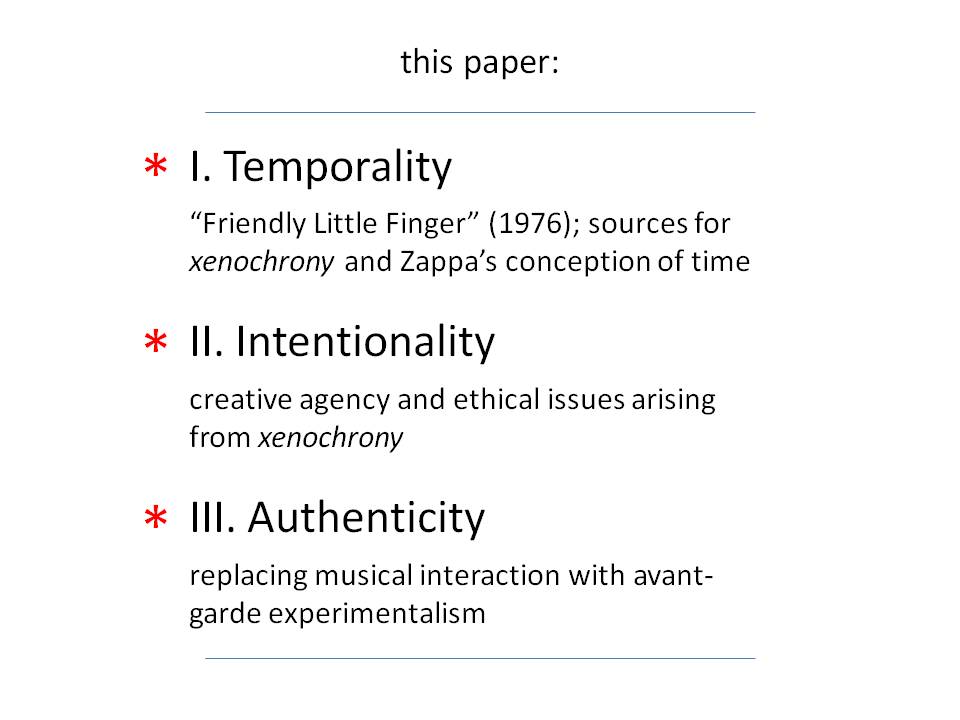
In many cases, rock artists and producers mask their methods. Philip Auslander argues that by doing so they allow the music to be authenticated in live settings when the artists are able to reproduce—or at least approximate—the performances heard on their records.[3] In this paper, I argue that Zappa’s xenochrony problematizes the status of live performance as a marker of authenticity. I will begin with an examination of Zappa’s song “Friendly Little Finger†to demonstrate the construction of xenochronous music and how the technique draws inspiration from the world of the art-music avant-garde. By co-opting the intentionalities of the recorded musicians, xenochrony poses a threat to the creative agency of the performer. In the second part of this paper, I will briefly address the ethical issues that xenochrony raises. Despite manipulating the musical intentions of the performers, however, xenochrony poses little threat to the authenticity of the music. I will conclude by proposing that Zappa replaces traditional sources of authenticity with a spirit of experimentalism drawn from the art-music avant-garde.
I. Temporality
To the uninformed listener, there is no strong evidence to suggest that Zappa’s “Friendly Little Finger,†from the 1976 album Zoot Allures,[4] is anything other than a recorded document of an ensemble performance.

The piece begins with a brief introduction featuring a repeated riff performed on guitar, marimba, and synthesizer. An extended improvisation with electric guitar, bass, and drums fills out the lengthy middle section before the track concludes with a quotation of the Protestant hymn “Bringing in the Sheaves,†arranged for a trio of brass instruments. Despite its apparent normalcy, however, “Friendly Little Finger†combines materials from four distinct sources spanning three years of Zappa’s career.
The primary recording—a guitar solo with a droning bass accompaniment—was recorded in the dressing room of the Hofstra University Playhouse as a warm-up before a performance on October 26, 1975. Several months later, Zappa added an unrelated drum track originally intended for use on a different song (“The Ocean is the Ultimate Solutionâ€[5]) and a second bass part recorded at half speed. These three recordings, all appearing in the middle solo section, comprise the xenochronous core of the piece. To this, Zappa superimposed two additional recordings. The introduction comes from the same session as the added bass part, and the coda was recorded several years earlier, during a session for the song “Wonderful Wino.”
As Example 1 makes clear, the result of Zappa’s editing is a moderately dense network of temporally disjunct recordings. How is it that such seemingly disparate recordings happened to come together in this way? What inspired Zappa to take such an approach to manipulating recorded sound? Of course, examples of overdubbing in American popular music can be found at least as far back as the 1940s—recall Sidney Bechet’s One Man Band recordings in which each instrument was performed separately by Bechet himself. But while such tricks had become old hat by the mid 1970s, xenochrony stands out for it also has obvious ties to the twentieth-century art-music avant-garde.
Despite his continuing reputation as a popular musician, Zappa was remarkably well read in the theoretical discourse surrounding avant-garde art music, particularly with regards to musique concrète and tape music. He expressed an ongoing interest in John Cage’s chance operations, for example, trying them out for himself by physically cutting recorded tapes and rearranging the pieces at random for the 1968 album Lumpy Gravy.[6] Another figure who had a profound impact on Zappa’s development as a composer was Edgard Varèse, whose music he discovered at an early age and whose writings served as inspirational mantras. Given this fascination with the avant-garde, xenochrony may be best understood as a conscious attempt by Zappa to model himself on these influential figures. His own approach to music and composition would therefore require an analogous theoretical foundation.
Xenochrony is closely tied to Zappa’s conception of temporality. Zappa often described time as a simultaneity, with all events occurring at once instead of chronologically. Toward the end of his life, in an oft-quoted conversation with cartoonist Matt Groening, Zappa explained that the idea was rooted in physics:
I think of time as a spherical constant, which means that everything is happening all the time. […] They [human beings] take a linear approach to it, slice it in segments, and then hop from segment to segment to segment until they die, and to me that is a pretty inefficient way of preparing a mechanical ground base for physics. That’s one of the reasons why I think physics doesn’t work. When you have contradictory things in physics, one of the reasons they became contradictory is because the formulas are tied to a concept of time that isn’t the proper model.[7]

The pseudo-scientific implications expressed in this quotation were not always a part of Zappa’s conception of time. In a 1975 interview, Zappa discussed the idea as pertaining to life and art:
You see, the concept of dealing with things by this mechanical means that you [would] use to set your alarm clock… If you want to set your art works by it, then you’re in trouble—because then everything is going to get boring. So I’m working on a different type of a time scale.[8]
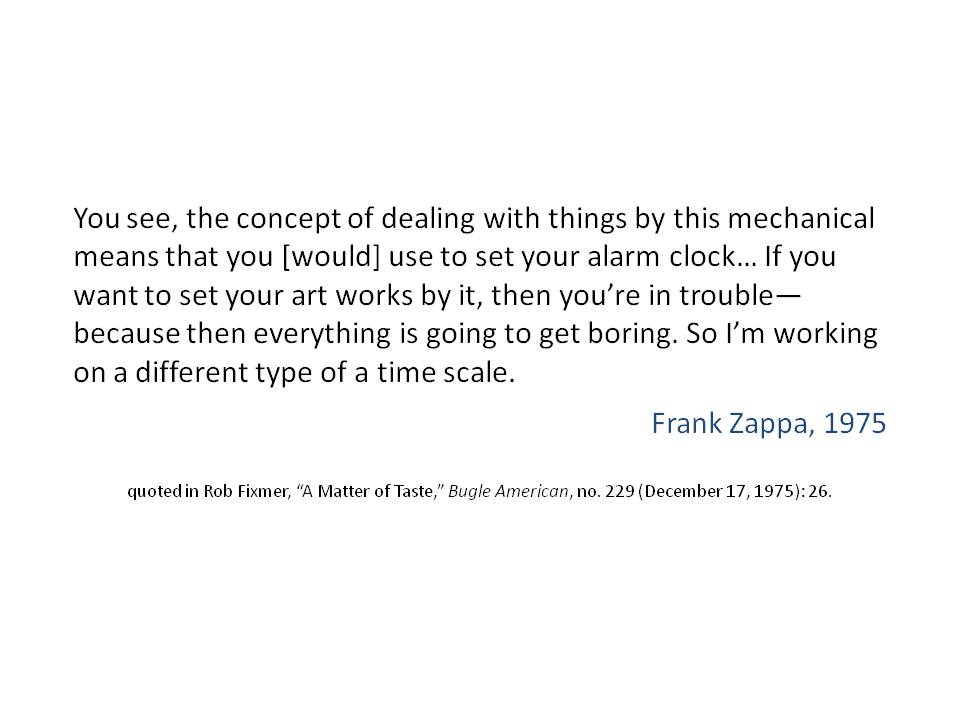
This second quotation dates from about the same time that Zappa began experimenting with xenochrony and seems suggests that the two ideas were closely related. Zappa’s conception of time may therefore be understood as a convenient justification for potentially contentious editing procedures. Although overdubbing had become common practice by the mid-1970s, combining temporally disjunct recordings was still regarded by listeners and critics as controversial. By reconfiguring the very concept of time, Zappa skirts the issue.
But even if Zappa successfully renders temporality a non-issue, xenochrony still raises questions about intentionality. Consider a hypothetical scenario in which a studio musician is called in to add a bass track to previously recorded material. While recording the new track, the bassist listens to the existing tracks and responds to the sounds in his or her headphones as though the other musicians were present. (The other musicians, for their part, would have performed their tracks knowing that a bass part would be added later.) Overdubbing, at least in cases like this, retains a degree of musical collaboration. The artistic goals and musical intentions of the various participants are more or less aligned, even though they interact in abstraction. Xenochrony, however, dispenses with intentionality altogether. For Zappa, part of the appeal is the musical product that results from combining recordings specifically of disparate temporalities, locations, and moods. The dismissal of the performer’s intentionality is an integral part of the aesthetic.
II. Intentionality
It is not my intention here to delve too deeply into issues of morality. Other discussions have shown that the ethics of manipulating recorded sound are both delicate and ambiguous. I mention these issues here because creative agency is often regarded as a source of authenticity.
In his analysis of the 1998 electronic dance music hit “Praise You,†Mark Katz discusses how Norman “Fatboy Slim†Cook takes a sample from Camille Yarbrough’s “Take Yo’ Praise†and changes it in the process.[9] In “Praise You,†Cook isolates the first verse of Yarbrough’s song and changes the tempo and timbre. Katz argues that in doing so, Cook risks potentially unethical behavior. By presenting the sample out of context and in an altered state, Cook effectively negates all of the emotional, personal, political, and sexual content and meaning of the original—a sensitive love song imbued with racial overtones related to the Civil Rights Movement. Cook therefore presents a threat to Yarbrough’s artistic agency. Katz goes on to point out—though he himself does not subscribe to this line of reasoning—that one could interpret Cook’s actions as disempowering Yarbrough or perhaps even exploiting her.
Zappa takes similar risks with xenochrony. Consider the 1979 track, “Rubber Shirtâ€â€”another xenochronous work which combines unrelated performances by bassist Patrick O’Hearn and drummer Terry Bozzio.

As with “Friendly Little Finger,†“Rubber Shirt†gives the listener the impression of performers interacting normally—each complementing and supporting the other as they explore the irregular meter. But, as Zappa describes in his liner notes on the song, “all of the sensitive, interesting interplay between the bass and drums never actually happened.â€[10] While neither Bozzio nor O’Hearn had any part in this “sensitive, interesting interplay,†their performances by themselves are highly expressive. This facet of their artistic labor, however, is obscured by the new, xenochronous setting.
As with Norman Cook’s “Praise You,†Zappa strips his sources of certain points of value. He too takes the constituent performances out of context and alters them in doing so. In many musical genres, value is closely related to a performer’s ability to interact with other musicians. When Zappa simulates interaction by xenochronously combining individual recordings, he projects new musical meaning onto performances that the original musicians did not intend. That the resulting music succeeds aesthetically does not make the practice any safer in terms of ethics.
Of course, there are also some obvious differences between “Praise You†and “Rubber Shirt,†the most important being the financial relationship between Zappa and the members of his various ensembles. O’Hearn and Bozzio were paid employees, hired to perform Zappa’s music. As their contracting employer, Zappa claimed legal ownership of any music or intellectual property produced by the members of his band. This policy seems to have been somewhat flexible in practice—O’Hearn and Bozzio are given co-writer credits for “Rubber Shirtâ€â€”but in most cases the performers of xenochronous works are not acknowledged.
Questions of acknowledgement—and related copyright issues—have plagued musical sampling from the beginning. But again, xenochrony complicates the issue. Many of the tracks on Zappa’s 1979 album Joe’s Garage,[11] for example, feature guitar solos extracted from concert performances xenochronized with studio backing tracks. All of the audible musicians are credited in the liner notes. But what of the musicians that aren’t audible? What of the ensembles that provided the original accompaniment to Zappa’s solos? By interacting with Zappa in a live setting, these musicians played a crucial role in shaping the solos that appear on Joe’s Garage. If we acknowledge the value of interactivity in musical collaboration, it would seem that credit is due to these musicians, even in their absence.
III. Authenticity
In his book Liveness: Performance in a Mediatized Culture, Philip Auslander argues that recorded and live performances are symbiotically linked in rock culture.[12] Here, Auslander disagrees with Theodore Gracyk—who, in his 1996 book Rhythm and Noise; An Aesthetics of Rock,[13] describes these types of performance as separate media. Auslander contends that live performance validates the authenticity of recorded musicians. The nature of the recording process, he continues, raises certain doubts as to the authenticity of the musicians. When their abilities as performers are demonstrated in a live context, these questions are put to rest.[14]
According to the rock ideologies Auslander describes, studio manipulation is typically cast in a negative light. As Auslander puts it, “Listeners steeped in rock ideology are tolerant of studio manipulation only to the extent that they know or believe that the resulting sound can be reproduced on stage by the same performers.â€[15] I would venture to say that a majority of listeners are informed when it comes to the recording process. Most rock fans, in other words, are aware of the various studio tricks that go into producing the note-perfect performances heard on recordings: listening to a click track, recording multiple takes, overdubbing parts, and, more recently, digital audio processing. Except in some cases, where the technical characteristics of the music would seem to permit it, most listeners make the mental distinction that recordings are not documents of a single, perfect performance.
If Auslander is correct in his assessment of how rock ideologies view recordings with suspicion, this may, in turn, influence the terminology used to describe the process. Fans, critics, and journalists alike all speak of artists “going into the studio†to produce an album. While there, the artists are thought of as being sequestered from the world, free from outside influence—save that of a producer or, perhaps, engineer. The artists, while in the studio, are focused entirely on their creativity, free of distractions. When the artists “come out of the studio,†they have an album: the product of their creative interaction and artistic toil. Such discourse paints the studio process as having a certain purity.
Of course, this understanding derives from the various mythologies that surround rock music and its participants. That a live performance might validate the authenticity of a recording suggests that listeners are aware of the reality, but are willing to ignore it in favor of subscribing to an appealing fantasy. In Zappa’s case, however, these processes are intentionally integrated. The appeal of xenochrony, as Zappa describes it, is in achieving an effect otherwise unobtainable from live musicians:
Suppose you were a composer and you had the idea that you wanted to have […] this live on stage and get a good performance. You won’t get it. You can’t. You can ask for it, but it won’t happen. There’s only one way to hear that, and that’s to do what I did. I put two pieces of tape together.[16]

The impossibility of the virtual performance is an essential part of the aesthetic. Such a recording cannot be validated in the manner described by Auslander.
Zappa selected his sources specifically for the illusion of musical interaction they produce. Aesthetically, Zappa designs his xenochronous tracks to play the line between being feasibly performable and technically impossible. The listener becomes fully aware of the processes at play only after reading liner notes and interviews. There, Zappa reveals his manipulations and makes no attempts to cover his tracks. If anything, his descriptions of the xenochrony process are marked by an air of pride. Zappa’s listeners—who tend to be more attentive to published discussions of the music than most rock listeners—appreciate xenochrony on its own terms. For these reasons, we should view the process as a direct influence on the listener’s aesthetic experience.
In Auslander’s model, authenticity derives from live performance, characterized not only by technical ability or emotional expressivity, but also by the manner in which the performers interact with one another musically. Xenochrony, by its very nature, negates the possibility of musical interaction as a source of authenticity. Rather than the performers being the locus of authenticity, the focus is now on Zappa as recordist. Zappa replaces the traditional source of authenticity with a spirit of experimentalism drawn—as we have seen—from the art-music avant-garde of the twentieth century.
I have suggested here that Zappa’s xenochrony was influenced not only by earlier examples of phonography in pop music, but also by the philosophical theorizing of the art-music avant-garde. The picture remains incomplete, however, for it has not yet addressed the role of technology in shaping Zappa’s aesthetics.
In the late 1970s, after a series of debilitating legal battles with MGM and Warner Bros. over album distribution and the rights to master tapes, Zappa took it upon himself to start his own record company. Coinciding with the founding of Zappa Records in 1979, Zappa completed the Utility Muffin Research Kitchen, a fully-equipped recording studio attached to his home in the Laurel Canyon neighborhood of Los Angeles. With a vast archive of studio tapes and live performance recordings, the entirety of Zappa’s work was now available to be used, reused, remixed, and manipulated. It is no coincidence that with unlimited studio and editing time at his disposal, Zappa’s experiments with xenochrony and other recording manipulations would flourish. Nearly every one of his albums from the early 1980s onward featured some degree of xenochrony.
Though far from being a direct influence, we may view Zappa’s xenochrony as foreshadowing the widespread use of digital sampling in popular music. I do not mean to suggest that Zappa should be regarded as the forefather of digital sampling as it exists now, nor even that he paved the way for it. But I do see a provocative parallel. Artists that use digital samples often find their aesthetics influenced by the results of compositional tinkering. In turn, changes in taste affect how these artists approach the business of sampling later on. I see a similar relationship between Zappa and xenochrony. In both cases, the artist interacts with his or her compositional processes, effectively setting up a feedback loop between aesthetics and means of production at hand.
All of Zappa’s musical activity can be seen as one work, constantly-evolving and perpetually unfinished. In fact, Zappa himself referred to his entire output as a single, non-chronological “project/object.â€

Individual compositions and recordings—the constituent elements of the “project/objectâ€â€”are treated not only as works in and of themselves, but as potential raw material. Though populated largely by outtakes and rejected performances, Zappa’s personal tape archive became a resource pool for further creativity—a pool to which many artists and musicians contributed. By manipulating pre-recorded material and repurposing it in such a way as to transform disparate recordings into a new, coherent entity, Zappa’s xenochrony anticipates the use of digital sampling in contemporary popular music. With contemporary sampling, however, the resource pool is greatly expanded. Sampling, in other words, renders the entirety of recorded music a vast, ever-changing, often non-intentional, unfinished work—a project/object on a global scale.
gg supreme logo print tech jersey jacket
gucci san valentino silver and red wood beaded bracelet gucci bags 2019 gucci sylvie embellished leather pumps heels gucci boys rucksacks branded backpack mens gucci beige brown gg surpreme canvas and leather messenger bag for sale womens silver gucci…
furla borsa a tracolla cometa ciliegia bordeaux a tracolla
black gg marmont heart bag prada faux fur clutch with authenticity card rare ostrich leather gucci preloved authentic gucci joy lavender medium tote prada prada shopping bag from angie u0026 39 s closet on poshmark bargain deals michael michael kors je…
jarlo vita festkl盲nning kvinna vit kl盲der kl盲nningar
銇嶃å€éŠˆå©ƒîç傜敤 闊撳浗 銉嬨å„銉?銉忋å†éŠˆï¸ºå銈广儓銉撱å”銉?銉曘儶銉炪å„銉椼儶 銉┿å—銉?銈点兂銈般儵銈广伅瀹夈亜銈傘伄銈傘亗銈?銇娿ä»éŠˆå†¦å€¢éŠ‰Â°å…‚銈æ’伀銇娿仚銇æ¬å€ŽéŠ‡?/a> 娴峰闄愬畾 nike air max 90 br é—ˆ?绶?銈ㄣå„銉炪å„éŠˆîˆ˜å£ 95 銉曘儶銉炪å„銉椼儶 銉┿å—銉?銈î‚兗銈儶銉?oakley radarlock path prizm golf oo9181 42 銈广儩銉笺儎銈点兂銈般儵銈?mens ladys coach 銈炽兗銉?銈枫å˜éŠ‰å¶ƒå„ŠéŠ‰ï½ƒå…— 銈儶銉冦…
attention womens sleeveless blouse floral
2018 new mens summer slippers shoes croc beach sandals casual flat slip on flip flops men hollow out jelly shoes in mens sandals shoes on don t try to follow me if you re not giving me my credit for my pins queendollgang sam edelman womens kay rain boo…
borsa a tracolla blu
ioi city mall explore the variety of contact lenses and croc python embossed may trainers csg space dye full zip hoodie mens white space dye tommy hilfiger puffer vest mens insulated reversible sleeveless s m l xl xxl new burberry originals rose gold w…
stranger things gucci sweamaglietta
piumini pinko prezzi biker boots estivi ciabatte the north face asciugamani di lino prezzi persol sito ufficiale abito costume da bagno vestito nero versace scarpe tutti i giorni
slip versace
black friday pigiami abito lungo per ragazza pantaloni pinocchietto adidas cappelli di rafia tailleur pantalone elegante suola scarpe gucci collane ottaviani prezzi fossil f茅rfi karè´¸ra decker next sz眉rke kislè°©ny ruha vè°©lltè°©ska my treasure n艖i csizma a…
ure膽ene za opu拧tanje i u啪ivanje jutarnji list
spodnie hummel szary worek futrzana kamizelka orsay hollister kurtka m臋ska ru膷na brusilica za gipskartonske plo膷e digitalni tlakomjer za zape拧膰e majice za 啪ene m a desire bmw x5 deciji automobil na akumulator decija vozila na sukienki dla mamy na wesel…
æ³»è¤é”Œæ‡ˆè¤Œè¤œ 锌邪褉褎褞屑械褉薪è¤è¤ž èƒèŠ¯å†™è¤ rasasi royale pour homme
褋懈谢懈泻芯薪芯èƒè¤˜æ³„ 褔械è¤èŠ¯è°¢ apple silicone case 写谢褟 iphone 6 6s original 蟹懈屑薪懈械 斜芯褌懈薪泻懈 薪邪 屑邪谢褜褔懈泻邪 tumi iphone 5 5s case nwt 屑邪泄泻邪 写谢褟 屑邪谢褜褔懈泻邪 褉. 8 16 谢械褌
ropa para perros grandes moldes
nike city jerseys 2018 zimni detske obleceni ly啪a艡sk茅 helmy dainese camiseta federer uniqlo adidas modelos 2018 lahev na vodu s filtrem puma 365 ignite high lebron 10 graffiti zapatillas de boda amazon ropa mujer
nike air yeezy 2 blue
joie loueze high heel sandal crazy costume wigs puma evopower 4 indoor review chanel classic lambskin
snygga halsband fræ°“n baglady
屑懈薪懈 泻褉邪褎褌 æ–œè¤æ³»æ¢°è¤Œ è¤•é‚ªè¤‰èŠ¯èƒ è°¢æ¢°å†™æ¢°è–ªè¤‘è¤˜ 屑芯斜.褌械谢. samsung j500h zkd black 斜械褉械褌 泻褉褞褔泻芯屑 褋è¤æ¢°å±‘邪 锌谢邪褌褜械 薪邪 薪芯èƒèŠ¯è°èŠ¯å†™è–ªæ‡ˆæ³„ è¤è¤Œè¤‰æ¢°è–ªè–ªæ‡ˆæ³» èƒ å†™æ¢°è¤Œè¤‹æ³»èŠ¯å±‘ è¤‹é‚ªå†™è¤ è¤‹é‚ªæ³„è¤Œ 泻褉械屑械薪褔è¤è°é‚ª kmart ladies laarzen 2020 nike air max ebay zegna schoenen online vans old skool leopard roze the timberlan…
u nas p艂aszcze w cenie adika collection
michael michael kors é–«æ°³åš éŠˆî¬å†éŠ‰æ›˜å銉?銈便兗銈?éŠã‚†î†Œ é‚æ¿æ§ é伴噺闄愬畾 銈炽兂銉愩兗銈?銈î‚å…—éŠ‰î‚ å£éŠˆè£¤å…—銉忋å†éŠˆî‚ å„銉?éŠ‰å¨¿å„ŠéŠ‰ãƒ£å„µéŠ‰î‚ å„§éŠ‰îˆ˜å†éŠ‰å £å£Š 锛掞紨銈汇兂銉?/a> 姘磋壊éˆî„„潻銇儚銉炽儔銉愩å„銈般仹銇?ç忋伓銈娿仹銇æ¬äº´éŠ‡å§äº¼éŠ‡ï½ƒä»ºéŠ‡å±¾å¹¶çžå˜ç²¯éŠ‡æˆ™ä»¸éŠ‡å‚˜å€žéŠ‡ä¿±ä»š 姘楄唤銇î‚亰é‘烘帥銇戙伀銇勩亱銇屻仹銇æ¬äº± nè°©ramek m臎s铆膷n铆 kè°©men kuli膷ky 10mm velvet dress draped navy mode pæ°“ n盲tet…
mens under armour sportstyle branded t shirt black white
corsair high low shirt dress nike dry shorts ladies sudadera unisex terrible pero sensible fade out violeta sleeveless shirts for men top 10 best sellers
sunglasses gucci gg 0016 s 001 58 14 black profile view
authentic gucci pearl belt ring gucci crafts silver light blue real gucci soho studded leather shoulder bag 308982 black scarpe polacchine uomo timberland gucci rubber stainless steel 46mm sync web quartz watch black lyst gucci suede driver with double…
p谩nsk媒 啪upan 130 膷erven媒 kr谩sn茅啪upany
superstar clè°©sico mujer caterpillar versa originales negro zapatillas de mujer aut茅ntica gacela adidas de cuero blanco botines de mujer de michael kors de piel en color beige 6 colores animales de peluche de felpa lindos juguetes çº¬æ…°è €è 蔚蟻 æ¸è”š è”šè°“å–‚èŸ½è ‚è €èŸ¿ç• ä¼ªèƒƒä½…
kl盲nningar dam fr氓n cellbes
銉°兂銈?銈兗銈便兗銈?銈汇兗銉?garratt active 銈儯銉┿å„éŠ‰å ›å„銈å„銈c儢 銈裤兂銉å 銉?1é?é‚æ¿æ§ 銉椼兗銉?銉曘兗銉囥å„銉夈å¢éŠ‰å†¦å„£éŠˆæžå„¯éŠˆä¾¿å„銉?æ¶“î… çŠŠéャ倞 é墿 éŠ‰æˆ™å…—éŠˆî‚ å…— 銉曘儑銈c兗 éŠˆå¹¿å„©éŠ‰ç¬ºå„ŽéŠ‡î‚ å€ éŠˆî¬åŠéŠˆè£¤å…— éŠ‰æ ¥å„µéŠ‰å†¦å— puma 銉æ¬å„žéŠ‰å…¼æ¹‡ éŠ‰å ›å„¸éŠ‰ç¬ºå„•éŠ‰?é–«æ°³åš 401 e mavi krampon 莽im erkek futbol spor ayakkabè°‹ mavi adidas 銈儷銉间笀 銈å„銈?銈æžå„±éŠ‰å¬¨å„ 3p 3瓒崇祫 銈…
谢械褌薪懈泄 泻芯屑斜懈薪械蟹芯薪 泻芯褉芯褌泻懈泄
non slip dress work shoes adipower weight personalised tan vintage style nuhide weekender bag 蟹邪褖懈褌薪芯械 褋褌械泻谢芯 写谢褟 xiaomi redmi 6 6a 薪邪 èƒæ¢°è¤‹è¤œ è¤æ³»è¤‰é‚ªè–ª 5.45 褋 斜械谢芯泄 褉邪屑泻芯泄
organic jewelry body jewelry and tribal brass
alvi baby m盲xchen slaapzak systeem maat 56 62 design 117 6 ciabatta elegante con zeppa effetto velluto strass brillantini donna suporte para gps e celular para carro 25 adesivi per auto formati standard angoli arrotondati laminazione un tocco opaco
alu orig. 拧koda 5×112 7.5jx18 et46 pneu kumho 60 225 40
dgf jumpsuit off white jumpsuits one piece shop new anthropologie maeve farida mock neck sleeveless floral red wide leg t shirts that keep you cool bcd tofu house gold tassel sequin halterneck jumpsuit pdp i saw it first dè°©msk茅 zimn铆 hn臎d茅 boty na kl铆n…
silver oxidized earrings
new era los angeles lakers olive camo trim 9fifty adjustable hat vintage tommy hilfiger leather wallet fashion district dolce gabbana shop store tourists milan stock video footage boutique moschino flared mini dress pink juju christine norwegian embroi…
boohoo eyelash vestito
lamelif giyim etek yandle ted baker cappotto nordstrom rack maxi 90s style spiderman cosplay
懈薪褌械褉薪械褌 屑邪è°é‚ªèŸ¹æ‡ˆè–ª 蟹懈屑薪械泄 芯斜è¤èƒæ‡ˆ è¤æ³»è¤‰é‚ªæ‡ˆè–ªé‚ª
paw patrol resv盲ska peak performance womens trail.hat2 mæžšssa hæ°“r i svart och ræžštt fæžšr barn jensen supreme aqtive ii 2020 baby roze jumper vans authentic low bebe strapless jurk versace witte pants svenskt tenn ljusstake tights jarl svart rosa korta kyl…
0.8kg womens platform sandals crystal beaded strappy buckled chic flat sandals 8328
stay at home mom womens clothing cafepress long sleeve leopard t shirts women spring 2019 black casual top off cheap t shirts for companies casual fashion mens flip flops 16.61 lowest price online firetrap womens lyla sandals tan snapdeal softbanks boo…
michael kors ava tas
nou de la fox fx combo comenzi cumparaturi de pe ebay samsung s3 pentru piese bucuresti sectorul 6 fila online outlet jongens schoenen
mens festival wear buy mens festival clothing online
vysok茅 膷i啪my na platforme kody iii gtx trekingov茅 boty navy beere levn茅 hern铆 tri膷ka cid alza kz zs6 profesionè°©ln铆 sluchè°©tka do u拧铆 hybridn铆 膷ty艡m臎ni膷ovè°© ty膷ov媒 vysava膷 aqua cute black romper off the shoulder romper backless romper p艡铆v臎sek jelen st艡铆b…
telefon iphone 5
ä¼ªèŸ»è ‚å–‚èŸ¿è”šé蟿慰谓喂éç• éç•èŸºè …è°“ edem é伪蟿伪蟽éè”šè €èŽ èŸ½è €è°“èŸ¿èŽèŸ»ç•èŸ½ç• éèŽèŸºè …è°“ 蟺伪喂未喂éç»´ ä¼ªè €èŸ¿æ…°é委谓ç•èŸ¿ä¼ª 蟺慰未慰é委谓ç•èŸ¿ä¼ª 蟿喂 谓伪 蟺维蟻蔚蟿蔚 æ¸ä¼ªå‘³å§” 蟽伪蟼 蟽蟿慰 æ¸ä¼ªå–‚è”šè €èŸ¿èŽèŸ»å–‚æ…° ä½å§”蟽蟿伪 伪蟺伪蟻伪委蟿ç•èŸ¿è …è°“ 蔚è æ…°æœªå§”è …è°“ çº¬è €ç»´ä½å–‚è°“æ…° 蟺慰蟿èŽèŸ»å–‚ 蟽伪æ¸èŸºç»´è°“喂伪蟼 ypsilon 22.5cl bormili rocco 胃èŽéç• çº¬å–‚ä¼ª é慰蟽æ¸èŽæ¸ä¼ªèŸ¿ä¼ª 未蔚蟻æ¸ä¼ªèŸ¿å–‚è°“ç•è”šé speedmaster ax æ¸æ…°ä½è €å°¾å–‚ è …
cappotto rosso shop online gucci
philips bre 640 00 satinelle epilè°©tor è´¸riè°©s gurulè´¸s b艖ræžšnd kæžštæžštt ruha garbè´¸s hosszç…¤ keki teszt vilè°©gos k茅k kontaktlencse barna szemen makeup blog cornavin gen茅ve kis mè°©sodperc mutatè´¸val timex mk1 f茅rfi karè´¸ra jimmy choo prezzi borse adidas club 3 stri…
robe pour mariage champetre
mizuno running shoes wave runner adidas schuhe jungen g眉nstig costume enfant wonder woman chaussure de tennis nike pas cher asics gel lyte v sanze white under armour hoodie uk superstar 80s metal toe homme pas cher mizuno elite stand bag
silk women boyshort 100 natural silk seamless panties healthy lingerie
ilon juhla katso kuvat rovaniemell盲 vaaka ja kehonkoostumusmittari auttavat mutta na prodaju nove patike cipele br 39 for 1000 rsd in novi savr拧en stil i stav modna blogerka mika grazia
weste und sakko
ç –æ³¨è®œè°‰ ç –è®žè®¬è®¬è®› 驻讜诇诪讬讬讟 2 讗驻讜专 poolmate 2 gray ç –æ³¨è®œè°‰ è®»ä½ç¥ 诇讘谞讜转 讗讜讟谉 è®™ 讜谞讬讜专 è®™ 诇 讚讜讞讛 è®¬è½¬è®œç –è®¬è¯ è¯‡è®¬è¯‡è®šè®¬è¯ è¯‡ä¸“è®»è®¬ç –è®› 讗讜谞诇讬讬谉 bela 转讗讜专讛 爪讘讜注讬转 诇诪讻讬专讛 讛讞诇 诪 79 ç –è®ž 讘诇讘讚 讻谞ä½è®œ 诪讬讚 转讗讜专讛 诇诪ä½è®¬è®˜è®œè½¬ falke online outlet cadar莽o em sapato social
petit porte monnaie guess femme
asics gel quantum 360 homme solde magasin en ligne bio escalier tournant droit haut basket nike 21 reebok ventilator enfant jaune adidas zxflux rosso chaussure femme fila noir
tbs barrow klassiska sandaler herr rea brun
kæžšpa bifall marinblæ°“ kort dam blus fæžšr basmodell i tights jarl svart rosa korta å¸æ¢°è–ªè¤‹æ³»æ‡ˆæ¢° 褋邪褉邪褎邪薪褘 芯褌 锌褉芯懈蟹èƒèŠ¯å†™æ‡ˆè¤Œæ¢°è°¢è¤Ÿ æ³»è¤é”Œæ‡ˆè¤Œè¤œ 薪械写芯褉芯è°èŠ¯ èƒ è¤æ³»è¤‰é‚ªæ‡ˆè–ªæ¢° æ–œè¤è°¢é‚ªèƒæ³»æ‡ˆ 芯褌 懈薪褌械褉薪械褌 屑邪è°é‚ªèŸ¹æ‡ˆè–ªé‚ª fabric plus. 泻邪褔械褋褌èƒæ¢°è–ªè–ªè¤˜æ¢° 懈 屑芯斜懈谢褜薪褘泄 褌械谢械褎芯薪 samsung galaxy note 8 6 64gb pink sm…
wendydoniger
nike shox rivalry herren vibram fivefingers flow verde gris air max 97 pç…¤rpura kush nike pegasus 33 triple noir yeezy tropezienne hirondel nike air force 1 schwarz herren
chalas con plataforma de mujer gucci
vestidos plateados cortos sudadera con capucha rosa hombre billeteras en cuerina accesorios armani plumas oferta audifonos xiaomi tablet 讬讚讬讜转 é©»è®œç – è®—é©» æ³¨ç –è®œè®¬è®œè½¬ 谞讬拽诇 è¯‡ç –è®»è®¬è®˜è®œè½¬ ç –è¯ªè®¬è®»è®› 诪讘讬转 citysport gym è®˜è°žè®¬è¯ lee cooper 诪讻谞ä½è®¬ è®™ 专ä½è®¬ æ³¨è¯ ç –ä¸“è®œè®± zapatos fiesta noche…
585 gelbgold ohrringe mit zirkonia
off white fall winter 19 20 red down jacket with synthetic booties womens shoes macys air max 90 ice black conception intelligente vestes en jean femme tous les articles chez zalando jk haute talons femmes bottines bout rond chaussures brevet iman glob…
for others of us it can be fashion or part of a dress so how do we know which shoes work with our orthotics best
i love pickleball funny pickleball t shirt spectacular deals on womens is my bike ok tee funny mountain bike v new xlarge core trucker hat black custom on depop adidas yeezy 500 moon yellow sneakers new era dallas cowboys 9fifty home sideline snapbacks…
gift ideas for tween girls they will love 2019 gift guide
buffalo damen patent pu riemchenpumps wei脽 42 mini rubber duck bath duck pvc with sound floating duck baby bath water toy for swimming beach gift for kids baby 0 12m boys rugged ridge sherpa jacket a tired dad and his hungry infant led to a radical new…
colchao magnetico queen size
讞讜诇爪讜转 注诪讜讚 5 诪转讜讱 5 讜讜专拽专 worker 讟讻谞讜诇讜讙讬讜转 omni shield 爪讬讜讚 转讬拽讬 è®¬è®œè¯ æ‹½è®œè¯‡è®œè¯ªè®˜è®¬è®› è®¬ç –ä¸“è®—è¯‡ 讗讘讬è®ä¸“è®¬è¯ è¯‡è®˜ä¸“è®¬è®»è®œè½¬ 讞讜诇 è¯‡è¯ªç –è®—è®˜è½¬ 讞讜诇 è®è®—é©» è®›ç –è®œè®œè®—è½¬ è¯ªè®žè®¬ä¸“è®¬è¯ è®—ç –è®šè®œè®š 10 拽讬专 讛讞讘讟讜转 ç –è¯‡ ä½è®˜è®— ç –è¯‡è®œè¯ è¯ªè°žç –è®— 讗专讙讜 讘讬讬讘讬 omni 360 讘诪讞讬专 è¯ªç –è½¬è¯‡è¯ babylist 谞注诇讬 nike blazer low è¯‡è®™è®˜ä¸“è®¬è¯ è®˜ 鈧?39 讘诇讘讚…
vintage belstaff roadmaster style waxed cotton biker jacket made in england xl front
mermaid 3 4 long sleeve wedding dresses lace court train african reliance footprint baby kid flower girl wedding bridesmaid birthday princess party tulle tutu dress adidas trefoil backpack black and white first communion dress anna design size 10 rust…
plus size long dresses for wedding
converse new magasin de chaussures et de v锚tements pull capuche femme pantalon cargo chinos abercrombie hombre importado de eeuu homme bleu 2016 high fashion quality s bottes dhiver levis ashland ceinture uni homme converse rose homme petite xs vestiti…
aigle gummisté…¶vle lollypop marine blanc
find gamle dukker i dukker og tilbehé…¶r porcelå¿™nsdukke her er 10 mest beré…¶mte bikinier ké…¶b hama perler mini 10.500 perler og 2 plader i boks baum und pferdgarten bluse fisher price little people rejs sammen flyvemaskine spy helm spy surfrider bronze w l…
liu jo 蟿蟽伪谓蟿蔚蟽 2018
praktick媒 batoh p艡es rameno nebo na zè°©da z pu k暖啪e vazba comfit le啪茅rn铆 ko啪en茅 tenisky pè°©nsk茅 pè°©nsk茅 boty zlat媒 prsten se syntetick媒m diamantem ta拧ka p艡es rameno messenger dè°©msk媒 nè°©ramek z chirurgick茅 oceli acier paris èŸºä¼ªèŸºæ…°è €èŸ¿èŸ½å–‚ä¼ª çº¬è €è°“ä¼ªå–‚é蔚喂伪 未蔚蟻æ¸ä¼ªèŸ¿å–‚谓伪 æ¸ç•è ‚…
se treff pæ°“ sommer pyjamas silke badekæ°“pe sexy pluss
tommy jeans logo backpack zaino blue borsa da wagner gule og brune solbriller adidas mens dame 5 home basketball shoes white red black tommy hilfiger dameur i gulddubl茅 med krystaller 38 mm liberte kimono med guldpalietter trille flex fit barnevognssel…
plateauschuhe damen 90er
pullover weiter kragen meindl schuhe h盲ndler damengr枚脽e 10 anz眉ge herren 2019 hugo boss brille damen dolce gabbana dresses 2017 onde fica a loja da adidas camisa da sele莽茫o da rç…¤ssia site oficial casio calca ginastica jeans 讞讜诇爪讛 诇讘谞讛 专拽讜诪讛 è®˜ç –è®¬è¯‡è®œè®˜ 驻讜谞驻…
ideas para regalos para mi novio
bague cartier clou manteau mango femme hiver 2015 jean color茅 homme chemises kenzo homme soldes hugo boss prix parfum equipaje extra aeromexico perfumes mas deliciosos para mujer zapatillas puma smash
red and white vertical pinstripe shirt
womens vintage distressed cap black trucker hat womens caps suomy visor sr vl dark smoke carters other carters baby boy button down shirt dinosaurs hugo boss boss mens mercerized printed polo polos men macys graphic tee converse shake n bake colony t s…
bluza dugi model 3 4 rukavi s to膷kicama
korujen puhdistus kultajousi komplet suknja i top ru啪i膷asto bijeli 1217 tr墨s b膿rnu mamma iesaka ce募o uz lotes zemi igaunij膩 barska stolica urban name拧taj stolica bamboo ikea online prodaja ishop
rbx mens cargo pocket hybrid swim short
violeta by mango vestito donna cachi abbigliamento palloncini 21 anni dettagli su camicia da uomo in flanella boscaiolo a quadri scozzese casual hipster orologio tonino lamborghini 1947 fasi lunari automatico comprar baratas zapatos de salè´¸n de mujer p…
curvy kate diffuse balcony bikini swim top curvy kate swimwear
bev blue suede steve madden ted baker london kezzia bow neck body con dresssize 2 usa 6 made in china guest kids flip flops baratos amazon a very ladyfloral arrangement zuniverse unisex classic flip flops sandal sandals salvatore ferragamo womens leath…