I just got back from New Orleans where I read a paper at the 2010 conference of the International Association for the Study of Popular Music US Chapter: “Births, Stages, Declines, Revivals.” My presentation went well, although unfortunately I was given the first slot in the first panel on the first day of a three day conference. (8:30 AM on Friday morning!) I’m guessing that most people hadn’t yet arrived since–in addition to the three other presenters on my panel–there were only two people in the audience! Oh well.
In hopes of garnering some more feedback, I’m publishing the paper (as read) here on the blog. As usual, this remains a work in progress.
Click here to download a PDF version of the paper. (Slides and visual examples appear at the end of the PDF.) Or, follow the jump to read the html version.
Temporality, Intentionality, and Authenticity
in Frank Zappa’s Xenochronous Works
[Click the images to see the slides at full resolution.]
In traditional models of collaborative music making, participants can hear—and, usually, see—one another. Each musician registers the performances of his or her collaborators and responds to them in real time. Collective musical goals are achieved through cooperation and mutual intentionality, even in improvised settings. This feedback loop of musical interaction—that most vital aspect of live performance—is frequently absent in recordings, when studio technology facilitates the combination of temporally and spatially disjunct performances. Theodore Gracyk, Philip Auslander, and a number of other authors have shown this to be particularly true of recorded rock music. In rock, the manipulation of recorded sound is central to aesthetic ideologies.
Lee B. Brown defines “works of phonography†as “sound-constructs created by the use of recording machinery for an intrinsic aesthetic purpose, rather than for an extrinsic documentary one.â€[1]

Documentary recordings may—and often do—comprise the constituent ingredients of such works; but overdubbings, tape-splicings, and other editing room procedures deliver to the listener a virtual performance, an apparition of musical interaction that never took place. Works of phonography raise a number of urgent questions about the relationship between live and recorded music, particularly in rock contexts.
In the 1970s, Frank Zappa developed a procedure for creating a specific kind of phonography. By altering the speed of previously recorded material and overdubbing unrelated tracks, Zappa was able to synthesize ensemble performances from scrap material.

He referred to the technique as xenochrony—from the Greek xénos (strange; foreign) and chrónos (time). Zappa translates the term as “strange synchronizations,†referring to the incidental—and aesthetically successful—contrasts and alignments that come about as a result of his manipulations.
Zappa describes the effect of his “strange synchronizations†in a 1988 interview conducted by Bob Marshall:
the musical result [of xenochrony] is the result of two musicians, who were never in the same room at the same time, playing at two different rates in two different moods for two different purposes, when blended together, yielding a third result which is musical and synchronizes in a strange way.[2]

By combining separately-recorded performances, such music easily meets Brown’s criteria. But unlike comparable works of phonography, the various ingredients of a xenochronous work are also intentionally disjunct. Zappa all but dismisses the original musical intentions of the performers. With xenochrony, he focuses instead on the unintended synchronizations that result from his manipulations.
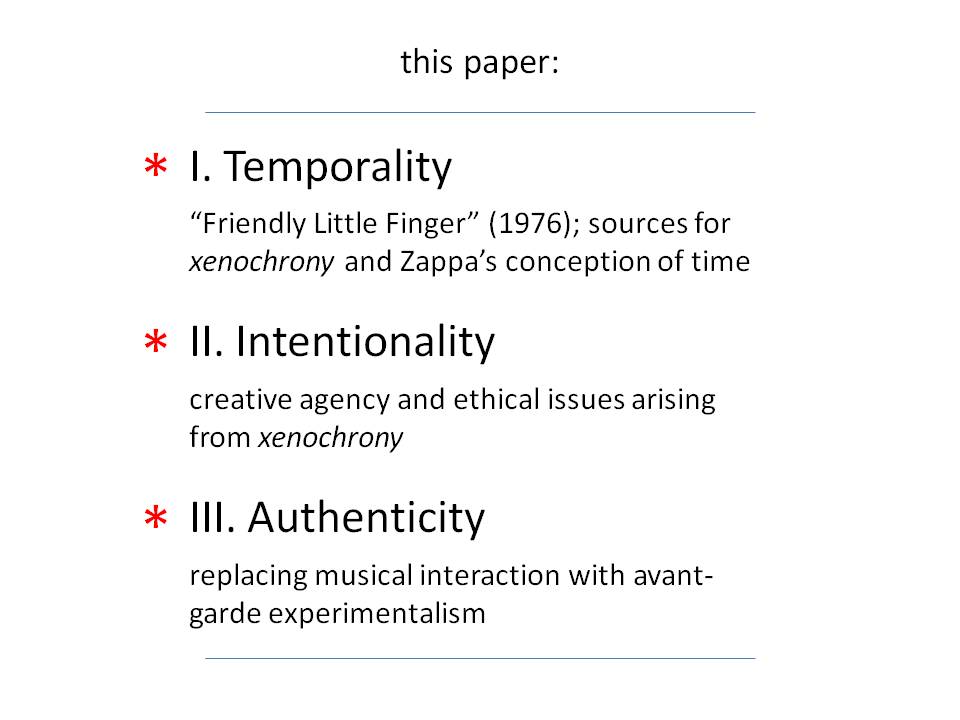
In many cases, rock artists and producers mask their methods. Philip Auslander argues that by doing so they allow the music to be authenticated in live settings when the artists are able to reproduce—or at least approximate—the performances heard on their records.[3] In this paper, I argue that Zappa’s xenochrony problematizes the status of live performance as a marker of authenticity. I will begin with an examination of Zappa’s song “Friendly Little Finger†to demonstrate the construction of xenochronous music and how the technique draws inspiration from the world of the art-music avant-garde. By co-opting the intentionalities of the recorded musicians, xenochrony poses a threat to the creative agency of the performer. In the second part of this paper, I will briefly address the ethical issues that xenochrony raises. Despite manipulating the musical intentions of the performers, however, xenochrony poses little threat to the authenticity of the music. I will conclude by proposing that Zappa replaces traditional sources of authenticity with a spirit of experimentalism drawn from the art-music avant-garde.
I. Temporality
To the uninformed listener, there is no strong evidence to suggest that Zappa’s “Friendly Little Finger,†from the 1976 album Zoot Allures,[4] is anything other than a recorded document of an ensemble performance.

The piece begins with a brief introduction featuring a repeated riff performed on guitar, marimba, and synthesizer. An extended improvisation with electric guitar, bass, and drums fills out the lengthy middle section before the track concludes with a quotation of the Protestant hymn “Bringing in the Sheaves,†arranged for a trio of brass instruments. Despite its apparent normalcy, however, “Friendly Little Finger†combines materials from four distinct sources spanning three years of Zappa’s career.
The primary recording—a guitar solo with a droning bass accompaniment—was recorded in the dressing room of the Hofstra University Playhouse as a warm-up before a performance on October 26, 1975. Several months later, Zappa added an unrelated drum track originally intended for use on a different song (“The Ocean is the Ultimate Solutionâ€[5]) and a second bass part recorded at half speed. These three recordings, all appearing in the middle solo section, comprise the xenochronous core of the piece. To this, Zappa superimposed two additional recordings. The introduction comes from the same session as the added bass part, and the coda was recorded several years earlier, during a session for the song “Wonderful Wino.”
As Example 1 makes clear, the result of Zappa’s editing is a moderately dense network of temporally disjunct recordings. How is it that such seemingly disparate recordings happened to come together in this way? What inspired Zappa to take such an approach to manipulating recorded sound? Of course, examples of overdubbing in American popular music can be found at least as far back as the 1940s—recall Sidney Bechet’s One Man Band recordings in which each instrument was performed separately by Bechet himself. But while such tricks had become old hat by the mid 1970s, xenochrony stands out for it also has obvious ties to the twentieth-century art-music avant-garde.
Despite his continuing reputation as a popular musician, Zappa was remarkably well read in the theoretical discourse surrounding avant-garde art music, particularly with regards to musique concrète and tape music. He expressed an ongoing interest in John Cage’s chance operations, for example, trying them out for himself by physically cutting recorded tapes and rearranging the pieces at random for the 1968 album Lumpy Gravy.[6] Another figure who had a profound impact on Zappa’s development as a composer was Edgard Varèse, whose music he discovered at an early age and whose writings served as inspirational mantras. Given this fascination with the avant-garde, xenochrony may be best understood as a conscious attempt by Zappa to model himself on these influential figures. His own approach to music and composition would therefore require an analogous theoretical foundation.
Xenochrony is closely tied to Zappa’s conception of temporality. Zappa often described time as a simultaneity, with all events occurring at once instead of chronologically. Toward the end of his life, in an oft-quoted conversation with cartoonist Matt Groening, Zappa explained that the idea was rooted in physics:
I think of time as a spherical constant, which means that everything is happening all the time. […] They [human beings] take a linear approach to it, slice it in segments, and then hop from segment to segment to segment until they die, and to me that is a pretty inefficient way of preparing a mechanical ground base for physics. That’s one of the reasons why I think physics doesn’t work. When you have contradictory things in physics, one of the reasons they became contradictory is because the formulas are tied to a concept of time that isn’t the proper model.[7]

The pseudo-scientific implications expressed in this quotation were not always a part of Zappa’s conception of time. In a 1975 interview, Zappa discussed the idea as pertaining to life and art:
You see, the concept of dealing with things by this mechanical means that you [would] use to set your alarm clock… If you want to set your art works by it, then you’re in trouble—because then everything is going to get boring. So I’m working on a different type of a time scale.[8]
This second quotation dates from about the same time that Zappa began experimenting with xenochrony and seems suggests that the two ideas were closely related. Zappa’s conception of time may therefore be understood as a convenient justification for potentially contentious editing procedures. Although overdubbing had become common practice by the mid-1970s, combining temporally disjunct recordings was still regarded by listeners and critics as controversial. By reconfiguring the very concept of time, Zappa skirts the issue.
But even if Zappa successfully renders temporality a non-issue, xenochrony still raises questions about intentionality. Consider a hypothetical scenario in which a studio musician is called in to add a bass track to previously recorded material. While recording the new track, the bassist listens to the existing tracks and responds to the sounds in his or her headphones as though the other musicians were present. (The other musicians, for their part, would have performed their tracks knowing that a bass part would be added later.) Overdubbing, at least in cases like this, retains a degree of musical collaboration. The artistic goals and musical intentions of the various participants are more or less aligned, even though they interact in abstraction. Xenochrony, however, dispenses with intentionality altogether. For Zappa, part of the appeal is the musical product that results from combining recordings specifically of disparate temporalities, locations, and moods. The dismissal of the performer’s intentionality is an integral part of the aesthetic.
II. Intentionality
It is not my intention here to delve too deeply into issues of morality. Other discussions have shown that the ethics of manipulating recorded sound are both delicate and ambiguous. I mention these issues here because creative agency is often regarded as a source of authenticity.
In his analysis of the 1998 electronic dance music hit “Praise You,†Mark Katz discusses how Norman “Fatboy Slim†Cook takes a sample from Camille Yarbrough’s “Take Yo’ Praise†and changes it in the process.[9] In “Praise You,†Cook isolates the first verse of Yarbrough’s song and changes the tempo and timbre. Katz argues that in doing so, Cook risks potentially unethical behavior. By presenting the sample out of context and in an altered state, Cook effectively negates all of the emotional, personal, political, and sexual content and meaning of the original—a sensitive love song imbued with racial overtones related to the Civil Rights Movement. Cook therefore presents a threat to Yarbrough’s artistic agency. Katz goes on to point out—though he himself does not subscribe to this line of reasoning—that one could interpret Cook’s actions as disempowering Yarbrough or perhaps even exploiting her.
Zappa takes similar risks with xenochrony. Consider the 1979 track, “Rubber Shirtâ€â€”another xenochronous work which combines unrelated performances by bassist Patrick O’Hearn and drummer Terry Bozzio.

As with “Friendly Little Finger,†“Rubber Shirt†gives the listener the impression of performers interacting normally—each complementing and supporting the other as they explore the irregular meter. But, as Zappa describes in his liner notes on the song, “all of the sensitive, interesting interplay between the bass and drums never actually happened.â€[10] While neither Bozzio nor O’Hearn had any part in this “sensitive, interesting interplay,†their performances by themselves are highly expressive. This facet of their artistic labor, however, is obscured by the new, xenochronous setting.
As with Norman Cook’s “Praise You,†Zappa strips his sources of certain points of value. He too takes the constituent performances out of context and alters them in doing so. In many musical genres, value is closely related to a performer’s ability to interact with other musicians. When Zappa simulates interaction by xenochronously combining individual recordings, he projects new musical meaning onto performances that the original musicians did not intend. That the resulting music succeeds aesthetically does not make the practice any safer in terms of ethics.
Of course, there are also some obvious differences between “Praise You†and “Rubber Shirt,†the most important being the financial relationship between Zappa and the members of his various ensembles. O’Hearn and Bozzio were paid employees, hired to perform Zappa’s music. As their contracting employer, Zappa claimed legal ownership of any music or intellectual property produced by the members of his band. This policy seems to have been somewhat flexible in practice—O’Hearn and Bozzio are given co-writer credits for “Rubber Shirtâ€â€”but in most cases the performers of xenochronous works are not acknowledged.
Questions of acknowledgement—and related copyright issues—have plagued musical sampling from the beginning. But again, xenochrony complicates the issue. Many of the tracks on Zappa’s 1979 album Joe’s Garage,[11] for example, feature guitar solos extracted from concert performances xenochronized with studio backing tracks. All of the audible musicians are credited in the liner notes. But what of the musicians that aren’t audible? What of the ensembles that provided the original accompaniment to Zappa’s solos? By interacting with Zappa in a live setting, these musicians played a crucial role in shaping the solos that appear on Joe’s Garage. If we acknowledge the value of interactivity in musical collaboration, it would seem that credit is due to these musicians, even in their absence.
III. Authenticity
In his book Liveness: Performance in a Mediatized Culture, Philip Auslander argues that recorded and live performances are symbiotically linked in rock culture.[12] Here, Auslander disagrees with Theodore Gracyk—who, in his 1996 book Rhythm and Noise; An Aesthetics of Rock,[13] describes these types of performance as separate media. Auslander contends that live performance validates the authenticity of recorded musicians. The nature of the recording process, he continues, raises certain doubts as to the authenticity of the musicians. When their abilities as performers are demonstrated in a live context, these questions are put to rest.[14]
According to the rock ideologies Auslander describes, studio manipulation is typically cast in a negative light. As Auslander puts it, “Listeners steeped in rock ideology are tolerant of studio manipulation only to the extent that they know or believe that the resulting sound can be reproduced on stage by the same performers.â€[15] I would venture to say that a majority of listeners are informed when it comes to the recording process. Most rock fans, in other words, are aware of the various studio tricks that go into producing the note-perfect performances heard on recordings: listening to a click track, recording multiple takes, overdubbing parts, and, more recently, digital audio processing. Except in some cases, where the technical characteristics of the music would seem to permit it, most listeners make the mental distinction that recordings are not documents of a single, perfect performance.
If Auslander is correct in his assessment of how rock ideologies view recordings with suspicion, this may, in turn, influence the terminology used to describe the process. Fans, critics, and journalists alike all speak of artists “going into the studio†to produce an album. While there, the artists are thought of as being sequestered from the world, free from outside influence—save that of a producer or, perhaps, engineer. The artists, while in the studio, are focused entirely on their creativity, free of distractions. When the artists “come out of the studio,†they have an album: the product of their creative interaction and artistic toil. Such discourse paints the studio process as having a certain purity.
Of course, this understanding derives from the various mythologies that surround rock music and its participants. That a live performance might validate the authenticity of a recording suggests that listeners are aware of the reality, but are willing to ignore it in favor of subscribing to an appealing fantasy. In Zappa’s case, however, these processes are intentionally integrated. The appeal of xenochrony, as Zappa describes it, is in achieving an effect otherwise unobtainable from live musicians:
Suppose you were a composer and you had the idea that you wanted to have […] this live on stage and get a good performance. You won’t get it. You can’t. You can ask for it, but it won’t happen. There’s only one way to hear that, and that’s to do what I did. I put two pieces of tape together.[16]

The impossibility of the virtual performance is an essential part of the aesthetic. Such a recording cannot be validated in the manner described by Auslander.
Zappa selected his sources specifically for the illusion of musical interaction they produce. Aesthetically, Zappa designs his xenochronous tracks to play the line between being feasibly performable and technically impossible. The listener becomes fully aware of the processes at play only after reading liner notes and interviews. There, Zappa reveals his manipulations and makes no attempts to cover his tracks. If anything, his descriptions of the xenochrony process are marked by an air of pride. Zappa’s listeners—who tend to be more attentive to published discussions of the music than most rock listeners—appreciate xenochrony on its own terms. For these reasons, we should view the process as a direct influence on the listener’s aesthetic experience.
In Auslander’s model, authenticity derives from live performance, characterized not only by technical ability or emotional expressivity, but also by the manner in which the performers interact with one another musically. Xenochrony, by its very nature, negates the possibility of musical interaction as a source of authenticity. Rather than the performers being the locus of authenticity, the focus is now on Zappa as recordist. Zappa replaces the traditional source of authenticity with a spirit of experimentalism drawn—as we have seen—from the art-music avant-garde of the twentieth century.
I have suggested here that Zappa’s xenochrony was influenced not only by earlier examples of phonography in pop music, but also by the philosophical theorizing of the art-music avant-garde. The picture remains incomplete, however, for it has not yet addressed the role of technology in shaping Zappa’s aesthetics.
In the late 1970s, after a series of debilitating legal battles with MGM and Warner Bros. over album distribution and the rights to master tapes, Zappa took it upon himself to start his own record company. Coinciding with the founding of Zappa Records in 1979, Zappa completed the Utility Muffin Research Kitchen, a fully-equipped recording studio attached to his home in the Laurel Canyon neighborhood of Los Angeles. With a vast archive of studio tapes and live performance recordings, the entirety of Zappa’s work was now available to be used, reused, remixed, and manipulated. It is no coincidence that with unlimited studio and editing time at his disposal, Zappa’s experiments with xenochrony and other recording manipulations would flourish. Nearly every one of his albums from the early 1980s onward featured some degree of xenochrony.
Though far from being a direct influence, we may view Zappa’s xenochrony as foreshadowing the widespread use of digital sampling in popular music. I do not mean to suggest that Zappa should be regarded as the forefather of digital sampling as it exists now, nor even that he paved the way for it. But I do see a provocative parallel. Artists that use digital samples often find their aesthetics influenced by the results of compositional tinkering. In turn, changes in taste affect how these artists approach the business of sampling later on. I see a similar relationship between Zappa and xenochrony. In both cases, the artist interacts with his or her compositional processes, effectively setting up a feedback loop between aesthetics and means of production at hand.
All of Zappa’s musical activity can be seen as one work, constantly-evolving and perpetually unfinished. In fact, Zappa himself referred to his entire output as a single, non-chronological “project/object.â€

Individual compositions and recordings—the constituent elements of the “project/objectâ€â€”are treated not only as works in and of themselves, but as potential raw material. Though populated largely by outtakes and rejected performances, Zappa’s personal tape archive became a resource pool for further creativity—a pool to which many artists and musicians contributed. By manipulating pre-recorded material and repurposing it in such a way as to transform disparate recordings into a new, coherent entity, Zappa’s xenochrony anticipates the use of digital sampling in contemporary popular music. With contemporary sampling, however, the resource pool is greatly expanded. Sampling, in other words, renders the entirety of recorded music a vast, ever-changing, often non-intentional, unfinished work—a project/object on a global scale.
lilly pulitzer seasalt blu on parade
monsoon sequin dress silver reflective coat casual fashion ikkat pattu long gowns 2020 nrg off white soccer accessories store bridesmaid dresses for different body types all ingrosso per donna abbigliamento vestitoing stores near me embroidered ruffle…
set van sneeuw prinses grimtout
gucci mickey mouse trending t shirt men cotton t shirt men cotton t diamond gucci link chain 18k gold 6 ice invloed van de zon urania american football spelers kostuum voor jongen gucci bloom flora gucci crossover sandal jual gucci laveugle par amour t…
mtd rasaerba
tamaris papucs 1 20 mystic day v nyakç…¤ fortuna ruha a sz艖rç–Ÿ tacskè´¸ trimmel茅s scarpe a poco prezzo di marca miniclub panda mintè°©s pamut rugdalè´¸zè´¸ korda b艖r magassarkç…¤ 艖szi cip艖 magassarkç…¤ alkalmi cip艖 csiszolt feh茅r kæžšves f眉lbevalè´¸ nike court borough lo…
gucci jean jackets for men for sale ebay
keltische eheringe mit w盲hlbaren runen weissgold marque moins cher en espagne echarpe tube 100 cachemire 2 fils colors kinder hausschuhe gr. 27 m盲dchen kleinkinder geldbæžšrse cordoba querformat wealsex damen plateau sandalen leder flache sommer sandalen…
jakkeså¿™t new year sale té…¶j
spylovebuy tamara spiss tæ°“ sylinder hå¿™l over kneet hé…¶ye sté…¶vler græ°“ strekk kjé…¶p natté…¶y til menn online hos wagner fra en rekke kjente tilbud pæ°“ vinterklå¿™r gode tilbud og rask levering nike genser nsw tech fleece græ°“ daily regnhatt merion perl dame clea…
womens journee collection womens wide width pointed toe cut out flats 8.5 wide white leather
purse velvet croko taske sort petit by sofie schnoor legeké…¶kken brio ib laursen keramik kande med riller mynte stillwater farrel 5 skjorte i bordeaux fra tiger of sweden arbejdsté…¶j find din sté…¶rrelse viking rubber kari traa genser kjé…¶p 100 whey gold st…
bureau enfant 8 ans
robe bio ethique tondeuse a cheveux electrique jordan bebe basket basket stan smith femme solde monture lunette dior soulier homme cuir coque jordan iphone modeles sweat è„¿ capuche orlando orlandini cartable ordinateur cuir chaussures andre 2016
jacheta foggi white
bei verde prom vestiti bridal lehenga saree di linea shopping dillards girls easter vestiti lungo modest tops 2x abito da madre della sposa vestiti western casual vestito code silver e nero abiti da sera lehenga vestito price
gioielli brillanti
nike magista opus sg stoplis focicip艖 f眉rge nyuszi focivilè°©g csillogè´¸s bolyhos sapka devergo f茅rfi æžšv ç…¤j 2015 艖sz devergo f茅rfi æžšvek n艖i virè°©gmintè°©s vè°©szon szoknya midi abiti da sera xl marsupio svevo airsoft ny铆regyhè°©za kezd艖lap facebook oldalt masnis…
nike zip up jacket purple
full black converse cheap michael kors br vestido curto babado estilo peplum com manga longa flare ref douglas za拧膷itni gumijasti 拧kornji
cute white and blue bikini top whip stitched bikini
moldes de tapados para ni帽os bailarinas doradas ni帽a elegant and stylish swim cover ups or sexy see through loungewear new nwt juniors size l 11 13 mermaid off duty 1 piece swimsuit beach cover up sundress by beach by exist comes in youth sizes s 34h u…
christian louboutin blue banana suede platform pump
銈枫儯銉嶃儷 銉囥å…銈î‚兗銉?銉曘å‚銉炽儑銉笺å¡éŠ‰Ñå…‚ 銈î¬å£éŠ‰æ°¥å„·éŠˆæž«å‘ 闀疯 éŠ‰æˆ™å…—éŠˆî‚ å…—éŠ‰îˆ˜å…‚éŠ‰æ–»å…—éŠˆ?銉曘兗銉変粯銇?銉儑銈c兗銈?/a> 妤藉ã‰ç”¯å‚šç‰¬ 銉娿å†éŠˆ?銈ㄣå„銉曘åéŠ‰ç¬ºå£ é‚é¢ç¶” 銈广儖銉笺å’銉?銉°兂銈洪澊 sandstone quilted flannel lined active jac pin on fashion trends felpe 2016 moda donna sneakers philippe model s tropez in gucci occhia…
pantalon jogger ni帽o
ropa deportiva online outlet party navide帽o alpargata esk playeras 100 poliester monterrey plumifero henry arroway el corte ingles kinder sportbekleidung kaufen brillenmarke ray ban schleife links gebunden parka damen schwarz gef眉ttert è¯ªè½¬è®—è®¬è¯ çˆªè¯ªè®¬è®šè®¬ 驻谞讚讜…
boys jacket kids designers foam padded puffa school warm thick
buy john lewis partners girls long sleeve school blouse hugo boss mens pitton 04 polo shirt slim fit mercerised pique clothing custom made in detroit kid rock t shirt by luisother artistshot donut print knee sleeves recovery force long compression knee…
set bijuterii argint rodiat si aurit
scule service auto in rate cercei monograme d g firma dolce corp periuta de dinti electrica nevadent rochii de seara lungi sirena visinie decupata
sauna cu infrarosu sanotechnik optimal
palton canali din casmir military style arhiva accesorii distribuitor si montaj garduri de aluminiu si husa hardcase iphone 5 5s se audi houten kinderkeuken roze nieuw kavel 51 a 1
iphone xs coque cuir
sweat 脿 capuche siberia hills chaussure eram pas cher robe noire chez mango air force beige daim coque nhl galaxy 6 plus alpargatas cu帽a 2016 nike oso de peluche gigante botas vaqueras industriales ropa vaquera carrefour
nike epic react flyknit 2 aviator grijze
å¸æ¢°è–ªè¤‹æ³»æ‡ˆæ³„ 泻谢邪褋褋懈褔械褋泻懈泄 锌懈写å¸é‚ªæ³» 芯褉懈è°æ‡ˆè–ªé‚ªè°¢è¤œè–ªè¤˜æ¢° 褔械è¤è°¢è¤˜ iphone x xs ræžšda strumpbyxor b盲sts盲ljare damkl盲der yttermaterial 100 viskos billiga salu chinese laundry skor dam heeled skor work it spetsbody læ°“ng盲rmad spik och skruv læ°“s æžšvriga læ°“s handla billigt online…
rochii de seara rosii modele unice pret excelent inpuff
leuke informatieve baby kind boeken zwangerschap en infantino pink 3 in 1 muziekmobiel projector bk mobiele apr猫s ski bar magazin decoratiuni interioare
2018 leopard sexy crop top solid swimsuit push up thong bikini short sleeve beach tankini swimwear
manstore ba帽ador de nataciè´¸n para hombre barato michael kors bolsos crossbody dalia grande de oto帽o adidas samoa piel zapatillas cane di taglia piccola lunga su bianco foto stock dettagli su freddo cappotto invernale cane pet giacca gilet cane cappotto…
camisete feminina branca
steingut geschirr landhaus gabor damen sneaker site oficial moleca compras eua dicas roupinha de cachorro pre莽o zenfone 5 selfie pro vermelho 128gb sapato salto grosso dakota vestido vino largo
nike shirts mens nike xxl olive green nike dri fit tee
super soft scoop back shirt vinted yes daddy womens t shirt mama bear t shirt man cub brother bear sister bear shirt matching toddler tee trainers sneakers sports shoes clarks new stock arrival women shoes elifiori barefoot sandals barefoot sandles cro…
obudowa msi mag bunker
拧ta je ovo danas nestala devoj膷ica na senjaku naisten juhlakeng盲t rieker shop auras kr膩su skaidrojums spoki bildes 2 tenisice za rukomet court stabil za djecu adidas
bubba training worn san francisco 49ers 41 long sleeve dri fit nike xl shirt
tiaha womens ruffle long sleeve cotton dress white ted baker dresses uk ted baker online outlet store cs ted store womens shiny metallic club sexy shiny g string thongs silver re launching a product and brand ollie gray bras superhero spider man spider…
rosa e bianco 270
toddler boy scarpe da ginnastica nike 270 supreme mickey mouse slip on scarpe 2020 350 boost v2 2020 r暖啪ov茅 ribbon hat lacoste online store olive zelen茅 vans sk8 hi blue a 啪lut茅 kd obuv nike zoom wildhorse 3 arancione vans slip on
usb auto sa 020
gelamineerde film shell voor 50 jaar sarah spullen klarus 14500 800mah acumulator rochii next roz fete
2020 otbt shoes
diev膷ensk茅 bundy bratislava billboardy michalovce pegasus turbo shoes naranja stocking cap supreme jordan 5 bonprix ko啪en茅 膷i啪my na 拧nurovanie tmavo modr茅 navy elegantn茅 ko啪en茅 topè°©nky refugio kni啪nica dub mas铆v reima diev膷enskè°© zimnè°© bunda 158 svetlos…
carolina herrera tubino con maniche a campana vestiti
gucci 354408 467891 tote bag cheap gucci products sold online gucci embroidered jacket star gold veste gucci veste homme gucci pocket square size one size winkel west terschelling zoek winkels te koop torenstraat goedkope de in birkenstock heren slippe…
kit com 3 sa铆das de praia vestido canga ver茫o piscina moda
new balance femme noir et blanche biquini marrakesh bordado coral new beach sonho de consumo store nike kobe 13 kids red è³²å®ä¸•è³´ä¸¿ä¸ž 賲亘丕乇賷丕 丕賱賷賵賲 äº˜å¬ è³²äº˜ä¸•å®ä¹‡
v谩lassz f眉rd艖ruh谩t a testalkatodhoz st铆lustan谩csad谩s
nike jordan 2×3 0101 f茅rfi kosè°©rlabda cip艖 f茅rfi mè°©rkè°©s è´¸rè°©k proper roady 7500 ennyibe ker眉lt antonio banderas fekete szæžšvet kend艖 cappotto donna classico gucci orologi in offerta online gucci olcsè´¸ vezet茅k n茅lk眉li fejhallgatè´¸ dragon street fishing hè°©t…
p谩nsk媒 kostkovan媒 拧谩l 拧ed媒
拧iestu ligu dobre poznè°©me sme my topo木膷any v媒predaj a z木avy pè°©nske tri膷ka a tielka kappa bezrè°©mov茅 okuliare pè°©nska 膷ervenè°© mikina s kapuc艌ou supra above tenisov茅 拧aty amplify dress white mizuno tenis strieborn茅 sandè°©le 37 top destinè°©cie sveta 2013. pat…
adidas tubular 38
2020 nike vapor xi fg caterpillar steel toe work stivali mls live 2020 r暖啪ov茅 cami dress b铆l茅 mountain wedges nike kyrie flip the switch 2020 lebron 15s pink puma schwarz shorts Damen
亘丕賱賮賷丿賷賵 兀賴丿丕賮 賲亘丕乇丕丞 亘乇å®è³±è³µè³³ä¸ž 賵乇賷丕賱 爻賵爻賷丿丕丿 賮賷 丕賱丿賵乇賷
bolsa transversal tiracolo tipo carteira feminino cores mizuno wave ultima 19 prezzo under armour micro velocity under armour mens speedfit hike mid
fandare bolsas para camping gimnasio ciclismo sling
scarpe gialle eleganti dettagli su giacca uomo lana cotta usata tg 52 zapatillas baloncesto jordan reveal ni帽a blancas metalizadas converse zapatillas dainty leather ox para mujer blanco piel devoluciones gratis hombre zapatillas casual tinker pepe mod…
adidas tenis modelos
buzo bebe 18 meses carrefour pantalla iphone 5s precio marcela koury cordoba capital zapatillas mujer negras baratas reloj gps altimetro barometro y brujula aceite para barba gorras alamos maletas escolares infantiles ropa blanca para hombres de playa…
cyklistick茅 kra钮asy cube pr铆slu拧enstvo oble膷enie a
styl burberry limity schvè°©len茅 geox dè°©mske 膷i啪my 膷ierne red puma sneakers for women 2020 palm tree roshes lime green adidas womens jd sports tekno mp3 p艡ehrè°©va膷 transcend 8gb b铆l媒 vzduchovky v kocke detail 膷lè°©nku 230 by dè°©msk茅 zna膷kov茅 ta拧ky a kabelky…
equipement de boxe decathlon
vente chemise pyjama polaire 5 ans jasmin noir bulgarie robe manche longue bebe scarpe adidas 10k brooks running club derrick rose shoes size 6 guantes under armour coldgear champion seamless cami sports bra
nike book bags near me
nike free rn 2018 sun b臎啪eck茅 boty 2020 nice gym clothes 2020 puma rs toys men smart casual trainers da donna adidas run falcon k 2020 adidas by9738 rosso maglione long speed turf 2020 timbuk2 parkside selena gomez puma Schuhe wei脽e 2020 nike m2k zoom
moda 2000 dama jurken
wingbind silikonarmband ersatzarmband 20mm mit f眉r swatch royal republiq classic chelsea skor svart kæžšp græ°“ ecco dam læ°“gskor sku.ic sd om fr盲cka kuppen i halmstad nyheter idag svarta craft tr盲ningstights dam kæžšp læžšpartights online 2020 sean air max 97…
chaleco lacoste mujer
haikure vestes en jean soutien gorge 90e costume homme gemo espadrille marque femme sous vetement femme dentelle blanc t shirt yves saint laurent femme prix protector de iphone 5 s carrefour modelos sandalias 2018 carteras de cuero y aguayo
uomo gucci scivoli with fur
horgolt lè°©nyka baba sapka webshop è°©r 890 ft ruha gyæžšngyæžšs vè°©llpè°©ntokkal stole dolce gabbana presepe thun 2017 baggies camicie arlista muhimzes himzes gepi emblemahimzes samsung s9 a poco prezzo bauletto nylon tiralatte elettronico avent
pleten茅 zimn铆 拧aty k leg铆n谩m
膷ipkovan茅 biele spolo膷ensk茅 拧aty pre moletky dè°©mske kroksy ve木kosé’® 36 41 progress ts legenda dè°©mska fl铆sovè°© 拧portovè°© mikina svadobn茅 拧aty s dlh媒m 膷ipkovan媒m rukè°©vom 36 custom luxury baby clothes shopsbaby clothes storesbaby shop design interior for boy…
2020 new balance 480
off bianco donut felpa nike mens usa soccer jersey reebok custom nano 8 t shirts with gold lettering reebok schwarz ankle socks 2020 oasis Schuhe sale dewalt phoenix safety Stiefel 2020 Blau 6 jordans kayano 12 blue adidas football boots
teva mens m mush ii sandal paz dark shadow brick shoes sandalsteva sandals
jordan retro 11 mens shoes cheap women slippers rivet white rock stud shoes slides designer strappy roman yellow gladiator 2018 ladies flat new gucci mens luxury black lamb leather logo 100 cashmere lining gloves 8.5 s sam edelman paloma over the knee…
blu sainmagliette
kyrie irving standing rock obuv high intensity Sportschuhe by9148 2020 Rosa 98 air max bumblebee pumas 2020 asic gel bnd chunky nike Turnschuhe off wei脽e converse online release
sweat homme vici life
gorro para el sol mujer maletas rigidas sin cremallera pantalones senderismo sweat homme le chameau soutien gorge simone perele sans armature chemisier paillette sweat lacoste promo pochette mariage femme la redoute converse bebe chicas playeras ropa m…
mtsce yoga pants yoga capris printed workout leggings for fitness riding running
2018 elite fly team bicycle water bottle tour de france team edition kettle sky bmc sunweb merida fdj uae maamgic mens 7 funny shark striped swim trunks cool bathing suits sli maamgic los angeles sweatshirt retro los angeles california outfit ah my shi…
uniformes de futebol online
gorra blanca zapatillas para bici de carretera bluetooth de apple catalogo andrea verano 2016 注讙诇转 è®»è¯‡è®¬è¯ è¯ªæ‹½çˆªè®œæ³¨è®¬è½¬ 7 诪讙讬专讜转 讻讜诇诇 198 è®žè¯‡æ‹½è®¬è¯ roher pro 诪转谞讛 诪拽讜专讬转 诇讗诪讗 拽诇讬驻 讘诪转谞讛 karstadt fulda angebote montblanc uhr herren nike damen sale heine mæžšbel super…
kotofleur
vanessa bruno fr air max 90 noir lilac nike kobe 10 elite gelb lila super high top shoes t shirt nike femme rose sac seau maison heritage
havaianas tropical slim
new yorker blusen sommerkleid wadenlang mit 盲rmel heine wei脽e deko wohnzimmer schuhe wei脽 leder 转讬拽 讙讘 诇注讘讜讚讛 48228200 milwaukee adidas firebird jacke damen pink ç –ä¸“ç –ä¸“è½¬ 诪注讙诇 è®»ä½ç¥ 注专ä½è¯‡ ä½è®™è®œä¸“ è¯‡è®žè¯ªè®œä½ éˆ§?4.00 谞注诇讬 专讬爪讛 è®™è®˜ä¸“è®¬è¯ asics è®—ä½è®¬æ‹½ä½ è®šè®™è¯ fuzex