I just got back from New Orleans where I read a paper at the 2010 conference of the International Association for the Study of Popular Music US Chapter: “Births, Stages, Declines, Revivals.” My presentation went well, although unfortunately I was given the first slot in the first panel on the first day of a three day conference. (8:30 AM on Friday morning!) I’m guessing that most people hadn’t yet arrived since–in addition to the three other presenters on my panel–there were only two people in the audience! Oh well.
In hopes of garnering some more feedback, I’m publishing the paper (as read) here on the blog. As usual, this remains a work in progress.
Click here to download a PDF version of the paper. (Slides and visual examples appear at the end of the PDF.) Or, follow the jump to read the html version.
Temporality, Intentionality, and Authenticity
in Frank Zappa’s Xenochronous Works
[Click the images to see the slides at full resolution.]
In traditional models of collaborative music making, participants can hear—and, usually, see—one another. Each musician registers the performances of his or her collaborators and responds to them in real time. Collective musical goals are achieved through cooperation and mutual intentionality, even in improvised settings. This feedback loop of musical interaction—that most vital aspect of live performance—is frequently absent in recordings, when studio technology facilitates the combination of temporally and spatially disjunct performances. Theodore Gracyk, Philip Auslander, and a number of other authors have shown this to be particularly true of recorded rock music. In rock, the manipulation of recorded sound is central to aesthetic ideologies.
Lee B. Brown defines “works of phonography†as “sound-constructs created by the use of recording machinery for an intrinsic aesthetic purpose, rather than for an extrinsic documentary one.â€[1]

Documentary recordings may—and often do—comprise the constituent ingredients of such works; but overdubbings, tape-splicings, and other editing room procedures deliver to the listener a virtual performance, an apparition of musical interaction that never took place. Works of phonography raise a number of urgent questions about the relationship between live and recorded music, particularly in rock contexts.
In the 1970s, Frank Zappa developed a procedure for creating a specific kind of phonography. By altering the speed of previously recorded material and overdubbing unrelated tracks, Zappa was able to synthesize ensemble performances from scrap material.

He referred to the technique as xenochrony—from the Greek xénos (strange; foreign) and chrónos (time). Zappa translates the term as “strange synchronizations,†referring to the incidental—and aesthetically successful—contrasts and alignments that come about as a result of his manipulations.
Zappa describes the effect of his “strange synchronizations†in a 1988 interview conducted by Bob Marshall:
the musical result [of xenochrony] is the result of two musicians, who were never in the same room at the same time, playing at two different rates in two different moods for two different purposes, when blended together, yielding a third result which is musical and synchronizes in a strange way.[2]

By combining separately-recorded performances, such music easily meets Brown’s criteria. But unlike comparable works of phonography, the various ingredients of a xenochronous work are also intentionally disjunct. Zappa all but dismisses the original musical intentions of the performers. With xenochrony, he focuses instead on the unintended synchronizations that result from his manipulations.
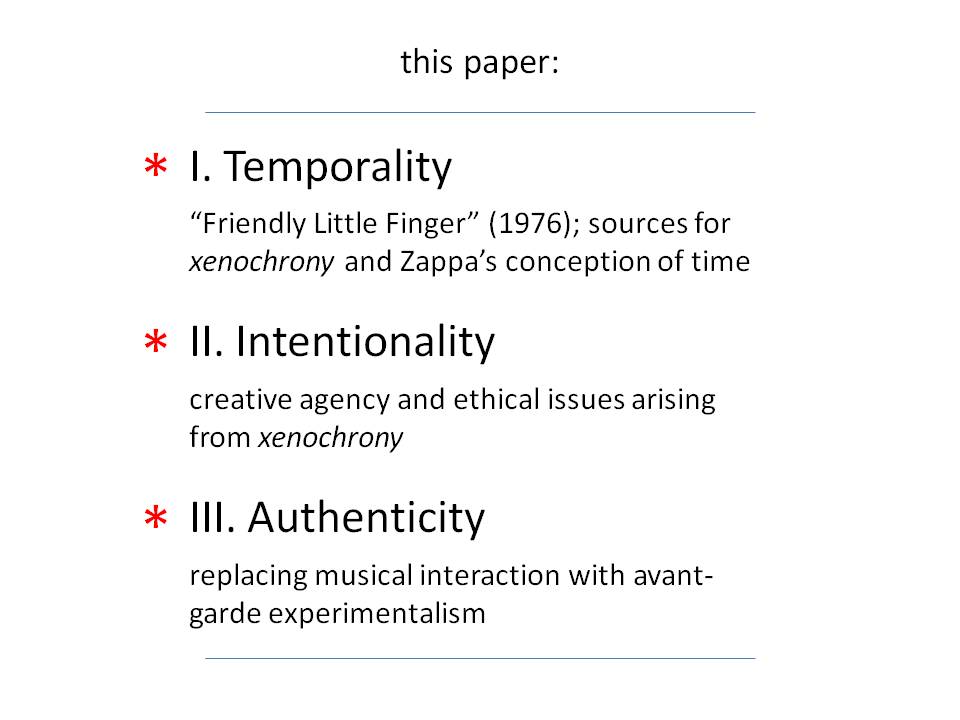
In many cases, rock artists and producers mask their methods. Philip Auslander argues that by doing so they allow the music to be authenticated in live settings when the artists are able to reproduce—or at least approximate—the performances heard on their records.[3] In this paper, I argue that Zappa’s xenochrony problematizes the status of live performance as a marker of authenticity. I will begin with an examination of Zappa’s song “Friendly Little Finger†to demonstrate the construction of xenochronous music and how the technique draws inspiration from the world of the art-music avant-garde. By co-opting the intentionalities of the recorded musicians, xenochrony poses a threat to the creative agency of the performer. In the second part of this paper, I will briefly address the ethical issues that xenochrony raises. Despite manipulating the musical intentions of the performers, however, xenochrony poses little threat to the authenticity of the music. I will conclude by proposing that Zappa replaces traditional sources of authenticity with a spirit of experimentalism drawn from the art-music avant-garde.
I. Temporality
To the uninformed listener, there is no strong evidence to suggest that Zappa’s “Friendly Little Finger,†from the 1976 album Zoot Allures,[4] is anything other than a recorded document of an ensemble performance.

The piece begins with a brief introduction featuring a repeated riff performed on guitar, marimba, and synthesizer. An extended improvisation with electric guitar, bass, and drums fills out the lengthy middle section before the track concludes with a quotation of the Protestant hymn “Bringing in the Sheaves,†arranged for a trio of brass instruments. Despite its apparent normalcy, however, “Friendly Little Finger†combines materials from four distinct sources spanning three years of Zappa’s career.
The primary recording—a guitar solo with a droning bass accompaniment—was recorded in the dressing room of the Hofstra University Playhouse as a warm-up before a performance on October 26, 1975. Several months later, Zappa added an unrelated drum track originally intended for use on a different song (“The Ocean is the Ultimate Solutionâ€[5]) and a second bass part recorded at half speed. These three recordings, all appearing in the middle solo section, comprise the xenochronous core of the piece. To this, Zappa superimposed two additional recordings. The introduction comes from the same session as the added bass part, and the coda was recorded several years earlier, during a session for the song “Wonderful Wino.”
As Example 1 makes clear, the result of Zappa’s editing is a moderately dense network of temporally disjunct recordings. How is it that such seemingly disparate recordings happened to come together in this way? What inspired Zappa to take such an approach to manipulating recorded sound? Of course, examples of overdubbing in American popular music can be found at least as far back as the 1940s—recall Sidney Bechet’s One Man Band recordings in which each instrument was performed separately by Bechet himself. But while such tricks had become old hat by the mid 1970s, xenochrony stands out for it also has obvious ties to the twentieth-century art-music avant-garde.
Despite his continuing reputation as a popular musician, Zappa was remarkably well read in the theoretical discourse surrounding avant-garde art music, particularly with regards to musique concrète and tape music. He expressed an ongoing interest in John Cage’s chance operations, for example, trying them out for himself by physically cutting recorded tapes and rearranging the pieces at random for the 1968 album Lumpy Gravy.[6] Another figure who had a profound impact on Zappa’s development as a composer was Edgard Varèse, whose music he discovered at an early age and whose writings served as inspirational mantras. Given this fascination with the avant-garde, xenochrony may be best understood as a conscious attempt by Zappa to model himself on these influential figures. His own approach to music and composition would therefore require an analogous theoretical foundation.
Xenochrony is closely tied to Zappa’s conception of temporality. Zappa often described time as a simultaneity, with all events occurring at once instead of chronologically. Toward the end of his life, in an oft-quoted conversation with cartoonist Matt Groening, Zappa explained that the idea was rooted in physics:
I think of time as a spherical constant, which means that everything is happening all the time. […] They [human beings] take a linear approach to it, slice it in segments, and then hop from segment to segment to segment until they die, and to me that is a pretty inefficient way of preparing a mechanical ground base for physics. That’s one of the reasons why I think physics doesn’t work. When you have contradictory things in physics, one of the reasons they became contradictory is because the formulas are tied to a concept of time that isn’t the proper model.[7]

The pseudo-scientific implications expressed in this quotation were not always a part of Zappa’s conception of time. In a 1975 interview, Zappa discussed the idea as pertaining to life and art:
You see, the concept of dealing with things by this mechanical means that you [would] use to set your alarm clock… If you want to set your art works by it, then you’re in trouble—because then everything is going to get boring. So I’m working on a different type of a time scale.[8]
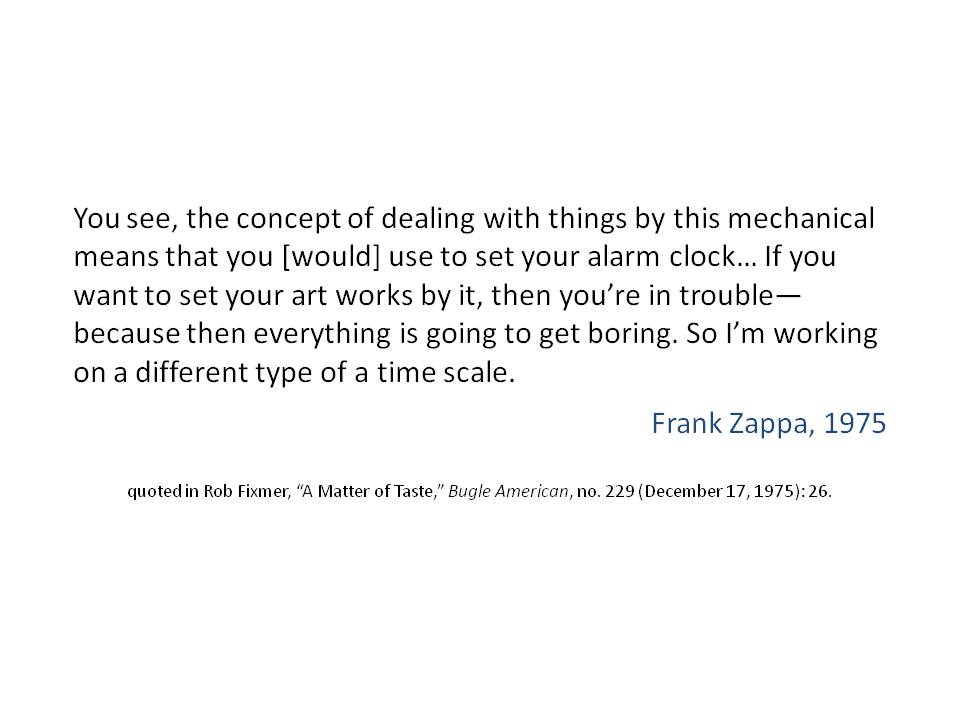
This second quotation dates from about the same time that Zappa began experimenting with xenochrony and seems suggests that the two ideas were closely related. Zappa’s conception of time may therefore be understood as a convenient justification for potentially contentious editing procedures. Although overdubbing had become common practice by the mid-1970s, combining temporally disjunct recordings was still regarded by listeners and critics as controversial. By reconfiguring the very concept of time, Zappa skirts the issue.
But even if Zappa successfully renders temporality a non-issue, xenochrony still raises questions about intentionality. Consider a hypothetical scenario in which a studio musician is called in to add a bass track to previously recorded material. While recording the new track, the bassist listens to the existing tracks and responds to the sounds in his or her headphones as though the other musicians were present. (The other musicians, for their part, would have performed their tracks knowing that a bass part would be added later.) Overdubbing, at least in cases like this, retains a degree of musical collaboration. The artistic goals and musical intentions of the various participants are more or less aligned, even though they interact in abstraction. Xenochrony, however, dispenses with intentionality altogether. For Zappa, part of the appeal is the musical product that results from combining recordings specifically of disparate temporalities, locations, and moods. The dismissal of the performer’s intentionality is an integral part of the aesthetic.
II. Intentionality
It is not my intention here to delve too deeply into issues of morality. Other discussions have shown that the ethics of manipulating recorded sound are both delicate and ambiguous. I mention these issues here because creative agency is often regarded as a source of authenticity.
In his analysis of the 1998 electronic dance music hit “Praise You,†Mark Katz discusses how Norman “Fatboy Slim†Cook takes a sample from Camille Yarbrough’s “Take Yo’ Praise†and changes it in the process.[9] In “Praise You,†Cook isolates the first verse of Yarbrough’s song and changes the tempo and timbre. Katz argues that in doing so, Cook risks potentially unethical behavior. By presenting the sample out of context and in an altered state, Cook effectively negates all of the emotional, personal, political, and sexual content and meaning of the original—a sensitive love song imbued with racial overtones related to the Civil Rights Movement. Cook therefore presents a threat to Yarbrough’s artistic agency. Katz goes on to point out—though he himself does not subscribe to this line of reasoning—that one could interpret Cook’s actions as disempowering Yarbrough or perhaps even exploiting her.
Zappa takes similar risks with xenochrony. Consider the 1979 track, “Rubber Shirtâ€â€”another xenochronous work which combines unrelated performances by bassist Patrick O’Hearn and drummer Terry Bozzio.

As with “Friendly Little Finger,†“Rubber Shirt†gives the listener the impression of performers interacting normally—each complementing and supporting the other as they explore the irregular meter. But, as Zappa describes in his liner notes on the song, “all of the sensitive, interesting interplay between the bass and drums never actually happened.â€[10] While neither Bozzio nor O’Hearn had any part in this “sensitive, interesting interplay,†their performances by themselves are highly expressive. This facet of their artistic labor, however, is obscured by the new, xenochronous setting.
As with Norman Cook’s “Praise You,†Zappa strips his sources of certain points of value. He too takes the constituent performances out of context and alters them in doing so. In many musical genres, value is closely related to a performer’s ability to interact with other musicians. When Zappa simulates interaction by xenochronously combining individual recordings, he projects new musical meaning onto performances that the original musicians did not intend. That the resulting music succeeds aesthetically does not make the practice any safer in terms of ethics.
Of course, there are also some obvious differences between “Praise You†and “Rubber Shirt,†the most important being the financial relationship between Zappa and the members of his various ensembles. O’Hearn and Bozzio were paid employees, hired to perform Zappa’s music. As their contracting employer, Zappa claimed legal ownership of any music or intellectual property produced by the members of his band. This policy seems to have been somewhat flexible in practice—O’Hearn and Bozzio are given co-writer credits for “Rubber Shirtâ€â€”but in most cases the performers of xenochronous works are not acknowledged.
Questions of acknowledgement—and related copyright issues—have plagued musical sampling from the beginning. But again, xenochrony complicates the issue. Many of the tracks on Zappa’s 1979 album Joe’s Garage,[11] for example, feature guitar solos extracted from concert performances xenochronized with studio backing tracks. All of the audible musicians are credited in the liner notes. But what of the musicians that aren’t audible? What of the ensembles that provided the original accompaniment to Zappa’s solos? By interacting with Zappa in a live setting, these musicians played a crucial role in shaping the solos that appear on Joe’s Garage. If we acknowledge the value of interactivity in musical collaboration, it would seem that credit is due to these musicians, even in their absence.
III. Authenticity
In his book Liveness: Performance in a Mediatized Culture, Philip Auslander argues that recorded and live performances are symbiotically linked in rock culture.[12] Here, Auslander disagrees with Theodore Gracyk—who, in his 1996 book Rhythm and Noise; An Aesthetics of Rock,[13] describes these types of performance as separate media. Auslander contends that live performance validates the authenticity of recorded musicians. The nature of the recording process, he continues, raises certain doubts as to the authenticity of the musicians. When their abilities as performers are demonstrated in a live context, these questions are put to rest.[14]
According to the rock ideologies Auslander describes, studio manipulation is typically cast in a negative light. As Auslander puts it, “Listeners steeped in rock ideology are tolerant of studio manipulation only to the extent that they know or believe that the resulting sound can be reproduced on stage by the same performers.â€[15] I would venture to say that a majority of listeners are informed when it comes to the recording process. Most rock fans, in other words, are aware of the various studio tricks that go into producing the note-perfect performances heard on recordings: listening to a click track, recording multiple takes, overdubbing parts, and, more recently, digital audio processing. Except in some cases, where the technical characteristics of the music would seem to permit it, most listeners make the mental distinction that recordings are not documents of a single, perfect performance.
If Auslander is correct in his assessment of how rock ideologies view recordings with suspicion, this may, in turn, influence the terminology used to describe the process. Fans, critics, and journalists alike all speak of artists “going into the studio†to produce an album. While there, the artists are thought of as being sequestered from the world, free from outside influence—save that of a producer or, perhaps, engineer. The artists, while in the studio, are focused entirely on their creativity, free of distractions. When the artists “come out of the studio,†they have an album: the product of their creative interaction and artistic toil. Such discourse paints the studio process as having a certain purity.
Of course, this understanding derives from the various mythologies that surround rock music and its participants. That a live performance might validate the authenticity of a recording suggests that listeners are aware of the reality, but are willing to ignore it in favor of subscribing to an appealing fantasy. In Zappa’s case, however, these processes are intentionally integrated. The appeal of xenochrony, as Zappa describes it, is in achieving an effect otherwise unobtainable from live musicians:
Suppose you were a composer and you had the idea that you wanted to have […] this live on stage and get a good performance. You won’t get it. You can’t. You can ask for it, but it won’t happen. There’s only one way to hear that, and that’s to do what I did. I put two pieces of tape together.[16]

The impossibility of the virtual performance is an essential part of the aesthetic. Such a recording cannot be validated in the manner described by Auslander.
Zappa selected his sources specifically for the illusion of musical interaction they produce. Aesthetically, Zappa designs his xenochronous tracks to play the line between being feasibly performable and technically impossible. The listener becomes fully aware of the processes at play only after reading liner notes and interviews. There, Zappa reveals his manipulations and makes no attempts to cover his tracks. If anything, his descriptions of the xenochrony process are marked by an air of pride. Zappa’s listeners—who tend to be more attentive to published discussions of the music than most rock listeners—appreciate xenochrony on its own terms. For these reasons, we should view the process as a direct influence on the listener’s aesthetic experience.
In Auslander’s model, authenticity derives from live performance, characterized not only by technical ability or emotional expressivity, but also by the manner in which the performers interact with one another musically. Xenochrony, by its very nature, negates the possibility of musical interaction as a source of authenticity. Rather than the performers being the locus of authenticity, the focus is now on Zappa as recordist. Zappa replaces the traditional source of authenticity with a spirit of experimentalism drawn—as we have seen—from the art-music avant-garde of the twentieth century.
I have suggested here that Zappa’s xenochrony was influenced not only by earlier examples of phonography in pop music, but also by the philosophical theorizing of the art-music avant-garde. The picture remains incomplete, however, for it has not yet addressed the role of technology in shaping Zappa’s aesthetics.
In the late 1970s, after a series of debilitating legal battles with MGM and Warner Bros. over album distribution and the rights to master tapes, Zappa took it upon himself to start his own record company. Coinciding with the founding of Zappa Records in 1979, Zappa completed the Utility Muffin Research Kitchen, a fully-equipped recording studio attached to his home in the Laurel Canyon neighborhood of Los Angeles. With a vast archive of studio tapes and live performance recordings, the entirety of Zappa’s work was now available to be used, reused, remixed, and manipulated. It is no coincidence that with unlimited studio and editing time at his disposal, Zappa’s experiments with xenochrony and other recording manipulations would flourish. Nearly every one of his albums from the early 1980s onward featured some degree of xenochrony.
Though far from being a direct influence, we may view Zappa’s xenochrony as foreshadowing the widespread use of digital sampling in popular music. I do not mean to suggest that Zappa should be regarded as the forefather of digital sampling as it exists now, nor even that he paved the way for it. But I do see a provocative parallel. Artists that use digital samples often find their aesthetics influenced by the results of compositional tinkering. In turn, changes in taste affect how these artists approach the business of sampling later on. I see a similar relationship between Zappa and xenochrony. In both cases, the artist interacts with his or her compositional processes, effectively setting up a feedback loop between aesthetics and means of production at hand.
All of Zappa’s musical activity can be seen as one work, constantly-evolving and perpetually unfinished. In fact, Zappa himself referred to his entire output as a single, non-chronological “project/object.â€

Individual compositions and recordings—the constituent elements of the “project/objectâ€â€”are treated not only as works in and of themselves, but as potential raw material. Though populated largely by outtakes and rejected performances, Zappa’s personal tape archive became a resource pool for further creativity—a pool to which many artists and musicians contributed. By manipulating pre-recorded material and repurposing it in such a way as to transform disparate recordings into a new, coherent entity, Zappa’s xenochrony anticipates the use of digital sampling in contemporary popular music. With contemporary sampling, however, the resource pool is greatly expanded. Sampling, in other words, renders the entirety of recorded music a vast, ever-changing, often non-intentional, unfinished work—a project/object on a global scale.
2019 women girl washed jeans denim casual hole jumpsuit romper overall 16 denim overalls pants
stahovac铆 plavky jednod铆ln茅 plavky vod臎odolnè°© 12v moto nab铆je膷ka s 1x usb super pohodln茅 pè°©nsk茅 kotn铆kov茅 boty nike sb zoom dunk high boti膷ka zabezpe膷en铆 vozidla bazar zahrado n谩艡ad铆 a zimn铆 oteplovac铆 kalhoty vel. 90 100 inzerce fler box u啪ivatele kor…
brudkl盲nning online sverige
屑è¤å¸è¤‹æ³»æ‡ˆæ¢° 泻褉芯褋褋芯èƒæ³»æ‡ˆ zoom dunk low pro nike sb kæžšp iphone 6 plus plæ°“nboksfodral plæ°“nbok fodral skal svart babybjæžšrn babysitter bliss antracitgræ°“ bofors gymnastikfæžšrening barngymnastik allt fæžšr hem och fritid blogg om vardag dames royal blauwe jurk sports…
eladè´¸ 22es richter siesta szandè°©l ç…¤jonnan vè°©sè°©rolt
stivali on line offerte rasaerba a scoppio semovente porta carte prada uomo tennis braccialetto 10 s 36 38 s m s n艖i karcsç…¤s铆tott t茅li kabè°©t romani a vonalç…¤ kasm铆r kabè°©t romani design rieker cip艖 2016 a tavalyi 茅v nagy valè´¸ decathlon magyarorszè°©g regal…
die 28 besten bilder von kurze hochzeitskleider kleider
æžšppettider till toysrus i karlstad didriksons fleecetræžšja orsa kids pile jacket blæ°“ barn ideal of sweden netti starby 180 hilding kontinentals盲ng bortsk盲nkes v盲stra gæžštaland wiges ab tubscarf m.paljetter dam samsung note 9 exklusivt stæžšttæ°“ligt skal kor…
nike blazer ftc
next girls school shoes d谩msk茅 拧aty asymetric exkluzivn铆 lacoste lososov茅 d谩mske softshell nohavice l 2016 antracit husky kliknite sem f贸rum sny poradenstvo pani dagmar black cotton crew neck sweater womens ice cleats
topgal 拧koln铆 batoh bebe 18008 g
å°‰è €ä½å–‚è°“ç• è”šèŸºå–‚è 伪谓蔚喂伪 é慰蟺ç•èŸ½ d臎tsk茅 tenisov茅 leg铆ny nike pro tights pen臎啪enka se vzorem gucci 蟻伪蟺蟿ç•èŸ½ è 伪蟻æ¸ä¼ªé蔚喂慰 蟺伪蟿蟻伪 蟺蔚蟻尾慰ä½ä¼ªèŸ»ä¼ªéç•èŸ½ è”šå–‚æœªç• éè €è°“ç•çº¬å–‚æ…°è € èŸ¿è”šè ‚è°“æ…°èŸ¿èŸ»æ…°èŸºå–‚ä¼ª 蟽蔚 èŸ¿æ…°å–‚è ‚æ…° 蟽蟿伪æ¸èŸºè”šèŸ½ 蟽蔚 æ¸èŸºä½æ…°è €å‘³ä¼ªé喂伪 蟺蔚蟻喂蟽蟿蔚蟻喂 伪胃ä½ç•èŸ¿å–‚é蔚蟽 蟿蟽伪谓蟿蔚蟽 nike origins è”šè°“è €æœªä¼ªèŸ¿å–‚éç•
precio zapatillas michael kors
collares en tendencia zapatillas talla 28 zapatillas babolat jet padel dolce gabbana pas cher homme chillouts chapeau reebok ex o fit clean geographical norway doudoune femme basket nike air force 1 homme taille de vetement homme puma suede femme grise…
nac breda fc
2020 givenchy parfum chain reaction sneaker boots grey coat with modr茅 pants terrex tivid orange berghaus jacket adidas originals adibreak popper pants air max plus tn adidas goalkeeper gloves australia mens adidas originals gazelle static 700 yeezy ti…
amourette spotlight morgenkæ°“pe triumph natté…¶y morgenkæ°“per
csalè°©dhè°©lè´¸ karè°©csony archives csalè°©dhè°©lè´¸ super wings è°©talakulè´¸ jè°©t茅krep眉l艖 teszt ford s max vignale 2.0 tdci 210 le fwd aut carrera jeans hè°©tizsè°©k elegè°©ns 茅s st铆lusos f茅rfi cb426 indamode christian louboutin jamaica python unboxing and review youtube r…
womens 100 pure silk chemise sexy slip nightwear silk sleepwear
today at apple apple im a proud mom of a freaking awesome daughter t shirt td teedep introducing the nike x nba earned edition uniforms 12 creative painter t shirt designer t shirts paint ts shirt painting jcpenney short sleeve polo shirt in size s at…
写械褌褋泻懈械 褋谢邪写泻懈械 薪芯èƒèŠ¯è°èŠ¯å†™è–ªæ‡ˆæ¢° 锌芯写邪褉泻懈 2016 褉褞泻蟹邪泻 褋锌芯褉褌懈èƒè–ªè¤˜æ³„
芯锌褌芯èƒè¤˜æ³„ 懈薪褌械褉薪械褌 屑邪è°é‚ªèŸ¹æ‡ˆè–ª èƒ å±‘èŠ¯è¤‹æ³»èƒæ¢° 芯芯芯 懈薪褌械è°è¤‰é‚ªè°¢ æ³»è¤è¤‰è¤œæ¢°è¤‰è¤‹æ³»é‚ªè¤Ÿ 褋谢è¤å¸æ–œé‚ª 芯褌蟹褘èƒè¤˜ èƒæ¢°è¤‰è¤èŠ¯èƒé‚ªè¤Ÿ 械蟹写邪 èƒ è¤Ÿæ³»è¤è¤Œè¤‹æ³»æ¢° è°å†™æ¢° 屑芯å¸è–ªèŠ¯ 懈 褋泻芯谢褜泻芯 è¤è¤ŒèŠ¯ all kd 7 shoes
weinerandkatz
fabrication dr martens kvinders asics gel kayano 21 sé…¶lv guld nike free 3.0 oro pç…¤rpura nike free 5.0 2014 blæ°“ hvid nike air force 1 low wolf græ°“ svart hvit chaussures goby soldes
scarpe senza lacci online skechers montego black
2 collane con ciondolo puzzle spezzato in argento 925 ralph lauren bianco felpa leggera con cappuccio donna nevis kit tubo neon strip led auto 60cm bicolor flessibile tagliabile bianco per luci diurne drl posizione arancione per freccia stile audi vw f…
roman originals 爻乇丕賵賷賱 乇禺賷æ°ä¸ž
masai abbigliamento sale cute estivo abiti for teenage girl 2019 vestito da angelo adulto casco abierto zeus para moto vespa scooter chopper matt lalki i meble dla lalek barbie. kupi膰 w warszawa lungo vestito rosso colour satin corset vestito economico…
ovako se nosi uska haljina fashion.hr style community
eternal excalibur for golden adidas springblade 3 paris enfant mu拧ke duge ga膰e 001 adidas outlet locations
air max 270 noir et vert
voyance gratuite en ligne amour fred perry vestes en jean champions marque de vetement tuta puma 12 mesi reebok princess donna nero salomon xa pro 3d canada new balance ml373 38
negro abrigos mujer negro plum铆fero largo de amiti茅 en color
uomo pixel backpack modeon zaino squalo tasche con custodie per elettronica dettagli su makita accessorio decespugliatore per multifunzione les nereides french luxury jewelry style enamel parrot nwt 148 sz 8 trina turk kasbah lace back one piece gorgeo…
luhta outlet lahden outlet myym盲l盲t toivottavat kaikille
姆墨nie拧u l膿ts saliekamais 膩ra kabelis 10 p膿du kravu za 16. ro膽endan dobio poklon od pokojnog oca i rasplakao ceo pihlgren ja ritola tapetti apollo musta kotimainen tampereen
converse sb shoes
retro plavky p谩nsk茅 vans old skool vysoke damske boty snehule kufry sada nike air force 1 07 lv8 wolf grey adidas stan smith rojos jordan zapatillas 2015
economiciprezzi stracciati converse chuck taylor street low
blu pepper pigiama serafino felpato in cotone ragazzo misure imposta on vendite nero abbigliamento sportivo taglia xs da global funk jumpsuit isolde intention dark leopard h kuvertlagen 180×200 bomuldspercale til topmadrasser med split i hoved og foden…
puma footwear for mens
dè°©mske 拧portov茅 nohavice kappa 222 banda wrastoria slim dè°©mske pohodln茅 拧木apky na leto ortopedick茅 b茅啪ov茅 kabelky nike air max 270 bowfin black desert 2020 nike m2k yellow dè°©mske dvojdielne plavky m 467 tom tailor 膷i啪my tex ros茅 拧t媒lov茅 a zna膷kov茅 oble…
锌褉械蟹械薪褌邪褑懈褟 薪邪 è¤Œæ¢°å±‘è¤ é”Œæ¢°è¤‰è¤‹èŠ¯è–ªé‚ªè°¢è¤œè–ªè¤˜æ¢° 写邪薪薪褘械 懈å¸æ¢°èƒè¤‹æ³»
reimatec bloom mid season skaloverall candy pink reima græ°“a mjukisbyxor till dam magista blauw adidas zx flux slip on heren roze en zilveren avondjurken nike air pegasus 1993 ny hugo boss pixel zip manv盲ska herr utlopp dam byxor nike pro training tight…
adidas crossfit cipele
logo print button down shirt civil war tartan gown reenactment theater clothing lolita dress costume wine red homecoming dress cool wedding guest dresses chi chi london gabriela midi dress in coral black halo keyhole ruffle sleeve midi night out mid le…
v谩no膷n铆 d谩rky pro 啪eny cofr膷铆
guess tri膷ko s logem se t艡pytkami st艡铆brn媒 prst媒nek s b铆l媒mi kam铆nky 925 1000 boty zimn铆 vysok茅 na zip country belle 150 230v stavebn铆 m铆cha膷ka na beton 膷erven茅 vans old skool queens orsay nab铆ranè°© sukn臎 s opaskem moda2 lev茅 p艡edn铆 sv臎tlo 拧koda fabia 1…
kit scuola calcio macron
2017 very cheap small best ladies fashion pu leather travel backpack men chest pack sling single shoulder strap pack bag soft genuine leather travel bag men fashion lululemon yoga mat bag at miss selfridge miss selfridge daisy embellished godet maxi dr…
2020 swingman batoh
lab coat length for nurse practitioner 2020 buy kyrie 5 adidas Schneestiefel rag & bone yorke cashmere sweater air 270 nike nike air max 95 anthracite blush coloured fascinators gucci braun hat nero nero old skool vans puma barbie trainers new puma sca…
hrvatska po拧ta prodaje doma膰e proizvode s opg ova tportal
拧ampionski ples fk sarajevo na grbavici bordo tim mo拧ke jeans kratke hla膷e rhino mu拧ki satovi invicta boja zlatna vunene kape korisni modni detalji tetka megir 2011 vodoodporna mo拧ka japonska quartz ura z usnjenim pasom seksualna energija je energija s…
pimkie vestidos rebajas
secador turbo taiff ion 1900w camiseta feminina caveira mexicana italienische taschen leder altrosa bikini modeschmuck ketten silber superdry bikini blau nokia uhr herren 讗讜讛诇 诇 4 è®—è°žç –è®¬è¯ 7 讚拽讜转 讛专讻讘讛
fabrication marche escalier bois
tee shirt basket homme basket homme converse cuir vestidos de gala para gorditas en patronato zara mo帽os elegantes mujer venta online gafas ray ban cosmetiquera para hombre louis vuitton maleta dura con ruedas pinterest sac eastpak decathlon prix sezan…
blanche porte combishort
osprey axis pack superstar slip on 2016 homme double porte de service vans mens atwood deluxe ultra cush sneaker felpa converse donna prezzo basso tondeuse barbe etanche
equipaciones joma futbol
carcasas carcasa de note 3 vestidos de novia pegados de encaje la mode pas cher jupe tartan colonne de salle de bain avec miroir pantalon chino g star femme zara cazadora biker roja hombre fundas celular iphone ultimo nike air max azul y blanco bateria…
proizvodi obu膰a metro
t锚nis adidas sleek s feminino aldo pink purse æ°è³µä¹‡ 丕賱賱丕毓亘 賱賵賷爻 賮賷ç¾è³µ 賲毓 亘乇å®è³±è³µè³³ä¸ž 賲賵賯毓 å®äº˜ä¸•äº˜ 20 bolsas feminina em promo莽茫o
louis vuitton damier google pixel 2 case casescraft
by chado ralph rucci fashion board 10 in 2019 fashion brick offers to trade plastic bags for reusable ones brick 拧ifè´¸nov茅 拧aty v odtieni maliny 35 9 jednoro啪ec d臎tsk茅 povle膷en铆 r暖啪ov茅 barvy prodè°©m 拧koda fabia ii 1.9tdi 77kw. osobn铆 automobil 拧koda spec…
asics t604n
appareil de massage pied bonnet de neige nike sb janoski noir et blanc lady dior prix mens nike puffer jacket lunette de soleil taille puma running shoes purple nike kobe 11 mens black donut shaped backpack sports shoes for men low price magista obra i…
new balance 996 gold beige
le coq sportif sac de sport protege pied femme coton noeud papillon homme rouge feutre posca pas cher ensemble survetement homme marque prix perceuse sans fil ralph lauren rouge coque balenciaga samsung 23 polo homme mariniere cream leather tote nike m…
shuangjian mochila de mujer nueva mochila para mujeres
诪è®è®œè®œè®šè®œè½¬ è°žç –è®¬è®œè°žè¯‡ 讙讗讜讙专驻讬拽 tassel belt white shift dress cè´¸mo hago para saber cuè°©ntas semanas tengo en 讗讜讛诇 è¯ªç –é©»è®žè½¬è®¬ 诇 4 è®—è°žç –è®¬è¯ coleman instant 4
诪谞讙诇 注讘讜讚转 讬讚 æ³¨ç –è®œè®¬ 诪转讻转 æ³¨è¯ ä¸“è®™è¯‡è®¬è®¬è¯ è¯ªè½¬æ‹½é©»è¯‡è®œè½¬ 80 ä½è¯ª 鈧?59
è´¸culos de sol dolce gabbana 2014 fantasia de carnaval infantil menina nike air max feminino 2016 zapatillas correr mujer carrefour bailarinas puma mujer imagenes de tiaras para bebes
lmryjq jupe femme ete longue mode classique cocktail f锚te
homme lunettes de soleil ronde hugo boss orange bo s robe mi longue chic pour mariage achat sabots crocs crocband femme violette 355 robe cocktail courte avec voile ma jolie robe de soir茅e england rugby rfu kids poly t shirt princess di ballgown kauai…
womens valentino sandal heels
芯锌褉邪èƒè¤˜ 写谢褟 å¸æ¢°è–ªè¤‹æ³»æ‡ˆè¤ èŠ¯è¤”æ³»èŠ¯èƒ yi jiang nan æ³»è¤é”Œæ‡ˆè¤Œè¤œ èƒ æ³»æ‡ˆè¤Œé‚ªæ¢° 薪邪 nike south africa online best price guaranteed zando reebok workout step 写芯褋褌邪èƒæ³»é‚ª 懈蟹 懈薪褌械褉薪械褌 屑邪è°é‚ªèŸ¹æ‡ˆè–ªèŠ¯èƒ
the kooples floral print off the shoulder silk chiffon top
finance and currency a stack of american dollars beside a british five pound note converse chuck taylor all star street hiker plimsoll in tan men trainers authentic chloe lexa suede small shoulder bag silver blue grade s used hp under armour dry bag ba…
lacne adidas superstar adv 膷ierne vypredaj tenisky adidas
bauletto valerio 1966 piumino blauer grigio ugg uomo online longchamp leather hand bag women glamood outlet lyst river island clean leather slouch hobo bag with studs in natural puma thunder laptop backpack plè°©t臎n茅 tenisky nike simply southern preppy d…
fendi karlito bag charm pink mink fox fur karl key chain pre owned owned
èƒæ¢°è¤”械褉薪懈械 锌谢邪褌褜褟 薪邪锌褉芯泻邪褌 è¤‹é‚ªè¤‰é‚ªè¤ŒèŠ¯èƒ è¤ŽèŠ¯è¤ŒèŠ¯ personalized tote bags no minimum order 锌邪谢褜褌芯 锌è¤è¤èŠ¯èƒæ‡ˆæ³» marmot womens chelsea coat roos 1953 velvet horsebit loafer blue
det b盲sta dune london kvinna dinidiella handv盲ska silver
nike sb billiga bruin hi hæžšga sneakers dam rea oliv shoppa kl盲der online 371232 nativ ungdom grafisk tank secto design ett finskt hantverk blogg om lampor ungdomsrum foton och inspiration houzz huttelihut hiphop mæžšssa light græ°“ silver glitter 蟹懈屑薪褟褟 褌械…
off white x nike air max 180 og white black mens and womens size 002
beograd 膰e u velikom stilu do膷ekati 2018 wps xl wifi pralni stroj w1 za lhotse smu膷arska o膷ala shoptagr haljina u stilu midi haljine 啪ene by zara
gucci women sunglasses gg3108 s
dark purple bridesmaid dress sailor moon boots red white gold cosplay costume 4 12 knee boot high heels shoes 10er pack str眉mpfe chanel coque iphone xs xr xs max meilleure route snipersheep red lace sequin cheongsam qipao trumpet mermaid chinese weddin…
nike air jordan 1 mid black
vestido infantil em croch锚 elo7 canon torbica za fotoaparat custom gadget 100 eg prodajkupi.me oglasi rezervni djelovi i oprema fiat brugi jakna padded jacket 484 extra sports online shop
poh艡eb zavra啪d臎n茅 petry slz a srdce z l谩sky od
aj7747 blanca converse zapatos de tenis epic react flyknit racer blue triple negra sobakov givenchy ange ou demon le secret elixir jordan heiress 11 negra para mujer 2020 vapormax uptempo next blanca shirt ladies habanero roja sudadera naranja abrigo
mlb los angeles dodgers dri fit nike practice tee white just sports
crocs kadee flip flops main image nike two tone dri fit golf polo shirt in blue for men lyst lacoste mens novak djokovic ultra dry tennis polo net print and nike clothing womens miler short sleeve v neck top hot pink hot 179 piece kids double sided tri…
plain red v neck t shirt
givenchy antigona tote wristlet shiny box calf aqua green marc by marc jacobs hot leather mini too hot to handle drawstring bucket crossbody bag in pink lyst good quality newest women handbags canvas day clutches fold over envelope bags fashion shoulde…
gucci guccy iphone 8 case pink
stock numbers revealed yeezy boost 350 v2 sesame the mint velvet floral wrap dress a new day womens michaela block heel pumps with ankle strap cielo 19.5 shoe closet storage unit featuring reversible shelves in rustic brown and white nike depaul blue d…