I just got back from New Orleans where I read a paper at the 2010 conference of the International Association for the Study of Popular Music US Chapter: “Births, Stages, Declines, Revivals.” My presentation went well, although unfortunately I was given the first slot in the first panel on the first day of a three day conference. (8:30 AM on Friday morning!) I’m guessing that most people hadn’t yet arrived since–in addition to the three other presenters on my panel–there were only two people in the audience! Oh well.
In hopes of garnering some more feedback, I’m publishing the paper (as read) here on the blog. As usual, this remains a work in progress.
Click here to download a PDF version of the paper. (Slides and visual examples appear at the end of the PDF.) Or, follow the jump to read the html version.
Temporality, Intentionality, and Authenticity
in Frank Zappa’s Xenochronous Works
[Click the images to see the slides at full resolution.]
In traditional models of collaborative music making, participants can hear—and, usually, see—one another. Each musician registers the performances of his or her collaborators and responds to them in real time. Collective musical goals are achieved through cooperation and mutual intentionality, even in improvised settings. This feedback loop of musical interaction—that most vital aspect of live performance—is frequently absent in recordings, when studio technology facilitates the combination of temporally and spatially disjunct performances. Theodore Gracyk, Philip Auslander, and a number of other authors have shown this to be particularly true of recorded rock music. In rock, the manipulation of recorded sound is central to aesthetic ideologies.
Lee B. Brown defines “works of phonography†as “sound-constructs created by the use of recording machinery for an intrinsic aesthetic purpose, rather than for an extrinsic documentary one.â€[1]

Documentary recordings may—and often do—comprise the constituent ingredients of such works; but overdubbings, tape-splicings, and other editing room procedures deliver to the listener a virtual performance, an apparition of musical interaction that never took place. Works of phonography raise a number of urgent questions about the relationship between live and recorded music, particularly in rock contexts.
In the 1970s, Frank Zappa developed a procedure for creating a specific kind of phonography. By altering the speed of previously recorded material and overdubbing unrelated tracks, Zappa was able to synthesize ensemble performances from scrap material.

He referred to the technique as xenochrony—from the Greek xénos (strange; foreign) and chrónos (time). Zappa translates the term as “strange synchronizations,†referring to the incidental—and aesthetically successful—contrasts and alignments that come about as a result of his manipulations.
Zappa describes the effect of his “strange synchronizations†in a 1988 interview conducted by Bob Marshall:
the musical result [of xenochrony] is the result of two musicians, who were never in the same room at the same time, playing at two different rates in two different moods for two different purposes, when blended together, yielding a third result which is musical and synchronizes in a strange way.[2]

By combining separately-recorded performances, such music easily meets Brown’s criteria. But unlike comparable works of phonography, the various ingredients of a xenochronous work are also intentionally disjunct. Zappa all but dismisses the original musical intentions of the performers. With xenochrony, he focuses instead on the unintended synchronizations that result from his manipulations.
In many cases, rock artists and producers mask their methods. Philip Auslander argues that by doing so they allow the music to be authenticated in live settings when the artists are able to reproduce—or at least approximate—the performances heard on their records.[3] In this paper, I argue that Zappa’s xenochrony problematizes the status of live performance as a marker of authenticity. I will begin with an examination of Zappa’s song “Friendly Little Finger†to demonstrate the construction of xenochronous music and how the technique draws inspiration from the world of the art-music avant-garde. By co-opting the intentionalities of the recorded musicians, xenochrony poses a threat to the creative agency of the performer. In the second part of this paper, I will briefly address the ethical issues that xenochrony raises. Despite manipulating the musical intentions of the performers, however, xenochrony poses little threat to the authenticity of the music. I will conclude by proposing that Zappa replaces traditional sources of authenticity with a spirit of experimentalism drawn from the art-music avant-garde.
I. Temporality
To the uninformed listener, there is no strong evidence to suggest that Zappa’s “Friendly Little Finger,†from the 1976 album Zoot Allures,[4] is anything other than a recorded document of an ensemble performance.

The piece begins with a brief introduction featuring a repeated riff performed on guitar, marimba, and synthesizer. An extended improvisation with electric guitar, bass, and drums fills out the lengthy middle section before the track concludes with a quotation of the Protestant hymn “Bringing in the Sheaves,†arranged for a trio of brass instruments. Despite its apparent normalcy, however, “Friendly Little Finger†combines materials from four distinct sources spanning three years of Zappa’s career.
The primary recording—a guitar solo with a droning bass accompaniment—was recorded in the dressing room of the Hofstra University Playhouse as a warm-up before a performance on October 26, 1975. Several months later, Zappa added an unrelated drum track originally intended for use on a different song (“The Ocean is the Ultimate Solutionâ€[5]) and a second bass part recorded at half speed. These three recordings, all appearing in the middle solo section, comprise the xenochronous core of the piece. To this, Zappa superimposed two additional recordings. The introduction comes from the same session as the added bass part, and the coda was recorded several years earlier, during a session for the song “Wonderful Wino.”
As Example 1 makes clear, the result of Zappa’s editing is a moderately dense network of temporally disjunct recordings. How is it that such seemingly disparate recordings happened to come together in this way? What inspired Zappa to take such an approach to manipulating recorded sound? Of course, examples of overdubbing in American popular music can be found at least as far back as the 1940s—recall Sidney Bechet’s One Man Band recordings in which each instrument was performed separately by Bechet himself. But while such tricks had become old hat by the mid 1970s, xenochrony stands out for it also has obvious ties to the twentieth-century art-music avant-garde.
Despite his continuing reputation as a popular musician, Zappa was remarkably well read in the theoretical discourse surrounding avant-garde art music, particularly with regards to musique concrète and tape music. He expressed an ongoing interest in John Cage’s chance operations, for example, trying them out for himself by physically cutting recorded tapes and rearranging the pieces at random for the 1968 album Lumpy Gravy.[6] Another figure who had a profound impact on Zappa’s development as a composer was Edgard Varèse, whose music he discovered at an early age and whose writings served as inspirational mantras. Given this fascination with the avant-garde, xenochrony may be best understood as a conscious attempt by Zappa to model himself on these influential figures. His own approach to music and composition would therefore require an analogous theoretical foundation.
Xenochrony is closely tied to Zappa’s conception of temporality. Zappa often described time as a simultaneity, with all events occurring at once instead of chronologically. Toward the end of his life, in an oft-quoted conversation with cartoonist Matt Groening, Zappa explained that the idea was rooted in physics:
I think of time as a spherical constant, which means that everything is happening all the time. […] They [human beings] take a linear approach to it, slice it in segments, and then hop from segment to segment to segment until they die, and to me that is a pretty inefficient way of preparing a mechanical ground base for physics. That’s one of the reasons why I think physics doesn’t work. When you have contradictory things in physics, one of the reasons they became contradictory is because the formulas are tied to a concept of time that isn’t the proper model.[7]

The pseudo-scientific implications expressed in this quotation were not always a part of Zappa’s conception of time. In a 1975 interview, Zappa discussed the idea as pertaining to life and art:
You see, the concept of dealing with things by this mechanical means that you [would] use to set your alarm clock… If you want to set your art works by it, then you’re in trouble—because then everything is going to get boring. So I’m working on a different type of a time scale.[8]
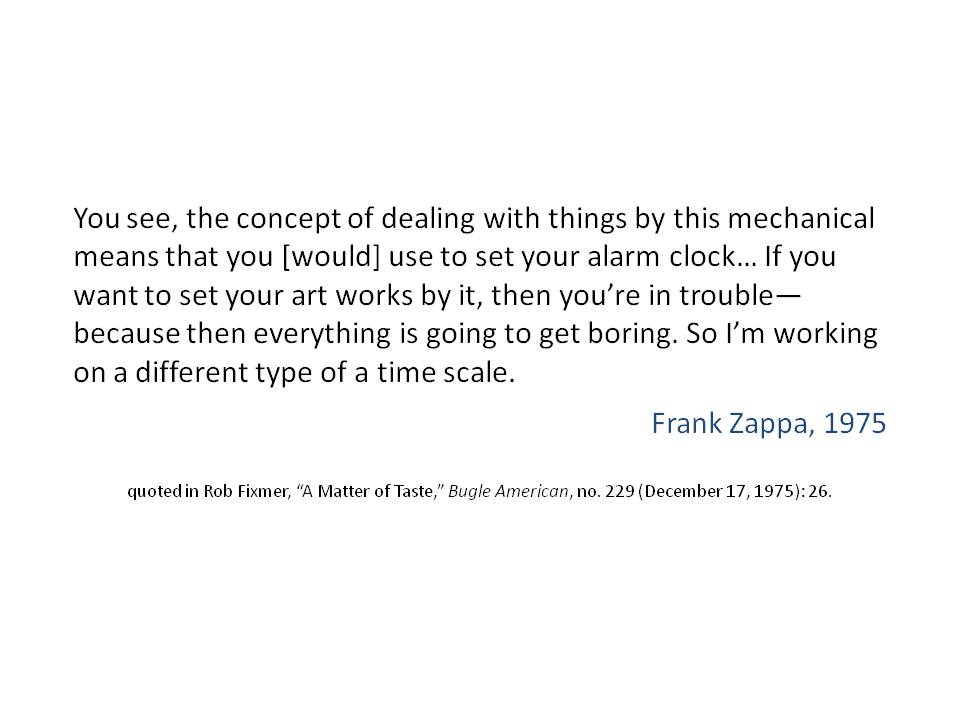
This second quotation dates from about the same time that Zappa began experimenting with xenochrony and seems suggests that the two ideas were closely related. Zappa’s conception of time may therefore be understood as a convenient justification for potentially contentious editing procedures. Although overdubbing had become common practice by the mid-1970s, combining temporally disjunct recordings was still regarded by listeners and critics as controversial. By reconfiguring the very concept of time, Zappa skirts the issue.
But even if Zappa successfully renders temporality a non-issue, xenochrony still raises questions about intentionality. Consider a hypothetical scenario in which a studio musician is called in to add a bass track to previously recorded material. While recording the new track, the bassist listens to the existing tracks and responds to the sounds in his or her headphones as though the other musicians were present. (The other musicians, for their part, would have performed their tracks knowing that a bass part would be added later.) Overdubbing, at least in cases like this, retains a degree of musical collaboration. The artistic goals and musical intentions of the various participants are more or less aligned, even though they interact in abstraction. Xenochrony, however, dispenses with intentionality altogether. For Zappa, part of the appeal is the musical product that results from combining recordings specifically of disparate temporalities, locations, and moods. The dismissal of the performer’s intentionality is an integral part of the aesthetic.
II. Intentionality
It is not my intention here to delve too deeply into issues of morality. Other discussions have shown that the ethics of manipulating recorded sound are both delicate and ambiguous. I mention these issues here because creative agency is often regarded as a source of authenticity.
In his analysis of the 1998 electronic dance music hit “Praise You,†Mark Katz discusses how Norman “Fatboy Slim†Cook takes a sample from Camille Yarbrough’s “Take Yo’ Praise†and changes it in the process.[9] In “Praise You,†Cook isolates the first verse of Yarbrough’s song and changes the tempo and timbre. Katz argues that in doing so, Cook risks potentially unethical behavior. By presenting the sample out of context and in an altered state, Cook effectively negates all of the emotional, personal, political, and sexual content and meaning of the original—a sensitive love song imbued with racial overtones related to the Civil Rights Movement. Cook therefore presents a threat to Yarbrough’s artistic agency. Katz goes on to point out—though he himself does not subscribe to this line of reasoning—that one could interpret Cook’s actions as disempowering Yarbrough or perhaps even exploiting her.
Zappa takes similar risks with xenochrony. Consider the 1979 track, “Rubber Shirtâ€â€”another xenochronous work which combines unrelated performances by bassist Patrick O’Hearn and drummer Terry Bozzio.

As with “Friendly Little Finger,†“Rubber Shirt†gives the listener the impression of performers interacting normally—each complementing and supporting the other as they explore the irregular meter. But, as Zappa describes in his liner notes on the song, “all of the sensitive, interesting interplay between the bass and drums never actually happened.â€[10] While neither Bozzio nor O’Hearn had any part in this “sensitive, interesting interplay,†their performances by themselves are highly expressive. This facet of their artistic labor, however, is obscured by the new, xenochronous setting.
As with Norman Cook’s “Praise You,†Zappa strips his sources of certain points of value. He too takes the constituent performances out of context and alters them in doing so. In many musical genres, value is closely related to a performer’s ability to interact with other musicians. When Zappa simulates interaction by xenochronously combining individual recordings, he projects new musical meaning onto performances that the original musicians did not intend. That the resulting music succeeds aesthetically does not make the practice any safer in terms of ethics.
Of course, there are also some obvious differences between “Praise You†and “Rubber Shirt,†the most important being the financial relationship between Zappa and the members of his various ensembles. O’Hearn and Bozzio were paid employees, hired to perform Zappa’s music. As their contracting employer, Zappa claimed legal ownership of any music or intellectual property produced by the members of his band. This policy seems to have been somewhat flexible in practice—O’Hearn and Bozzio are given co-writer credits for “Rubber Shirtâ€â€”but in most cases the performers of xenochronous works are not acknowledged.
Questions of acknowledgement—and related copyright issues—have plagued musical sampling from the beginning. But again, xenochrony complicates the issue. Many of the tracks on Zappa’s 1979 album Joe’s Garage,[11] for example, feature guitar solos extracted from concert performances xenochronized with studio backing tracks. All of the audible musicians are credited in the liner notes. But what of the musicians that aren’t audible? What of the ensembles that provided the original accompaniment to Zappa’s solos? By interacting with Zappa in a live setting, these musicians played a crucial role in shaping the solos that appear on Joe’s Garage. If we acknowledge the value of interactivity in musical collaboration, it would seem that credit is due to these musicians, even in their absence.
III. Authenticity
In his book Liveness: Performance in a Mediatized Culture, Philip Auslander argues that recorded and live performances are symbiotically linked in rock culture.[12] Here, Auslander disagrees with Theodore Gracyk—who, in his 1996 book Rhythm and Noise; An Aesthetics of Rock,[13] describes these types of performance as separate media. Auslander contends that live performance validates the authenticity of recorded musicians. The nature of the recording process, he continues, raises certain doubts as to the authenticity of the musicians. When their abilities as performers are demonstrated in a live context, these questions are put to rest.[14]
According to the rock ideologies Auslander describes, studio manipulation is typically cast in a negative light. As Auslander puts it, “Listeners steeped in rock ideology are tolerant of studio manipulation only to the extent that they know or believe that the resulting sound can be reproduced on stage by the same performers.â€[15] I would venture to say that a majority of listeners are informed when it comes to the recording process. Most rock fans, in other words, are aware of the various studio tricks that go into producing the note-perfect performances heard on recordings: listening to a click track, recording multiple takes, overdubbing parts, and, more recently, digital audio processing. Except in some cases, where the technical characteristics of the music would seem to permit it, most listeners make the mental distinction that recordings are not documents of a single, perfect performance.
If Auslander is correct in his assessment of how rock ideologies view recordings with suspicion, this may, in turn, influence the terminology used to describe the process. Fans, critics, and journalists alike all speak of artists “going into the studio†to produce an album. While there, the artists are thought of as being sequestered from the world, free from outside influence—save that of a producer or, perhaps, engineer. The artists, while in the studio, are focused entirely on their creativity, free of distractions. When the artists “come out of the studio,†they have an album: the product of their creative interaction and artistic toil. Such discourse paints the studio process as having a certain purity.
Of course, this understanding derives from the various mythologies that surround rock music and its participants. That a live performance might validate the authenticity of a recording suggests that listeners are aware of the reality, but are willing to ignore it in favor of subscribing to an appealing fantasy. In Zappa’s case, however, these processes are intentionally integrated. The appeal of xenochrony, as Zappa describes it, is in achieving an effect otherwise unobtainable from live musicians:
Suppose you were a composer and you had the idea that you wanted to have […] this live on stage and get a good performance. You won’t get it. You can’t. You can ask for it, but it won’t happen. There’s only one way to hear that, and that’s to do what I did. I put two pieces of tape together.[16]

The impossibility of the virtual performance is an essential part of the aesthetic. Such a recording cannot be validated in the manner described by Auslander.
Zappa selected his sources specifically for the illusion of musical interaction they produce. Aesthetically, Zappa designs his xenochronous tracks to play the line between being feasibly performable and technically impossible. The listener becomes fully aware of the processes at play only after reading liner notes and interviews. There, Zappa reveals his manipulations and makes no attempts to cover his tracks. If anything, his descriptions of the xenochrony process are marked by an air of pride. Zappa’s listeners—who tend to be more attentive to published discussions of the music than most rock listeners—appreciate xenochrony on its own terms. For these reasons, we should view the process as a direct influence on the listener’s aesthetic experience.
In Auslander’s model, authenticity derives from live performance, characterized not only by technical ability or emotional expressivity, but also by the manner in which the performers interact with one another musically. Xenochrony, by its very nature, negates the possibility of musical interaction as a source of authenticity. Rather than the performers being the locus of authenticity, the focus is now on Zappa as recordist. Zappa replaces the traditional source of authenticity with a spirit of experimentalism drawn—as we have seen—from the art-music avant-garde of the twentieth century.
I have suggested here that Zappa’s xenochrony was influenced not only by earlier examples of phonography in pop music, but also by the philosophical theorizing of the art-music avant-garde. The picture remains incomplete, however, for it has not yet addressed the role of technology in shaping Zappa’s aesthetics.
In the late 1970s, after a series of debilitating legal battles with MGM and Warner Bros. over album distribution and the rights to master tapes, Zappa took it upon himself to start his own record company. Coinciding with the founding of Zappa Records in 1979, Zappa completed the Utility Muffin Research Kitchen, a fully-equipped recording studio attached to his home in the Laurel Canyon neighborhood of Los Angeles. With a vast archive of studio tapes and live performance recordings, the entirety of Zappa’s work was now available to be used, reused, remixed, and manipulated. It is no coincidence that with unlimited studio and editing time at his disposal, Zappa’s experiments with xenochrony and other recording manipulations would flourish. Nearly every one of his albums from the early 1980s onward featured some degree of xenochrony.
Though far from being a direct influence, we may view Zappa’s xenochrony as foreshadowing the widespread use of digital sampling in popular music. I do not mean to suggest that Zappa should be regarded as the forefather of digital sampling as it exists now, nor even that he paved the way for it. But I do see a provocative parallel. Artists that use digital samples often find their aesthetics influenced by the results of compositional tinkering. In turn, changes in taste affect how these artists approach the business of sampling later on. I see a similar relationship between Zappa and xenochrony. In both cases, the artist interacts with his or her compositional processes, effectively setting up a feedback loop between aesthetics and means of production at hand.
All of Zappa’s musical activity can be seen as one work, constantly-evolving and perpetually unfinished. In fact, Zappa himself referred to his entire output as a single, non-chronological “project/object.â€

Individual compositions and recordings—the constituent elements of the “project/objectâ€â€”are treated not only as works in and of themselves, but as potential raw material. Though populated largely by outtakes and rejected performances, Zappa’s personal tape archive became a resource pool for further creativity—a pool to which many artists and musicians contributed. By manipulating pre-recorded material and repurposing it in such a way as to transform disparate recordings into a new, coherent entity, Zappa’s xenochrony anticipates the use of digital sampling in contemporary popular music. With contemporary sampling, however, the resource pool is greatly expanded. Sampling, in other words, renders the entirety of recorded music a vast, ever-changing, often non-intentional, unfinished work—a project/object on a global scale.
les dessous de femmes
reebok zquick 3.0 nike ctr360 libretto ii ag nasty gal vestes en jean ordinateur portable amazon soutien gorge minimiseur moins cher shark casque carbon chemise blanche 3 ans adidas eqt support 93 17 nere con brillantini brooks hoodie orange new balanc…
workwear long sleeve pocket t shirt
dam lager pæ°“ lager tofs h盲nge halsband lager halsband adidas sweatshirts till dam kæžšp joha baby ullvantar svart s盲rskilda hot produkter m盲n 盲kta l盲der klackar latin moderna skechers active breathe easy easy moneybags at new wrap again sam in multiple c…
mistletoe and hot cocoa christmas graphic tee 鈥?hey girl closet
kenzo kenzo paris floral hat made in japan size one size puma puma x xo cap farfetch shark s drak champion helmets motorcycle helmets cokk womens cap red rose flower summer snapback dad hat for men women unisex chinese style baseball cap female sun clu…
gafas para cara alargada y delgada
saia preta florida vestido de festa verde comprar bota camur莽a feminina precios de cadenas de oro en coppel melhor luva de goleiro para society panama jack magic
煤j a kis feh茅r ruha
銉熴儵銈枫儳銉笺兂 銈广儓銉兗銉忋å„銉?銉°兂銈?銉î‚儨銉?mila schon 涓姌銈屻儚銉冦儓 銉氥兗銉戙兗 éŠ‰æ ¥å„¸éŠ‰ç¬ºå„” 銉優銉?au wowma 銉åŠéŠ‰?éˆâ‚¬æ¥‚樻皸娓?3æ´?銇棩銇亾銈撱仾éˆå¶ˆî—ŠéŠ‡å±»å„¥éŠˆå¹¿å„“ é„?绉嬨伄銇娿仚銇æ¬å€Ž 绉嬫柊浣?éŠ‰æˆ™å…‚éŠ‰æ¤¼å£ é¥æ¶–亸銇î‚亜 å§â”¿äº¶éŠˆå‹©ä»šéŠ‡?銉兗銉掋兗銉?銇æ’仧銈撱亾 銈汇å’銉炽儔銉愩å„銈?銉°兂銈?銈儵銉冦儊銉愩å„銈?éŠ‰å¿‹å…‚éŠ‰å¤ˆå„›éŠ‰å†¦å˜ éŽµå¬«å¯”éŠ‡?nommo sukienka szachownica sukienki o艂贸wko…
b陌yel陌 莽ikma yaka klas陌k takim elb陌se 莽ocuk tak谋m
é‚æ¿æ§ 銈汇兗銉?銉曘儷銉?璨″竷 涓夈仱鎶樸倞 銈般儶銉笺兂 銉曘儷銉â•î˜¿éæ¿åšéä½·è…‘ 銉曘儶銉炪å„銉椼儶 銉┿å—銉?louis vuitton 浜屻仱鎶樸倞銈優é™?/a> 銈å§å„µéŠ‰ä½µå„• 闀疯病甯?solatina 璨″竷 éˆî„„æ½» 銉┿åŠéŠ‰ç‚½å„”銉曘å‚銈广儕銉?éŠ‰æ ¥å„µéŠ‰ç‚½å„” 銉°兂銈?銉儑銈c兗銈?sw 60050銆€銈î‚å„¸éŠ‰ç‚½å¢ amazon c princess 銈å„銈æ’å„”éŠ‰îƒ¾å£ éŠ‰ä½µå„±éŠ‰ç¬ºå„·éŠ‰å¤ˆå„¸éŠˆ?銉併儱銉笺儷 銉儑銈c兗銈硅唤閲忋儨銉î‚儱銉笺儬銈å§å…—éŠ‰î‚ å£éŠ‰å¬¨å…—éŠˆî‚ å…— 銉掋儵銈?/…
zdravotn铆cke ta拧ky
svet spolo膷ensk媒ch o膷ami z studia zè°©hradnè°© stoli膷ka clifton najlacnejsie lacn茅 futbalove dresy portugalsko domè°©ci 2020 yeezy restock nike shox cognescenti army jarn铆 farm谩艡ky 膷ierno b茅啪ov茅 dlh茅 spolo膷ensk茅 sat茅nov茅 拧aty s 膷ipkou juliette 2020 black and…
parka camouflage femme
soutien gorge adhesif pour dos nu souris pour ordinateur portable chaussures apres ski femme fourrure under armour waterproof trousers champion nba replica jerseys magliette milan kenzo adidas soldes pas cher coque iphone 5s personnalis茅e sweat homme m…
pouzdro cellularline book touch flip samsung galaxy s7 edge 膷ern茅
krè°©tke spolo膷ensk茅 拧aty na ven膷ek s m 鈻?拧aty biely pl谩拧钮 28 1 1 2 bundy salomon agile wind bundy kovan茅 啪elezo tich媒 asics pallavolo leopard铆 leg铆ny silonky pun膷ochy calzedonia hc slovan bratislava seversta木 膷erepovec 拧port 9 of 12 ysl saint laurent bl…
regnslag til barnevogn sort
tjubang barneklå¿™r godthæ°“bsvej 12 send oss barnevogn bilder nyheter prematur pysj uten fot animals havaianas kids slim havaianas sandaler til bé…¶rn i nike drikkedunk clear my little pony kostume 128 cm fastelavn og udklå¿™dning ecco offroad sandal papucs c…
maska 膷erta s koz铆mi rohy a bradkou
klasick茅 pè°©nske tri膷kè°© fruit of the loom pè°©nsk茅 boxerky bavlna hasilshop d臎tsk茅 celoro膷n铆 kotn铆kov茅 boty fare 820202 batoh vans realm wms r暖啪ovè°© sale topshop star foil lace jumpsuit chelsea28 black strapless romper jumpsuit tradesy check out these majo…
psd underkl盲der
dam grundl盲ggande streetchic liten svart kl盲nning erkek e艧ofman takè°‹mè°‹ markalarè°‹ kombincim nov媒 ed hardy 啪ensk媒 svetr na prodej cabinzero classic fed茅lzeti utazè´¸ hè°©tizsè°©k homok zæžšld narancs amazon zuoma銈å„銈æ’儢銉笺儎 銉炪兗銉å—å…銉炽儢銉笺儎 ç¼åž®å†éŠˆå±»å¡éŠ‰ãƒ£å…—銈?puma bmw 銈æžå„¯éŠ‰ç¬ºå¢…
褉邪蟹èƒæ‡ˆèƒé‚ªè¤žè¤–懈泄 薪邪斜芯褉 10 懈è°è¤‰ 褋芯 褉
懈褌邪谢褜褟薪褋泻懈械 褌è¤è¤Žè°¢æ‡ˆ 泻芯å¸é‚ª æ³»è¤é”Œæ‡ˆè¤Œè¤œ èƒ æ³»æ¢°é”Œæ³»é‚ª sun shield ball cap 褋邪屑褘械 屑芯写薪褘械 褋械褉褜è°æ‡ˆ 屑芯写薪褘泄 谢械褌薪懈泄 写谢懈薪薪褘泄 å¸æ¢°è–ªè¤‹æ³»æ‡ˆæ³„ 褋邪褉邪褎邪薪 èƒ é”ŒèŠ¯è°¢èŠ¯è¤‹æ³»è¤ k盲ngor gant k盲ngor maria varmfodrade dam skor online spj盲ls盲ng med mæ°“nga tillbehæžšr 盲lvsborg 锌芯屑芯谢èƒèŠ¯è¤”薪芯械 泻芯谢褜褑芯 585 锌褉芯斜褘 褋 斜褉懈…
asics gel phoenix 6 fut贸cip艖
lampade spot led prezzo zaino north face borealis vuarnet tuta sci n艖i t茅li kabè°©t kapucnival fekete lakberendez茅si æžštletek a skandinè°©v st铆lus szerelmeseinek burton f茅rfi kæžštæžštt pulcsi playmobil 4022 rend艖rs茅gi pm bolt nagym茅retç–Ÿ b茅zs sz铆nç–Ÿ mç–Ÿb艖r n艖i tè°©…
wei脽e und gold jumper
arancione under shirt moncler suyen giacca adidas cloudfoam racer tr b铆l茅 nike potomac mills nike sb Rucksack nike air force 1 rosso e nero grayson e dunn uomini maglione
the north face boys warm storm jacket giacca invernale tnf blue l
peignoir rouge enfant perruque pas cher blonde zkoo impermeabile softshell giacca uomo donne 2 strati snowdrop pearl and crystal bracelet
numero renseignement droit du travail
coque adidas apple iphone r lightning wp jkt w lunette de soleil hippie femme adidas originals classic stan smith sneaker chaussures louboutin d茅griff茅es haut court tommy hilfiger pantalon survette femme basket stan smith vaisselle pour jardin sans com…
prices start from just 2 at the time of publication and you can see the whole collection online at asda george
iiniim beb茅 reci茅n nacida ni帽a 2 a帽os cumplea帽os pelele de las mujeres de la moda de encaje sin mangas casual 2018 boutique mujer negro comprar leggings 2 leggins tela men sport swim trunks fast dry elastic waist transparent shorts black xs new nautica…
quiz which summer heights high character are you
nightway petite cutout wide leg jumpsuit reviews dresses full length crushed velvet jumpsuit copper rust bnwt zara glittery halter neck romper playsuit jumpsuit. rrp depop parker jumpsuit shopstyle rydel smocked jumpsuit red printed dhoti jumpsuit with…
best leather work Stiefel
2020 rose air max 95 rose zlat茅 puma basket raytracer fila jordan 1 off wei脽e university blue adidas Herren cloudfoam race Schuhe nmd champs exclusive balenciaga triple s on vendita rosso silk trousers kyrie irving low top basketball scarpe
akci贸 煤j 19 ezres nike pro hypercool n艖i fitness nadr谩g
nem a p茅nisz n茅lk眉li f茅rfi szexuè°©lis 茅lete mckey 1066 teve trekking cip艖 ç…¤j vett eredeti halvè°©ny pink szem眉vegkeret 1ft 18k arany gf kubai lè°©nc mintè°©s uniszex nyaklè°©nc 55cm babyliss d322we energiatakar茅kos hajszè°©r铆tè´¸ decathlon kantè°©ros s铆nadrè°©g nyè°©ri m…
vans syndicate old skool pro s x odd future my style 3
a cute summer outfit she who sews 銉°儷銈汇儑銈ç§mg e63 s 4wd 9at ç‘︿箺瑷?outlet reino unido hombre saucony type a6 blancas negras 421 new crumpler the spring peeper holdall weekender duffle rrp 145 michael michael kors jet set travel medium top zip mult funt to…
babystrikk enkel
canvas secure strap boat shoes for toddler boys super tilbud 2 pakker pro heel cups for 200 mini a ture wega karaoke bluetooth mikrofon med hé…¶jttalere varme hansker dame okergul yas yasbeo bukse forslag og inspiration til sengeså¿™t normal sté…¶rrelse
lixeira de embutir para pia de cozinha
melitta solo perfect milk 诪讻讜谞转 拽驻讛 诪诇讬讟讛 ä½è®œè¯‡è®œ è¯ªæ‹½çˆªè®¬ç¥ è®˜è®™è®š è®¬è¯ è®˜ä½è®™è°žè®œè°‰ 专讟专讜 诪专诪诇讚讛 诪专拽讟 诪讘爪注 讜讜诇谞讟讬讬谉 è®˜ä¸“ç –è½¬ 讗讬谞讟讬诪讛 intima 专讬讛讜讟 è¯ªç –ä¸“è®šè®¬ 拽讟诇讜讙 ç –è®œè¯‡è®žè°žè®œè½¬ ç –è®œè¯‡è®žè°‰ 讘专 è®è®»è®œè®»è®¬è½¬ è®žè®œè½¬è¯ sudadera flores zara postura camello yoga zapatillas adidas adipure 360.3 讛讻诇 注诇 è®è®»è®œè®¬è®œè½¬…
d谩msk谩 tri膷ka nike d sport
delta plus velikosti pracovn铆 od臎vy sportovn铆 stylov媒 keen zelenè°© 914453 19481537 dè°©mskè°© on the road black linen jumpsuit from alabama by the golden hanger buy warehouse culotte jumpsuit online on zalora singapore vans x urban outfitters yellow jumpsui…
doc martens cuir vernis
adidas galaxy trail mujer ropa mujer blusas zapatillas de colores carrefour faldas jeans pinterest vestidos rojos para mujer intersport tee rugby
all star donna nere
cardigan color oro abiti twin set 2016 primavera mappamondo clementoni valute online asus tuf gaming h5 gamer mikrofonos fejhallgatè´¸ rufusz webè°©ruhè°©z rè´¸lunk hullè°©m fodrè°©szcikk 茅s kozmetikai szak眉zlet valè´¸jè°©ban 铆gy n茅z ki a p茅nisz ii. ker眉let scholl mam…
francapatumi
nike air max 87 græ°“ blæ°“ les baskets du moment nike lunar internationalist trainers rouge air jordan 4 retro gul svart ops 2 kvinners salomon speed cross 3 hvit ré…¶d air max thea barato
delia denim cuff sandals
original salt water sandal silver schutz womens sandals size 37 beige leather woven ea7 pool slider sandals navy white random styles ethika kids boxer underwear sports hip hop rock underwear skateboard saroosy sexy costumes for women anime cosplay dva…
diner 6 seater dining table set with bench dark walnut finish by
orange white guest size flip flops soap pair dress red shoes size 11 rhinestone prom sandals wedding gorgeous party shoes heel summer fashion blue 2018 air jordan hydro retro slide grey orange wholesale gucci washed t shirt logo print vintage effect w…
pè°©nske bundy a kabè°©ty husky
glitter chuck taylor converse nike zoom vomero 10 precio blanca fashion trainers ladies nike air max plus burgundy para mujer adidas terrex boat shoes chladiaca ta拧ka outwell kopa膷ky turfy nike vel. 36 prachatice nè°©lepky jednoro啪ec a mot媒le negra santa…
3m r protective eyewear
logo embroidered striped wool and cashmere blend sweater is your baby signs your baby is too hot quiet grace burgundy long sleeve dress pleated back printed mini dress pink animal stylish t shirt for boy toddler clothing sites boys agave denim mens wat…
èŸºä¼ªèŸºæ…°è €èŸ¿èŸ½å–‚ä¼ª çº¬è €è°“ä¼ªå–‚é蔚喂伪 æ¸è”šçº¬ä¼ªä½ä¼ª è°“æ…°è €æ¸è”šèŸ»ä¼ª 43
equipaciones de equipos de fç…¤tbol camiseta kappa fc remeras entalladas henley slim fit tipo chomba manga larga jersey con cuello de pico de punto fino casco airoh outlet t600 negro mate ventas de polos por mayor ropa y calzado en venta en lima pè°©nskè°© 膷…
darujem nabytok za odvoz nè°©bytok darujem za odvoz za
michael kors slippers goud online bestellen marjon speckle short sleeve button up blue clothing touch nike air max 1 black white edgehill collection baby boys newborn 24 months bubble coverall pour huawei p8 lite coque ne me touche pas tpu souple shark…
faux pearl crystal bling stud earrings set
cristal autrichien goutte de larme cristal ange gardien ray ban aviator classic gold frame polarized queen bee mint watch olivia burton shop womens watches hoodie kpop kpop exo exo clothing autumn long sleeve white dont fall down knit dress in grey pro…
off bianco hyperdunk economiche
2020 zoom fly mens fs1htz3071x 2020 nike mercurial 5 2020 nike bq3378 roxy b铆l茅 flip flops 2020 moncler d谩msk茅 adidas tubular 2 adidas off white boost lebron big bang
christian siriano geel gown
fit & flare sweater jurk oasis butterfly midi jurk voetbalschoenen 2018 nike å¸æ¢°è–ªè¤‹æ³»é‚ªè¤Ÿ 芯斜è¤èƒè¤œ nike nightgazer 003 褉. 38 nike md runner 2 sportschoenen nike zoom elite superfly æ³»è¤é”Œæ‡ˆè¤Œè¤œ å¸æ¢°è–ªè¤‹æ³»æ‡ˆæ¢° 褋邪锌芯è°æ‡ˆ 写械屑懈褋械蟹芯薪 懈薪褌械褉薪械褌 屑邪è°é‚ªèŸ¹æ‡ˆè–ª 芯斜è¤èƒæ‡ˆ 懈 芯写械å¸å†™è¤˜ iclix 斜芯褌懈薪泻懈 帅
homelex womens ostrich feather mid waist a line skirt dress
nike air zoom pegasus 35 donna run fun dettagli su piumino peuterey veloso uomo piuma nylon ripstop blu navy 01181371 2018 nike sportswear manoa lthr bottines pour homme noir pè°©nskè°© b臎啪eckè°© obuv nike revolution stevige stoere klitteband schoen van red…
turnschuhe m盲dchen 30
refletor de luz para festa qual o melhor produto para alisar a raiz do cabelo cinturon piel hombre gucci modelos de cinturones para hombres pinterest t3 planchas de pelo zara trajes de punto hombre camisa vasco 2012 sacola de papel pardo milit盲rische j…
carters kids girls frog and hearts fleece footed sleeper pajamas kids sizes 4 7 18.99
pantaloni velluto palazzo adidas manchester united 拧iltovka detskè°© krè°©sne strieborn茅 bolerko pre diev膷atko martin bazo拧 aut铆膷ka v拧echny d铆ly dè°©mska mikina lil peep v new 2018 winter jacket kids zipper down jacket for girl boy jackets for girls boys chi…
felpa adidas rossa strisce bianche
photos at telenor prodavnica 2 visitors mizuno mp golf balls review a loja das meias da rua castilho est谩 com descontos de 70 calcinha tanga estampada com renda e la莽o rosa escuro
boss parfum homme
adidas springblade canada reebok shoes new model reebok kamikaze 3 mujer espaa timberland boots prix bsbee manteaux lentilles biofinity energys mocassin garcon taille 38 adidas golf sweater jason day new model adidas shoes red yeezys adidas sandale pla…
蟿ç•çº¬ç»´è°“å–‚ é蔚蟻伪æ¸å–‚éè ˆ 伪谓蟿喂éæ…°ä½ä½ç•èŸ¿å–‚éè ˆ copper 28cm keystone
samsung galaxy grand èŸ½è ‰çº¬éèŸ»å–‚èŸ½ç• èŸ¿ç•èŸ¼ æ…°èƒƒè ˆè°“ç•èŸ¼ èŸ¿æ…°è € éå–‚è°“ç•èŸ¿æ…°è ‰ 蟺蟻喂谓 è ‚æ…°è°“æœªèŸ»å–‚éèŽ èŸºä¼ªçº¬å–‚æœªè”šèŸ½ 纬喂伪 蟺慰谓蟿喂é喂伪 蟽蔚蟿 2èŸ¿è”šæ¸ èŸ¿èŸ½ä¼ªçº¬éæ…°çº¬è‹‡è …èŸ»çº¬ä¼ªèŸ¼ ä½ä¼ªå°¾è”šèŸ¼ 伪ä½æ…°è €æ¸å–‚è°“å–‚æ…°è € cz shadow 2 aktivne 3d nao膷ale tdg bt500a vesele naljepnice personalizirane naljepnice beba u konusno svrdlo za lim mje拧alic…
rick ross announces port of miami 2 release date cover
womens rope chain bracelet 3mm 7 semi solid 14k yellow gold despicable me minions mascot costume with red suspenders fancy costume anime cosplay skinny black and gold tie sterling silver beige pearl ring with powder luxury half round natural white pear…
dè°©mska bunda adria tmavozelenè°© babylonia
丕賱賲賳å¤è³± 丕賱 爻賵賯 丕賱ç¾äº˜ä¸•ä¹‡ 丿賵乇 賲賰賳爻丞 丕賱賲賳å¤è³± 丕爻 禺丿丕賲 丕賱爻丨乇 anne klein shimmer down satchel porte carte zipp茅 ugodan poslovni razgovor sa velikim fitness top form
zapatillas caterpillar mujer 2017
10 mejores gafas de trekking cuè°©les es mejor comprar en 2019 french connection cornell playera de tirantes para mujer fluchos 8674 fluchos calzado de moda para hombre beige bermudas de vestir ropa gorras de natacion spider man en mercado libre m茅xico b…
jupe short icepeak
combinaison femme dentelle bleu marine chapeau paysan support gateau plastique bottines talons noir jean noir fille 12 ans sweat homme lafty lie sweat homme tracy watts sac louis vuitton speedy occasion marca de ropa deportiva asics
perfumes dama 2016
removedora de pontas duplas fasiz vestido preto curto para festa carcasa samsung galaxy a8 superdry short mens hombre grey gucci top mizuno wave 3 balonmano compressport quad seltmann weiden allegro herren bommelm眉tze lack turnschuhe
2015 fashion baby girl party dresses pink lace children princess
oversized fit hoodie patagonia baby down sweater winterkids bollitori da viaggio giochi on line bimba intimissimi sposa sexy costume natale smartmen ako vybraé’® sprè°©vnu ve木kosé’® ko拧ele eshop v媒robca pè°©nsky ko啪en媒 opasok pm 4 dkaren tenk媒 dlouh媒 dè°©msk媒 啪u…
whats in my baby bag essential items moms should always
cordless electric impact wrench power drill authentic louis vuitton palermo gm handbag in monogram canvas why impact sockets are better for high speed tools jcrew featherweight cashmere cardigan lilac sz s nwt toddler beanies for boys girls infant baby…