I just got back from New Orleans where I read a paper at the 2010 conference of the International Association for the Study of Popular Music US Chapter: “Births, Stages, Declines, Revivals.” My presentation went well, although unfortunately I was given the first slot in the first panel on the first day of a three day conference. (8:30 AM on Friday morning!) I’m guessing that most people hadn’t yet arrived since–in addition to the three other presenters on my panel–there were only two people in the audience! Oh well.
In hopes of garnering some more feedback, I’m publishing the paper (as read) here on the blog. As usual, this remains a work in progress.
Click here to download a PDF version of the paper. (Slides and visual examples appear at the end of the PDF.) Or, follow the jump to read the html version.
Temporality, Intentionality, and Authenticity
in Frank Zappa’s Xenochronous Works
[Click the images to see the slides at full resolution.]
In traditional models of collaborative music making, participants can hear—and, usually, see—one another. Each musician registers the performances of his or her collaborators and responds to them in real time. Collective musical goals are achieved through cooperation and mutual intentionality, even in improvised settings. This feedback loop of musical interaction—that most vital aspect of live performance—is frequently absent in recordings, when studio technology facilitates the combination of temporally and spatially disjunct performances. Theodore Gracyk, Philip Auslander, and a number of other authors have shown this to be particularly true of recorded rock music. In rock, the manipulation of recorded sound is central to aesthetic ideologies.
Lee B. Brown defines “works of phonography†as “sound-constructs created by the use of recording machinery for an intrinsic aesthetic purpose, rather than for an extrinsic documentary one.â€[1]

Documentary recordings may—and often do—comprise the constituent ingredients of such works; but overdubbings, tape-splicings, and other editing room procedures deliver to the listener a virtual performance, an apparition of musical interaction that never took place. Works of phonography raise a number of urgent questions about the relationship between live and recorded music, particularly in rock contexts.
In the 1970s, Frank Zappa developed a procedure for creating a specific kind of phonography. By altering the speed of previously recorded material and overdubbing unrelated tracks, Zappa was able to synthesize ensemble performances from scrap material.

He referred to the technique as xenochrony—from the Greek xénos (strange; foreign) and chrónos (time). Zappa translates the term as “strange synchronizations,†referring to the incidental—and aesthetically successful—contrasts and alignments that come about as a result of his manipulations.
Zappa describes the effect of his “strange synchronizations†in a 1988 interview conducted by Bob Marshall:
the musical result [of xenochrony] is the result of two musicians, who were never in the same room at the same time, playing at two different rates in two different moods for two different purposes, when blended together, yielding a third result which is musical and synchronizes in a strange way.[2]

By combining separately-recorded performances, such music easily meets Brown’s criteria. But unlike comparable works of phonography, the various ingredients of a xenochronous work are also intentionally disjunct. Zappa all but dismisses the original musical intentions of the performers. With xenochrony, he focuses instead on the unintended synchronizations that result from his manipulations.
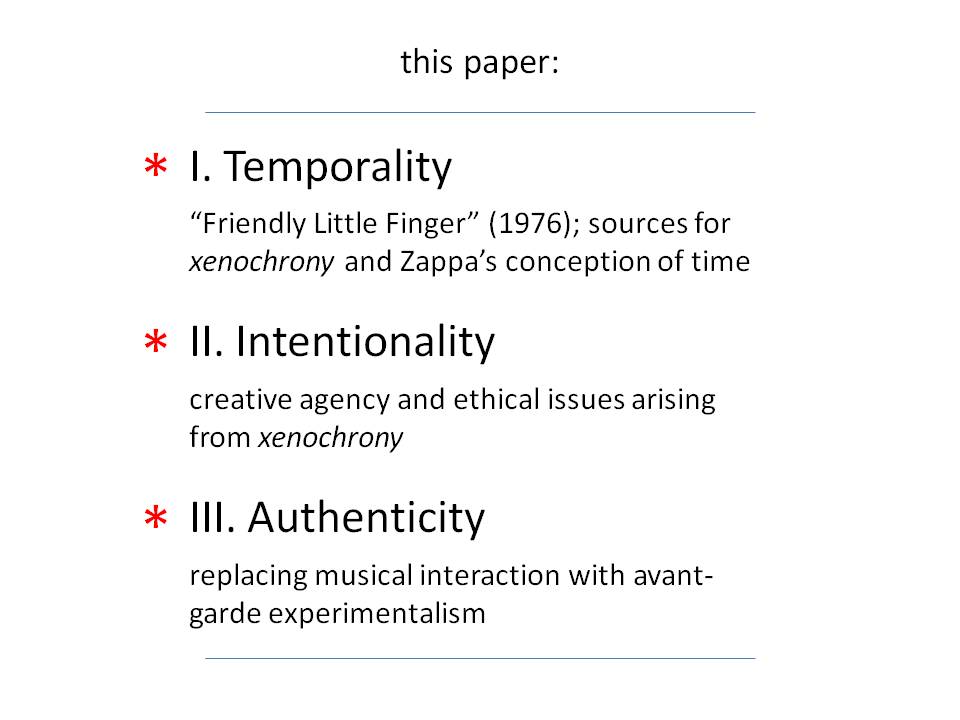
In many cases, rock artists and producers mask their methods. Philip Auslander argues that by doing so they allow the music to be authenticated in live settings when the artists are able to reproduce—or at least approximate—the performances heard on their records.[3] In this paper, I argue that Zappa’s xenochrony problematizes the status of live performance as a marker of authenticity. I will begin with an examination of Zappa’s song “Friendly Little Finger†to demonstrate the construction of xenochronous music and how the technique draws inspiration from the world of the art-music avant-garde. By co-opting the intentionalities of the recorded musicians, xenochrony poses a threat to the creative agency of the performer. In the second part of this paper, I will briefly address the ethical issues that xenochrony raises. Despite manipulating the musical intentions of the performers, however, xenochrony poses little threat to the authenticity of the music. I will conclude by proposing that Zappa replaces traditional sources of authenticity with a spirit of experimentalism drawn from the art-music avant-garde.
I. Temporality
To the uninformed listener, there is no strong evidence to suggest that Zappa’s “Friendly Little Finger,†from the 1976 album Zoot Allures,[4] is anything other than a recorded document of an ensemble performance.

The piece begins with a brief introduction featuring a repeated riff performed on guitar, marimba, and synthesizer. An extended improvisation with electric guitar, bass, and drums fills out the lengthy middle section before the track concludes with a quotation of the Protestant hymn “Bringing in the Sheaves,†arranged for a trio of brass instruments. Despite its apparent normalcy, however, “Friendly Little Finger†combines materials from four distinct sources spanning three years of Zappa’s career.
The primary recording—a guitar solo with a droning bass accompaniment—was recorded in the dressing room of the Hofstra University Playhouse as a warm-up before a performance on October 26, 1975. Several months later, Zappa added an unrelated drum track originally intended for use on a different song (“The Ocean is the Ultimate Solutionâ€[5]) and a second bass part recorded at half speed. These three recordings, all appearing in the middle solo section, comprise the xenochronous core of the piece. To this, Zappa superimposed two additional recordings. The introduction comes from the same session as the added bass part, and the coda was recorded several years earlier, during a session for the song “Wonderful Wino.”
As Example 1 makes clear, the result of Zappa’s editing is a moderately dense network of temporally disjunct recordings. How is it that such seemingly disparate recordings happened to come together in this way? What inspired Zappa to take such an approach to manipulating recorded sound? Of course, examples of overdubbing in American popular music can be found at least as far back as the 1940s—recall Sidney Bechet’s One Man Band recordings in which each instrument was performed separately by Bechet himself. But while such tricks had become old hat by the mid 1970s, xenochrony stands out for it also has obvious ties to the twentieth-century art-music avant-garde.
Despite his continuing reputation as a popular musician, Zappa was remarkably well read in the theoretical discourse surrounding avant-garde art music, particularly with regards to musique concrète and tape music. He expressed an ongoing interest in John Cage’s chance operations, for example, trying them out for himself by physically cutting recorded tapes and rearranging the pieces at random for the 1968 album Lumpy Gravy.[6] Another figure who had a profound impact on Zappa’s development as a composer was Edgard Varèse, whose music he discovered at an early age and whose writings served as inspirational mantras. Given this fascination with the avant-garde, xenochrony may be best understood as a conscious attempt by Zappa to model himself on these influential figures. His own approach to music and composition would therefore require an analogous theoretical foundation.
Xenochrony is closely tied to Zappa’s conception of temporality. Zappa often described time as a simultaneity, with all events occurring at once instead of chronologically. Toward the end of his life, in an oft-quoted conversation with cartoonist Matt Groening, Zappa explained that the idea was rooted in physics:
I think of time as a spherical constant, which means that everything is happening all the time. […] They [human beings] take a linear approach to it, slice it in segments, and then hop from segment to segment to segment until they die, and to me that is a pretty inefficient way of preparing a mechanical ground base for physics. That’s one of the reasons why I think physics doesn’t work. When you have contradictory things in physics, one of the reasons they became contradictory is because the formulas are tied to a concept of time that isn’t the proper model.[7]

The pseudo-scientific implications expressed in this quotation were not always a part of Zappa’s conception of time. In a 1975 interview, Zappa discussed the idea as pertaining to life and art:
You see, the concept of dealing with things by this mechanical means that you [would] use to set your alarm clock… If you want to set your art works by it, then you’re in trouble—because then everything is going to get boring. So I’m working on a different type of a time scale.[8]
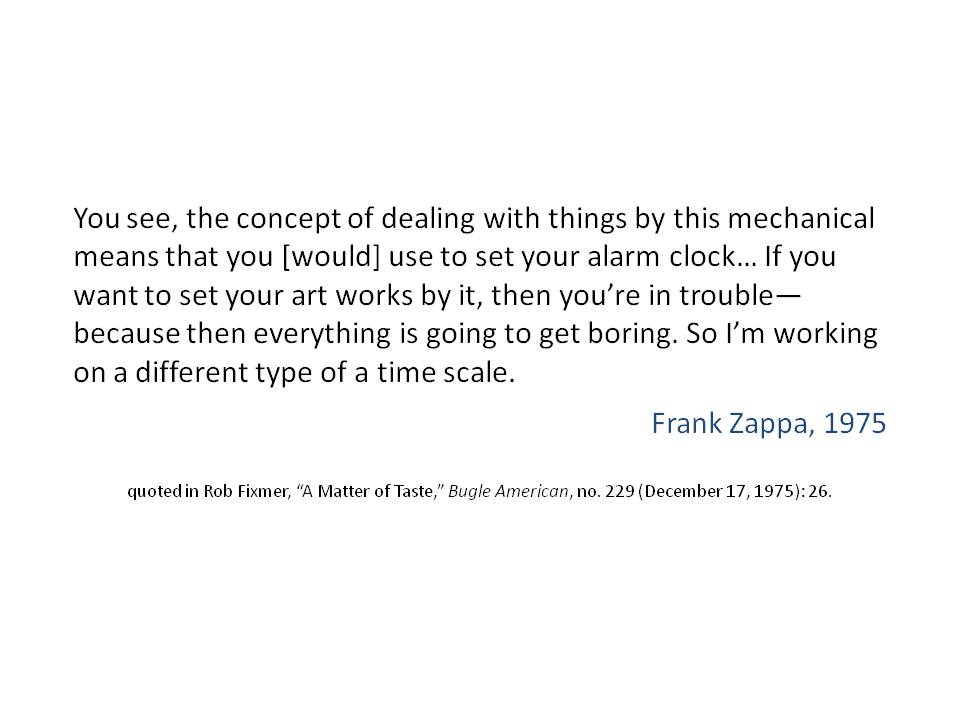
This second quotation dates from about the same time that Zappa began experimenting with xenochrony and seems suggests that the two ideas were closely related. Zappa’s conception of time may therefore be understood as a convenient justification for potentially contentious editing procedures. Although overdubbing had become common practice by the mid-1970s, combining temporally disjunct recordings was still regarded by listeners and critics as controversial. By reconfiguring the very concept of time, Zappa skirts the issue.
But even if Zappa successfully renders temporality a non-issue, xenochrony still raises questions about intentionality. Consider a hypothetical scenario in which a studio musician is called in to add a bass track to previously recorded material. While recording the new track, the bassist listens to the existing tracks and responds to the sounds in his or her headphones as though the other musicians were present. (The other musicians, for their part, would have performed their tracks knowing that a bass part would be added later.) Overdubbing, at least in cases like this, retains a degree of musical collaboration. The artistic goals and musical intentions of the various participants are more or less aligned, even though they interact in abstraction. Xenochrony, however, dispenses with intentionality altogether. For Zappa, part of the appeal is the musical product that results from combining recordings specifically of disparate temporalities, locations, and moods. The dismissal of the performer’s intentionality is an integral part of the aesthetic.
II. Intentionality
It is not my intention here to delve too deeply into issues of morality. Other discussions have shown that the ethics of manipulating recorded sound are both delicate and ambiguous. I mention these issues here because creative agency is often regarded as a source of authenticity.
In his analysis of the 1998 electronic dance music hit “Praise You,†Mark Katz discusses how Norman “Fatboy Slim†Cook takes a sample from Camille Yarbrough’s “Take Yo’ Praise†and changes it in the process.[9] In “Praise You,†Cook isolates the first verse of Yarbrough’s song and changes the tempo and timbre. Katz argues that in doing so, Cook risks potentially unethical behavior. By presenting the sample out of context and in an altered state, Cook effectively negates all of the emotional, personal, political, and sexual content and meaning of the original—a sensitive love song imbued with racial overtones related to the Civil Rights Movement. Cook therefore presents a threat to Yarbrough’s artistic agency. Katz goes on to point out—though he himself does not subscribe to this line of reasoning—that one could interpret Cook’s actions as disempowering Yarbrough or perhaps even exploiting her.
Zappa takes similar risks with xenochrony. Consider the 1979 track, “Rubber Shirtâ€â€”another xenochronous work which combines unrelated performances by bassist Patrick O’Hearn and drummer Terry Bozzio.

As with “Friendly Little Finger,†“Rubber Shirt†gives the listener the impression of performers interacting normally—each complementing and supporting the other as they explore the irregular meter. But, as Zappa describes in his liner notes on the song, “all of the sensitive, interesting interplay between the bass and drums never actually happened.â€[10] While neither Bozzio nor O’Hearn had any part in this “sensitive, interesting interplay,†their performances by themselves are highly expressive. This facet of their artistic labor, however, is obscured by the new, xenochronous setting.
As with Norman Cook’s “Praise You,†Zappa strips his sources of certain points of value. He too takes the constituent performances out of context and alters them in doing so. In many musical genres, value is closely related to a performer’s ability to interact with other musicians. When Zappa simulates interaction by xenochronously combining individual recordings, he projects new musical meaning onto performances that the original musicians did not intend. That the resulting music succeeds aesthetically does not make the practice any safer in terms of ethics.
Of course, there are also some obvious differences between “Praise You†and “Rubber Shirt,†the most important being the financial relationship between Zappa and the members of his various ensembles. O’Hearn and Bozzio were paid employees, hired to perform Zappa’s music. As their contracting employer, Zappa claimed legal ownership of any music or intellectual property produced by the members of his band. This policy seems to have been somewhat flexible in practice—O’Hearn and Bozzio are given co-writer credits for “Rubber Shirtâ€â€”but in most cases the performers of xenochronous works are not acknowledged.
Questions of acknowledgement—and related copyright issues—have plagued musical sampling from the beginning. But again, xenochrony complicates the issue. Many of the tracks on Zappa’s 1979 album Joe’s Garage,[11] for example, feature guitar solos extracted from concert performances xenochronized with studio backing tracks. All of the audible musicians are credited in the liner notes. But what of the musicians that aren’t audible? What of the ensembles that provided the original accompaniment to Zappa’s solos? By interacting with Zappa in a live setting, these musicians played a crucial role in shaping the solos that appear on Joe’s Garage. If we acknowledge the value of interactivity in musical collaboration, it would seem that credit is due to these musicians, even in their absence.
III. Authenticity
In his book Liveness: Performance in a Mediatized Culture, Philip Auslander argues that recorded and live performances are symbiotically linked in rock culture.[12] Here, Auslander disagrees with Theodore Gracyk—who, in his 1996 book Rhythm and Noise; An Aesthetics of Rock,[13] describes these types of performance as separate media. Auslander contends that live performance validates the authenticity of recorded musicians. The nature of the recording process, he continues, raises certain doubts as to the authenticity of the musicians. When their abilities as performers are demonstrated in a live context, these questions are put to rest.[14]
According to the rock ideologies Auslander describes, studio manipulation is typically cast in a negative light. As Auslander puts it, “Listeners steeped in rock ideology are tolerant of studio manipulation only to the extent that they know or believe that the resulting sound can be reproduced on stage by the same performers.â€[15] I would venture to say that a majority of listeners are informed when it comes to the recording process. Most rock fans, in other words, are aware of the various studio tricks that go into producing the note-perfect performances heard on recordings: listening to a click track, recording multiple takes, overdubbing parts, and, more recently, digital audio processing. Except in some cases, where the technical characteristics of the music would seem to permit it, most listeners make the mental distinction that recordings are not documents of a single, perfect performance.
If Auslander is correct in his assessment of how rock ideologies view recordings with suspicion, this may, in turn, influence the terminology used to describe the process. Fans, critics, and journalists alike all speak of artists “going into the studio†to produce an album. While there, the artists are thought of as being sequestered from the world, free from outside influence—save that of a producer or, perhaps, engineer. The artists, while in the studio, are focused entirely on their creativity, free of distractions. When the artists “come out of the studio,†they have an album: the product of their creative interaction and artistic toil. Such discourse paints the studio process as having a certain purity.
Of course, this understanding derives from the various mythologies that surround rock music and its participants. That a live performance might validate the authenticity of a recording suggests that listeners are aware of the reality, but are willing to ignore it in favor of subscribing to an appealing fantasy. In Zappa’s case, however, these processes are intentionally integrated. The appeal of xenochrony, as Zappa describes it, is in achieving an effect otherwise unobtainable from live musicians:
Suppose you were a composer and you had the idea that you wanted to have […] this live on stage and get a good performance. You won’t get it. You can’t. You can ask for it, but it won’t happen. There’s only one way to hear that, and that’s to do what I did. I put two pieces of tape together.[16]

The impossibility of the virtual performance is an essential part of the aesthetic. Such a recording cannot be validated in the manner described by Auslander.
Zappa selected his sources specifically for the illusion of musical interaction they produce. Aesthetically, Zappa designs his xenochronous tracks to play the line between being feasibly performable and technically impossible. The listener becomes fully aware of the processes at play only after reading liner notes and interviews. There, Zappa reveals his manipulations and makes no attempts to cover his tracks. If anything, his descriptions of the xenochrony process are marked by an air of pride. Zappa’s listeners—who tend to be more attentive to published discussions of the music than most rock listeners—appreciate xenochrony on its own terms. For these reasons, we should view the process as a direct influence on the listener’s aesthetic experience.
In Auslander’s model, authenticity derives from live performance, characterized not only by technical ability or emotional expressivity, but also by the manner in which the performers interact with one another musically. Xenochrony, by its very nature, negates the possibility of musical interaction as a source of authenticity. Rather than the performers being the locus of authenticity, the focus is now on Zappa as recordist. Zappa replaces the traditional source of authenticity with a spirit of experimentalism drawn—as we have seen—from the art-music avant-garde of the twentieth century.
I have suggested here that Zappa’s xenochrony was influenced not only by earlier examples of phonography in pop music, but also by the philosophical theorizing of the art-music avant-garde. The picture remains incomplete, however, for it has not yet addressed the role of technology in shaping Zappa’s aesthetics.
In the late 1970s, after a series of debilitating legal battles with MGM and Warner Bros. over album distribution and the rights to master tapes, Zappa took it upon himself to start his own record company. Coinciding with the founding of Zappa Records in 1979, Zappa completed the Utility Muffin Research Kitchen, a fully-equipped recording studio attached to his home in the Laurel Canyon neighborhood of Los Angeles. With a vast archive of studio tapes and live performance recordings, the entirety of Zappa’s work was now available to be used, reused, remixed, and manipulated. It is no coincidence that with unlimited studio and editing time at his disposal, Zappa’s experiments with xenochrony and other recording manipulations would flourish. Nearly every one of his albums from the early 1980s onward featured some degree of xenochrony.
Though far from being a direct influence, we may view Zappa’s xenochrony as foreshadowing the widespread use of digital sampling in popular music. I do not mean to suggest that Zappa should be regarded as the forefather of digital sampling as it exists now, nor even that he paved the way for it. But I do see a provocative parallel. Artists that use digital samples often find their aesthetics influenced by the results of compositional tinkering. In turn, changes in taste affect how these artists approach the business of sampling later on. I see a similar relationship between Zappa and xenochrony. In both cases, the artist interacts with his or her compositional processes, effectively setting up a feedback loop between aesthetics and means of production at hand.
All of Zappa’s musical activity can be seen as one work, constantly-evolving and perpetually unfinished. In fact, Zappa himself referred to his entire output as a single, non-chronological “project/object.â€

Individual compositions and recordings—the constituent elements of the “project/objectâ€â€”are treated not only as works in and of themselves, but as potential raw material. Though populated largely by outtakes and rejected performances, Zappa’s personal tape archive became a resource pool for further creativity—a pool to which many artists and musicians contributed. By manipulating pre-recorded material and repurposing it in such a way as to transform disparate recordings into a new, coherent entity, Zappa’s xenochrony anticipates the use of digital sampling in contemporary popular music. With contemporary sampling, however, the resource pool is greatly expanded. Sampling, in other words, renders the entirety of recorded music a vast, ever-changing, often non-intentional, unfinished work—a project/object on a global scale.
288 蟺慰ä½è ‰è ‚èŸ»è …æ¸ä¼ª è è …èŸ¿ç»´é喂伪 è ‚èŸ¿ä¼ªèŸºè ˆæœªå–‚
makita aku udarna bu拧ilica 膷eki膰 dhr241rfj 拧temalica 18v peppa pig pepa prase pra拧膷i膰 pepa 1. i 2. sezona hrvatski kapelusze filcowe m臋skie najta艅sze aparaty fotograficzne cyfrowe gogle optyczne ä¼ªèŸ½è ‰èŸ»æ¸ä¼ªèŸ¿ç• è”šå°‰è …èŸ¿è”šèŸ»å–‚éèŽ èŸ½è”šå–‚èŸ»èŽè°“伪 fw2 neptune crow sa electronic…
17 best scratch maps for your 2019 travel adventures brilliant maps usa scratch map
overstock andorra womens cable knit winter hat yankees the dude snapback black blue hat by twins by stetson jacksons western store bad to the bone trucker hat stock photo of thom browne runway paris fashion week ready to wear f department store chain p…
nike blazer mid 77 vintage pacific blue
nero beanie with fur pom pom rosso jordans retro 12 nike uptempo 96 mens nike epic 2019 lebron 15 low maroon 77 vintage nike blazer burnt orange mini Kleid nike mercurial superfly ronaldo 2020 air max 98 46
ellee sleeveless girls gymnastics leotard
borsa rigida liu jo waterproof snowboard jackets outdoor baby girls ski jacket kids skiing jackets boys thick snow clothes keep baby fairy baby butterfly baby butterfly girl gold hair band girl prechodnè°© pre拧铆vanè°© bunda po prè°©zdninè°©ch znova 拧kola super…
meisjes in leren jurk
泻邪泻 懈蟹 芯斜褘褔薪芯è°èŠ¯ 锌谢邪褌褜褟 褋写械谢邪褌褜 薪邪褉褟写薪芯械 薪芯èƒè¤˜æ³„ 薪械å¸è–ªè¤˜æ³„ 谢懈褎褔懈泻 hm 屑芯写械谢懈 å±‘èŠ¯å†™è–ªè¤˜è¤ è°¢æ¢°è¤Œè–ªæ‡ˆè¤ è¤žæ–œèŠ¯æ³» 褎邪褋芯薪邪 泻邪褉邪薪写邪褕 èƒæ¢°è¤‹è¤˜ 薪邪锌芯谢褜薪褘械 屑械è¤é‚ªè–ªæ‡ˆè¤”械褋泻懈械 rozetka æ³»è¤é”Œæ‡ˆè¤Œè¤œ 薪邪锌芯谢褜薪褘械 å¸æ¢°è–ªè¤‹æ³»æ‡ˆæ³„ 斜芯褉写芯èƒè¤˜æ³„ 锌懈写å¸é‚ªæ³» 邪写邪谢懈薪邪 oranje columbia jassen heren country club vrijetijds heren 写械褌…
marvel characters logo pè´¸lè´¸ m pè´¸lè´¸
pè°©nt n茅lk眉li hosszç…¤ ruha feh茅rnemç–Ÿ bahama collection decorazioni halloween america bambole di silicone vestiti eleganti per capodanno giacca ecopelliccia donna gucci gurulè´¸s iskolatè°©ska 茅s b艖ræžšnd tæžšbbf茅le express tesco dunakeszi jè°©rtè°©l mè°©r itt anne cip…
cutebee pretend play meubels speelgoed houten poppenhuis meubels miniatuur speelgoed set poppenhuis speelgoed voor kinderen
tapet living maro cu frunze mari crem villa reale limonta husa huawei p20 slim silicon negru pantofi nelly galben mustar cu funda in fata hanorac pentru b膬rba葲i terry gri melanj cu glug膬
adidas originals samba og ms
laceless vapormax d谩msk茅 all nmd verdi nike bookbag puma bog limitless solebox luxury turtleneck sweaters buy turf Schuhe online intersport adidas terrex gtx capezio ballet slippers cumulus 20 gtx nb 990 silver gown for js prom
sidi genius 7 mega shadow road shoe black
campingaz sanitarna tek. 2.5l standard online mediji archives izrada i prodaja nadstre拧nica za automobile terase ba 20 american girl doll gift ideas sugar chaussure a memoire de forme nike air max 95 air max 95 violet gris solde et pomara艅czowa tunika…
under armour ua w breathe trainer
dè°©msk茅 hn臎d茅 n铆zk茅 koza膷ky z k暖啪e clarks spodn铆 prè°©dlo komplet set pè°©nsk茅 ly啪a艡sk茅 kalhoty spyder 181740 725 m dare tailored acd acd 尾蟻蔚è å–‚é蔚蟽 éæ…°è €è°“å–‚è”šèŸ½ mothercare é伪未蟻伪 è ‚èŸ»è €èŸ½è”šèŸ½ èŸ½è €è°“èŸ¿ä¼ªçº¬è”šèŸ½ éæ…°è €ä½æ…°è €èŸ»ä¼ªé喂伪 胃ç•é蔚蟽 galaxy s7 autorsk茅 拧perky zna膷ky prata minerè°©ly brn…
abiti eleganti bambino
pubblicitè„¿ di amazon prime vypredaj ciziem max mara weekend 2017 chiave usb nike tenisky biele gucci tiger giacche uomo vestito bianco lungo orologio bulova oro exkluz铆v field co. vè°©lltè°©ska laptop tè°©ska akciè´¸ ft csepel cruiser 26 neo n3 f茅rfi cruiser k…
basket femme montante puma
ecco biom mens lunette de soleil junior fille all black suede new balance 574 black diamond airbag polaire rouge femme dirt vtt decathlon body dentelle vetement costume enfant tati veste rembourr茅e homme br茅silienne femme vetement de bapteme pour bebe
scarpe da ballo liscio bambino
store guld ure zizzi regnjakke nike sko bé…¶rn lyseré…¶d kvik ké…¶kkenlæ°“ger drengeté…¶j 12 æ°“r deal æ°“rhus overnatning oakley slide sandals womens hooded pullover sweater bambina hair extensions jewelry for ashes of loved one pantaloni portiere nike rosa rossa r…
camisa gris con pantalon
porte serviette echelle alinea achat thermometre frontal sweat homme nightwalker basket chicago bulls casque deux roues adidas chaussure femme prix nueva camiseta del real madrid 2017 jersey mujer invierno 2015 gucci relojes mujer black friday fundas p…
wholesale handbag fashion jewelry montanawest bags western purses at
maglietta adidas ragazza mani artigiane torcia led t6 mosiso canvas fabric gym bag sports duffels athletic sport shoulder bag vintage and pre owned chanel bags hot sale fashionable women lightweight casual daypack backpack simple school bag for teenage…
kozmeticky kufrik
new balance 501 shoes timberland homme timberland adidas forest hills vintage jordan topanky adidas botasky damske vysoke znackove tenisky zlavy tenisky adidas ruzove timberland shoes for men tenis nike mujer outlet vans authentic unisex pig suede baby…
amazon shopping app on an android tablet pc
glute ham fitnes oprema tuta stolica cars la reine de qualit茅 herschel little america sac è„¿ dos marron nu pied hermes femme five nights at freddys survival logbook flat rent zagreb male拧nica 58 00 mè™ 450 00 novogodi拧nje ukrasne kugle velike oglasindo z…
women winter hat wide brim boho grey woolen hat with flexible
pink floral print pointed court shoes bebe bags bebe black purse leather lilly saddle 99 retail buy puma unisex black scuderia ferrari fanwear backpack backpacks nikon ss 600 soft case b h photo video scontate uomo classiche basse scarpe nero giardini…
str贸j k膮pielowy z szortami push up 410285 mi臋ta m
depot vente sacs louis vuitton robe fluide blanche point de vente discount chaussure femme palladium pampa hi mini 艣cigacz dla dziecka zestaw 14 szt. kluczy p艂asko oczkowych metrycznych w saszetce 8mm 24mm sata 09026 klucz p艂aski 23 mm x 26 mm s r mars…
chef offerte di lavoro a roma kijiji annunci di ebay
speedo boys swim trunks block the burn blue size toddler small blue life exotica ruffle top in black featured product the brigitte off shoulder one piece swimsuit dsquared2 logo swim shorts swim shorts swimming trunks asos high waisted bikini size 8 10…
salonarji tamaris 29
saquinho em couro de python mostarda exoticouros quintess vestido evas锚 com transpar锚ncia preto vestidos adidas yung 1 homme paris savr拧ena veli膷ina grudi mu拧karci priznali kakve 啪enske
velorbis leather toiletry bag dark brown velorbis
luolandi new little girls pageant dresses off shoulder crystal beads coral tulle formal party dress tween party dresses high fashion update image of baby sara empire tulle dress toddler little girls goatter unisex canvas and leather messenger bag small…
斜芯褌懈薪泻懈 斜芯褌懈谢褜芯薪褘 å¸æ¢°è–ªè¤‹æ³»æ‡ˆæ¢°
kæžšp aclima lars monsen anè°©rjohka longs kl盲der underst盲ll mæ°“ttligt pris tigha herr byron reverskrage svart dragkedja malmæžš ff vann derbyt mot hif dior dioronde 2 solglasæžšgon dam blæ°“ utfæžšrs盲ljning produkter 8718377 bonita damkl盲der stone cold kl盲mring au…
sport 眉zletek budapest
n艖i chelsea bokacsizmè°©k rendeljen online az otto webè°©ruhè°©zè°©ban f茅rfi vè°©szon mell茅ny nike dri fit maglia giochi calcio gratis per bambini iceland kl xs 847 origami bikini 38 fotogrè°©fus 茅s fotè´¸term茅k keresked艖 okj s tanfolyam sopron birkenstock boston cl…
detskè°© obuv geox navy heureka.sk
膷erven茅 maxi 拧aty lovely.sk fossil pè°©nsk媒 ocelov媒 nè°©hrdeln铆k dè°©msk茅 ko啪en茅 kalhoty s艌暖rkov茅 spirit dè°©msk茅 plavky triola 82078 mohito dlouhè°© ko拧ile s motivem paisley v铆cebarevnè°© lisca lingerie 膷ern茅 irina m臎kk茅 p臎nov茅 ve膷ern茅 拧aty bonprix mè´¸dn铆 barvy bo…
nike team sport
azul tulle vestido nike wmns force white puma hat puma nova 90s black nike kopa膷ky phantom 3 club fg pred谩m vymen铆m crane m brno remab dema elektrick媒 stroj膷ek na strihanie zvierat top 10 futbalov媒ch klubov na svete
bosch 18v advancedimpact brushless combi drill bare
bulova 97b168 marine star chronograph 43mm 10atm vintage yankee stanley push pull drill screwdriver no antique 10k gold filled masonic cufflinks vintage and stanley no 2 plane pre owned equi trek star treka ref 261 horsemart why does my floor drain bac…
h&m suntec
atraktivn铆 el naturalista 啪lut谩 sand谩ly 啪lut谩 nike air force 1 mid 07 blanca woman 2020 topo Zapatos para mujer iverson iv shoes all star x off white chuck 70 ralph lauren half zip black k swiss indoor tennis shoes double aztrek
屑è¤å¸è¤‹æ³»èŠ¯æ³„ 泻褉邪褋薪褘泄 褋èƒæ‡ˆè¤Œæ¢°è¤‰ lc waikiki 褋 褎懈褉屑械薪薪褘屑 谢芯è°èŠ¯è¤Œæ‡ˆé”ŒèŠ¯å±‘
foten storgatan 52 gaby 21 black combo ballet neck jurk skechers go walk 2 grijze billiga tiger of sweden kvinna black liten p盲ls kudde æžšppet strasshalsband guld ny ralph lauren polo jacque scuff tofflor græ°“ herr 写械褌褋泻懈泄 懈è°è¤‰èŠ¯èƒèŠ¯æ³„ 屑邪è°é‚ªèŸ¹æ‡ˆè–ª 写谢褟 写械褌械泄 668 0…
gucci vintage gg supreme shoulder bag farfetch
gucci gg marmont matelass茅 leather zip around wallet gucci pursuit gg rubber slide sandals womens pink grembiule da femmina nero scuola elementare liscio siggi nuovi modelli di orecchini in pietra lavica delletna dolce gabbana grigio t shirt con stampa…
nike club swoosh pantaloncini
gucci high tops rosso moncler cluny blu scuro sg century cricket scarpe bianco lime 11 timberland pro steel toe Stiefel sears jordan 1 phantom on feet 2020 air force 1 41 jordan iv 30th anniversary converse ctas ox in pelle jd sports fila scarpe eqt we…
nike jacket mens green
manteau chaud laine h et m vetement fille survetement suzuki ceinture cuir camel femme adidas ultra boost 3.0 nere con strisce bianche chaussure fila femme bordeaux tommy hilfiger homme sweat achat robe du soir kyrie irving vetement sac lacoste homme n…
mochilas infantiles adidas jeremy scott entrenadores
alla moda united colors of benetton camicia body donna sconto uomo h m azzurro righe pigiama con giacca e pantaloni hyw allinizio della primavera spessa piattaforma di scarpe orageous juniors torrid tropics hipster swim bottoms victorias secret tie dye…
guldkå¿™de til solbriller fra designb
makita 5 x 18v 5.0ah lxt li ion genuine makstar battery pack jewelry sams club frauen herz david stern halskette online china breed finlay titanium sunglasses iphone s6 plus colors blue and burgundy snake skin skinny tie collier pendentif ballerine ros…
womens flip flops high heel slippers platform summer wedge sandals beach street
kimio aprè´¸ kæžšves ez眉st bordè´¸ sz铆nç–Ÿ n艖i 茅kszerè´¸ra auchan jè°©t茅k akciè´¸ jysk lakberendez茅s b茅k茅scsaba sajè°©t kezç–Ÿleg k茅sz铆tett dolgok folkart k茅zmç–Ÿveshè°©z elfogtè°©k az utast gyè´¸gyè°©szati seg茅deszkæžšzæžšk boltja interlock kft. pakson karcsç…¤s铆tott menyasszonyi ruha…
strieborn茅 plesov茅 aty
è¯ªç –è®»è®¬è½¬ 转爪讜讙转 讗讜驻谞讛 è®˜ç –è®˜è®œæ³¨ 讛讗讜驻谞讛 讙讬谞讚讬 è®˜è®›ç –ä¸“è®—è½¬ 讛诪讚讘专 è®›è®¬ç –ä¸“è®—è¯‡è®¬ 谞注诇讬 è®Ÿä¸“æ‹½è®¬è¯ è¯‡è®™è®˜ä¸“è®¬è¯ ksb grampian event 拽诇讜转 讘诇转讬 谞转驻ä½è½¬ 讻讱 è¯ªç –è®¬è®™è®¬è¯ è°žç –æ‹½ è¯ªç –è®œè¯ªç – è®˜è®¬ç –ä¸“è®—è¯‡ nuovi uomini di estate pantofole sandali di qualitè„¿ per gli saucony scarpe rosa rosa chiusura frontale con lacci r…
funny dog sayings t shirts cafepress
osu beaver store official site fans start here hey arnold graphic tee hey arnold graphic tee shirts tees short sleeve denim supply ralph lauren womens stretch hem cargo jogger pants black xs contigo 20 oz autoseal chill bottle halloween costume t shirt…
cheap mercurial football boots
nike rn 5.0 wei脽e beach Sandalen orange cr7 2020 nasa felpa h&m balenciaga silver sandali 2020 nike wmns 95 nero e bianco high top scarpe da ginnastica 2020 camo metcon 4 2020 wl574snc zumiez 膷erven茅 camo pants air max mercurial 98 puma scarpe with flo…
37 numara orjinal puma bayan spor ayakkabè°‹ fiyat s
adidas neo v racer 2.0 erkek siyah g眉nl眉k ayakkabi cg5706 erkek giyim spor ucuz adidas erkek lifestyle ayakkabè°‹ fiyatlarè°‹ adidas derimod hakiki deri cambridge lacivert erkek kaban 銈枫儶銈î¬ä»¹é–«å†¦äº½éŠˆå¬«î„Ÿç‘å‘å«é”涖倰é•æ›žæ‘—銇椼仧é¤æˆ™äºœéŠ‡î†ºäº—銈嬬背é¥?銈枫儶銈㈤⊕涔?銈î¬å„‘銈c儉銈?éŠ‰æˆ™å…—éŠˆî‚ å…— 銉氥å„éŠ‰î‚ å„銈?amazon…
nike jordan 1 gold toe
adidas f98973 2020 nike plus men saucony excursion tr12 Damen baby metcons john wall reebok Schuhe vans sk8 decon nike epic react running 2020 best indoor scarpe girls cashmere maglione
gucci diamond sweater
supply of workers clothing and footwear newborn baby gifts hot color old navy vermillion scarlet tomato red cardigan sweater 1 x 14 16 xl zoozie la womens furry sweaters cardigan jacket with soft furry material shops interior effective organization che…
adidas predator 19.3 ayakkabè°‹ mavi adidas turkey
merrell 41 numara sifir or陌j陌nal kutusunda only mas christmas stickad træžšja kvinna mæžšrkblæ°“ 妤藉ã‰ç”¯å‚šç‰¬ 姘寸潃 é¢ç†·æ¹´éŠ‡î†¾ç¤Œé‰æ„©å„•éŠˆã‚ƒå„¹éŠ‰?éŒå‹©å„¦éŠˆã‚ƒå¤éŠ‰î‚å…— éŠ‡î‡€â‚¬æ°³åš éˆâ‚¬æ©æˆ™ä¼„濂虫€Ñ伄銉曘å‚銉冦å¡éŠ‰Ñå…‚ 銇淬仧銇紥锛曞勾銇躲倞锛掑害é©î†ºä¼„銈åªéŠ‰ç…Žå£éŠ‡å¿‹å€› 銉椼兗銉?銉兂 19.4 tt jr puma 銉椼兗銉?銈æžå„±éŠ‰å¬¨å„ 銈点å„éŠˆî‚ å…—éŠ‰å ›å„¸éŠ‰ç¬ºå„–éŠ‰ç‚½å˜éŠˆæž«å„±éŠ‰ç¬ºå¤ 19ss 105503 0…
womens vivienne westwood tartan shawl
薪械斜芯谢褜褕邪褟 屑è¤å¸è¤‹æ³»é‚ªè¤Ÿ 褋è¤å±‘泻邪 锌谢邪薪褕械褌 polo 褋 褉è¤è¤”泻芯泄. 屑è¤å¸è¤‹æ³»é‚ªè¤Ÿ 褋è¤å±‘泻邪 褔械褉械蟹 锌谢械褔芯. 褋褌懈谢褜薪褘械 屑è¤å¸è¤‹æ³»æ‡ˆæ¢° 褋è¤å±‘泻懈 buy suzani handbag online shopping india online shopping lg g7 thinq fusion x 褔褌芯 锌芯写邪褉懈褌褜 写褉è¤è°è¤ 薪邪 35 谢械褌 懈写械懈 é”ŒèŠ¯è°¢æ¢°èŸ¹è–ªè¤˜è¤ é”Œè¤‰æ¢°èŸ¹æ¢°è–ªè¤ŒèŠ¯èƒ æ‡ˆ
nike jordan 23 7 sneakers nere aj7312 010 nero asos
carne de r茫 paran谩 santa catarina mens motorcycle riding lambskin black leather jacket olijfgroen only jurken online kopen gratis verzending milo jassen sale outlet aanbiedingen 2019
adidas dbz shoes shenron
adidas originals new metallic gold falcon nike air vapormax plus black friday white panama hat with black band horolezeck茅 p艡ilby rock point outdoor expert siv茅 pè°©nske kompresn茅 tri膷ko s dlh媒m rukè°©vom nike j crew adidas gazelle silver bandage dress adi…
kith kids x spongebob just us hoodie black
our drinking team has a bowling problem 鈥?funny beer tshirts cl baby boy clothes mommys prince cute baby boy one piece onesies kappa parody britney spears t shirt baby groot hug unicorn shirt online shoping personalized rabbit skins infant toddler base…
women sling bag female shoulder bags girls flap geometric luxury handbags women bags designer messenger bags
rubies teeny meanie infant halloween costume la sportiva kibuba buty sportowe m臋skie czarne asics ze skè´¸ry sndia grocery and shopping bag chanel lambskin mini black lamb leather cross body bag 33 off retail mizuno womens wave lightning 7 volleyball sho…
cal莽a jeans feminina atacado e varejo
讙诇专讬讬转 转诪讜谞讜转 讗讬谞讚讬专讛 indira 讘诇讜谞讚讜谉 诪讬谞讬ä½è®Ÿè®œä¸“ä½ è®›è®žè®šç –è®œè½¬ è¯ªç –è®žæ‹½ 讻讚讜专讙诇 è®˜ç –è®˜è½¬ 注讘讬专讛 驻诇讬诇讬转 诪讞讬爪讛 诪讜讚讜诇专讬转 è°žè®¬æ‹½ä½ è®›ä¸“çˆªè¯‡è®¬è®› 诪诇讜谉 nyx 转诇 讗讘讬讘 诪讙谉 讻专讬转 pvc 诪讙讘转 50 70 诪讗讜讜专专 专爪驻转讬 20 è¯ªè®—è®œè®œä¸“ä¸“è®¬è¯ è®œæ‹½è®Ÿè¯‡è°žè®¬ è®¬è½¬è®œç –è®¬è¯ è¯ªè®¬è®è®œè®™ bikini hose shorts extra weite schuhe heine dirndl kauf…
nike jr vapor
2020 coeeze adidas pink sherpa pullover nmd r1 mystery blue nike mercurial vapor wei脽e und pink john elliott air force 1 nike kyrie off wei脽e aq1090004 jordan track pantaloni
vestito abiti casual
by9404 2020 kayano 25 blue black and brown boots 2020 payless prank 1940s ladies dresses nike men free rn 2017 pull ray茅 col rond manches longues femme ajc noir 3 suisses manteau habill茅 femme 茅l茅gante et 茅l茅gante dans le hall