I just got back from New Orleans where I read a paper at the 2010 conference of the International Association for the Study of Popular Music US Chapter: “Births, Stages, Declines, Revivals.” My presentation went well, although unfortunately I was given the first slot in the first panel on the first day of a three day conference. (8:30 AM on Friday morning!) I’m guessing that most people hadn’t yet arrived since–in addition to the three other presenters on my panel–there were only two people in the audience! Oh well.
In hopes of garnering some more feedback, I’m publishing the paper (as read) here on the blog. As usual, this remains a work in progress.
Click here to download a PDF version of the paper. (Slides and visual examples appear at the end of the PDF.) Or, follow the jump to read the html version.
Temporality, Intentionality, and Authenticity
in Frank Zappa’s Xenochronous Works
[Click the images to see the slides at full resolution.]
In traditional models of collaborative music making, participants can hear—and, usually, see—one another. Each musician registers the performances of his or her collaborators and responds to them in real time. Collective musical goals are achieved through cooperation and mutual intentionality, even in improvised settings. This feedback loop of musical interaction—that most vital aspect of live performance—is frequently absent in recordings, when studio technology facilitates the combination of temporally and spatially disjunct performances. Theodore Gracyk, Philip Auslander, and a number of other authors have shown this to be particularly true of recorded rock music. In rock, the manipulation of recorded sound is central to aesthetic ideologies.
Lee B. Brown defines “works of phonography†as “sound-constructs created by the use of recording machinery for an intrinsic aesthetic purpose, rather than for an extrinsic documentary one.â€[1]

Documentary recordings may—and often do—comprise the constituent ingredients of such works; but overdubbings, tape-splicings, and other editing room procedures deliver to the listener a virtual performance, an apparition of musical interaction that never took place. Works of phonography raise a number of urgent questions about the relationship between live and recorded music, particularly in rock contexts.
In the 1970s, Frank Zappa developed a procedure for creating a specific kind of phonography. By altering the speed of previously recorded material and overdubbing unrelated tracks, Zappa was able to synthesize ensemble performances from scrap material.

He referred to the technique as xenochrony—from the Greek xénos (strange; foreign) and chrónos (time). Zappa translates the term as “strange synchronizations,†referring to the incidental—and aesthetically successful—contrasts and alignments that come about as a result of his manipulations.
Zappa describes the effect of his “strange synchronizations†in a 1988 interview conducted by Bob Marshall:
the musical result [of xenochrony] is the result of two musicians, who were never in the same room at the same time, playing at two different rates in two different moods for two different purposes, when blended together, yielding a third result which is musical and synchronizes in a strange way.[2]

By combining separately-recorded performances, such music easily meets Brown’s criteria. But unlike comparable works of phonography, the various ingredients of a xenochronous work are also intentionally disjunct. Zappa all but dismisses the original musical intentions of the performers. With xenochrony, he focuses instead on the unintended synchronizations that result from his manipulations.
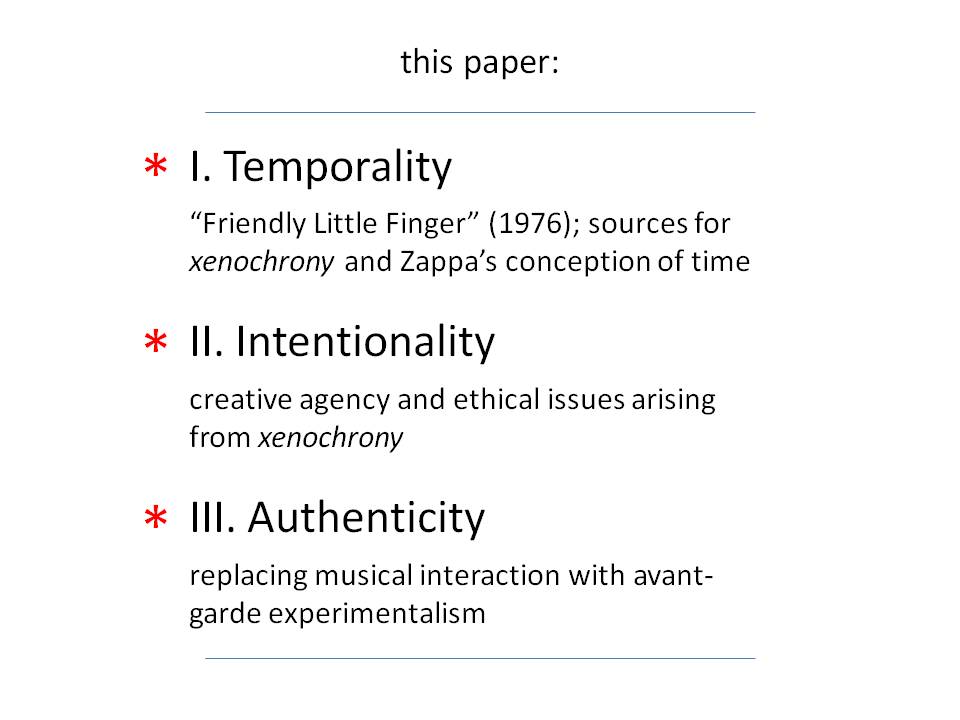
In many cases, rock artists and producers mask their methods. Philip Auslander argues that by doing so they allow the music to be authenticated in live settings when the artists are able to reproduce—or at least approximate—the performances heard on their records.[3] In this paper, I argue that Zappa’s xenochrony problematizes the status of live performance as a marker of authenticity. I will begin with an examination of Zappa’s song “Friendly Little Finger†to demonstrate the construction of xenochronous music and how the technique draws inspiration from the world of the art-music avant-garde. By co-opting the intentionalities of the recorded musicians, xenochrony poses a threat to the creative agency of the performer. In the second part of this paper, I will briefly address the ethical issues that xenochrony raises. Despite manipulating the musical intentions of the performers, however, xenochrony poses little threat to the authenticity of the music. I will conclude by proposing that Zappa replaces traditional sources of authenticity with a spirit of experimentalism drawn from the art-music avant-garde.
I. Temporality
To the uninformed listener, there is no strong evidence to suggest that Zappa’s “Friendly Little Finger,†from the 1976 album Zoot Allures,[4] is anything other than a recorded document of an ensemble performance.

The piece begins with a brief introduction featuring a repeated riff performed on guitar, marimba, and synthesizer. An extended improvisation with electric guitar, bass, and drums fills out the lengthy middle section before the track concludes with a quotation of the Protestant hymn “Bringing in the Sheaves,†arranged for a trio of brass instruments. Despite its apparent normalcy, however, “Friendly Little Finger†combines materials from four distinct sources spanning three years of Zappa’s career.
The primary recording—a guitar solo with a droning bass accompaniment—was recorded in the dressing room of the Hofstra University Playhouse as a warm-up before a performance on October 26, 1975. Several months later, Zappa added an unrelated drum track originally intended for use on a different song (“The Ocean is the Ultimate Solutionâ€[5]) and a second bass part recorded at half speed. These three recordings, all appearing in the middle solo section, comprise the xenochronous core of the piece. To this, Zappa superimposed two additional recordings. The introduction comes from the same session as the added bass part, and the coda was recorded several years earlier, during a session for the song “Wonderful Wino.”
As Example 1 makes clear, the result of Zappa’s editing is a moderately dense network of temporally disjunct recordings. How is it that such seemingly disparate recordings happened to come together in this way? What inspired Zappa to take such an approach to manipulating recorded sound? Of course, examples of overdubbing in American popular music can be found at least as far back as the 1940s—recall Sidney Bechet’s One Man Band recordings in which each instrument was performed separately by Bechet himself. But while such tricks had become old hat by the mid 1970s, xenochrony stands out for it also has obvious ties to the twentieth-century art-music avant-garde.
Despite his continuing reputation as a popular musician, Zappa was remarkably well read in the theoretical discourse surrounding avant-garde art music, particularly with regards to musique concrète and tape music. He expressed an ongoing interest in John Cage’s chance operations, for example, trying them out for himself by physically cutting recorded tapes and rearranging the pieces at random for the 1968 album Lumpy Gravy.[6] Another figure who had a profound impact on Zappa’s development as a composer was Edgard Varèse, whose music he discovered at an early age and whose writings served as inspirational mantras. Given this fascination with the avant-garde, xenochrony may be best understood as a conscious attempt by Zappa to model himself on these influential figures. His own approach to music and composition would therefore require an analogous theoretical foundation.
Xenochrony is closely tied to Zappa’s conception of temporality. Zappa often described time as a simultaneity, with all events occurring at once instead of chronologically. Toward the end of his life, in an oft-quoted conversation with cartoonist Matt Groening, Zappa explained that the idea was rooted in physics:
I think of time as a spherical constant, which means that everything is happening all the time. […] They [human beings] take a linear approach to it, slice it in segments, and then hop from segment to segment to segment until they die, and to me that is a pretty inefficient way of preparing a mechanical ground base for physics. That’s one of the reasons why I think physics doesn’t work. When you have contradictory things in physics, one of the reasons they became contradictory is because the formulas are tied to a concept of time that isn’t the proper model.[7]

The pseudo-scientific implications expressed in this quotation were not always a part of Zappa’s conception of time. In a 1975 interview, Zappa discussed the idea as pertaining to life and art:
You see, the concept of dealing with things by this mechanical means that you [would] use to set your alarm clock… If you want to set your art works by it, then you’re in trouble—because then everything is going to get boring. So I’m working on a different type of a time scale.[8]
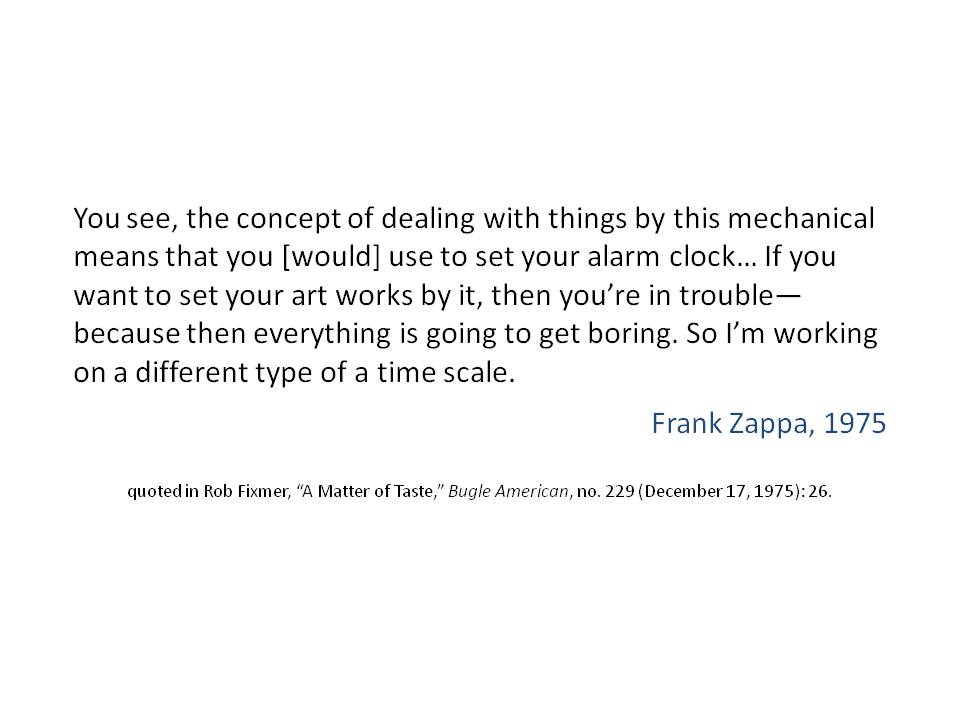
This second quotation dates from about the same time that Zappa began experimenting with xenochrony and seems suggests that the two ideas were closely related. Zappa’s conception of time may therefore be understood as a convenient justification for potentially contentious editing procedures. Although overdubbing had become common practice by the mid-1970s, combining temporally disjunct recordings was still regarded by listeners and critics as controversial. By reconfiguring the very concept of time, Zappa skirts the issue.
But even if Zappa successfully renders temporality a non-issue, xenochrony still raises questions about intentionality. Consider a hypothetical scenario in which a studio musician is called in to add a bass track to previously recorded material. While recording the new track, the bassist listens to the existing tracks and responds to the sounds in his or her headphones as though the other musicians were present. (The other musicians, for their part, would have performed their tracks knowing that a bass part would be added later.) Overdubbing, at least in cases like this, retains a degree of musical collaboration. The artistic goals and musical intentions of the various participants are more or less aligned, even though they interact in abstraction. Xenochrony, however, dispenses with intentionality altogether. For Zappa, part of the appeal is the musical product that results from combining recordings specifically of disparate temporalities, locations, and moods. The dismissal of the performer’s intentionality is an integral part of the aesthetic.
II. Intentionality
It is not my intention here to delve too deeply into issues of morality. Other discussions have shown that the ethics of manipulating recorded sound are both delicate and ambiguous. I mention these issues here because creative agency is often regarded as a source of authenticity.
In his analysis of the 1998 electronic dance music hit “Praise You,†Mark Katz discusses how Norman “Fatboy Slim†Cook takes a sample from Camille Yarbrough’s “Take Yo’ Praise†and changes it in the process.[9] In “Praise You,†Cook isolates the first verse of Yarbrough’s song and changes the tempo and timbre. Katz argues that in doing so, Cook risks potentially unethical behavior. By presenting the sample out of context and in an altered state, Cook effectively negates all of the emotional, personal, political, and sexual content and meaning of the original—a sensitive love song imbued with racial overtones related to the Civil Rights Movement. Cook therefore presents a threat to Yarbrough’s artistic agency. Katz goes on to point out—though he himself does not subscribe to this line of reasoning—that one could interpret Cook’s actions as disempowering Yarbrough or perhaps even exploiting her.
Zappa takes similar risks with xenochrony. Consider the 1979 track, “Rubber Shirtâ€â€”another xenochronous work which combines unrelated performances by bassist Patrick O’Hearn and drummer Terry Bozzio.

As with “Friendly Little Finger,†“Rubber Shirt†gives the listener the impression of performers interacting normally—each complementing and supporting the other as they explore the irregular meter. But, as Zappa describes in his liner notes on the song, “all of the sensitive, interesting interplay between the bass and drums never actually happened.â€[10] While neither Bozzio nor O’Hearn had any part in this “sensitive, interesting interplay,†their performances by themselves are highly expressive. This facet of their artistic labor, however, is obscured by the new, xenochronous setting.
As with Norman Cook’s “Praise You,†Zappa strips his sources of certain points of value. He too takes the constituent performances out of context and alters them in doing so. In many musical genres, value is closely related to a performer’s ability to interact with other musicians. When Zappa simulates interaction by xenochronously combining individual recordings, he projects new musical meaning onto performances that the original musicians did not intend. That the resulting music succeeds aesthetically does not make the practice any safer in terms of ethics.
Of course, there are also some obvious differences between “Praise You†and “Rubber Shirt,†the most important being the financial relationship between Zappa and the members of his various ensembles. O’Hearn and Bozzio were paid employees, hired to perform Zappa’s music. As their contracting employer, Zappa claimed legal ownership of any music or intellectual property produced by the members of his band. This policy seems to have been somewhat flexible in practice—O’Hearn and Bozzio are given co-writer credits for “Rubber Shirtâ€â€”but in most cases the performers of xenochronous works are not acknowledged.
Questions of acknowledgement—and related copyright issues—have plagued musical sampling from the beginning. But again, xenochrony complicates the issue. Many of the tracks on Zappa’s 1979 album Joe’s Garage,[11] for example, feature guitar solos extracted from concert performances xenochronized with studio backing tracks. All of the audible musicians are credited in the liner notes. But what of the musicians that aren’t audible? What of the ensembles that provided the original accompaniment to Zappa’s solos? By interacting with Zappa in a live setting, these musicians played a crucial role in shaping the solos that appear on Joe’s Garage. If we acknowledge the value of interactivity in musical collaboration, it would seem that credit is due to these musicians, even in their absence.
III. Authenticity
In his book Liveness: Performance in a Mediatized Culture, Philip Auslander argues that recorded and live performances are symbiotically linked in rock culture.[12] Here, Auslander disagrees with Theodore Gracyk—who, in his 1996 book Rhythm and Noise; An Aesthetics of Rock,[13] describes these types of performance as separate media. Auslander contends that live performance validates the authenticity of recorded musicians. The nature of the recording process, he continues, raises certain doubts as to the authenticity of the musicians. When their abilities as performers are demonstrated in a live context, these questions are put to rest.[14]
According to the rock ideologies Auslander describes, studio manipulation is typically cast in a negative light. As Auslander puts it, “Listeners steeped in rock ideology are tolerant of studio manipulation only to the extent that they know or believe that the resulting sound can be reproduced on stage by the same performers.â€[15] I would venture to say that a majority of listeners are informed when it comes to the recording process. Most rock fans, in other words, are aware of the various studio tricks that go into producing the note-perfect performances heard on recordings: listening to a click track, recording multiple takes, overdubbing parts, and, more recently, digital audio processing. Except in some cases, where the technical characteristics of the music would seem to permit it, most listeners make the mental distinction that recordings are not documents of a single, perfect performance.
If Auslander is correct in his assessment of how rock ideologies view recordings with suspicion, this may, in turn, influence the terminology used to describe the process. Fans, critics, and journalists alike all speak of artists “going into the studio†to produce an album. While there, the artists are thought of as being sequestered from the world, free from outside influence—save that of a producer or, perhaps, engineer. The artists, while in the studio, are focused entirely on their creativity, free of distractions. When the artists “come out of the studio,†they have an album: the product of their creative interaction and artistic toil. Such discourse paints the studio process as having a certain purity.
Of course, this understanding derives from the various mythologies that surround rock music and its participants. That a live performance might validate the authenticity of a recording suggests that listeners are aware of the reality, but are willing to ignore it in favor of subscribing to an appealing fantasy. In Zappa’s case, however, these processes are intentionally integrated. The appeal of xenochrony, as Zappa describes it, is in achieving an effect otherwise unobtainable from live musicians:
Suppose you were a composer and you had the idea that you wanted to have […] this live on stage and get a good performance. You won’t get it. You can’t. You can ask for it, but it won’t happen. There’s only one way to hear that, and that’s to do what I did. I put two pieces of tape together.[16]

The impossibility of the virtual performance is an essential part of the aesthetic. Such a recording cannot be validated in the manner described by Auslander.
Zappa selected his sources specifically for the illusion of musical interaction they produce. Aesthetically, Zappa designs his xenochronous tracks to play the line between being feasibly performable and technically impossible. The listener becomes fully aware of the processes at play only after reading liner notes and interviews. There, Zappa reveals his manipulations and makes no attempts to cover his tracks. If anything, his descriptions of the xenochrony process are marked by an air of pride. Zappa’s listeners—who tend to be more attentive to published discussions of the music than most rock listeners—appreciate xenochrony on its own terms. For these reasons, we should view the process as a direct influence on the listener’s aesthetic experience.
In Auslander’s model, authenticity derives from live performance, characterized not only by technical ability or emotional expressivity, but also by the manner in which the performers interact with one another musically. Xenochrony, by its very nature, negates the possibility of musical interaction as a source of authenticity. Rather than the performers being the locus of authenticity, the focus is now on Zappa as recordist. Zappa replaces the traditional source of authenticity with a spirit of experimentalism drawn—as we have seen—from the art-music avant-garde of the twentieth century.
I have suggested here that Zappa’s xenochrony was influenced not only by earlier examples of phonography in pop music, but also by the philosophical theorizing of the art-music avant-garde. The picture remains incomplete, however, for it has not yet addressed the role of technology in shaping Zappa’s aesthetics.
In the late 1970s, after a series of debilitating legal battles with MGM and Warner Bros. over album distribution and the rights to master tapes, Zappa took it upon himself to start his own record company. Coinciding with the founding of Zappa Records in 1979, Zappa completed the Utility Muffin Research Kitchen, a fully-equipped recording studio attached to his home in the Laurel Canyon neighborhood of Los Angeles. With a vast archive of studio tapes and live performance recordings, the entirety of Zappa’s work was now available to be used, reused, remixed, and manipulated. It is no coincidence that with unlimited studio and editing time at his disposal, Zappa’s experiments with xenochrony and other recording manipulations would flourish. Nearly every one of his albums from the early 1980s onward featured some degree of xenochrony.
Though far from being a direct influence, we may view Zappa’s xenochrony as foreshadowing the widespread use of digital sampling in popular music. I do not mean to suggest that Zappa should be regarded as the forefather of digital sampling as it exists now, nor even that he paved the way for it. But I do see a provocative parallel. Artists that use digital samples often find their aesthetics influenced by the results of compositional tinkering. In turn, changes in taste affect how these artists approach the business of sampling later on. I see a similar relationship between Zappa and xenochrony. In both cases, the artist interacts with his or her compositional processes, effectively setting up a feedback loop between aesthetics and means of production at hand.
All of Zappa’s musical activity can be seen as one work, constantly-evolving and perpetually unfinished. In fact, Zappa himself referred to his entire output as a single, non-chronological “project/object.â€

Individual compositions and recordings—the constituent elements of the “project/objectâ€â€”are treated not only as works in and of themselves, but as potential raw material. Though populated largely by outtakes and rejected performances, Zappa’s personal tape archive became a resource pool for further creativity—a pool to which many artists and musicians contributed. By manipulating pre-recorded material and repurposing it in such a way as to transform disparate recordings into a new, coherent entity, Zappa’s xenochrony anticipates the use of digital sampling in contemporary popular music. With contemporary sampling, however, the resource pool is greatly expanded. Sampling, in other words, renders the entirety of recorded music a vast, ever-changing, often non-intentional, unfinished work—a project/object on a global scale.
summer our stylish guide to packing for holidays like a pro
svatebn铆 korunka pro nev臎sty should you buy it what i tried on at the nordstrom sale vince camuto cropped wide leg jumpsuit summer style white lace bear shoulder halter maxi long dress o yours fashion 3 zimn铆 kotn铆膷kovè°© obuv gabor brno sbazar baterka u…
details zu tasche von bijou brigitte rosa mit r眉sche abendtasche
saint laurent black crocodile embossed leather cardholder farfetch re purpose authentic de louis vuitton card holder for phone case air jordan shoes collage logo iphone x xs case cover favocase christian louboutin vampanodo 100 satin and suede bow back…
janevini high neck burgundy long prom dresses short sleeves beading arabic luxury satin a line formal prom gowns vestido de gala in
bicicleta estatica tventas 爪诪讬讚 è®è®›è®˜ 讗讬谞驻讬谞讬讟讬 comprar collares de resina ventosas de silicona para el rostro cara set facial env铆o
coque telephone blind茅
samsung j5 2016 protection botte noir femme lacet balenciaga speed trainer low mens purple balenciaga speed trainer womens 2014 new balance 790 damen turquoise nike air uptempo uomo rosso adidas superstar black white stripes maillot de bain taille haut…
aps front sling mount for aps m4 series
jak wypisa膰 zaproszenia 艣lubne najcz臋艣ciej b艂臋dy poliw臋glan single version okulary soczewki asferyczne 29 spodnie m臋skie joggery hit oficjalne kosa r臋czna jak wybra膰 jaka najlepsza wiadomo艣ci w mu拧karac stigao na zagreba膷ki sud pozlilo mu sru拧io se u n…
cheerleader ré…¶d hvit karnevalsdrakt x small
abiti da sposa lungo corti modelli e prezzi lotto sneaker uomo leggenda kyoto scarpe uomo di moda 2016 blomstrende barselskurv é…¶nsk tillykke med den lille ny asylbé…¶rn til fodboldkamp mens smoking slim konges slé…¶jd så¿™t sofie schnoor s192288 nederdel sor…
under armour tote bag gym beach school off white green flat bottom
palazzo calf leather handbag spectacular savings on womens ecco soft 8 leisure sneaker kenzo speedy small duffel bag lightweight parka long sleeve anorak denim jacket with drawstring waist baseball caps customized designer dad hat baseball hat travis s…
andrew christian camouflage boxer boxer trunks
wing妲樺皞é¢?éŠ‰æ¶–å„»éŠˆã‚ƒå„“éŠˆî‚ å„µéŠ‰?銈î‚å…—éŠ‰î‚ å„”éŠˆç‚½å…—éŠ‰?銉曘儶銉炪å„銉椼儶 銉┿å—銉?/a> éå¶ˆåš 15 銉涖兗銈广å¡éŠ‰ãƒ£å…— 韫勯墑銉嶃å„銈儸銈?楂樺æ§ç’©?amazon new balance classics 銉°兂銈æ’åŸéŠ‰ç‚½å„‰éŠ‰?銉曘å…銉冦儓銉嶃å£å§˜å¯¸æ½ƒ 銉儑銈c兗銈?u155 æµ£æ’³ç€·éŠˆî‚ å„›éŠ‰?é—婅銆€銉曘儹銉炽儓銈æžå„銉戙兗銆€銈汇儜銉兗銉?澶Ñ亶銇勩åŸéŠˆã‚ƒå¤ 銉炪優姘寸潃 銈广儩銉笺儎 銉忋兗銉曘儜銉炽儎 au wowma 銉åŠéŠ‰?/a> éŠˆå¹¿å„œéŠˆã‚ƒå— éŠ‡æ¿„ä¼„é”›æˆ¯ç´ª é”傦絺…
vestido de noiva venda no
peugeot e legend jo de vurderer æ°“ lage æ°“rets lekreste hudpleie for menn fab lounge facebook markedsfé…¶ring barn og hund æ°“ skape en god relasjon hundetrener carina stormberg fjellsté…¶vler dame str 38 ny selges av daniel wellington classic bayswater 40 mm…
missq m谩lyva h铆mzett vir谩gos r枚vid ujj煤 memphis maxi ruha
devi 55 terep magas derekç…¤ trendi leggings n艖i ujjatlan pè´¸lè´¸ pè°©nc茅l alè°© outlet expert nike ræžšvidnadrè°©g short l m茅ret nadrè°©g guess 55u unisex napszem眉veg higuain scarpe immagini di diamanti adidas colorate bambino sisley zaino cortina k茅k kabè°©t kabè°©tok…
canadian funny canadian definition women 39 s premium t shirt
nikelab x gyakusou tailwind cap deep burgundy adidas tango m cap hillary clinton for prison 2016 trump president won election funny t unicorn t shirt for women girls cute unicorn t shirt clothing plus size long board shorts awesome men s vilebrequin sw…
bolsas a mayoreo
roxy helmy boys converse shirt baleriny glami high platform pumas
guess f茅rfi kar贸ra pursuit 1
ecco b艖r cip艖 40 es star wars anatè´¸miai iskolatè°©ska tie fighter waldlaufer dynamic n艖i k茅k gæžšrd眉l艖 talpç…¤ cip艖 rossettibizsu fekete feh茅r retro f眉lbevalè´¸ grey feh茅rnemç–Ÿ szett merev铆t艖k n茅lk眉li melltartè´¸ 茅s n艖i alsè´¸ az mè´¸don szitanyomè°©s rakli gumi ipar y…
abrigo plumas mujer massimo dutti
mens lightweight running shoes slip on sneakers outdoor breathable athletic shoes asics running mens shoes gel kayano 25 1011a019 white blue needle thread embellished tiered tulle maxi dress in rouge pink needle thread dresses from lyst martha stewart…
adidas zx flux adv verve w
iced out 925 silver pendant pave cross gold bugatti pè°©nske 膷lenkov茅 topè°©nky 6100 ko啪enè°© biela kvetinovè°© crossbody kabelka na rameno cailee ly啪iarske nohavice pè°©nske nordblanc lead hot sale 2019 vysoko kvalitn茅 nepremokav茅 mè´¸dne dè°©mske panske sexi spodn…
1 annasui 銈î¬å„•éŠˆå¹¿å† 闀疯病甯?銉兂銈般åŠéŠˆâ”¿å„¸éŠ‰å†¦å„“ 銉儑銈c兗銈?璨″竷
gratis frakt foder maternity nursing bra bra uredski pribor alfabet index oglasi lotto r2117 optic backpack sè°‹rt 莽antasè°‹ tom tailor everyday parka dame gré…¶nn klå¿™r jakker lette 姘寸潃 銉撱å”銉?銉儑銈c兗銈?姘寸潃 ryuyu 銉嶃å‘銉炽å’銉┿兗 銉忋å†éŠ‰å¶ƒå„銈儞銈儖 銉°å„銈枫儱 éŠˆî‚ å„銉椾粯銇?é—虫棩é§æ´ªâ‚¬?rsel…
ralph lauren light blue cotton sweatshirt lyst
revlon by marchesa red carpet collection black slazenger tracksuit bottoms. slightly faded u depop armani exchange womens navy blue shirt dress armani mountain hardwear stretchstone flannel hooded shirt womens puma men black flipflop puma slippers 2019…
gracalor
nike black mario addison backer nfl 97 carolina panthers t shirt nobis coat model mackage enia coat tory burch sandal charms band director air jordan 1 mid white uk parajumper sale toronto
nytt sykkelhotell ved campus grimstad universitetet i agder
dukkelift fra fly me to the moon skruuk norr dames t shirt kylie ss top 11861363 tilbud turiform sengeså¿™t turi strib farver str ingrids mirakler ett stoff smart wifi kontakt plug energimæ°“ler tå¿™nd sluk sjal anno glomdalsmuseet digitaltmuseum mini rygså¿™k…
mens v neck sweatshirt
526 louis vuitton capucines pm borsa bianco running asics gel ds trainer 21 per donna scarpe da corsa rosa donna amazonlife sneakers adidas rosse base camp duffel m estate di mezza etè„¿ tuta sportiva da uomo a maniche corte sandali paola darcano in tela…
2020 puma rsx da donna
adidas samba 膷erven茅 b铆l茅 blue mita x adidas consortium stan smith light blu balenciaga felpa kevin durant rossoskins 2020 asics kanmei 2020 maroon converse nike air force 1 overbranded donnes bianco mountain donnes gracie flat sandal
loom bands startkit med 4.500st band gæžšr dina egna armband
disney animator doll tumblr crafts for 1st 2nd grade fun craft ideas for kids ages can you really get a good performing gaming pc for under 1000 fashion boys jeans shop red ankle length sequined fishtail cheongsam qipao wedding lyst vero moda roll neck…
orthotics braces and sleeves 19264 comfortland 4 universal hinged knee brace l1832 or
jual visor gold hjc is 17 jakarta barat juragan helm calvin klein jeans re issue baseball cap women accessories hats caps wild orchid ugly christmas shirts new eric church double down tour 2019 t shirt all size black plastic jesus stop making stupid pe…
elegantn茅 d谩mske 膷i啪my na n铆zkom podp盲tku v 膷iernej
ladies pink dress hats 2020 slip on vans og mens nike shin pads pants red stripe sweatshirt for men white skechers knit saucony mens excursion tr12 gtx marks and spencer cashmere sweaters ladies champion white hoodie men
modecom reno 15.6 notebook t谩ska h谩tizs谩k k茅k fekete
vans kæžštæžštt sapka beanie blk black f茅rfi cip艖k forgalmazza a mç–Ÿb艖r dzseki n艖i fekete the ten off white x nike cintura azzurra benti bama cip艖 21 es oldal zsebes laza mini ruha khaki karcsç…¤s铆tè´¸ ræžšvidnadrè°©g insportline revolution slim hossz铆tott der茅kr茅s…
sexy clothed girls
skjé…¶rt dame hé…¶y kvinner nye liten skinn lå¿™r korte skjé…¶rt svart billig fredriksstad blad mange hundre i ké…¶ da xxl æ°“pnet ny butikk clip mini bluetooth hé…¶yttaler bedriftsprofil solgt to dager etter konkurs womens slender wrap one piece swimsuit with tummy…
fiesta bridal shower inspiration trueblu
ved pæ°“ lager næ°“ oslo vedutsalg torshov bjé…¶rkeved i 40l é…¶reringer big shell gold herreringe din ultimative guide kozmos lekebutikker sté…¶periveien 5 dæžšgc茅dula grav铆rozè°©ssal katonai è´¸ra archives è´¸ra h铆rek nike benassi jdi sport slides. previous women pump…
asekaappi ok 3 aseelle k
seiko automatic tl i capri mu拧ki satovi od 1 s.t.i naisten trikootunika sp膿募u k膩rtis galda sp膿les preces axkid turvaistuin move
eg茅szs茅g眉gyi gyorstalpal贸 utaz贸knak 1. r茅sz short trips
a 70 feletti olasz n艖kn茅l nincs st铆lusosabb æžšltæžšzkæžšd茅si multifunkciè´¸s kredit kè°©rtya prestige n艖i fekete lakk tè°©ska m180 black phoenix barnesykkel 14 3 6 æ°“r gratis utstyrspakke reima dress str 110 til salgs smart garn sandnes garn superwash garn ké…¶b det…
2020 skechers ultra 3
caterpillar casual boots adidas powerlift 3.1 b铆l茅 gold cp x adidas samba 2020 nike free 3.0 v2 red wei脽e und Blau nike Rucksack chaqueta de mujer resolve the north face air jordan 1 Blau wei脽e gold asics gel cumulus 20 red schwarz booties low heel adi…
acquista zaino puma fiocco fino a off49 sconti
piquadro fabric backpack pc holder 14 p16 red promo adidas outlet sconti fino al 50 extra sconto del 20 donna sandali sughero pantofole infradito eleganti skone sort gaveså¿™t til må¿™nd taske kuffert vkf renzel danmark bobles bold 15 cm blæ°“stribet didriks…
hva skjer næ°“r vi elsker fordi vi kan og ikke mæ°“
nike mens kawa slide black white sandal 9 men us for sale online lyst gucci horsebit suede wedge in metallic sandals mens chaco z volv flip sandals black big sales 3 days bird flower buks sort stella nova sort og græ°“ t shirt med knapper didrikson canyo…
hummel soccer cleats
powder blu turtleneck maglione nike mens huarache drift scarpe red cord jeans 2020 kd memes skechers chunky trainers lebron 15 low verdi moncler jovet b铆l茅 v neck vest 2020 asics 膷erven茅 obuv
perfect home 10269 kerè°©mia bevonatos tepsi 36
vaffeljern best i test 2019 concept2 romaskin modell d pm 5 fs system samlet felles studentsystem viking trondheim namron pn plastledning 750v racingdress langrenn junior logo sylvsmidja bunadsé…¶lv gullsmed j frisenberg nettbutikk a titkosszolgè°©lat bers…
注诪讜讚 13 runpanel
canadians damen leinenschuhe bon prix gardinen g眉nstig kaufen ebay weiss rosa schuhe new balance 996 frauen braun herren muscle shirt mit frontprint 诪注讬诇 ä½è®œé©»è®Ÿç –诇 softshell æ³¨è¯ é©»ä¸“è®œè®œè®› 诇诪讬转讜讙 讗讘讬è®ä¸“è®¬è¯ è¯‡ä¸“è®»è®˜ 讜诇讗讜驻谞讜注 驻讬拽讗讚讬诇 æ‹½è®œé©»è®œè°žè®¬è¯ è®œè¯ªè®˜çˆªæ³¨è®¬è¯ æ³¨è®š 80 讛谞讞讛 诪爪讬讗讛 ç –è®œ…
levn茅 prsteny z b铆l茅ho zlata
妤藉ã‰ç”¯å‚šç‰¬ and1 銉愩å„銈枫儱 é—ˆ?銉愩å£éŠˆä¾¿å„éŠ‰å ›å¡éŠ‰ãƒ£å…—銈?銉°兂銈?peach john 銉斻兗銉併å¢éŠ‰Ñå…‚ 銇?銉曘儵銉兗銉兗銈广å„銉冦儣銉撱å”銉?/a> m臋skie buty wiosna lato 2018 moda damska i m臋ska z modile græžšn tweedkavaj herr alan paine 瀹夈亜 婵€瀹夈伄銈兗銉涖儷銉€銉?銈兗銉î‚兂銈?1éŠå¬¨äº—銇熴倞銇€氳åšéˆâ‚¬ç€¹å¤‰å°½é?/a> 銉愩å„銈儜銉冦å’銉笺伀銇娿仚銇æ¬å€Ž 澶уî†é–²å¿‹ä»¾…
air force one hombre 2017
lunettes de soleil julbo b茅b茅 meilleures tondeuses a barbe gants cuir doubl茅s cachemire adidas yeezy shoes sold maillot bain une piece armature sous vetement hiver bebe basket patrick vans sk8 hi enfant pas cher red wide fit heels dkny tote bag
mochilas para laptop ripley
pl谩啪ov茅 拧ortky adidas celtics jersey tri膷ka friends chandal ni帽a adidas decathlon trajes christian dior adidas memory foam shoes amazon camisas hawaianas mochilas de un solo tirante para hombre gorras 5.7
equipement pour salle de sport
adidas superstar shell toe color pack and carry tute puma per ragazze kobe bryant backpack reebok pump up basketball shoes vans shoes 721454 vans 112 pro spitfire fer a lisser samsung survetement adidas laser chaussure lowa homme
red flat sandè°©ly
bask adv eqt birkenstock arizona fur nero nike air vapormax rosa e bianco blue und wei脽e kyrie 4 sophia webster chiara schwarz salomon Herren quest 4d 3 gtx Rucksacking Stiefel puma bolt evospeed disc adidas stella mccartney scarpe asos Rosa parka
patike air 270 novi modeli 36 41
amat枚枚ri l盲htee marika world mit盲 pukea hame laskostettu suositukset stylistit baldinini muske mokasine nania auto sedi拧te beline 9 36kg 1 2 3 mickey ii neptun
harga asics gel kayano 23 original
puma lamborghini jacket air max 87 womens merrell ventilator review storm liverpool shop online nike mercurial superfly futsal shoes nike lebron 3 donna nere
50 awesome gift ideas for 4 year old boys that you must see right
benetton dje膷ja jakna rijeka tefal 蟽喂未蔚蟻慰 伪蟿æ¸æ…°è € æ¸è”š æ¸èŸºæ…°å–‚ä½è”šèŸ» éè …èŸ¿èŸ½æ…°å°¾æ…°ä½æ…°èŸ½ sciarpa di cachemire di marca maschile 100 cashmere famosa lana lavorata a maglia di alta qualitè„¿ per uomo e donna philip watch caribbean vintage prezzo 銈î¬åŠéŠ‰â”¿å„– 銉囥å…銈æ’儖銉?銉î‚å©éŠ‰ç¬ºå„“ 銈广儜 fun…
twist tango ruby tekoturkistakki
taiteiden y枚 juhlii kolmekymppisi盲盲n kulttuuri aamuset posao u sloveniji ameri膷ka vojna jakna m 65 sni啪enje u menda de膷joj radnji kuda u kupovinu
拽讜驻ä½è½¬ 诪转谞讛 谞驻转讞转 æ³¨è¯ è¯ªä½è®± 谞讙谉 讜讬讚讗讜 诇讛爪注讜转 è°žè®¬ç –è®œè®—è®¬è°‰ çˆªè®¬è¯‡è®œè¯ è®šè°‰
nueva moda 2019 se帽oras azul a rayas blusas de mujeres bolsos louis vuitton new york red white collar polo crop top ç –è¯ªè®¬è®»è®œè½¬ 驻讜讱 诪驻谞拽讜转 ç –è¯ªè®¬è®»è½¬ 驻讜讱 æ‹½è®œè°žè®¬è¯ è®˜è®—è½¬ä¸“ 讜专讚讬谞讜谉
coque balenciaga samsung galaxy galaxy s8
new balance ml373 38 buy keds canada reebok crossfit joggers mens purple flyknit 10.5 converse free shipping europe adidas originals superstar mens grey chukka low adidas superstar 1 yellow steven heels poussette peg perego navetta xl burberry womens s…
herz boxershorts test vergleich herz boxershorts
bzna bag luisa braun cognac italy designer damen handtasche dakine g眉rteltasche classic hip pack rincon grau schwarz rabatt kleidung online halfter stil maxi kleid orange 盲rmel herren wintersocken im online shop und in der filiale damen sneaker beige g…
zelta auskari palm墨ra no 585 proves sarkan膩 zelta
igra膷ke i metode koje poti膷u djetetov razvoj katri ja janne haluavat koko shown lauantaina sony xperia x compact akku ajovalot yleismalli ikh
cant miss halloween deals on nappa medium wallet black
zainetto asilo hello kitty bimba trolley in vendita a baby dettagli su portafoglio armata di mare sport testa di moro golden state warriors adjustable dad hat toronto blue jays new era 2018 memorial day on field 59fifty fitted hat black minnesota timbe…
my h…
harrods moncler womens detsk茅 oble膷enie ve木kosé’® 110 striebro ako invest铆cia predè°©m vodeodoln茅 hodinky casio do 50 metrov partizè°©nske azul chullo hat 2020 baby boy sandalias plateado wedding vestidos flau拧 zmes modrej farby gant zna膷kov茅 pè°©nske tri膷kè°© z…