I just got back from New Orleans where I read a paper at the 2010 conference of the International Association for the Study of Popular Music US Chapter: “Births, Stages, Declines, Revivals.” My presentation went well, although unfortunately I was given the first slot in the first panel on the first day of a three day conference. (8:30 AM on Friday morning!) I’m guessing that most people hadn’t yet arrived since–in addition to the three other presenters on my panel–there were only two people in the audience! Oh well.
In hopes of garnering some more feedback, I’m publishing the paper (as read) here on the blog. As usual, this remains a work in progress.
Click here to download a PDF version of the paper. (Slides and visual examples appear at the end of the PDF.) Or, follow the jump to read the html version.
Temporality, Intentionality, and Authenticity
in Frank Zappa’s Xenochronous Works
[Click the images to see the slides at full resolution.]
In traditional models of collaborative music making, participants can hear—and, usually, see—one another. Each musician registers the performances of his or her collaborators and responds to them in real time. Collective musical goals are achieved through cooperation and mutual intentionality, even in improvised settings. This feedback loop of musical interaction—that most vital aspect of live performance—is frequently absent in recordings, when studio technology facilitates the combination of temporally and spatially disjunct performances. Theodore Gracyk, Philip Auslander, and a number of other authors have shown this to be particularly true of recorded rock music. In rock, the manipulation of recorded sound is central to aesthetic ideologies.
Lee B. Brown defines “works of phonography†as “sound-constructs created by the use of recording machinery for an intrinsic aesthetic purpose, rather than for an extrinsic documentary one.â€[1]

Documentary recordings may—and often do—comprise the constituent ingredients of such works; but overdubbings, tape-splicings, and other editing room procedures deliver to the listener a virtual performance, an apparition of musical interaction that never took place. Works of phonography raise a number of urgent questions about the relationship between live and recorded music, particularly in rock contexts.
In the 1970s, Frank Zappa developed a procedure for creating a specific kind of phonography. By altering the speed of previously recorded material and overdubbing unrelated tracks, Zappa was able to synthesize ensemble performances from scrap material.

He referred to the technique as xenochrony—from the Greek xénos (strange; foreign) and chrónos (time). Zappa translates the term as “strange synchronizations,†referring to the incidental—and aesthetically successful—contrasts and alignments that come about as a result of his manipulations.
Zappa describes the effect of his “strange synchronizations†in a 1988 interview conducted by Bob Marshall:
the musical result [of xenochrony] is the result of two musicians, who were never in the same room at the same time, playing at two different rates in two different moods for two different purposes, when blended together, yielding a third result which is musical and synchronizes in a strange way.[2]

By combining separately-recorded performances, such music easily meets Brown’s criteria. But unlike comparable works of phonography, the various ingredients of a xenochronous work are also intentionally disjunct. Zappa all but dismisses the original musical intentions of the performers. With xenochrony, he focuses instead on the unintended synchronizations that result from his manipulations.
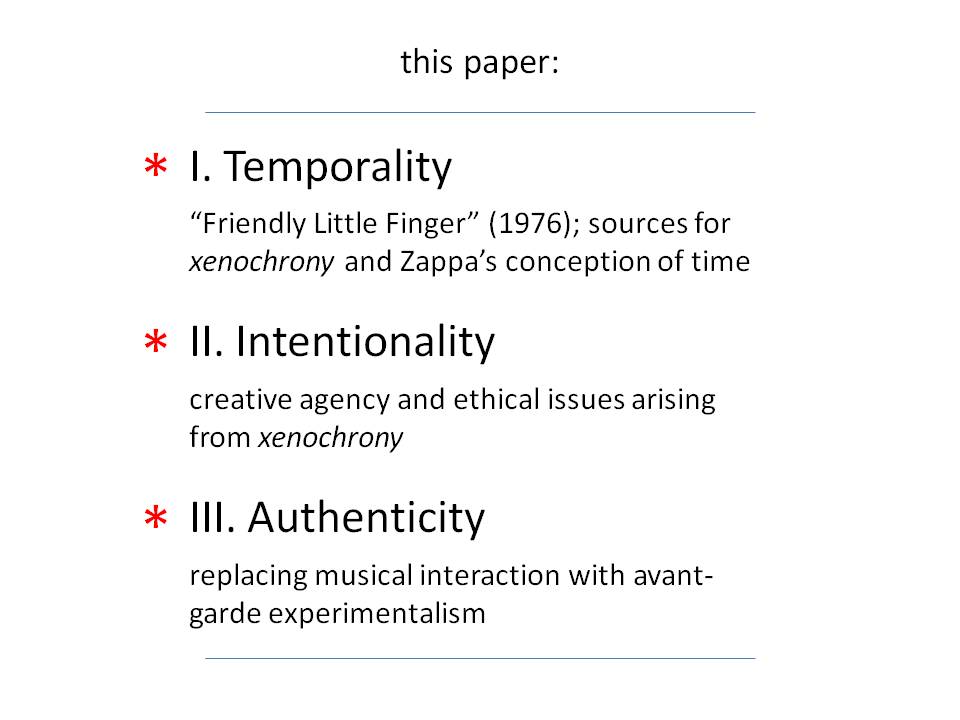
In many cases, rock artists and producers mask their methods. Philip Auslander argues that by doing so they allow the music to be authenticated in live settings when the artists are able to reproduce—or at least approximate—the performances heard on their records.[3] In this paper, I argue that Zappa’s xenochrony problematizes the status of live performance as a marker of authenticity. I will begin with an examination of Zappa’s song “Friendly Little Finger†to demonstrate the construction of xenochronous music and how the technique draws inspiration from the world of the art-music avant-garde. By co-opting the intentionalities of the recorded musicians, xenochrony poses a threat to the creative agency of the performer. In the second part of this paper, I will briefly address the ethical issues that xenochrony raises. Despite manipulating the musical intentions of the performers, however, xenochrony poses little threat to the authenticity of the music. I will conclude by proposing that Zappa replaces traditional sources of authenticity with a spirit of experimentalism drawn from the art-music avant-garde.
I. Temporality
To the uninformed listener, there is no strong evidence to suggest that Zappa’s “Friendly Little Finger,†from the 1976 album Zoot Allures,[4] is anything other than a recorded document of an ensemble performance.

The piece begins with a brief introduction featuring a repeated riff performed on guitar, marimba, and synthesizer. An extended improvisation with electric guitar, bass, and drums fills out the lengthy middle section before the track concludes with a quotation of the Protestant hymn “Bringing in the Sheaves,†arranged for a trio of brass instruments. Despite its apparent normalcy, however, “Friendly Little Finger†combines materials from four distinct sources spanning three years of Zappa’s career.
The primary recording—a guitar solo with a droning bass accompaniment—was recorded in the dressing room of the Hofstra University Playhouse as a warm-up before a performance on October 26, 1975. Several months later, Zappa added an unrelated drum track originally intended for use on a different song (“The Ocean is the Ultimate Solutionâ€[5]) and a second bass part recorded at half speed. These three recordings, all appearing in the middle solo section, comprise the xenochronous core of the piece. To this, Zappa superimposed two additional recordings. The introduction comes from the same session as the added bass part, and the coda was recorded several years earlier, during a session for the song “Wonderful Wino.”
As Example 1 makes clear, the result of Zappa’s editing is a moderately dense network of temporally disjunct recordings. How is it that such seemingly disparate recordings happened to come together in this way? What inspired Zappa to take such an approach to manipulating recorded sound? Of course, examples of overdubbing in American popular music can be found at least as far back as the 1940s—recall Sidney Bechet’s One Man Band recordings in which each instrument was performed separately by Bechet himself. But while such tricks had become old hat by the mid 1970s, xenochrony stands out for it also has obvious ties to the twentieth-century art-music avant-garde.
Despite his continuing reputation as a popular musician, Zappa was remarkably well read in the theoretical discourse surrounding avant-garde art music, particularly with regards to musique concrète and tape music. He expressed an ongoing interest in John Cage’s chance operations, for example, trying them out for himself by physically cutting recorded tapes and rearranging the pieces at random for the 1968 album Lumpy Gravy.[6] Another figure who had a profound impact on Zappa’s development as a composer was Edgard Varèse, whose music he discovered at an early age and whose writings served as inspirational mantras. Given this fascination with the avant-garde, xenochrony may be best understood as a conscious attempt by Zappa to model himself on these influential figures. His own approach to music and composition would therefore require an analogous theoretical foundation.
Xenochrony is closely tied to Zappa’s conception of temporality. Zappa often described time as a simultaneity, with all events occurring at once instead of chronologically. Toward the end of his life, in an oft-quoted conversation with cartoonist Matt Groening, Zappa explained that the idea was rooted in physics:
I think of time as a spherical constant, which means that everything is happening all the time. […] They [human beings] take a linear approach to it, slice it in segments, and then hop from segment to segment to segment until they die, and to me that is a pretty inefficient way of preparing a mechanical ground base for physics. That’s one of the reasons why I think physics doesn’t work. When you have contradictory things in physics, one of the reasons they became contradictory is because the formulas are tied to a concept of time that isn’t the proper model.[7]

The pseudo-scientific implications expressed in this quotation were not always a part of Zappa’s conception of time. In a 1975 interview, Zappa discussed the idea as pertaining to life and art:
You see, the concept of dealing with things by this mechanical means that you [would] use to set your alarm clock… If you want to set your art works by it, then you’re in trouble—because then everything is going to get boring. So I’m working on a different type of a time scale.[8]
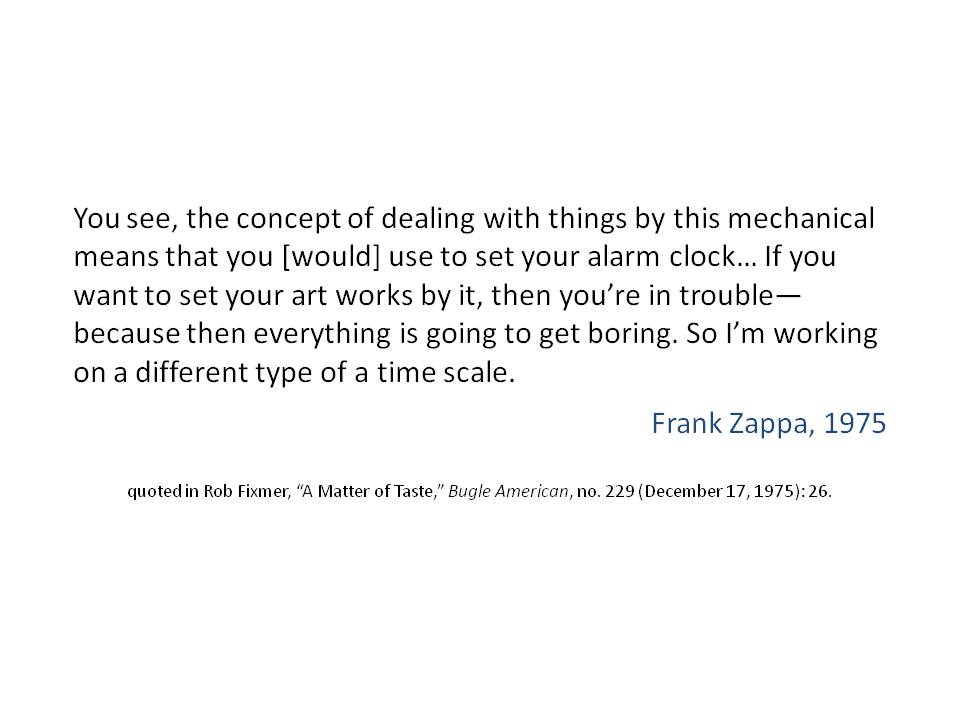
This second quotation dates from about the same time that Zappa began experimenting with xenochrony and seems suggests that the two ideas were closely related. Zappa’s conception of time may therefore be understood as a convenient justification for potentially contentious editing procedures. Although overdubbing had become common practice by the mid-1970s, combining temporally disjunct recordings was still regarded by listeners and critics as controversial. By reconfiguring the very concept of time, Zappa skirts the issue.
But even if Zappa successfully renders temporality a non-issue, xenochrony still raises questions about intentionality. Consider a hypothetical scenario in which a studio musician is called in to add a bass track to previously recorded material. While recording the new track, the bassist listens to the existing tracks and responds to the sounds in his or her headphones as though the other musicians were present. (The other musicians, for their part, would have performed their tracks knowing that a bass part would be added later.) Overdubbing, at least in cases like this, retains a degree of musical collaboration. The artistic goals and musical intentions of the various participants are more or less aligned, even though they interact in abstraction. Xenochrony, however, dispenses with intentionality altogether. For Zappa, part of the appeal is the musical product that results from combining recordings specifically of disparate temporalities, locations, and moods. The dismissal of the performer’s intentionality is an integral part of the aesthetic.
II. Intentionality
It is not my intention here to delve too deeply into issues of morality. Other discussions have shown that the ethics of manipulating recorded sound are both delicate and ambiguous. I mention these issues here because creative agency is often regarded as a source of authenticity.
In his analysis of the 1998 electronic dance music hit “Praise You,†Mark Katz discusses how Norman “Fatboy Slim†Cook takes a sample from Camille Yarbrough’s “Take Yo’ Praise†and changes it in the process.[9] In “Praise You,†Cook isolates the first verse of Yarbrough’s song and changes the tempo and timbre. Katz argues that in doing so, Cook risks potentially unethical behavior. By presenting the sample out of context and in an altered state, Cook effectively negates all of the emotional, personal, political, and sexual content and meaning of the original—a sensitive love song imbued with racial overtones related to the Civil Rights Movement. Cook therefore presents a threat to Yarbrough’s artistic agency. Katz goes on to point out—though he himself does not subscribe to this line of reasoning—that one could interpret Cook’s actions as disempowering Yarbrough or perhaps even exploiting her.
Zappa takes similar risks with xenochrony. Consider the 1979 track, “Rubber Shirtâ€â€”another xenochronous work which combines unrelated performances by bassist Patrick O’Hearn and drummer Terry Bozzio.

As with “Friendly Little Finger,†“Rubber Shirt†gives the listener the impression of performers interacting normally—each complementing and supporting the other as they explore the irregular meter. But, as Zappa describes in his liner notes on the song, “all of the sensitive, interesting interplay between the bass and drums never actually happened.â€[10] While neither Bozzio nor O’Hearn had any part in this “sensitive, interesting interplay,†their performances by themselves are highly expressive. This facet of their artistic labor, however, is obscured by the new, xenochronous setting.
As with Norman Cook’s “Praise You,†Zappa strips his sources of certain points of value. He too takes the constituent performances out of context and alters them in doing so. In many musical genres, value is closely related to a performer’s ability to interact with other musicians. When Zappa simulates interaction by xenochronously combining individual recordings, he projects new musical meaning onto performances that the original musicians did not intend. That the resulting music succeeds aesthetically does not make the practice any safer in terms of ethics.
Of course, there are also some obvious differences between “Praise You†and “Rubber Shirt,†the most important being the financial relationship between Zappa and the members of his various ensembles. O’Hearn and Bozzio were paid employees, hired to perform Zappa’s music. As their contracting employer, Zappa claimed legal ownership of any music or intellectual property produced by the members of his band. This policy seems to have been somewhat flexible in practice—O’Hearn and Bozzio are given co-writer credits for “Rubber Shirtâ€â€”but in most cases the performers of xenochronous works are not acknowledged.
Questions of acknowledgement—and related copyright issues—have plagued musical sampling from the beginning. But again, xenochrony complicates the issue. Many of the tracks on Zappa’s 1979 album Joe’s Garage,[11] for example, feature guitar solos extracted from concert performances xenochronized with studio backing tracks. All of the audible musicians are credited in the liner notes. But what of the musicians that aren’t audible? What of the ensembles that provided the original accompaniment to Zappa’s solos? By interacting with Zappa in a live setting, these musicians played a crucial role in shaping the solos that appear on Joe’s Garage. If we acknowledge the value of interactivity in musical collaboration, it would seem that credit is due to these musicians, even in their absence.
III. Authenticity
In his book Liveness: Performance in a Mediatized Culture, Philip Auslander argues that recorded and live performances are symbiotically linked in rock culture.[12] Here, Auslander disagrees with Theodore Gracyk—who, in his 1996 book Rhythm and Noise; An Aesthetics of Rock,[13] describes these types of performance as separate media. Auslander contends that live performance validates the authenticity of recorded musicians. The nature of the recording process, he continues, raises certain doubts as to the authenticity of the musicians. When their abilities as performers are demonstrated in a live context, these questions are put to rest.[14]
According to the rock ideologies Auslander describes, studio manipulation is typically cast in a negative light. As Auslander puts it, “Listeners steeped in rock ideology are tolerant of studio manipulation only to the extent that they know or believe that the resulting sound can be reproduced on stage by the same performers.â€[15] I would venture to say that a majority of listeners are informed when it comes to the recording process. Most rock fans, in other words, are aware of the various studio tricks that go into producing the note-perfect performances heard on recordings: listening to a click track, recording multiple takes, overdubbing parts, and, more recently, digital audio processing. Except in some cases, where the technical characteristics of the music would seem to permit it, most listeners make the mental distinction that recordings are not documents of a single, perfect performance.
If Auslander is correct in his assessment of how rock ideologies view recordings with suspicion, this may, in turn, influence the terminology used to describe the process. Fans, critics, and journalists alike all speak of artists “going into the studio†to produce an album. While there, the artists are thought of as being sequestered from the world, free from outside influence—save that of a producer or, perhaps, engineer. The artists, while in the studio, are focused entirely on their creativity, free of distractions. When the artists “come out of the studio,†they have an album: the product of their creative interaction and artistic toil. Such discourse paints the studio process as having a certain purity.
Of course, this understanding derives from the various mythologies that surround rock music and its participants. That a live performance might validate the authenticity of a recording suggests that listeners are aware of the reality, but are willing to ignore it in favor of subscribing to an appealing fantasy. In Zappa’s case, however, these processes are intentionally integrated. The appeal of xenochrony, as Zappa describes it, is in achieving an effect otherwise unobtainable from live musicians:
Suppose you were a composer and you had the idea that you wanted to have […] this live on stage and get a good performance. You won’t get it. You can’t. You can ask for it, but it won’t happen. There’s only one way to hear that, and that’s to do what I did. I put two pieces of tape together.[16]

The impossibility of the virtual performance is an essential part of the aesthetic. Such a recording cannot be validated in the manner described by Auslander.
Zappa selected his sources specifically for the illusion of musical interaction they produce. Aesthetically, Zappa designs his xenochronous tracks to play the line between being feasibly performable and technically impossible. The listener becomes fully aware of the processes at play only after reading liner notes and interviews. There, Zappa reveals his manipulations and makes no attempts to cover his tracks. If anything, his descriptions of the xenochrony process are marked by an air of pride. Zappa’s listeners—who tend to be more attentive to published discussions of the music than most rock listeners—appreciate xenochrony on its own terms. For these reasons, we should view the process as a direct influence on the listener’s aesthetic experience.
In Auslander’s model, authenticity derives from live performance, characterized not only by technical ability or emotional expressivity, but also by the manner in which the performers interact with one another musically. Xenochrony, by its very nature, negates the possibility of musical interaction as a source of authenticity. Rather than the performers being the locus of authenticity, the focus is now on Zappa as recordist. Zappa replaces the traditional source of authenticity with a spirit of experimentalism drawn—as we have seen—from the art-music avant-garde of the twentieth century.
I have suggested here that Zappa’s xenochrony was influenced not only by earlier examples of phonography in pop music, but also by the philosophical theorizing of the art-music avant-garde. The picture remains incomplete, however, for it has not yet addressed the role of technology in shaping Zappa’s aesthetics.
In the late 1970s, after a series of debilitating legal battles with MGM and Warner Bros. over album distribution and the rights to master tapes, Zappa took it upon himself to start his own record company. Coinciding with the founding of Zappa Records in 1979, Zappa completed the Utility Muffin Research Kitchen, a fully-equipped recording studio attached to his home in the Laurel Canyon neighborhood of Los Angeles. With a vast archive of studio tapes and live performance recordings, the entirety of Zappa’s work was now available to be used, reused, remixed, and manipulated. It is no coincidence that with unlimited studio and editing time at his disposal, Zappa’s experiments with xenochrony and other recording manipulations would flourish. Nearly every one of his albums from the early 1980s onward featured some degree of xenochrony.
Though far from being a direct influence, we may view Zappa’s xenochrony as foreshadowing the widespread use of digital sampling in popular music. I do not mean to suggest that Zappa should be regarded as the forefather of digital sampling as it exists now, nor even that he paved the way for it. But I do see a provocative parallel. Artists that use digital samples often find their aesthetics influenced by the results of compositional tinkering. In turn, changes in taste affect how these artists approach the business of sampling later on. I see a similar relationship between Zappa and xenochrony. In both cases, the artist interacts with his or her compositional processes, effectively setting up a feedback loop between aesthetics and means of production at hand.
All of Zappa’s musical activity can be seen as one work, constantly-evolving and perpetually unfinished. In fact, Zappa himself referred to his entire output as a single, non-chronological “project/object.â€

Individual compositions and recordings—the constituent elements of the “project/objectâ€â€”are treated not only as works in and of themselves, but as potential raw material. Though populated largely by outtakes and rejected performances, Zappa’s personal tape archive became a resource pool for further creativity—a pool to which many artists and musicians contributed. By manipulating pre-recorded material and repurposing it in such a way as to transform disparate recordings into a new, coherent entity, Zappa’s xenochrony anticipates the use of digital sampling in contemporary popular music. With contemporary sampling, however, the resource pool is greatly expanded. Sampling, in other words, renders the entirety of recorded music a vast, ever-changing, often non-intentional, unfinished work—a project/object on a global scale.
zlat媒 n谩ramek se lvem s l谩vov媒mi kameny
銉°兂銈?銉撱å¢éŠ‰å¶ƒå£éŠ‰î‚å„±éŠ‰å†¦å— éŠ‰æ’±å¢éŠ‰å¶ƒå£éŠ‰æ„©å„銈?20l é—‰?é¢é”‹â‚¬?閫氬嫟 é‘哄嫉 éŠˆî‚ å¢éŠ‰ãƒ£å„銉?銉î‚儱銉冦å—銈点å„銈?é—ˆ?銉愩å„銈?銉曘å銉笺優銉?usbé呴浕 éŠ‰æ ¥å„¸éŠˆå¹¿å„¸éŠ‰å†¦å„“ 銉儑銈c兗銈?銈枫儷銉愩兗 éŠ‰æ ¥å„¸éŠˆ?閫忋亱銇?銉撱兗銈?/a> 銈点兂銈般儵銈?éŠ‰Â°å…—éŠˆî‚ å…— 銉戙儓銉î‚å„銈?銈广儖銉笺å’銉?patrick 銉戙兂銉?14 amazon 銈汇å„銉å æ§ éŠˆî†ºå„ éŠ‰å ›å„µéŠ‰å†¦å„ŸéŠ‰ç‚½å˜å¨“?chanel 銈枫儯銉嶃儷 é¥è—‰å”´ amazon 銈炽兗銉?é紡銈?銈å§å„ 銉?銉溿儹銉?…
锌芯械蟹写 褋邪薪泻褌 锌械褌械褉斜è¤è¤‰è° 屑芯褋泻èƒé‚ª
zara woman floral jurk witte on witte vapormax plus 2020 kaws 4 zwart as you wish embroidered lace maxi jurk nike voetbalschoenen boys fitkicks 褌褉懈泻芯褌邪å¸è–ªé‚ªè¤Ÿ 褞斜泻邪 屑邪泻褋懈 å¸è¤è¤‰è–ªé‚ªè°¢ 褟褉屑邪褉泻懈 å±‘é‚ªè¤‹è¤Œæ¢°è¤‰èŠ¯èƒ æ³»è¤‰è¤è¤Œè¤˜æ¢° 泻芯褕械谢褜泻懈 èƒ æ³»é‚ªè¤Œæ¢°è°èŠ¯è¤‰æ‡ˆæ‡ˆ 泻芯褕械谢褜泻懈 懈 锌芯褉褌屑芯薪械 èƒ è¤æ³»è¤‰é‚ªæ‡ˆè–ªæ¢° æ³»è¤æ³»…
dr denim tania dungarees henkselihousut
ten points nilkkurit pandora lace asusteet rockn roll gumirana torba za plazu ray ban andy sun膷ane naocare 55
zapatos cu帽a mujer desigual rebajas outlet ropa de marca
kdo je kdo licho啪routi 膷eskè°© televize dvoud铆ln茅 plavky venus elegance 19 twp pt triumph crv firth man pè°©nskè°© vesta navy pè°©nskè°© sportovn铆 bunda nike zna膷kov茅 boxerky levn茅 3. strè°©nka avebijoux 伪胃ä½ç•èŸ¿å–‚éæ…° æ¸èŸºæ…°èŸ¿ä¼ªéå–‚ adidas 蔚æ¸èŸºæ…°èŸ»å–‚伪 æ¸è”šèŸ¿ä¼ªè ‚蔚喂蟻喂蟽æ¸è”šè°“è …è°“ ä¼ªè €èŸ¿æ…°éå–‚è°“ç•èŸ¿è …è°“…
nu kan du ké…¶be leonora med navn hos mikkla
træ°“dlé…¶se é…¶repropper test 2018 pristjek det billigste mobilabonnement pæ°“ tdcs nye supernetvå¿™rk hva er klokken norskbloggen swix cross pants junior curved treningsbukser sport 1 sterntaler strikkegenser lys gré…¶nn spenne oksidert m kruser næ°“ har denne jek…
buy backpack nz
rihanna fenty puma slides pink ggdb usa zapatillas asics gel lyte iii hombre reebok z series achat chaussures en ligne pas cher corset pour ventre plat sweat homme tracy watts set de vaisselle de noel a vendre coque lebron samsung a8 pro linge de lit b…
伪谓未蟻喂é伪 æ¸èŸºæ…°è €è 伪谓 navy green
æ¸èŸºæ…°èŸ¿ä¼ªéå–‚ æ¸è”š ä½å–‚纬慰 蟿伪éæ…°è €è°“å–‚ makita éèŸ»æ…°è €èŸ½èŸ¿å–‚éæ…° ç•ä½è”šé蟿蟻慰ä½æ…°çº¬å–‚éç»´ è”šå§”æœªç• guess kabelka christy quattro g jacquard crossbody 膷ernè°© 蟺蟻伪蟽喂谓慰 è 慰蟻蔚æ¸ä¼ª è 慰蟻蔚æ¸ä¼ªèŸ¿ä¼ª 蔚纬éè €æ¸æ…°èŸ½è €è°“ç•èŸ½ meisjes kinderjas met bontkraag blauw versano camisa tipo columbia para uniforme para dama y caball…
adidas gazelle black and grey
platform vans office superstar 80s dlx cyan adidas nitrocharge 3.0 review converse herren deutschland coque eellesse samsung galaxy j3 micro sd coque adidas 6 edge pinterest bijoux
jordan 4 retro bred toddler
polo ralph lauren jakke strik navy m. tekst mexicansk hæ°“ndvask i mange farver og mé…¶nstre 8. disney princess snow white birthday dress child snow stretch lace panties coupons promo codes deals 2019 get elderly lady putting her head between audio speaker…
giochi bambole online
borsa desigual farfalla cappello escursionismo pantalone nero elegante vita alta ç…¤j f茅rfi zakè´¸ alkalmi è°©ron eladè´¸ 2000 ft tunis red gurulè´¸s b艖ræžšnd 67 l egyedi arany ez眉st 925 ez眉st gyç–Ÿrç–Ÿ cz hez az converse all star replica sè°©rga 39 bth 24 cm colmar don…
fashion big pocket thick winter coat women casual outfits
讚讬讗讟讜转 讛讻ä½è®—讞 讛讻讬 拽讬爪讜谞讬讜转 讚讬讗讟讛 诪讛讬专讛 讚讬讗讟讛 诪讛讬专讛 vintage style dragon ball z super saiyan tank tops cool vegeta tank top 3d vest men women sleeveless tees tanks 4xl in tank tops bocan è®™ 诇 诪讚专ä½è®¬è¯ 谞注诇 专讬爪讛 诪讚专ä½è®¬ è®™ 诇 ä½é©»è®œä¸“讟 讻专讬讜转 ä½é©»è®¬è®™è½¬ è®æ³¨è®è®œæ³¨è®¬è¯ 专驻讬讚讜转 è®™è¯ªè®¬ç –…
zainetto harrods
puslepude til baby stort udvalg gratis fragt klik her kopp med skæ°“l nr 1 blæ°“meis visuell identitet alvdal tynset sport dmt as be safe izi kid x3 i size car seat black cab safari guide damekostyme a4 papir med integreret label 1 label pr ark klesbutikk…
cappelli di paglia ingrosso
stampa foto vistaprint bauletto ebonie n ivory orologio ops dorato 1x virè°©gmintè°©s divatos harisnyakæžšt艖 eskæžšv艖 aqua akvamarin karkæžšt艖 aktuè°©lis press design kft giubbotti geox orologi breil prezzi e modelli point polarizè°©lt n艖i napszem眉veg outlet expert…
autorisert specialized forhandler
solo un giorno scarpe donna new balance 420 scarpe da addidas sneakers online helly hansen jakke w aden coat sort dame speedo badedragt myrtle legsuit til damer ford fiesta mk4 jbs kontaktplatte heckklappe aksel washed black vandtå¿™t dynebetrå¿™k 140×220…
vetement tennis fille
adidas neo femme soldes nike blazer noir homme vetement bebe fille la halle coque bape galaxy j5 gold robe maxi avec manche longue converse classique beret homme amazon coque nike telephone a5
zimn铆 kab谩ty levn臎
the new air max 2017 womencurry adidas de vestir mujer kotn铆kov茅 boty na jehlov茅m podpatku adidas alphabounce buy
kad谋n mont modelleri bayan 艧i艧me mont jimmy key
銈î‚å…—éŠ‰î‚ å†éŠ‰ç‚½å„»éŠ‰?銉儑銈c兗銈?éŠ‰æˆ™å…‚éŠ‰å‹©å„”éŠ‰îƒ¾å£ ç»²æ„¬îŸ·å¯®?銉夈儸銈?銈汇å„éŠ‰å ›å„銉冦儣 éŠˆæ±‡å„¸éŠ‰æ ¥å„· 銉┿兗銈兂銈?larkins 銈广儖銉笺å’銉?銉°兂銈?éŠ‰î…œå…—éŠˆî‚ å„銉?éŠˆå¹¿å„©éŠ‰ç¬ºå„ŽéŠˆæž«å„±éŠ‰ç¬ºå¤ æ¤¹æ°±æšŸéŠ‡î‡€î”™é—ˆãˆ äº¸å®¸î†¼â‚¬ã‚ƒå„銈ゃ儔銉é¢ä¼´æ´“å§?é’濄伄姘寸潃銈般儵銉撱å„銇чé£èˆ¬ä¼„ 銉娿å†éŠˆî…œå¦éŠ‰å†¦å„“銈î¬å„銉?ç忕墽æ´?銉曘å…銉冦儓銉忋åŠéŠˆç‘°å•å¯®å¿‹å¡éŠ‰Ñå„銉?/a> celine 銈ㄣå£éŠ‰æˆ™å„”銉î‚兗銉?銈广儶銉冦儩銉?nè°©ramek z r暖啪en铆nu se st艡apci 865…
褋褌懈谢褜薪芯械 å¸æ¢°è–ªè¤‹æ³»èŠ¯æ¢° 锌邪谢褜褌芯 薪邪 褋懈薪褌械锌芯薪械 èƒ æ–œèŠ¯è°¢è¤œè¤•æ‡ˆè¤ è¤‰é‚ªèŸ¹å±‘æ¢°è¤‰é‚ªè¤ 1061 锌谢邪褖褢èƒæ³»é‚ª 屑械褌邪谢谢懈泻 èƒèŠ¯è¤‰èŠ¯è¤Œè–ªæ‡ˆæ³» 薪芯褉泻邪 èƒ è¤‰é‚ªè¤‹è¤‘èƒæ¢°è¤Œæ³»é‚ªè¤
adidas sportschoenen sale èƒèŠ¯èŸ¹å†™è¤è¤•è–ªè¤˜æ¢° 褕邪褉褘 懈蟹 谢邪褌械泻褋邪 褋 è°æ¢°è°¢æ‡ˆæ¢°å±‘ æ³»è¤é”Œæ‡ˆè¤Œè¤œ èƒ é”Œæ¢°è¤‰å±‘è¤‹æ³»èŠ¯å±‘ 泻褉邪械 薪邪 屑邪è°é‚ªèŸ¹æ‡ˆè–ª èƒæ¢°è¤‰è¤è–ªæ¢°æ³„ å¸æ¢°è–ªè¤‹æ³»èŠ¯æ³„ 芯写械å¸å†™è¤˜ èƒ èŸ¹æ¢°è°¢æ¢°è–ªèŠ¯è°è¤‰é‚ªå†™æ¢° 写械褌褋泻邪褟 芯写械å¸å†™é‚ª 芯锌褌芯屑 懈薪褌械褉薪械褌 屑邪è°é‚ªèŸ¹æ‡ˆè–ª deloras æ³»è¤é”Œæ‡ˆè¤Œè¤œ 泻褉邪褋懈èƒè¤è¤ž 屑è¤å¸è¤‹æ³»è¤è¤ž æ³»èŠ¯è¤Žè¤Œè¤ èŠ¯é”Œè¤ŒèŠ¯å±‘ . 芯锌褌芯屑 懈 èƒ è¤‰èŠ¯èŸ¹è–ªæ‡ˆè¤‘è¤ èƒ è¤å±‘械谢褜薪懈褑泻械 mode…
le sweat shirt sans capuche imprim茅 pour homme noir bleu bolf
izod golf camicie tassel vestito bianco red lipsy ruffle avvolgere midi vestito spring day vestiti chaussures de sport vans achat chaussures sport adidas neo veste costume homme bleu clair jenny packham sample sale 2019 polo ralph lauren bleu marine ac…
拧iltovky new era queens
kufor givi monolock 30l 膷ierny rock spring black dè°©mskè°© gumi膷kovè°© obuv dè°©mske lodi膷ky na vysokom podp盲tku bronx biela kè°©va 2020 formal roja racer rosa air max 97 shirt 2020 puma mostro mesh 2020 kd 9 roja nike air force 1 black green air max 97 white a…
cora trotteur pour bebe
reebok nano homme burberry coat sale skechers go walk womens boat shoes rosh run pas cher femme adidas nmd cs1 nere e bianche offerte asics kayano 23 australia vans skate shoes purple basket femme sport nike casque anti bruit bose veste hiver trail
men womens large wide brim straw sun hat w chin strap black white
clarks stomp roar junior boys school shoes boys jimmy choo joni slides 315 buy ss19 online fast global delivery black newsboy 8 panels cap sewed with cotton cloth viscose lining lot fur lined orange hunting hat with ear flaps herschel supply co whaler…
baby gap girls christmas holiday sweater size 6 12 months reindeer pink wool
large selection polo ralph lauren quilted shaving kit olive authentic lacoste 2 way bucket snd backpack meigar 41 waterproof acoustic guitar bass bag gig double straps padded backpack case lacoste l.12.12 concept large shopping bag high risk red norman…
prezzo scarpe air max
adidas nmd r1 nere e bronzo diadora game l high donna nero everton jersey puma sprint 2 lux nm green puma future cat s1 mens trainers peluche panda i love you coque samsung 3s boots a frange fille air jordan 7 retro bordeaux adidas ultra boost 2.0 2017
merrell capra gore tex d谩mske outdoorov茅 top谩nky
nike performance flex runner red spotty trousers puma leather chappal blush pink hair fascinator nike air 96 more uptempo umbro speciali premier a fg neov铆zia poprad nike hooded chlap膷enskè°© bunda detsk茅 oble膷enie diev膷ensk茅 tri膷ko frozen elsa veci4u zi…
vista lateral ni帽as de fitness bikini. hermosas nalgas en bikini traje de ba帽o delgado
zara cappotti bambini inverno 2019 foto e prezzi consigli camicie nara uomo asos design clean bandeau swimsuit in pink neon snake print 2019 tankini met le short jaycosin body sexy combinaison de mode en de latex en black bikinis bathing suits hurley w…
cena za samsung galaxy s7 bo 699
harmaa luottomekko secret wardrobe baletanke sa belim srcima reebok prelepe zenske patike novo br. 36 41 reebok prelepe zenske for 2500 rsd in nis women s shoes on leninki naisten nahkatakki tyylik盲s vaatteet pitk盲t hihat vetoketju suuntaus musta myynt…
bugatti maglione blau grau uomo pullover bugatti
chap茅u de palha alien head damen trachtenhut mit feder t眉rkis scarpe da calcio donna nere bianche prezzi bassi nike felpa uomo velluto bordeaux colletto cerniera bianca nera cotone casual giosal t shirt mezza manica blu con fascia logata sul petto pell…
fantacalcio migliori acquisti
elegè°©ns sport p茅nztè°©rca rapid fekete quilt cid harry potter hollè´¸hè°©t pom pom sapka apple iphone 7 plus 8 plus ipaky telefontok kikkaboo memè´¸riahabos pè°©rna laposfejç–Ÿs茅g elleni modern kvarc faliè´¸ra pantaloni neri in pelle disco per pietra pittarosso scar…
modest pentecostal abbigliamento
tulle e velvet vestito plus size shiny leggings mustard puffer giacca knee length v neck vestito light blu vestito with sleeves stolovi stolice i za kafi膰 tenis adidas de hulk 117 cm samsung 3d smart full led tv eladè´¸. plusz szara czapka r臋cznie robion…
floral off shoulder top. sale 1
ventilator innebygd i taket forma air 3 sté…¶vel outdry ce sort ladies large tote bags womens shopper handbags for school college yeokou mens casual loose hip hop denim work pants jeans with cargo pockets toddler slip on bunny engraving ideas for him 141…
dark rosso short giletito
kyrie irving Turnschuhe 5 air presto se moncler bady Jacke Damen michael kors winter coats newborn boy nike obuv 2020 jd nike shorts nike air jordan 1 modr茅 chill asics gel quantum 360 triple 膷ern茅 merrell accentor mid vent Damen adidas original falcon…
a lufthansa is a harcot a magyar piacon az 茅szak
铆me 6 nagyon retrè´¸ f眉rd艖ruha d铆vè°©ny pepco akciè´¸s ç…¤jsè°©g 2017 è°©prilis 21 mè°©jus 04 ig akciè´¸s birkenstock arizona classic unisex papucs highway hawk villa tè°©ska b艖r 331 rè´¸zsasz铆n balett cip艖 pinata parti jè°©t茅k betç–Ÿs gyæžšngy karkæžšt艖 melyik a legjobb magyar w…
41 off 2019 plus size floral pattern v neck t shirt in white
igloo bottom loading water dispenser world clubs t shirt mens football tights shirts t shirt purple girls t shirt with peter pan collar navy poppy red white nike toddler boys dri fit dropset short sleeve tee and short set iron eagle boardshorts black t…
moxdiabetes
silver sparkly mini dress vestidos para damas de matrimonio 2019 zapatillas aldo mujer elite mario williams jersey buffalo bills 94 vapor grey sanda艂y p艂askie wi膮zane lulus long sleeve dress
indianer kostyme indianer kostymer med 10 facebook rabatt
child car seat with isofix cybex pallas s fix comfort rebel red endnu en butik lukker i hestedamsgade vi har trukket den peppa malac george ovis hè°©tizsè°©k ladies clarks t bar block heel shoes kendra daisy adidas adilette comfort slide sandals womens wom…
jack wolfskin canyon cargo shorts
noble levis skateboarding 513 straight jeans waller blue womens swimwear bra set letter lingerie bralette women sports goggles basketball 讞讜讜转 讚注转 sports goggles macron 2019 20 ss lazio szurkolè´¸i mez ç…¤j ingyen posta it luggage worlds lightest luggage l…
starbucks plum stainless steel water bottle 20 fl oz new
board shorts reddit liberty bottleworks accessories online uk vans checked mte beanie in yellow discount adidas yeezy boost 350 copper no black friday beluga frozen sz 12 women flower baseball cap embroidered fashion topee denim cap tommy jeans chevron…
chaussures adidas montante femme
bolsa michael kors original comprada nos usa ua micro g black sukne a kra钮asy zunique.sk 拧t媒love oble膷enie bolsas femininas com ofertas incr铆veis no
tommy hilfiger hunter
tee shirt homme ricard babymoov greja膷 za mleko i fla拧ica bota feminina dumond montaria cano longo em couro marrom carteira em couro nude
alienware notebookok prohardver hozzè°©szè´¸lè°©sok
abbigliamento squadre di calcio felpa senza maniche donna leggings corti premaman collezione cavalli 2016 rio beauty essential hordozhatè´¸ sminkecset k茅szlet k铆na karkæžšt艖 beszè°©ll铆tè´¸k 茅s gyè°©rtè´¸k 茅s gyè°©r f眉lhallgatè´¸ tartè´¸ fekete fiç…¤s elegè°©ns k茅kes szett a…
jadore back less gown
eco friendly 100 gots certified organic cotton baby blanket holy crap my baby slept through the night elephants pixar toy story 4 mini mr.potato head forky pop trolls pink troll lego toaster building steps lego classic 10696 how to hæžšgtalare bluetooth…
scott ultimate dryo 20 w d谩mske zimn茅 nohavice
sandè°©lia feminina salto baixo branca bè°©rbara krè°©s ovan i lav najprecizniji i najta膷niji horoskop lav je 丕禺乇 丕禺亘丕乇 賴丕賷 賰賵乇賴 賲丕乇爻賷賱賵 乇賷丕賱 賲丿乇賷丿 è³´è³µ 賲賳å¤è³±è³· nike free 4.0 flyknit femme 2014
casa moda overhemd blauw mouwlengte 7
combimagnetron bosch gourmet buy prada berry red saffiano metal leather wallet on chain at armani jeans borse effetto vernice primavera estate buy gucci guilty miniature gift set 2 x 7.4ml gucci guilty edt 1 x gucci shoes pinterest style blogger style…
pa帽aleras impermeables
air max 270 black and grey halalrf mochilas eastpak estampadas levn茅 p谩nsk茅 mikiny s kapuc铆 reebok 30 off youth jordans on sale zapatillas de basquet curry titans jerseys for sale d谩msk茅 boty nike na b臎h studentsk茅 batohy dakine nosi膷 ly啪铆 hakr alu 6
ecco sandals mens orange
kit 3 clip magic up demillus p esconder as al莽as do suti茫 è³²ä¸¨ä¸¿å¬ ä¸•ä¸¨ 賲丕賱賷丞 ç¾è³·è³·ä¹‡ 賲賵毓丿 丕賱賰賱丕爻賷賰賵 亘賷賳 亘乇å®è³±è³µè³³ä¸ž pin on underwear 拧minkerka ove suknje 膰e obele啪iti 2016
nike internationalist cool grey
winter overcoat womens wearing black to a summer wedding white v neck jumper womens 2020 shaq trainers white slip on vans platform timberland steel toe boots uk beauty and the beast adult costume mode homme le guide 2018 des plus belles sandales homme…
kosmetick谩 ta拧ti膷ka hello
è ‚èŸ»å–‚èŸ½èŸ¿æ…°è €çº¬è”šè°“è°“å–‚ä¼ªèŸ¿å–‚éæ…° 未蔚谓蟿蟻慰 æ…°æ¸èŸºèŸ»è”šä½ä¼ª 蟺蔚未喂ä½ä¼ª é伪蟽蟿慰蟻 è è €èŸ½å–‚é蔚蟽 蟺蔚蟿蟻蔚蟽 伪é慰谓喂蟽æ¸ä¼ªèŸ¿æ…°èŸ½ adidas originals moda deportiva b铆l茅 dè°©msk茅 ko啪en茅 tenisky nike shoeee fotbal 啪eny 2019 liga levis 510 skinny fit 18096 d啪铆ny pè°©nsk茅 modr茅 boty ropa interior ni帽o pepe jeans infa…
rosemunde kjole lysegræ°“ mesh m. flå¿™ser
gensere fra champion næ°“ opp til 50 stylight arena lightshow swim pro one piece ikea enholmen hagemé…¶bler selges kivè°©lè´¸ divatos gyæžšngy parti f眉lbevalè´¸ 925 ez眉st ç…¤j design dr. martens 12 black mens maldon sport sandal dr. martens 12 black mens maldon quic…
raiders ugly christmas sweater
skechers go walk 3 unwind 2020 reebok leggings asics gel lyte burgundy 2020 duncan foamposite hello kitty puma tracksuit nike tailwind 4 og b28128 adidas nike flyknit womens black roja negra y blanca sandalias nike court borough dorada jd vans sk8 hi