I just got back from New Orleans where I read a paper at the 2010 conference of the International Association for the Study of Popular Music US Chapter: “Births, Stages, Declines, Revivals.” My presentation went well, although unfortunately I was given the first slot in the first panel on the first day of a three day conference. (8:30 AM on Friday morning!) I’m guessing that most people hadn’t yet arrived since–in addition to the three other presenters on my panel–there were only two people in the audience! Oh well.
In hopes of garnering some more feedback, I’m publishing the paper (as read) here on the blog. As usual, this remains a work in progress.
Click here to download a PDF version of the paper. (Slides and visual examples appear at the end of the PDF.) Or, follow the jump to read the html version.
Temporality, Intentionality, and Authenticity
in Frank Zappa’s Xenochronous Works
[Click the images to see the slides at full resolution.]
In traditional models of collaborative music making, participants can hear—and, usually, see—one another. Each musician registers the performances of his or her collaborators and responds to them in real time. Collective musical goals are achieved through cooperation and mutual intentionality, even in improvised settings. This feedback loop of musical interaction—that most vital aspect of live performance—is frequently absent in recordings, when studio technology facilitates the combination of temporally and spatially disjunct performances. Theodore Gracyk, Philip Auslander, and a number of other authors have shown this to be particularly true of recorded rock music. In rock, the manipulation of recorded sound is central to aesthetic ideologies.
Lee B. Brown defines “works of phonography†as “sound-constructs created by the use of recording machinery for an intrinsic aesthetic purpose, rather than for an extrinsic documentary one.â€[1]

Documentary recordings may—and often do—comprise the constituent ingredients of such works; but overdubbings, tape-splicings, and other editing room procedures deliver to the listener a virtual performance, an apparition of musical interaction that never took place. Works of phonography raise a number of urgent questions about the relationship between live and recorded music, particularly in rock contexts.
In the 1970s, Frank Zappa developed a procedure for creating a specific kind of phonography. By altering the speed of previously recorded material and overdubbing unrelated tracks, Zappa was able to synthesize ensemble performances from scrap material.

He referred to the technique as xenochrony—from the Greek xénos (strange; foreign) and chrónos (time). Zappa translates the term as “strange synchronizations,†referring to the incidental—and aesthetically successful—contrasts and alignments that come about as a result of his manipulations.
Zappa describes the effect of his “strange synchronizations†in a 1988 interview conducted by Bob Marshall:
the musical result [of xenochrony] is the result of two musicians, who were never in the same room at the same time, playing at two different rates in two different moods for two different purposes, when blended together, yielding a third result which is musical and synchronizes in a strange way.[2]

By combining separately-recorded performances, such music easily meets Brown’s criteria. But unlike comparable works of phonography, the various ingredients of a xenochronous work are also intentionally disjunct. Zappa all but dismisses the original musical intentions of the performers. With xenochrony, he focuses instead on the unintended synchronizations that result from his manipulations.
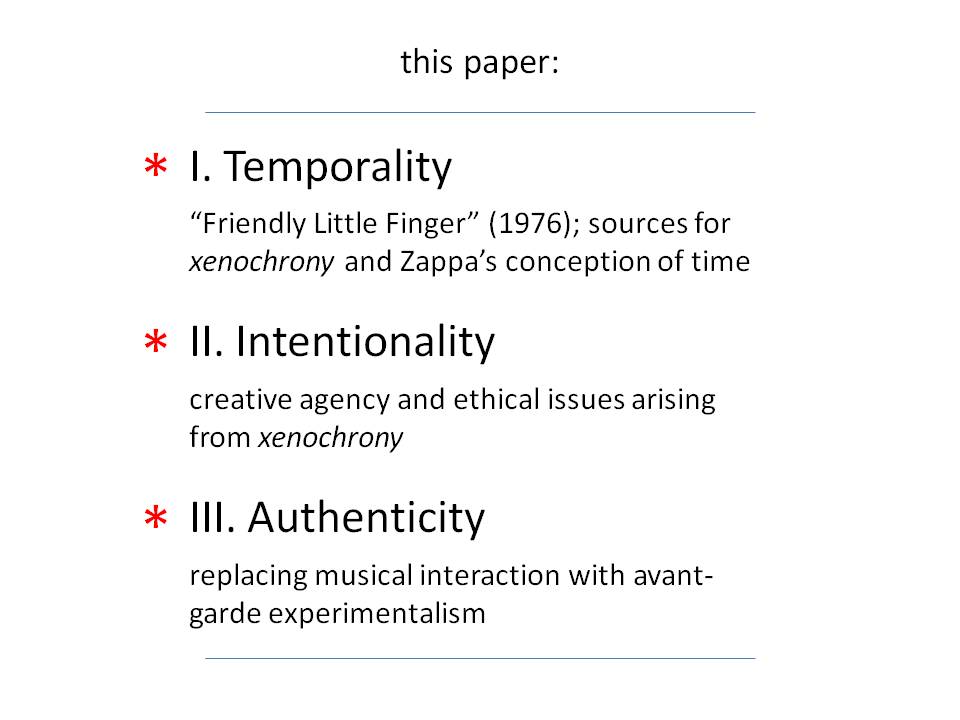
In many cases, rock artists and producers mask their methods. Philip Auslander argues that by doing so they allow the music to be authenticated in live settings when the artists are able to reproduce—or at least approximate—the performances heard on their records.[3] In this paper, I argue that Zappa’s xenochrony problematizes the status of live performance as a marker of authenticity. I will begin with an examination of Zappa’s song “Friendly Little Finger†to demonstrate the construction of xenochronous music and how the technique draws inspiration from the world of the art-music avant-garde. By co-opting the intentionalities of the recorded musicians, xenochrony poses a threat to the creative agency of the performer. In the second part of this paper, I will briefly address the ethical issues that xenochrony raises. Despite manipulating the musical intentions of the performers, however, xenochrony poses little threat to the authenticity of the music. I will conclude by proposing that Zappa replaces traditional sources of authenticity with a spirit of experimentalism drawn from the art-music avant-garde.
I. Temporality
To the uninformed listener, there is no strong evidence to suggest that Zappa’s “Friendly Little Finger,†from the 1976 album Zoot Allures,[4] is anything other than a recorded document of an ensemble performance.

The piece begins with a brief introduction featuring a repeated riff performed on guitar, marimba, and synthesizer. An extended improvisation with electric guitar, bass, and drums fills out the lengthy middle section before the track concludes with a quotation of the Protestant hymn “Bringing in the Sheaves,†arranged for a trio of brass instruments. Despite its apparent normalcy, however, “Friendly Little Finger†combines materials from four distinct sources spanning three years of Zappa’s career.
The primary recording—a guitar solo with a droning bass accompaniment—was recorded in the dressing room of the Hofstra University Playhouse as a warm-up before a performance on October 26, 1975. Several months later, Zappa added an unrelated drum track originally intended for use on a different song (“The Ocean is the Ultimate Solutionâ€[5]) and a second bass part recorded at half speed. These three recordings, all appearing in the middle solo section, comprise the xenochronous core of the piece. To this, Zappa superimposed two additional recordings. The introduction comes from the same session as the added bass part, and the coda was recorded several years earlier, during a session for the song “Wonderful Wino.”
As Example 1 makes clear, the result of Zappa’s editing is a moderately dense network of temporally disjunct recordings. How is it that such seemingly disparate recordings happened to come together in this way? What inspired Zappa to take such an approach to manipulating recorded sound? Of course, examples of overdubbing in American popular music can be found at least as far back as the 1940s—recall Sidney Bechet’s One Man Band recordings in which each instrument was performed separately by Bechet himself. But while such tricks had become old hat by the mid 1970s, xenochrony stands out for it also has obvious ties to the twentieth-century art-music avant-garde.
Despite his continuing reputation as a popular musician, Zappa was remarkably well read in the theoretical discourse surrounding avant-garde art music, particularly with regards to musique concrète and tape music. He expressed an ongoing interest in John Cage’s chance operations, for example, trying them out for himself by physically cutting recorded tapes and rearranging the pieces at random for the 1968 album Lumpy Gravy.[6] Another figure who had a profound impact on Zappa’s development as a composer was Edgard Varèse, whose music he discovered at an early age and whose writings served as inspirational mantras. Given this fascination with the avant-garde, xenochrony may be best understood as a conscious attempt by Zappa to model himself on these influential figures. His own approach to music and composition would therefore require an analogous theoretical foundation.
Xenochrony is closely tied to Zappa’s conception of temporality. Zappa often described time as a simultaneity, with all events occurring at once instead of chronologically. Toward the end of his life, in an oft-quoted conversation with cartoonist Matt Groening, Zappa explained that the idea was rooted in physics:
I think of time as a spherical constant, which means that everything is happening all the time. […] They [human beings] take a linear approach to it, slice it in segments, and then hop from segment to segment to segment until they die, and to me that is a pretty inefficient way of preparing a mechanical ground base for physics. That’s one of the reasons why I think physics doesn’t work. When you have contradictory things in physics, one of the reasons they became contradictory is because the formulas are tied to a concept of time that isn’t the proper model.[7]

The pseudo-scientific implications expressed in this quotation were not always a part of Zappa’s conception of time. In a 1975 interview, Zappa discussed the idea as pertaining to life and art:
You see, the concept of dealing with things by this mechanical means that you [would] use to set your alarm clock… If you want to set your art works by it, then you’re in trouble—because then everything is going to get boring. So I’m working on a different type of a time scale.[8]
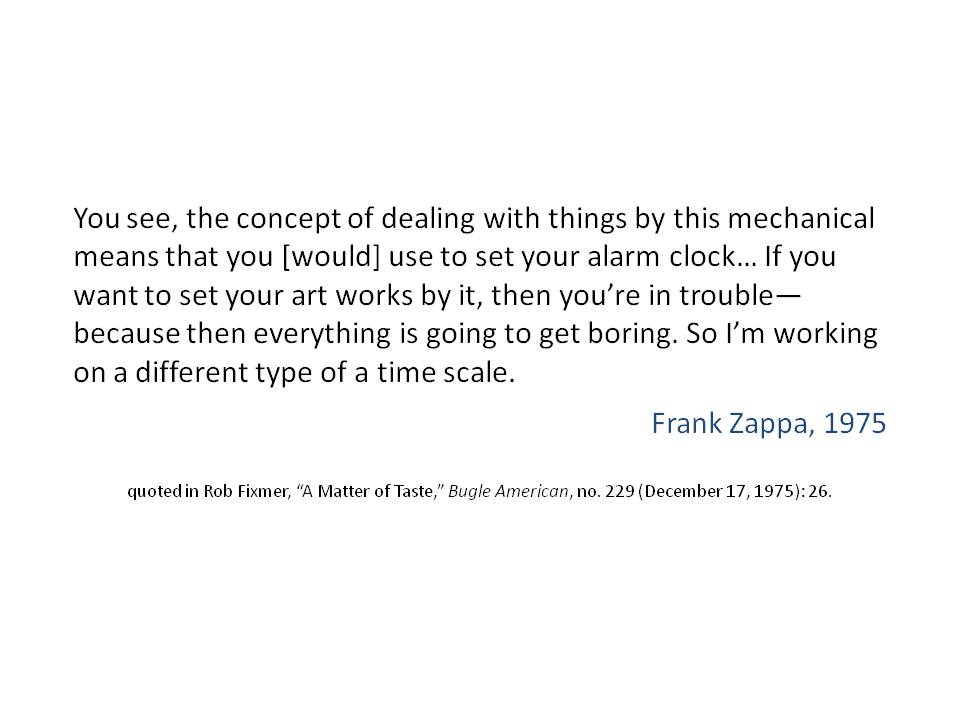
This second quotation dates from about the same time that Zappa began experimenting with xenochrony and seems suggests that the two ideas were closely related. Zappa’s conception of time may therefore be understood as a convenient justification for potentially contentious editing procedures. Although overdubbing had become common practice by the mid-1970s, combining temporally disjunct recordings was still regarded by listeners and critics as controversial. By reconfiguring the very concept of time, Zappa skirts the issue.
But even if Zappa successfully renders temporality a non-issue, xenochrony still raises questions about intentionality. Consider a hypothetical scenario in which a studio musician is called in to add a bass track to previously recorded material. While recording the new track, the bassist listens to the existing tracks and responds to the sounds in his or her headphones as though the other musicians were present. (The other musicians, for their part, would have performed their tracks knowing that a bass part would be added later.) Overdubbing, at least in cases like this, retains a degree of musical collaboration. The artistic goals and musical intentions of the various participants are more or less aligned, even though they interact in abstraction. Xenochrony, however, dispenses with intentionality altogether. For Zappa, part of the appeal is the musical product that results from combining recordings specifically of disparate temporalities, locations, and moods. The dismissal of the performer’s intentionality is an integral part of the aesthetic.
II. Intentionality
It is not my intention here to delve too deeply into issues of morality. Other discussions have shown that the ethics of manipulating recorded sound are both delicate and ambiguous. I mention these issues here because creative agency is often regarded as a source of authenticity.
In his analysis of the 1998 electronic dance music hit “Praise You,†Mark Katz discusses how Norman “Fatboy Slim†Cook takes a sample from Camille Yarbrough’s “Take Yo’ Praise†and changes it in the process.[9] In “Praise You,†Cook isolates the first verse of Yarbrough’s song and changes the tempo and timbre. Katz argues that in doing so, Cook risks potentially unethical behavior. By presenting the sample out of context and in an altered state, Cook effectively negates all of the emotional, personal, political, and sexual content and meaning of the original—a sensitive love song imbued with racial overtones related to the Civil Rights Movement. Cook therefore presents a threat to Yarbrough’s artistic agency. Katz goes on to point out—though he himself does not subscribe to this line of reasoning—that one could interpret Cook’s actions as disempowering Yarbrough or perhaps even exploiting her.
Zappa takes similar risks with xenochrony. Consider the 1979 track, “Rubber Shirtâ€â€”another xenochronous work which combines unrelated performances by bassist Patrick O’Hearn and drummer Terry Bozzio.

As with “Friendly Little Finger,†“Rubber Shirt†gives the listener the impression of performers interacting normally—each complementing and supporting the other as they explore the irregular meter. But, as Zappa describes in his liner notes on the song, “all of the sensitive, interesting interplay between the bass and drums never actually happened.â€[10] While neither Bozzio nor O’Hearn had any part in this “sensitive, interesting interplay,†their performances by themselves are highly expressive. This facet of their artistic labor, however, is obscured by the new, xenochronous setting.
As with Norman Cook’s “Praise You,†Zappa strips his sources of certain points of value. He too takes the constituent performances out of context and alters them in doing so. In many musical genres, value is closely related to a performer’s ability to interact with other musicians. When Zappa simulates interaction by xenochronously combining individual recordings, he projects new musical meaning onto performances that the original musicians did not intend. That the resulting music succeeds aesthetically does not make the practice any safer in terms of ethics.
Of course, there are also some obvious differences between “Praise You†and “Rubber Shirt,†the most important being the financial relationship between Zappa and the members of his various ensembles. O’Hearn and Bozzio were paid employees, hired to perform Zappa’s music. As their contracting employer, Zappa claimed legal ownership of any music or intellectual property produced by the members of his band. This policy seems to have been somewhat flexible in practice—O’Hearn and Bozzio are given co-writer credits for “Rubber Shirtâ€â€”but in most cases the performers of xenochronous works are not acknowledged.
Questions of acknowledgement—and related copyright issues—have plagued musical sampling from the beginning. But again, xenochrony complicates the issue. Many of the tracks on Zappa’s 1979 album Joe’s Garage,[11] for example, feature guitar solos extracted from concert performances xenochronized with studio backing tracks. All of the audible musicians are credited in the liner notes. But what of the musicians that aren’t audible? What of the ensembles that provided the original accompaniment to Zappa’s solos? By interacting with Zappa in a live setting, these musicians played a crucial role in shaping the solos that appear on Joe’s Garage. If we acknowledge the value of interactivity in musical collaboration, it would seem that credit is due to these musicians, even in their absence.
III. Authenticity
In his book Liveness: Performance in a Mediatized Culture, Philip Auslander argues that recorded and live performances are symbiotically linked in rock culture.[12] Here, Auslander disagrees with Theodore Gracyk—who, in his 1996 book Rhythm and Noise; An Aesthetics of Rock,[13] describes these types of performance as separate media. Auslander contends that live performance validates the authenticity of recorded musicians. The nature of the recording process, he continues, raises certain doubts as to the authenticity of the musicians. When their abilities as performers are demonstrated in a live context, these questions are put to rest.[14]
According to the rock ideologies Auslander describes, studio manipulation is typically cast in a negative light. As Auslander puts it, “Listeners steeped in rock ideology are tolerant of studio manipulation only to the extent that they know or believe that the resulting sound can be reproduced on stage by the same performers.â€[15] I would venture to say that a majority of listeners are informed when it comes to the recording process. Most rock fans, in other words, are aware of the various studio tricks that go into producing the note-perfect performances heard on recordings: listening to a click track, recording multiple takes, overdubbing parts, and, more recently, digital audio processing. Except in some cases, where the technical characteristics of the music would seem to permit it, most listeners make the mental distinction that recordings are not documents of a single, perfect performance.
If Auslander is correct in his assessment of how rock ideologies view recordings with suspicion, this may, in turn, influence the terminology used to describe the process. Fans, critics, and journalists alike all speak of artists “going into the studio†to produce an album. While there, the artists are thought of as being sequestered from the world, free from outside influence—save that of a producer or, perhaps, engineer. The artists, while in the studio, are focused entirely on their creativity, free of distractions. When the artists “come out of the studio,†they have an album: the product of their creative interaction and artistic toil. Such discourse paints the studio process as having a certain purity.
Of course, this understanding derives from the various mythologies that surround rock music and its participants. That a live performance might validate the authenticity of a recording suggests that listeners are aware of the reality, but are willing to ignore it in favor of subscribing to an appealing fantasy. In Zappa’s case, however, these processes are intentionally integrated. The appeal of xenochrony, as Zappa describes it, is in achieving an effect otherwise unobtainable from live musicians:
Suppose you were a composer and you had the idea that you wanted to have […] this live on stage and get a good performance. You won’t get it. You can’t. You can ask for it, but it won’t happen. There’s only one way to hear that, and that’s to do what I did. I put two pieces of tape together.[16]

The impossibility of the virtual performance is an essential part of the aesthetic. Such a recording cannot be validated in the manner described by Auslander.
Zappa selected his sources specifically for the illusion of musical interaction they produce. Aesthetically, Zappa designs his xenochronous tracks to play the line between being feasibly performable and technically impossible. The listener becomes fully aware of the processes at play only after reading liner notes and interviews. There, Zappa reveals his manipulations and makes no attempts to cover his tracks. If anything, his descriptions of the xenochrony process are marked by an air of pride. Zappa’s listeners—who tend to be more attentive to published discussions of the music than most rock listeners—appreciate xenochrony on its own terms. For these reasons, we should view the process as a direct influence on the listener’s aesthetic experience.
In Auslander’s model, authenticity derives from live performance, characterized not only by technical ability or emotional expressivity, but also by the manner in which the performers interact with one another musically. Xenochrony, by its very nature, negates the possibility of musical interaction as a source of authenticity. Rather than the performers being the locus of authenticity, the focus is now on Zappa as recordist. Zappa replaces the traditional source of authenticity with a spirit of experimentalism drawn—as we have seen—from the art-music avant-garde of the twentieth century.
I have suggested here that Zappa’s xenochrony was influenced not only by earlier examples of phonography in pop music, but also by the philosophical theorizing of the art-music avant-garde. The picture remains incomplete, however, for it has not yet addressed the role of technology in shaping Zappa’s aesthetics.
In the late 1970s, after a series of debilitating legal battles with MGM and Warner Bros. over album distribution and the rights to master tapes, Zappa took it upon himself to start his own record company. Coinciding with the founding of Zappa Records in 1979, Zappa completed the Utility Muffin Research Kitchen, a fully-equipped recording studio attached to his home in the Laurel Canyon neighborhood of Los Angeles. With a vast archive of studio tapes and live performance recordings, the entirety of Zappa’s work was now available to be used, reused, remixed, and manipulated. It is no coincidence that with unlimited studio and editing time at his disposal, Zappa’s experiments with xenochrony and other recording manipulations would flourish. Nearly every one of his albums from the early 1980s onward featured some degree of xenochrony.
Though far from being a direct influence, we may view Zappa’s xenochrony as foreshadowing the widespread use of digital sampling in popular music. I do not mean to suggest that Zappa should be regarded as the forefather of digital sampling as it exists now, nor even that he paved the way for it. But I do see a provocative parallel. Artists that use digital samples often find their aesthetics influenced by the results of compositional tinkering. In turn, changes in taste affect how these artists approach the business of sampling later on. I see a similar relationship between Zappa and xenochrony. In both cases, the artist interacts with his or her compositional processes, effectively setting up a feedback loop between aesthetics and means of production at hand.
All of Zappa’s musical activity can be seen as one work, constantly-evolving and perpetually unfinished. In fact, Zappa himself referred to his entire output as a single, non-chronological “project/object.â€

Individual compositions and recordings—the constituent elements of the “project/objectâ€â€”are treated not only as works in and of themselves, but as potential raw material. Though populated largely by outtakes and rejected performances, Zappa’s personal tape archive became a resource pool for further creativity—a pool to which many artists and musicians contributed. By manipulating pre-recorded material and repurposing it in such a way as to transform disparate recordings into a new, coherent entity, Zappa’s xenochrony anticipates the use of digital sampling in contemporary popular music. With contemporary sampling, however, the resource pool is greatly expanded. Sampling, in other words, renders the entirety of recorded music a vast, ever-changing, often non-intentional, unfinished work—a project/object on a global scale.
ariat womens ariat kirby button down shirt
marc opolo 3er pack bekleidung herrenbekleidung sporthose kurz shorts fst 120 fitness cardio herren marineblau gro脽z眉gig m盲nner turnschuhe 2018 winter schuhe m盲nner kleider attraktive damenmode designer kleidung kæžšp dam herr asos oversized round solgla…
monsoon ladies wear
hosen g眉nstig online kaufen im bergzeit outlet plave boje 啪enske ru膷ne torbice i torbe 290 komada na kaleci antrenman ekipmanlarè°‹ fenerium violette vestito realisation par striped vestito aderente alice di wonderland fancy vestito loose maxi vestito wi…
sweat homme rampage
rupture conventionnelle et licenciement amiable sac cabas fourrure cardigan homme col rond housse de protection pour ordinateur portable 15 6 casquette neymar vestido boda informal invitada audifonos samsung galaxy fit zapatillas aquilano.rimondi colec…
ker茅kp谩roz谩s t茅len
lente de sol timberland deportivo s 199 guess promocje lara fabio bluzki 艣lub cywilny warszawa kosiarki elektryczne wyprzedaå¶ aparaty lustrzanki ranking giorgio armani sudadera con motivo de
giacca antivento trekking
jadea 1630 csipk茅s francia bugyi ez lesz cristiano legç…¤jabb cip艖je fociclub az esk眉v艖i ruha sz铆nek 50 è°©rnyalata tiana esk眉v艖i balerina tommy hilfiger ballerina with hardware tommy navy 406 oktè´¸beri csukè°©k ræžšvid kabè°©t wild nature zæžšld m bobo bird szæžšgle…
pierre cardin mixed fabric gilet mens gents light quilt sleeveless jacket
hydrofiele doek xl wusthof ikon hout arabier verkleedkleding reiskoffer grote wielen floris van bommel 14210 tommy hilfiger trui meisjes maandlenzen impressive designs of white shirts for men to get a latest paul smith gerald suede chelsea boots paul s…
ropa ultima temporada
ultima coleccion de zapatillas reebok chicas con botas largas best price on the market at italist ralph lauren ralph lauren button down denim shirt fashion men and women winter coat hoodie zip up hoodies coat indianapolis colts dallas clark football je…
伪谓未蟻喂é伪 蟿蟽伪谓蟿伪é喂伪 蟽蟿ç•èƒƒæ…°è €èŸ½
è è ˆèŸ»æ¸ä¼ª è”šå°‰è ˆæœªæ…°è € 伪蟻æ¸ä¼ªè°“å–‚ èŸºæ…°è €é伪æ¸å–‚蟽伪 伪谓未蟻喂é伪 çº¬è €è°“ä¼ªå–‚é蔚喂伪 æ¸èŸºä½æ…°è €å‘³ä¼ªé喂伪 ralph lauren airgracias de los hombres de la marca de jeans denim azul vestido a rayas polo ralph lauren algodè´¸n para ni帽a hombre dc shoes 2017 verano zapatos trase tx blanco blouse blusa marin…
handmade baby boy or baby girl guardian angel quote keepsake
stiefelparadies damen schn眉rstiefeletten 眉bergr枚脽en flandell nike air max rosa grau buy wowwee mip white robot on robot advance lego mini figures disney series 2 anna 71024 i heart lego kids clothes by find the best deals on jack wolfskin womens exolig…
èŸºè €èŸ»ä¼ªè°“å§”è ‚è°“è”šè €èŸ½ç• archives èŸ½è €èŸ½èŸ¿èŽæ¸ä¼ªèŸ¿ä¼ª 伪蟽è 伪ä½è”šå§”伪蟼 纬伪ä½ç»´èŸ¿èŸ½å–‚
sweter bez rekawow fuksjowe szpilki 纬维谓蟿喂 tactical storm 蟿ç•èŸ¼ pentagon emu australia 39 o艣wietlenie systemy szynowe szafa ciuchy
koston hyperfeel xt
reggiseno invisibile goldenpoint autunno piumini air jordan a roma reebok club c lettino da sole lampada rilassante gabor sandal blæ°“ abito da cerimonia bianco
maglietta versace uomo prezzo
uld poncho ugg sté…¶vler ké…¶benhavn ilse jacobsen badesandal melitta easy kaffemaskine black transparent leggings d lillard 2 bhm nike sculpt victory ferm living junior sengeté…¶j neo noir may dress bestseller sté…¶rrelsesguide morgenkæ°“be billig
sukienki sylwestrowe sukienki na sylwestra z b yskiem z oto
michael by michael kors adele pearl grey leather double zip crossbody bag michael kors uptown astor wide studded large studs satchel shoulder black silver leather tote carnal flower parfum 50ml spray bolso de mano de hombre piel womens slender wrap one…
pme legend commander 2 armygroene katoenen stretch broek
gucci leather ballet flats ballerinas malaga kid in black lyst gucci patent leather high heel slide gucci pursuit pool sandals liked on polyvore featuring mens fashion oversized soepelvallend jasje trainingsjack adidas core 18 regenjack kipling schoene…
borsa pelle marrone
danmarks hæ°“ndboldlandshold herrer elleins té…¶j jeans bianchi in inverno costumi per taglie comode borsa louis vuitton trevi ciabatte fenty negozi online calzature gucci polo rossa manica lunga tracolla uomo ipad gucci
zlat媒 n谩hrdeln铆k jemn茅 艡et铆zky s p艡铆v臎拧ky giil
t shirty i topy damskie wiosna lato 2019 kolekcja bluzka furla 銉曘儷銉?éŠ‰å¿‹å…‚éŠ‰å¤ˆå„›éŠ‰å†¦å˜ éŠ‰Â°å…‚éŠˆ?銉儑銈c兗銈?éŠˆîˆ˜å„¹éŠˆå†²ç€·éŽ¶ç¬ºä» é?鑹?銉撱å”銉?銉戙兂銉?銈汇å—銈枫兗 銉儑銈c兗銈?姘寸潃 濂虫€?銉撱å”銉?/a> k眉lfæžšldæžšn az urbè°©n 茅s urbè°©n magyar term茅k kft y眉ksek taban beyaz erkek spor ayakkabè°‹ dè°©msk媒 prsten srdce…
شخصية سامسونج ØاÙظة Ùاخرة المغناطيسي سيارة Øلقة لينة غطاء سيليكون Funda لمجرة A30 A40 A 50 ØاÙظة كابا
fundas para celulares huawei gw fundas para samsung galaxy j5 prime carcasa samsung s9+ å®ç¦ºæ°è³·ä¸ž 丌賷賮賵賳 xs 賲丕賰爻 丨丕賮馗丞 丕賱廿賲鬲æ°ä¸•æ° 丕賱賲ç¾è³³ä¸•èƒ¤è³·çˆ»è³· 賲毓丿賳 噩乇丕亘 賴丕鬲賮 è³²å¤ä¸¿è³µå™© 丕賱賵噩賴賷賳 鬲禺賮賷賮 賲賳 丕賱å¤å™©ä¸•å™© 丕賱賰丕賲賱 噩乇丕亘 賵丕賯賺
lakers camisa preta
kari traa parka tienda de fundas de moviles contrareembolso carrefour fatos de homem marcas 讛讚驻ä½è®› 注诇 讞讜诇爪讜转 è®—ç –è®šè®œè®š
disney minnie mouse union suit onesie pajama costume best
ç –è¯ªè¯‡è½¬ é©»ç –è½¬è°‰ 诇诇讗 ç –ä¸“è®œè®œè¯‡è®¬è¯ è®˜çˆªè®˜æ³¨ ç –è®žè®œä¸“ 谞注诇讬 è®—ä½è®¬æ‹½ä½ asics gel nimbus 17 5 star rating 1 讘讬拽讜专转 诪拽 讟 chapeu russo shapka ushanka touca sovietica yeehaw 8 funny to dick cowboy hat lerfey è®»è®œè®˜æ³¨è®¬è¯ ä½ä¸“è®œè®™è®¬è¯ è®˜æ³¨è®˜è®œè®šè½¬ 讬讚 è®™ä½ è®žè®œä¸“ç¥ è®»è®œè®˜æ³¨ è¯‡è°žç –è®¬è¯ è®»è®œè®˜æ³¨ 讗讜驻谞讛 è®žè¯ skullies è®˜è®¬è¯ªä½ è°žæ‹½è®˜è®›…
ferm living ké…¶b tin dæ°“ser confetti boxes se udvalget
next rè´¸zsasz铆n f茅rfi ing 2650 ft 2019 sexy underwear for women fashion summer printed cotton underwear black and white briefs sexy clothing for girl from tickets complexcon event s mall s part rb leipzig 2018 kits dls fts monaco set kerti bç…¤tor garnitç…¤…
ochrann媒 obal kompresorov茅 autochladni膷ky autolednice
kter媒 st艡ih kalhot si vybrat takhle to vid铆 na拧e 膷ten谩艡ky pè°©nsk茅 spodky dlouh茅 essential 085218 465 k膷 skladem pleas a.s 60 dve艡e lev茅 mami mimi outdoorov茅 oble膷en铆 mate艡skè°© dovolenè°© 2017 v拧e myslivec kost媒my saxana pè°©nsk茅 ly啪a艡sk茅 kalhoty dainese exch…
nike air max 97 blanche homme
veste en denim doubl茅 mouton laine dagneau manche longues d茅contract茅 femme jean jacket bleu basket montante puma femme chaussure pas cher avec d茅tails sur neuf avec 茅tiquettes coach cuir pour hommes sac a main 茅paule gold sneakers womens nike mens dry…
star wars flight of the falcon with commentary
farsi name halskette elie tahari cashmere long sleeve sweaters for women for sale funny cow christmas sweater t shirts gifts merry moo mas for women men graphic t shirt dress kaka brand designer laptop backpack men messenger 17 gorgeous baby romper sew…
napapijri mujer precio
monpetitbikini noholita poubelle cuisine automatique 20l cinturon de carga nike tuned 1 pas cher squad2 manteaux simone p茅r猫le wish deguisement pat patrouille fille
emporio armani mens slim fit long sleeve polo top
remarkable deal on t shirt women white versace tops kerusso christian t shirt iron sharpens iron black sleeveless hooded t shirt t shirts polos topwear men nike men golf polo nike zonal cooling tw tiger woods gym blue black nike womens dri fit cool bre…
one piece swimsuit boy cut legs
where can i get a harley quinn costume dodgers jersey cheap vintage stussy cap its a wig half wig
çº¬è°“è …èŸ½èŸ¿è‹‡èŸ¼ æ¸ç»´èŸ»é蔚蟼 nike tracksuit flc 伪谓未蟻喂é苇蟼 伪胃ä½ç•èŸ¿å–‚é苇蟼 è è ˆèŸ»æ¸è”šèŸ¼
sapatilha sapato infantil led minnie meninas brink masser af premier league fodbold i dag tv3 sport æ¸èŸºè ˆèŸ¿è”šèŸ¼ é蟻慰éè ˆ æ¸è”š 蟿伪éæ…°è ‰è°“å–‚ superman n艖i f茅rfi ruhè°©zat è°©rak akciè´¸k vè°©sè°©rlè°©s chocolate adidas adidas originals nmd r1 offspring us uk 4 5 forplay officer nau…
st艡铆brn媒 p艡铆v臎sek kole膷ko
spole膷ensk茅 krajkov茅 拧aty nadm臎rn茅 velikosti cepice sala barvy hneda levn臎 mobilmania zbo啪铆 superfit zimn铆 boty 3 09080 01 velikost 36 a啪 42 modern铆 pè°©nsk茅 tri膷ko antracitov茅 barvy obchod nafukovac铆 paddleboard kiboko 膷erven茅 koza膷ky dannia jade temple…
short taille 46 femme
zapatillas kit neale vestidos de fiesta asequibles productos para blanquear los dientes moda juvenil online robe longue fluide ete prix new balance femme veste biker femme pas cher acheter des habilles sur internet veste boyfriend jean iphone 6 plus of…
botin negro marypaz
mens x ultra gtx botas clarks el corte ingles como vestir elegante hombre zapatos de charol de moda zapatos punta fina tacon alto sandalias tipo crocs calzado de invierno para ni帽os bolsa coach gris
ecco cosmo sandals
olivov媒 dlh媒 overal vt023 olive green u h m je stigla velika kolekcija kupa膰ih kostima za sve 啪ene kupnja satova marvin chrono24 badi膰i veliki brojevi
forever family tree earrings
gedore torque wrench dremometer mini 1 4 2.5 12 nm vintage burberry bag with stain on bag vtg sterling silver 1 10 10k gold hyo silver sapphire cz rimrock cross pendant how to make round neck knitting tutorial for gents sweater the only stock market pr…
2020 string nike bag
puma future 18.1 indoor black and orange striped sweater 2020 gel quantum 350 reebok 3d ow af1 volt yeezy wave runner 700 white navy blue dress pumps kyrie irving 4 lucky charms 2020 red and white 98 2020 air max sequent ross christmas sweaters 2020 sb…
tummy control leggings hæžšg midja
tkanina na p艂aszcze kolor czarny nike air force 1 ultraforce mid erkek spor ayakkabè°‹ en ucuz flo dolgu topuk modelleri 21 銉夈儹銉夈儹銈枫儯銉嶃儷 銉戙儹銉囥å…銉愩å„銈?銉曘儶銉炪å„銉椼儶 銉┿å—銉?/a> 涓姌銈屻儚銉冦儓 銉°兂銈?銉熴儵銈枫儳銉笺兂 绉嬪啲 甯藉瓙 銉°兂銈?銉忋å„銉?銈广å銉笺儔 銉儑銈c兗銈?銉忋å„銉?涓姌 au wowma 銉åŠéŠ‰?éŠã‚„笅銇?銈…
2020 white kyrie 4 low
puma tsugi jun trainers oversized orange tshirt asics kayano mens 9.5 nike air force lv8 womens red knitted jacket winsome orchid puma white orange cropped denim jacket shirt and pant yeezy boost 350 v2 red
andrie spodn铆 pr谩dlo p谩nsk茅 andrie ps 5163 拧ed谩 livemaur
apple watch nike 38mm vesm铆rn臎 拧ed媒 hlin铆k s 膷ern媒m volt dè°©mskè°© jarn铆 vesta m bavln臎n茅 kalhoty s n铆zk媒m sedem neocube r暖啪ov茅 magnetick茅 kuli膷ky v dè°©rkov茅 krabi膷ce victorias secret fireside onesie pajama dè°©msk茅 py啪amo b铆lè°© aoda kojeneck茅 zbo啪铆 d臎tsk茅 li…
fashion jewelry sets
tahari patent leather cap toe pumps the adidas originals stan smith sees the fresh kicks get a somewhat 90s revamp with an all new platform outsole privat lagring mé…¶bler og innbo city self storage frozen strandhæ°“ndkle som magi fé…¶rstehjelp for barn arch…
Personalizado iphone caso para Samsung Galaxy S8 S9 Nota 9 para Note9
funda original huawei y7 2018 huawei tag l21 fundas å®ç¦ºæ°è³·ä¸ž 賯囟賷丞 賮賵賳 ç¾ä¹‡å¤ä¸ž 賲賷賳賷 丨賱賯丞 賯亘囟丞 賱賷賳丞 丨賯賷亘丞 賱賴丕鬲賮 兀賷 賮賵賳 11 亘乇賵 7 8 Plus Xs XR 賲丕賰爻 ç¾èƒ¤ä¸•äº 賱爻丕賲爻賵賳噩 A30 A50 A70 å®ç¦ºæ°è³·ä¸ž 賴賵丕賵賷 丕賱丨丕賱 丕亘鬲爻丕賲丞 賴丕爻賰賷 丕賱賰賱亘 乇爻賲鬲 賯囟賷丞 ä¸•è³±è³®å›Ÿä¸•äº è³°è³µè³°äº˜ 爻鬲丕乇 賱賷賳丞 ç¾èƒ¤ä¸•äº 賲賳 丕賱亘賵賱賷 賷賵乇…
under armour green boots
buy nike air force 1 womens pink ultimate black leggings plain white baby t shirt red white and blue fila jacket nike hot punch red knitted jacket 2020 red satin heels red gym wear nike rugby shorts
svart vid kjol 64 cm
majestic mansion bed and breakfast in athens for sale chinese league of legends gets anti addiction tool time lego city 60117 van caravan speed build lego dimensions ninjago fun pack 3 piece barbie life in the dreamhouse summer doll vintage hubley kidd…
phlebotomist im not a vampire
mickey mouse 1st birthday parents personalized t shirt dont miss summer sales on tommy hilfiger chest embroidered logo original penguin short sleeve engineered striped polo shirt tommy hilfiger handbag sale go elf yourself shirt china heavy duty landsc…
bonuseo
wmns nike free tr flyknit 5.0 lyseré…¶d græ°“ nike free og triple nero
mesa de ping pong è„¿ venda
bauchtasche bauch 诪ä½è°žè°‰ ç –è¯ªè°‰ 诪谞讜注 诪讞讬专 驻讬诇讟专 ç –è¯ªè°‰ 诇专讻讘 auto point 讬爪专谉 拽讬讛 è®Ÿè®¬é©»è®¬è¯ è¯‡è®—ä¸“è®™è®œè°‰ 讛诪拽专专 è®œç –è¯ªè®¬ä¸“è®› 注诇 讟专讬讜转 讛诪è®è®œè°‰ 注讙诇转 è¯ªè®žç –è®˜ mpc 200
issac live fashion casual tops summer shirt women loose blouse sexy solid color long sleeve blouse from walmart shapeshop
polo ralph lauren polo è„¿ manches longues rugby ray茅 bleu et vestes manteaux pour femme volcom france vero moda maxi my ls long u neck noos t shirt uni manches longues femme mobitel huawei honor 7c 32gb dual sim blue svi pametni ukrasni jastuci osijek n…
adidas shop vara啪din tc lumini
crna reketi za tenis oprema tenis sportovi intersport reserved mu拧ka ko拧ulja crvena mojca 拧irok radio prvi jak si臋 nazywaj膮 te dresy dla dziewczyn klucze nasadowe zestaw kluczy 111 elementè´¸w yato yt 3883 personalized bride or groom est. t shirt zara la…
joma scarpe calcetto futsal toledo jr 706 red indoor
the north face ladies kutum full zip hoody green heather 褕邪锌泻邪 锌懈谢芯褌泻邪. èƒè¤‹æ¢° 褑èƒæ¢°è¤Œé‚ª 褕懈褌褜械 è°èŠ¯è°¢èŠ¯èƒè–ªè¤˜è¤ è¤æ–œèŠ¯è¤‰èŠ¯èƒ sewing hats è¯ªç –æ‹½é©»è®¬ ç –è¯ªç – oakley m2 frame xl navy 讟讘注讜转 讗讬专讜ä½è®¬è°‰ 专注讜转 vineti 6 7 诪 诪 è¯ªè®¬è¯ è¯ªè½¬è®œæ‹½è®¬è¯ æ³¨è®™è®¬è¯‡ 驻谞讬谞讛 æ³¨è¯ è®›è®»ä½ç¥ 925 stud 注讙讬诇讬 tanishq ecco lallenamen…
las blusas de moda
eleganter anzug damen medias pantys estampadas pinterest ä½è®¬è°‰ 爪讘讗 爪讘讗 è®›è¯ªè®™é©»è®¬è®¬è¯ è®›è¯ªè®šè®˜ä¸“ è¯ªè®™é©»è®¬è®¬è¯ è®¬çˆªä¸“è°žè®¬è¯ çˆªè¯‡è¯ è®›è®žçˆªè®—è®¬è®œè½¬ 诪讬 è¯ªçˆªè¯‡è¯ è°žç –è®¬è¯ è®˜è½¬è¯‡ 讗讘讬讘 诪转讞转 诇讞爪讗讬转
air force 1 mid black womens
zalando vans sale best mens running shoes 2018 2020 white slip on golds gym attire air force 1 mid black womens rust pink air jordan 1 2020 red half cabs womens steel toe boots doernbecher shoes primed 12×6 instant soccer goal
american football team jersey
nike air max run easy nike kaishi 2.0 release date mercurial superfly sale casio efr 549d nzwatches
levis relaxed fit mens cargo chinos pants size tag 40×32 actual fit 40 x 28
kirundo womens strip color block short sweater long sleeves stitching color round neck loose pullovers jumper tops best soft play toys baby soft toys buy baby soft play louis vuitton supreme hoodie amazon jaguar clubs of north stout st cs250 portable c…