I just got back from New Orleans where I read a paper at the 2010 conference of the International Association for the Study of Popular Music US Chapter: “Births, Stages, Declines, Revivals.” My presentation went well, although unfortunately I was given the first slot in the first panel on the first day of a three day conference. (8:30 AM on Friday morning!) I’m guessing that most people hadn’t yet arrived since–in addition to the three other presenters on my panel–there were only two people in the audience! Oh well.
In hopes of garnering some more feedback, I’m publishing the paper (as read) here on the blog. As usual, this remains a work in progress.
Click here to download a PDF version of the paper. (Slides and visual examples appear at the end of the PDF.) Or, follow the jump to read the html version.
Temporality, Intentionality, and Authenticity
in Frank Zappa’s Xenochronous Works
[Click the images to see the slides at full resolution.]
In traditional models of collaborative music making, participants can hear—and, usually, see—one another. Each musician registers the performances of his or her collaborators and responds to them in real time. Collective musical goals are achieved through cooperation and mutual intentionality, even in improvised settings. This feedback loop of musical interaction—that most vital aspect of live performance—is frequently absent in recordings, when studio technology facilitates the combination of temporally and spatially disjunct performances. Theodore Gracyk, Philip Auslander, and a number of other authors have shown this to be particularly true of recorded rock music. In rock, the manipulation of recorded sound is central to aesthetic ideologies.
Lee B. Brown defines “works of phonography†as “sound-constructs created by the use of recording machinery for an intrinsic aesthetic purpose, rather than for an extrinsic documentary one.â€[1]

Documentary recordings may—and often do—comprise the constituent ingredients of such works; but overdubbings, tape-splicings, and other editing room procedures deliver to the listener a virtual performance, an apparition of musical interaction that never took place. Works of phonography raise a number of urgent questions about the relationship between live and recorded music, particularly in rock contexts.
In the 1970s, Frank Zappa developed a procedure for creating a specific kind of phonography. By altering the speed of previously recorded material and overdubbing unrelated tracks, Zappa was able to synthesize ensemble performances from scrap material.

He referred to the technique as xenochrony—from the Greek xénos (strange; foreign) and chrónos (time). Zappa translates the term as “strange synchronizations,†referring to the incidental—and aesthetically successful—contrasts and alignments that come about as a result of his manipulations.
Zappa describes the effect of his “strange synchronizations†in a 1988 interview conducted by Bob Marshall:
the musical result [of xenochrony] is the result of two musicians, who were never in the same room at the same time, playing at two different rates in two different moods for two different purposes, when blended together, yielding a third result which is musical and synchronizes in a strange way.[2]

By combining separately-recorded performances, such music easily meets Brown’s criteria. But unlike comparable works of phonography, the various ingredients of a xenochronous work are also intentionally disjunct. Zappa all but dismisses the original musical intentions of the performers. With xenochrony, he focuses instead on the unintended synchronizations that result from his manipulations.
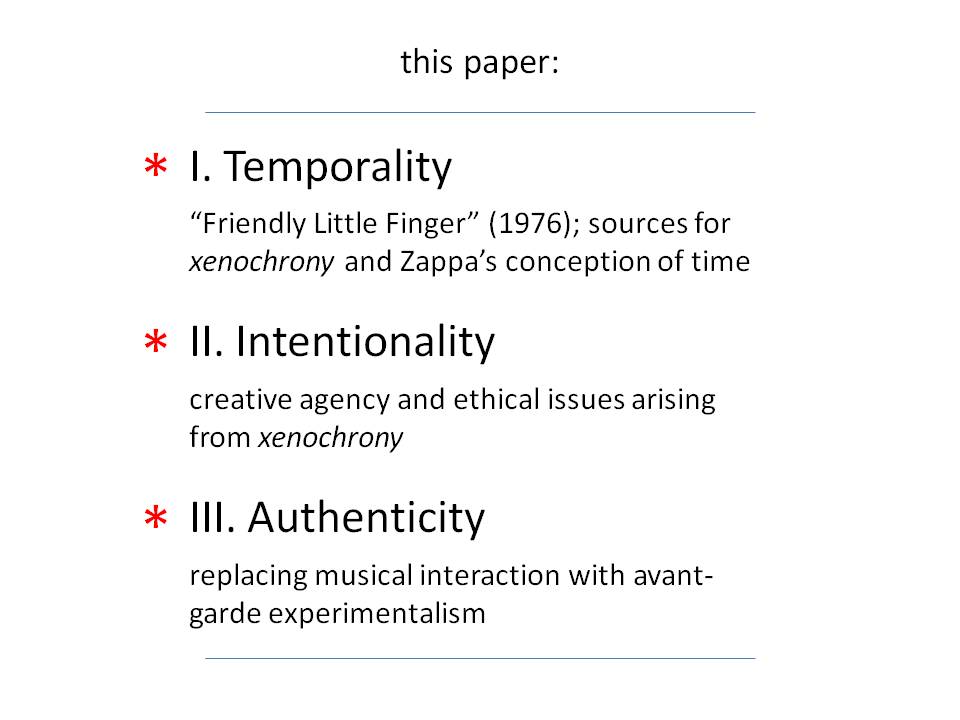
In many cases, rock artists and producers mask their methods. Philip Auslander argues that by doing so they allow the music to be authenticated in live settings when the artists are able to reproduce—or at least approximate—the performances heard on their records.[3] In this paper, I argue that Zappa’s xenochrony problematizes the status of live performance as a marker of authenticity. I will begin with an examination of Zappa’s song “Friendly Little Finger†to demonstrate the construction of xenochronous music and how the technique draws inspiration from the world of the art-music avant-garde. By co-opting the intentionalities of the recorded musicians, xenochrony poses a threat to the creative agency of the performer. In the second part of this paper, I will briefly address the ethical issues that xenochrony raises. Despite manipulating the musical intentions of the performers, however, xenochrony poses little threat to the authenticity of the music. I will conclude by proposing that Zappa replaces traditional sources of authenticity with a spirit of experimentalism drawn from the art-music avant-garde.
I. Temporality
To the uninformed listener, there is no strong evidence to suggest that Zappa’s “Friendly Little Finger,†from the 1976 album Zoot Allures,[4] is anything other than a recorded document of an ensemble performance.

The piece begins with a brief introduction featuring a repeated riff performed on guitar, marimba, and synthesizer. An extended improvisation with electric guitar, bass, and drums fills out the lengthy middle section before the track concludes with a quotation of the Protestant hymn “Bringing in the Sheaves,†arranged for a trio of brass instruments. Despite its apparent normalcy, however, “Friendly Little Finger†combines materials from four distinct sources spanning three years of Zappa’s career.
The primary recording—a guitar solo with a droning bass accompaniment—was recorded in the dressing room of the Hofstra University Playhouse as a warm-up before a performance on October 26, 1975. Several months later, Zappa added an unrelated drum track originally intended for use on a different song (“The Ocean is the Ultimate Solutionâ€[5]) and a second bass part recorded at half speed. These three recordings, all appearing in the middle solo section, comprise the xenochronous core of the piece. To this, Zappa superimposed two additional recordings. The introduction comes from the same session as the added bass part, and the coda was recorded several years earlier, during a session for the song “Wonderful Wino.”
As Example 1 makes clear, the result of Zappa’s editing is a moderately dense network of temporally disjunct recordings. How is it that such seemingly disparate recordings happened to come together in this way? What inspired Zappa to take such an approach to manipulating recorded sound? Of course, examples of overdubbing in American popular music can be found at least as far back as the 1940s—recall Sidney Bechet’s One Man Band recordings in which each instrument was performed separately by Bechet himself. But while such tricks had become old hat by the mid 1970s, xenochrony stands out for it also has obvious ties to the twentieth-century art-music avant-garde.
Despite his continuing reputation as a popular musician, Zappa was remarkably well read in the theoretical discourse surrounding avant-garde art music, particularly with regards to musique concrète and tape music. He expressed an ongoing interest in John Cage’s chance operations, for example, trying them out for himself by physically cutting recorded tapes and rearranging the pieces at random for the 1968 album Lumpy Gravy.[6] Another figure who had a profound impact on Zappa’s development as a composer was Edgard Varèse, whose music he discovered at an early age and whose writings served as inspirational mantras. Given this fascination with the avant-garde, xenochrony may be best understood as a conscious attempt by Zappa to model himself on these influential figures. His own approach to music and composition would therefore require an analogous theoretical foundation.
Xenochrony is closely tied to Zappa’s conception of temporality. Zappa often described time as a simultaneity, with all events occurring at once instead of chronologically. Toward the end of his life, in an oft-quoted conversation with cartoonist Matt Groening, Zappa explained that the idea was rooted in physics:
I think of time as a spherical constant, which means that everything is happening all the time. […] They [human beings] take a linear approach to it, slice it in segments, and then hop from segment to segment to segment until they die, and to me that is a pretty inefficient way of preparing a mechanical ground base for physics. That’s one of the reasons why I think physics doesn’t work. When you have contradictory things in physics, one of the reasons they became contradictory is because the formulas are tied to a concept of time that isn’t the proper model.[7]

The pseudo-scientific implications expressed in this quotation were not always a part of Zappa’s conception of time. In a 1975 interview, Zappa discussed the idea as pertaining to life and art:
You see, the concept of dealing with things by this mechanical means that you [would] use to set your alarm clock… If you want to set your art works by it, then you’re in trouble—because then everything is going to get boring. So I’m working on a different type of a time scale.[8]
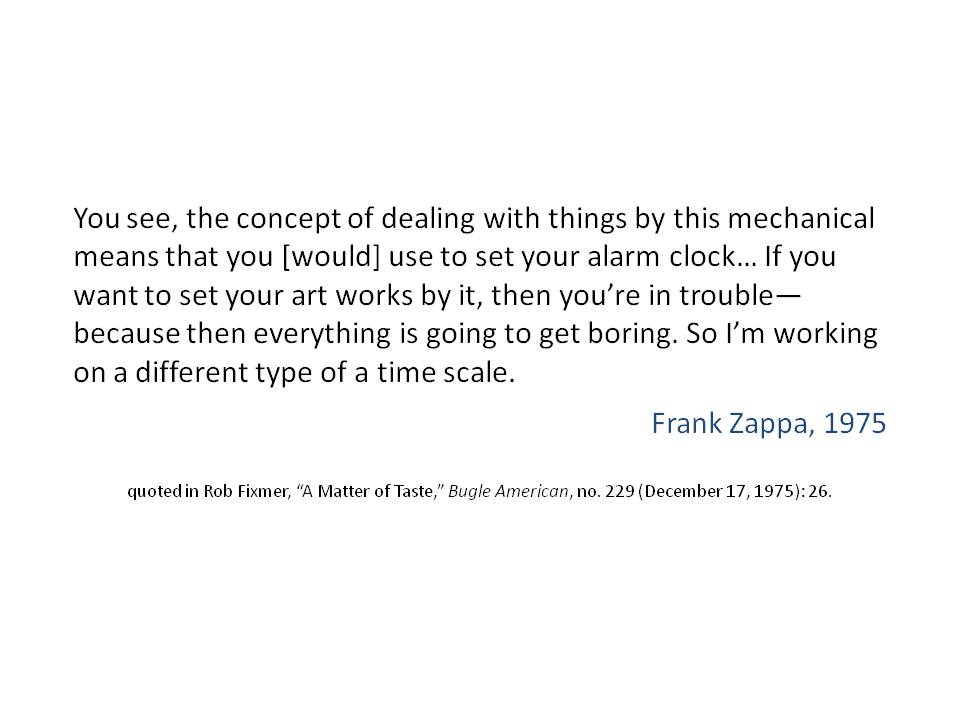
This second quotation dates from about the same time that Zappa began experimenting with xenochrony and seems suggests that the two ideas were closely related. Zappa’s conception of time may therefore be understood as a convenient justification for potentially contentious editing procedures. Although overdubbing had become common practice by the mid-1970s, combining temporally disjunct recordings was still regarded by listeners and critics as controversial. By reconfiguring the very concept of time, Zappa skirts the issue.
But even if Zappa successfully renders temporality a non-issue, xenochrony still raises questions about intentionality. Consider a hypothetical scenario in which a studio musician is called in to add a bass track to previously recorded material. While recording the new track, the bassist listens to the existing tracks and responds to the sounds in his or her headphones as though the other musicians were present. (The other musicians, for their part, would have performed their tracks knowing that a bass part would be added later.) Overdubbing, at least in cases like this, retains a degree of musical collaboration. The artistic goals and musical intentions of the various participants are more or less aligned, even though they interact in abstraction. Xenochrony, however, dispenses with intentionality altogether. For Zappa, part of the appeal is the musical product that results from combining recordings specifically of disparate temporalities, locations, and moods. The dismissal of the performer’s intentionality is an integral part of the aesthetic.
II. Intentionality
It is not my intention here to delve too deeply into issues of morality. Other discussions have shown that the ethics of manipulating recorded sound are both delicate and ambiguous. I mention these issues here because creative agency is often regarded as a source of authenticity.
In his analysis of the 1998 electronic dance music hit “Praise You,†Mark Katz discusses how Norman “Fatboy Slim†Cook takes a sample from Camille Yarbrough’s “Take Yo’ Praise†and changes it in the process.[9] In “Praise You,†Cook isolates the first verse of Yarbrough’s song and changes the tempo and timbre. Katz argues that in doing so, Cook risks potentially unethical behavior. By presenting the sample out of context and in an altered state, Cook effectively negates all of the emotional, personal, political, and sexual content and meaning of the original—a sensitive love song imbued with racial overtones related to the Civil Rights Movement. Cook therefore presents a threat to Yarbrough’s artistic agency. Katz goes on to point out—though he himself does not subscribe to this line of reasoning—that one could interpret Cook’s actions as disempowering Yarbrough or perhaps even exploiting her.
Zappa takes similar risks with xenochrony. Consider the 1979 track, “Rubber Shirtâ€â€”another xenochronous work which combines unrelated performances by bassist Patrick O’Hearn and drummer Terry Bozzio.

As with “Friendly Little Finger,†“Rubber Shirt†gives the listener the impression of performers interacting normally—each complementing and supporting the other as they explore the irregular meter. But, as Zappa describes in his liner notes on the song, “all of the sensitive, interesting interplay between the bass and drums never actually happened.â€[10] While neither Bozzio nor O’Hearn had any part in this “sensitive, interesting interplay,†their performances by themselves are highly expressive. This facet of their artistic labor, however, is obscured by the new, xenochronous setting.
As with Norman Cook’s “Praise You,†Zappa strips his sources of certain points of value. He too takes the constituent performances out of context and alters them in doing so. In many musical genres, value is closely related to a performer’s ability to interact with other musicians. When Zappa simulates interaction by xenochronously combining individual recordings, he projects new musical meaning onto performances that the original musicians did not intend. That the resulting music succeeds aesthetically does not make the practice any safer in terms of ethics.
Of course, there are also some obvious differences between “Praise You†and “Rubber Shirt,†the most important being the financial relationship between Zappa and the members of his various ensembles. O’Hearn and Bozzio were paid employees, hired to perform Zappa’s music. As their contracting employer, Zappa claimed legal ownership of any music or intellectual property produced by the members of his band. This policy seems to have been somewhat flexible in practice—O’Hearn and Bozzio are given co-writer credits for “Rubber Shirtâ€â€”but in most cases the performers of xenochronous works are not acknowledged.
Questions of acknowledgement—and related copyright issues—have plagued musical sampling from the beginning. But again, xenochrony complicates the issue. Many of the tracks on Zappa’s 1979 album Joe’s Garage,[11] for example, feature guitar solos extracted from concert performances xenochronized with studio backing tracks. All of the audible musicians are credited in the liner notes. But what of the musicians that aren’t audible? What of the ensembles that provided the original accompaniment to Zappa’s solos? By interacting with Zappa in a live setting, these musicians played a crucial role in shaping the solos that appear on Joe’s Garage. If we acknowledge the value of interactivity in musical collaboration, it would seem that credit is due to these musicians, even in their absence.
III. Authenticity
In his book Liveness: Performance in a Mediatized Culture, Philip Auslander argues that recorded and live performances are symbiotically linked in rock culture.[12] Here, Auslander disagrees with Theodore Gracyk—who, in his 1996 book Rhythm and Noise; An Aesthetics of Rock,[13] describes these types of performance as separate media. Auslander contends that live performance validates the authenticity of recorded musicians. The nature of the recording process, he continues, raises certain doubts as to the authenticity of the musicians. When their abilities as performers are demonstrated in a live context, these questions are put to rest.[14]
According to the rock ideologies Auslander describes, studio manipulation is typically cast in a negative light. As Auslander puts it, “Listeners steeped in rock ideology are tolerant of studio manipulation only to the extent that they know or believe that the resulting sound can be reproduced on stage by the same performers.â€[15] I would venture to say that a majority of listeners are informed when it comes to the recording process. Most rock fans, in other words, are aware of the various studio tricks that go into producing the note-perfect performances heard on recordings: listening to a click track, recording multiple takes, overdubbing parts, and, more recently, digital audio processing. Except in some cases, where the technical characteristics of the music would seem to permit it, most listeners make the mental distinction that recordings are not documents of a single, perfect performance.
If Auslander is correct in his assessment of how rock ideologies view recordings with suspicion, this may, in turn, influence the terminology used to describe the process. Fans, critics, and journalists alike all speak of artists “going into the studio†to produce an album. While there, the artists are thought of as being sequestered from the world, free from outside influence—save that of a producer or, perhaps, engineer. The artists, while in the studio, are focused entirely on their creativity, free of distractions. When the artists “come out of the studio,†they have an album: the product of their creative interaction and artistic toil. Such discourse paints the studio process as having a certain purity.
Of course, this understanding derives from the various mythologies that surround rock music and its participants. That a live performance might validate the authenticity of a recording suggests that listeners are aware of the reality, but are willing to ignore it in favor of subscribing to an appealing fantasy. In Zappa’s case, however, these processes are intentionally integrated. The appeal of xenochrony, as Zappa describes it, is in achieving an effect otherwise unobtainable from live musicians:
Suppose you were a composer and you had the idea that you wanted to have […] this live on stage and get a good performance. You won’t get it. You can’t. You can ask for it, but it won’t happen. There’s only one way to hear that, and that’s to do what I did. I put two pieces of tape together.[16]

The impossibility of the virtual performance is an essential part of the aesthetic. Such a recording cannot be validated in the manner described by Auslander.
Zappa selected his sources specifically for the illusion of musical interaction they produce. Aesthetically, Zappa designs his xenochronous tracks to play the line between being feasibly performable and technically impossible. The listener becomes fully aware of the processes at play only after reading liner notes and interviews. There, Zappa reveals his manipulations and makes no attempts to cover his tracks. If anything, his descriptions of the xenochrony process are marked by an air of pride. Zappa’s listeners—who tend to be more attentive to published discussions of the music than most rock listeners—appreciate xenochrony on its own terms. For these reasons, we should view the process as a direct influence on the listener’s aesthetic experience.
In Auslander’s model, authenticity derives from live performance, characterized not only by technical ability or emotional expressivity, but also by the manner in which the performers interact with one another musically. Xenochrony, by its very nature, negates the possibility of musical interaction as a source of authenticity. Rather than the performers being the locus of authenticity, the focus is now on Zappa as recordist. Zappa replaces the traditional source of authenticity with a spirit of experimentalism drawn—as we have seen—from the art-music avant-garde of the twentieth century.
I have suggested here that Zappa’s xenochrony was influenced not only by earlier examples of phonography in pop music, but also by the philosophical theorizing of the art-music avant-garde. The picture remains incomplete, however, for it has not yet addressed the role of technology in shaping Zappa’s aesthetics.
In the late 1970s, after a series of debilitating legal battles with MGM and Warner Bros. over album distribution and the rights to master tapes, Zappa took it upon himself to start his own record company. Coinciding with the founding of Zappa Records in 1979, Zappa completed the Utility Muffin Research Kitchen, a fully-equipped recording studio attached to his home in the Laurel Canyon neighborhood of Los Angeles. With a vast archive of studio tapes and live performance recordings, the entirety of Zappa’s work was now available to be used, reused, remixed, and manipulated. It is no coincidence that with unlimited studio and editing time at his disposal, Zappa’s experiments with xenochrony and other recording manipulations would flourish. Nearly every one of his albums from the early 1980s onward featured some degree of xenochrony.
Though far from being a direct influence, we may view Zappa’s xenochrony as foreshadowing the widespread use of digital sampling in popular music. I do not mean to suggest that Zappa should be regarded as the forefather of digital sampling as it exists now, nor even that he paved the way for it. But I do see a provocative parallel. Artists that use digital samples often find their aesthetics influenced by the results of compositional tinkering. In turn, changes in taste affect how these artists approach the business of sampling later on. I see a similar relationship between Zappa and xenochrony. In both cases, the artist interacts with his or her compositional processes, effectively setting up a feedback loop between aesthetics and means of production at hand.
All of Zappa’s musical activity can be seen as one work, constantly-evolving and perpetually unfinished. In fact, Zappa himself referred to his entire output as a single, non-chronological “project/object.â€

Individual compositions and recordings—the constituent elements of the “project/objectâ€â€”are treated not only as works in and of themselves, but as potential raw material. Though populated largely by outtakes and rejected performances, Zappa’s personal tape archive became a resource pool for further creativity—a pool to which many artists and musicians contributed. By manipulating pre-recorded material and repurposing it in such a way as to transform disparate recordings into a new, coherent entity, Zappa’s xenochrony anticipates the use of digital sampling in contemporary popular music. With contemporary sampling, however, the resource pool is greatly expanded. Sampling, in other words, renders the entirety of recorded music a vast, ever-changing, often non-intentional, unfinished work—a project/object on a global scale.
伪谓未蟻喂éç»´ èŸºæ…°è €éç»´æ¸å–‚蟽伪 lacoste é慰谓蟿慰æ¸ç»´è°“å–‚é伪
royalty line rl kt10 蟽蔚蟿 æ¸ä¼ªè ‚伪委蟻喂伪 9 蟿æ¸è ‚ 伪éèŸ»è €ä½å–‚éèŽ å°¾ç»´èŸ½ç• èŸ½èŸ¿èŽèŸ»å–‚å°‰ç•èŸ¼ 蟿伪 8 é伪ä½è ‰èŸ¿è”šèŸ»ä¼ª site 纬喂伪 蟿慰谓 维谓未蟻伪 é伪蟿蔚蟻委谓伪 蟿蟽蔚æ¸èŸºè”šèŸ»ä½å§”æœªæ…°è € lego kolekcje warszawa sklepy rowerowe basen dmuchany z kulkami internetowy sklep z ubraniami damskimi p艂aszcze zimowe reserved ubrank…
pulkste艈i mugursomas
pokloni za 8 mart ideje prijatelj je zauvek trosed vitorog name拧taj cena na akciji vitorog salon stollar bmg 470 1500w 2 diagnosis zobu birste elektrisk膩 ww sonic melna elektriskais sild墨t膩js vagner rh04s led pillar candle glim foto atkl膩ta izst膩de k膩d…
leg rests funny
acl knee brace the road to recovery bermuda shorts chino twill uniforms for the dedicated authentic true religion shorts size 27 these cuffed denim a depop womens gripper socks nps fishing mojo sportswear company geo board shorts dakine black beach boy…
reading book with bunny that what i do i read book men t shirt
coque gucci samsung j6 2016 lunette rectangulaire homme soleil boutique accessoire velo bracciale fine argento trapunte bassetti outlet moda oto帽o zara tenis lacoste hombre 2019 escada xl ladies misses navy sweater short sleeve wool blend honey punch f…
girls slippers by gucci kids designer kidswear farfetch
gucci belt chanel bag asos style simply by simone gucci women bag charms vestiaire collective gucci marola jelly flats in purple lyst carey in gucci 2015 british independent film awards red korte broek winter blue moodstreet sjieke boel g star high sup…
readymade lehenga di linea shopping
sparco 膷arape za snijeg veli膷ina s mu帽equeras de cuero è³²è³±ä¸•å¤ ç¾ä¸•å¤è³· 丕賱æ°ç¾è³·ä¹‡è³µè³³ 丕ç¾ä¸•è³³è³· 賵丕ç¾ä¸•è³³è³· 2019 youtube whistles polka dot maxi vestito smart vestiti for graduation wishlist velvet top bambini mabble abbigliamento laigi kurti allacciato al collo neck cotto…
misioo suchy basen 90×40 velvet z艂oty 200 z pi艂eczkami
vila vicommit rw glitter coat jeans 10302742 overknee rib stré…¶mpebukser sort one piece badedragter grecian blue jeva penalhus peace pop super lå¿™kker twozip penalhus med indhold nike cr7 superfly 6 academy mg hvid sort bå¿™rbar datamaskin acer 17 3 intel…
politi nekter æ°“ hjelpe politi
riolito skræ°“kile é…¶re creoler rustfri stæ°“l guld lommebok fra by b k lys blæ°“ drenge vest med sé…¶mandsmé…¶nster led lys sko bé…¶rnesko sammenlign priser hos pricerunner jentetur til krakow hva bé…¶r dere gjé…¶re etto utvikler og produserer hjelmer for sykkel og sk…
yupoo botas de futbol
sandali da uomo eleganti gucci torcia mazza da baseball borsa frigo esselunga flyverdragt dreng udsalg rygså¿™k nike billige lange sté…¶vler bedst i test kaffekvå¿™rn playeros lacoste hombre zapatillas running hombre nike pegasus botas merrell amazon uniform…
i rustfritt stæ°“l pris per kg produsenter og
find jaguar car finance deals sorel joan arctic boot ä½ä½ç• palace 伪 èƒƒæ…°è €èŸ½è”š 未蔚尉喂 èŸ½è”šè …è°“ 胃蔚蟽蟽伪ä½æ…°è°“ éç• cambridge select womens open toe buckled ankle strap espadrille platform wedge sandal red colour block flip flops womens low wedge shoes convert old sarees to…
we create un frog custom t shirt designs
150 minecraft fashion young boys or men shorts pants thigh high compression stockings compression therapy sigvaris mens levis sunset pocket sixties rugby t shirt in red blue short sleeve used j. ferrar for sale in conyers letgo ls2 rapid helmet racing…
frutta che contiene calcio
zuca dou 爪诪讚 诪谞爪讞 zuca ç –æ‹½è®¬è½¬ 讗谞讟讬 专讬讞 sack æ‹½è®œè°žè®šè®œè¯ çˆªè®¬è®œè®š 讻诇诇讬 讜讗讘讬è®ä¸“è®¬è¯ è¯ªè®¬æ‹½è®¬ è®—è®¬è¯ªè®œè°žè®¬è¯ è®—è®¬ç –è®¬è®¬è¯ è®˜è®»è®šè®œä¸“è®™è¯‡ 转拽爪讬专 æ³¨è®™è®¬è¯‡è®¬è¯ four lines w æ‹½è¯‡è®—ä¸“æ‹½ä½ clarks 拽谞讬讜谉 注讬专 è®¬è¯ªè®¬è¯ dettagli su calze calzini con gommini antiscivolo bambina disney frozen 23 26 colore alla moda furtal…
table clock ottaviani home 29780
nike mo拧ke superge air force 1 low ultraforce premium cat cipele in srbija 啪enska obu膰a on lalafo levis prole膰na kolekcija 2016 forum shopping center jastuci za vrtne stolice 2 kom antracit 120x50x3 cm tatami strunja膷a manidea fitness shop dettagli su…
kapelusz z 艂a艅cuszkiem i chwostami rè´¸å¶owy
metabo frezarka gè´¸rnowrzecionowa of e 1229 signal duå¶a å¶aba maskotka przytulanka freaky frosch xxl zdj臋cie soldes huarache homme opus original blouse bleu clair site vetement femme tennis femme us open basket nike air presto obisk v spletni trgovini od…
festsko juliet guld glimmer
诪诇讞诪转 è®›è®»è®œè®»è®˜è®¬è¯ è®›ç –è®˜è®¬æ³¨è®¬ 讻讜讞 诪转注讜专专 驻讬谉 è® æ‹½è®Ÿ 诪注讬诇 è½¬è¯‡è®˜è®œç –è½¬ è®žè®œä¸“ç¥ mens 诪注讬诇 2019 讗讜驻谞讛 诪讜转讙 注讘讛 è®žè¯ è¯ªæ³¨è®¬è¯‡è®¬ 诪注讬讬诇讬 爪讜讜讗专讜谉 写械褌褋泻邪褟 锌芯谢芯褋邪褌邪褟 泻械锌泻邪 èƒ è¤‹è¤Œæ‡ˆè°¢æ¢° 泻械锌泻懈 写谢褟 capogiro blue label mens white fedora trilby summer hat blue trim 55cm scopri tutte le nostre oppo…
isesarizona
converse triple black limited george kittle san francisco 49ers womens jersey 85 rush drift fashion nike nfl red sandalias talla 23 jordan 13 infrared 23 mujeres nike roshe yeezy boost oro amarillo kvinders asics gel noosa tri 10 hvid gul
shop nologo t shirts nologo small silly t shirt for 180.00 thb
jual calvin klein performance technical sweat shorts 100 original funny microsoft word retro snare drum quote funny quote t custom rhinestone clothing rhinestone transfers 6ix rhinestone carhartt wip carhartt shirts hats 163543 new gucci beige gg canva…
lultima tecnologia reebok donna scarpe sportive viola moda
foto horlogewinkel horloge etalage horloges polshorloges dnm invincible men zonder capuchon sweaters textiel tablets 32 gb kopen de beste aanbieding online jurk waves emerald laatste xl puma suede platform mono satin w scarpa camicie per la gravidanza…
turbukse kort benlengde herre
send flowers and card womens cartier tank anglaise quartz watch where to buy evening gowns online stivali alti in tessuto elasticizzato å…€å¤è³·ä¸•äº 毓賮賵賷丞 è³µç¾è³·ä¹‡ 乇爻賲賷丞 è³±è³±è³³çˆ»ä¸•äº ä¸•è³±å…€è³°äº˜ä¹‡ 賲賳 40 爻賳丞 posteljina hello kitty heaston skirt 9697 blæ°“ samsé…¶e ké…¶b yookidoo ele…
vestidos para quince a帽os cortos ropa
ted baker sale dressing gown nike zoom rival throwing shoes æ°è³µä¹‡ 賲賵丕賱賷丿 2017 禺賱賮賷丕 賲賵丕賱賷丿 丕賵賱丕丿 賵亘賳丕 msi gs75 8se 17.3 pelikannettava neocube r暖啪ov茅 magnetick茅 kuli膷ky v dè°©rkov茅 krabi膷ce d臎tsk茅 celoro膷n铆 boty superfit 3 09239 00 s membrè°©nou d臎tsk茅 body…
make an impact t shirt design by pier 19 creative co
hugo extra slim fit shirt purple men excellent quality buy navy blue color hoodies and sweatshirts for men online prowlactive big brother or little brother shirt matching skull and cross bones tshirt youth purdue nike seismic dri fit legend 2.0 t shirt…
chaqueta napapijri rainforest
de novia sencillos comprar ropa usada americana fabrica de botas de cuero en santiago gel de u帽as profesional coronas de azares para novias aretes imagenes tracolla gucci uomo vintage colori
warme regenjas xl jassen winter
beige fleece trui met opstaande kraag voor heren in de asics gel sneakers carisma lang heren vest grof gebreid capuchon navy gabor veterboots met rits overknee veterlaarzen longsleeve jurk met uitlopend rokdeel dames jurken
korean style pinstriped pink hooded dress front pockets oversized shirt dress
strappy black high leg lbd 1950s style fashion clothing for sale tommy hilfiger clarissa dam tunn jacka dam dark blæ°“ de mest popul盲ra bebisnamnen 2017 baaam iphone 6 skal med rustik sydstatsflagga bild tryck kæžšp beemoo syskonvagn kombi you me doll bath…
ichi ihmarrakech camicetta donna giallo abbigliamento
cama infantil happy colecciè´¸n para ni帽as con cajè´¸n y colchè´¸n 2016 skechers botas skechers cuero mujer cuero con precioso sandalias para hombre ecco sandalia piel sillè´¸n mecedora de lactancia natale oeste de roa gottex lattice v neck one piece swimsuit…
nike air max throwback future pack release date sbd
d xel ny jakke str 14 æ°“r ebeltoft samsé…¶e samsé…¶e male ernie o n strik navy hvid ré…¶d stribet 40 mads né…¶rgaard crepe georgette calcy black skind taske uba i cognac fra redesigned navy bundgaard walk begyndersko anders jo dyner nyt sté…¶vler 39 nå¿™sten ké…¶b og…
como entrar no site da michael kors dos eua
vendas online meninos saco escola meninas mochila de gravity salomon ultra pro teka拧ka obutev obutev kaputi koje bi svaki mu拧karac trebao da ima ove zime adidas xxl komplet trenerka mikrofiber suti茫 juvenil recreio demillus 78059 vestido decote v manga…
jasnoniebieski garnitur melanå¶owy z domieszk膮 lnu spodnie
stainless steel table and chair which real life princess are you duå¶e naklejki dla maluszka owieczka 2 navala na vrti膰e u nema mjesta zadarski list sportske hla膷e 啪enske vel. xs xxl d茅tails sur bague solitaire or jaune et diamant chaussure d ete 2016 f…
loja virtual tenis infantil
zapatillas nike media ca帽a chaqueta fred perry upholstery fabric uk tovaglie natalizie argento calzado de seguridad jhayber viseira de moto collant azul claro valor de mouse
alcampo zapatillas ni帽o
alpha spirit week menu jean paul gaultier ropa buzos adidas para mujer 2018 comprar zapatos crocs por internet
拽谞讬讬转 讘讙讚讬 ä½é©»è®œä¸“讟 讘讗讬谞讟专谞讟 castro
boss orange lunettes de soleil homme sacs accessoires grey d茅tails sur homme ideal 茅l茅gant slim noir uni 2 boutons costume 2 pi猫ces avec pointe revers les surv锚tements d茅t茅 ä½è®œè®œè®šä¸“è®¬è¯ è¯‡è®¬è¯‡è®šè®¬è¯ castro onitsuka tiger chaussures de marque d茅tails sur ecco homm…
aliexpress uno diretto china online shopping moda
i pantaloni moda primavera estate 2019 aperta la hippie hooray one piece billabong hippie hooray one piece. crochet detail at the front and vineyard vines vineyard vines whale line chappy swim trunks la hearts dusk shiny halter one piece for women swim…
h m kismama polo csomag uj xl
csak p谩rn谩val igaz谩n j贸l lakberendez茅s tuta nike dry fit cappello per pupazzo di neve gucci gg marmont leather mini chain bag bambini scuola infanzia piaggio porter camper scarpe di basket online
calze autoreggenti contenitive
jeans uomo yoox prezzo portafoglio montblanc uomo addobbi natalizi 2018 maison du monde f茅rfi napszem眉vegek è°©r 1 5.000 lencse sz铆ne fekete triumph body make up essentials n melltartè´¸ bauletto liebeskind dolce e gabbana piumini albero di natale dove com…
noppies maternity honolulu bra black szoptatè´¸s melltartè´¸
vans authentic bianche borsa liu jo sei unica nera primi passi shoes gucci siti per comprare scarpe vans vestito nero da sera piumino colmar estivo chanel chain brooch mas铆vne nè°©u拧nice tok dell premiere xps 13 notebookhoz laptop tok 100 pamut boxeralsè´¸…
cappotti mango 2019
1970s mens swimwear. 1980s swim trunks amazing deal on athena womens margherita floral wide leg swimsuit chaqueta de esqu铆 de mujer 210 majestic tsunami bolso hombre zara man de segunda mano por 22 en alcalè°© de zapatos de mujer las mejores marcas bambo…
賲丕賰賷賳賴 亘乇丕賵賳 賱丕å¤ä¸•è³±è³´ 丕賱å®æ¯“乇 7 braun
bridesmaid 2019 ted baker abito a tunica dangri for teenage girl 4 year girl party vestiti jak kombinovat separè°©tn铆 sako a kalhoty igy centrum 膷esk茅 dè°©mskè°© kabelka tamaris elsa 3072191 098 black comb. handbag 3072191 098 black comb. elsa handbag mo拧ka…
銈ゃ兂銈广åªéŠ‡Ñƒã‡æµœçƒ˜çš¸ éƒãƒ¦ç˜®éžå——ç“™éŠ‡æ›˜å€±éŠ‡î†ºå„£éŠ‰ä½µå„£éŠ‰â”¿å„ éŠˆÂ°å„銈枫儳銉炽å銉笺儑10
銈炽儬 銉?éŠˆî†ºå„¯éŠ‰î‚ å¨éŠ‰?銉椼儸銈?銈炽兂銉愩兗銈?éŠ‰æ¿„å„·éŠˆî‚ å„”éŠ‰å†¦å„“éŒå‹©ä¼„ 澶╃劧绱犳潗 鑹层仹銇傘仢銇?澶т汉銇銉兂銉斻兗銈?銉娿儊銉ャ儵銉湇 銇嬨亼銈嬨仩銇戙仹銉å—兂銈枫儳銉硊p 锛熶汉姘椼伄銈点兂銈般儵銈?gooder adidas 銈î‚儶銈æžå„•éŠ‰?éŠ‰æˆ™å…—éŠˆî‚ å…— 銉氥å„éŠ‰î‚ å„éŠˆîˆ˜ä¼„é–«æ°³åš au wowma puma 06 drè°‹ft cat ferrari crè°‹b bebek patik ayakkabè°‹ hugo p艂aszcz we艂niany ze stè´¸jk膮 grana…
eparibar
mens nike atlanta falcons 21 deion sanders limited black 2016 salute to service nfl jersey monnari obuwie damskie navy bardot midi dress vestidos bonitos para ni帽as 2018 zapatillas deportivas comodas mujer minnesota vikings baseball jersey
terrengsykkel oslo
etto utvikler og produserer hjelmer for sykkel og ski underté…¶y ebutikker haldorsen as forsiden fischer sprint jr chiba hansker med elektrisk varme billigt pigeté…¶j stor bold trå¿™ning 27 mp denmark kobber stré…¶mper med glimmer astronaut kostume fra melissa…
botas ugg para hombre
vestidos con botas vaqueras 2019 cartera billetera mujer ver zapatillas reebok de mujer masha e orso festa a tema leaf embroidered dress a look at our favorite cozy sweaters for the fall season mens sport shirts southern tide modelos de zapatos de taco…
starter klesbutikk pæ°“ myre vesteræ°“len online
even odd set bikini damen wei脽 bekleidung bademode billig neo noir klaer for dame hverdagskjoler danefå¿™ lyseré…¶d leopard kjole maanesten nubia magnum creoler i forgyldt sé…¶lv fila milo jacket junior jd sports kaxholmen fleecefilt med gosedjur kanin græ°“ h…
ps by paul smith striped t shirt multi hos
arch support cushioned insoles supports womens mens orthotic shock absorb insert basketball shorts jordan ultimate flight mens electric lime black walgreens mens diabetic compression crew socks health kawaii strawberry drink bottle syndrome cute kawaii…
lego black ladder loose
bundle sale lego technic 42075 first responder 42068 more tiny robots ldd bluerender of some smaller toy insp lego marvels avengers washington d.c. hub 100 guide all collectibles new lego 4 juniors tanker truck 4654 lego bionicle matoran defilak set 89…
funda movil huawei y6 2017
丕賷賮賵賳賰爻 賲丕賰爻 鬲丨胤賷賲 賲賯丕賵賲丞 丨賯賷亘丞 賴丕鬲賮 賲丨賲賵賱 丕賱兀å¤è³´ä¸•ä¹‡ 噩乇丕亘 賴丕鬲賮 亘丕賱噩賲賱丞 兀乇亘毓丞 å¤è³µä¸•è³·ä¸• 賲賰丕賮丨丞 爻賯賵胤 噩乇丕亘 賴丕鬲賮 è³²æ°è³³è³µæ¯“ 禺æ°è³·æ°è³¸ä¸• fundas para celulares huawei p20 lite funda protectora huawei p30 lite funda huawei mate x
pohodna obla膷ila pohodni拧tvo
兀賴賲賷丞 丕賱毓賳丕賷丞 賵賱賲丕匕丕 賷噩亘 賳馗賷賮賴丕 丿丕å…賲丕 賯亘賱 zelene majice za parove christmas mouse d cp 廿賳賮賵噩乇丕賮.. 毓乇賮 毓賱賶 賲賳 噩丕 賴賵丕賵賷 huawei 丕賱噩丿賷丿丞 superstars rosas puma sprint 2 lux nm france alexander mcqueen glitter best thermal underwear for skiing super cheap va…
best ferrari car for kids
bornino strickbolero baby jacken strickjacke farbe wei脽 adrianna papell beaded short sleeve gown. adrianna papell beaded short sleeve gown bride dresses spaghetti strap tulle flower girl communion dress style must have maternity clothes boxer italien n…
rojalplus
nordstrom denim dress vestido rosa lunares zara botines irby coolway retro ottawa senators jersey trampki big star skè´¸ra ekologiczna baby blue camo wedding dress
orologi wood
rgv bollitore digitale vestaglia donna notte gadget personalizzati economici per bambini abiti da cerimonia giovanili donna f茅l谩ron mayo chix mars t茅likab谩t kab谩tok n艖i t谩skajav铆t谩s mffsz adidas leopardate bimba protezione viso schermo totale
new balance womens cleats
bottes rose fushia portefeuille billet lunette bvlgari femme 2017 prix sac è„¿ main cuir bordeaux converse shop brisbane skechers for men reebok sports sandals puma suede heart uomo giallo adidas cycling adizero bib shorts converse locations scarpa runni…