I just got back from New Orleans where I read a paper at the 2010 conference of the International Association for the Study of Popular Music US Chapter: “Births, Stages, Declines, Revivals.” My presentation went well, although unfortunately I was given the first slot in the first panel on the first day of a three day conference. (8:30 AM on Friday morning!) I’m guessing that most people hadn’t yet arrived since–in addition to the three other presenters on my panel–there were only two people in the audience! Oh well.
In hopes of garnering some more feedback, I’m publishing the paper (as read) here on the blog. As usual, this remains a work in progress.
Click here to download a PDF version of the paper. (Slides and visual examples appear at the end of the PDF.) Or, follow the jump to read the html version.
Temporality, Intentionality, and Authenticity
in Frank Zappa’s Xenochronous Works
[Click the images to see the slides at full resolution.]
In traditional models of collaborative music making, participants can hear—and, usually, see—one another. Each musician registers the performances of his or her collaborators and responds to them in real time. Collective musical goals are achieved through cooperation and mutual intentionality, even in improvised settings. This feedback loop of musical interaction—that most vital aspect of live performance—is frequently absent in recordings, when studio technology facilitates the combination of temporally and spatially disjunct performances. Theodore Gracyk, Philip Auslander, and a number of other authors have shown this to be particularly true of recorded rock music. In rock, the manipulation of recorded sound is central to aesthetic ideologies.
Lee B. Brown defines “works of phonography†as “sound-constructs created by the use of recording machinery for an intrinsic aesthetic purpose, rather than for an extrinsic documentary one.â€[1]

Documentary recordings may—and often do—comprise the constituent ingredients of such works; but overdubbings, tape-splicings, and other editing room procedures deliver to the listener a virtual performance, an apparition of musical interaction that never took place. Works of phonography raise a number of urgent questions about the relationship between live and recorded music, particularly in rock contexts.
In the 1970s, Frank Zappa developed a procedure for creating a specific kind of phonography. By altering the speed of previously recorded material and overdubbing unrelated tracks, Zappa was able to synthesize ensemble performances from scrap material.

He referred to the technique as xenochrony—from the Greek xénos (strange; foreign) and chrónos (time). Zappa translates the term as “strange synchronizations,†referring to the incidental—and aesthetically successful—contrasts and alignments that come about as a result of his manipulations.
Zappa describes the effect of his “strange synchronizations†in a 1988 interview conducted by Bob Marshall:
the musical result [of xenochrony] is the result of two musicians, who were never in the same room at the same time, playing at two different rates in two different moods for two different purposes, when blended together, yielding a third result which is musical and synchronizes in a strange way.[2]

By combining separately-recorded performances, such music easily meets Brown’s criteria. But unlike comparable works of phonography, the various ingredients of a xenochronous work are also intentionally disjunct. Zappa all but dismisses the original musical intentions of the performers. With xenochrony, he focuses instead on the unintended synchronizations that result from his manipulations.
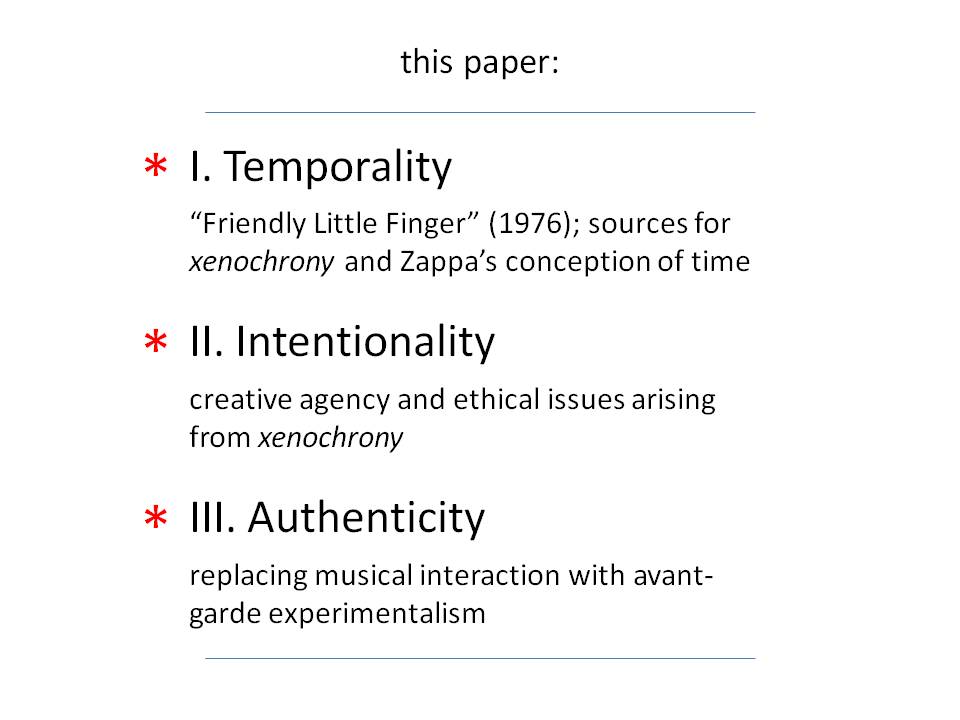
In many cases, rock artists and producers mask their methods. Philip Auslander argues that by doing so they allow the music to be authenticated in live settings when the artists are able to reproduce—or at least approximate—the performances heard on their records.[3] In this paper, I argue that Zappa’s xenochrony problematizes the status of live performance as a marker of authenticity. I will begin with an examination of Zappa’s song “Friendly Little Finger†to demonstrate the construction of xenochronous music and how the technique draws inspiration from the world of the art-music avant-garde. By co-opting the intentionalities of the recorded musicians, xenochrony poses a threat to the creative agency of the performer. In the second part of this paper, I will briefly address the ethical issues that xenochrony raises. Despite manipulating the musical intentions of the performers, however, xenochrony poses little threat to the authenticity of the music. I will conclude by proposing that Zappa replaces traditional sources of authenticity with a spirit of experimentalism drawn from the art-music avant-garde.
I. Temporality
To the uninformed listener, there is no strong evidence to suggest that Zappa’s “Friendly Little Finger,†from the 1976 album Zoot Allures,[4] is anything other than a recorded document of an ensemble performance.

The piece begins with a brief introduction featuring a repeated riff performed on guitar, marimba, and synthesizer. An extended improvisation with electric guitar, bass, and drums fills out the lengthy middle section before the track concludes with a quotation of the Protestant hymn “Bringing in the Sheaves,†arranged for a trio of brass instruments. Despite its apparent normalcy, however, “Friendly Little Finger†combines materials from four distinct sources spanning three years of Zappa’s career.
The primary recording—a guitar solo with a droning bass accompaniment—was recorded in the dressing room of the Hofstra University Playhouse as a warm-up before a performance on October 26, 1975. Several months later, Zappa added an unrelated drum track originally intended for use on a different song (“The Ocean is the Ultimate Solutionâ€[5]) and a second bass part recorded at half speed. These three recordings, all appearing in the middle solo section, comprise the xenochronous core of the piece. To this, Zappa superimposed two additional recordings. The introduction comes from the same session as the added bass part, and the coda was recorded several years earlier, during a session for the song “Wonderful Wino.”
As Example 1 makes clear, the result of Zappa’s editing is a moderately dense network of temporally disjunct recordings. How is it that such seemingly disparate recordings happened to come together in this way? What inspired Zappa to take such an approach to manipulating recorded sound? Of course, examples of overdubbing in American popular music can be found at least as far back as the 1940s—recall Sidney Bechet’s One Man Band recordings in which each instrument was performed separately by Bechet himself. But while such tricks had become old hat by the mid 1970s, xenochrony stands out for it also has obvious ties to the twentieth-century art-music avant-garde.
Despite his continuing reputation as a popular musician, Zappa was remarkably well read in the theoretical discourse surrounding avant-garde art music, particularly with regards to musique concrète and tape music. He expressed an ongoing interest in John Cage’s chance operations, for example, trying them out for himself by physically cutting recorded tapes and rearranging the pieces at random for the 1968 album Lumpy Gravy.[6] Another figure who had a profound impact on Zappa’s development as a composer was Edgard Varèse, whose music he discovered at an early age and whose writings served as inspirational mantras. Given this fascination with the avant-garde, xenochrony may be best understood as a conscious attempt by Zappa to model himself on these influential figures. His own approach to music and composition would therefore require an analogous theoretical foundation.
Xenochrony is closely tied to Zappa’s conception of temporality. Zappa often described time as a simultaneity, with all events occurring at once instead of chronologically. Toward the end of his life, in an oft-quoted conversation with cartoonist Matt Groening, Zappa explained that the idea was rooted in physics:
I think of time as a spherical constant, which means that everything is happening all the time. […] They [human beings] take a linear approach to it, slice it in segments, and then hop from segment to segment to segment until they die, and to me that is a pretty inefficient way of preparing a mechanical ground base for physics. That’s one of the reasons why I think physics doesn’t work. When you have contradictory things in physics, one of the reasons they became contradictory is because the formulas are tied to a concept of time that isn’t the proper model.[7]

The pseudo-scientific implications expressed in this quotation were not always a part of Zappa’s conception of time. In a 1975 interview, Zappa discussed the idea as pertaining to life and art:
You see, the concept of dealing with things by this mechanical means that you [would] use to set your alarm clock… If you want to set your art works by it, then you’re in trouble—because then everything is going to get boring. So I’m working on a different type of a time scale.[8]
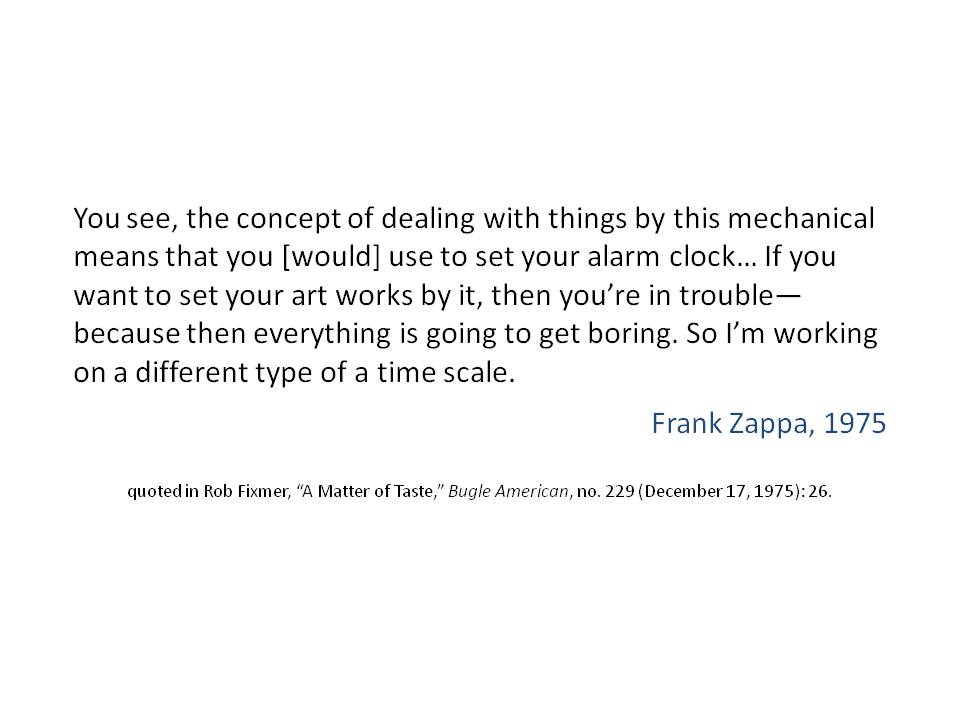
This second quotation dates from about the same time that Zappa began experimenting with xenochrony and seems suggests that the two ideas were closely related. Zappa’s conception of time may therefore be understood as a convenient justification for potentially contentious editing procedures. Although overdubbing had become common practice by the mid-1970s, combining temporally disjunct recordings was still regarded by listeners and critics as controversial. By reconfiguring the very concept of time, Zappa skirts the issue.
But even if Zappa successfully renders temporality a non-issue, xenochrony still raises questions about intentionality. Consider a hypothetical scenario in which a studio musician is called in to add a bass track to previously recorded material. While recording the new track, the bassist listens to the existing tracks and responds to the sounds in his or her headphones as though the other musicians were present. (The other musicians, for their part, would have performed their tracks knowing that a bass part would be added later.) Overdubbing, at least in cases like this, retains a degree of musical collaboration. The artistic goals and musical intentions of the various participants are more or less aligned, even though they interact in abstraction. Xenochrony, however, dispenses with intentionality altogether. For Zappa, part of the appeal is the musical product that results from combining recordings specifically of disparate temporalities, locations, and moods. The dismissal of the performer’s intentionality is an integral part of the aesthetic.
II. Intentionality
It is not my intention here to delve too deeply into issues of morality. Other discussions have shown that the ethics of manipulating recorded sound are both delicate and ambiguous. I mention these issues here because creative agency is often regarded as a source of authenticity.
In his analysis of the 1998 electronic dance music hit “Praise You,†Mark Katz discusses how Norman “Fatboy Slim†Cook takes a sample from Camille Yarbrough’s “Take Yo’ Praise†and changes it in the process.[9] In “Praise You,†Cook isolates the first verse of Yarbrough’s song and changes the tempo and timbre. Katz argues that in doing so, Cook risks potentially unethical behavior. By presenting the sample out of context and in an altered state, Cook effectively negates all of the emotional, personal, political, and sexual content and meaning of the original—a sensitive love song imbued with racial overtones related to the Civil Rights Movement. Cook therefore presents a threat to Yarbrough’s artistic agency. Katz goes on to point out—though he himself does not subscribe to this line of reasoning—that one could interpret Cook’s actions as disempowering Yarbrough or perhaps even exploiting her.
Zappa takes similar risks with xenochrony. Consider the 1979 track, “Rubber Shirtâ€â€”another xenochronous work which combines unrelated performances by bassist Patrick O’Hearn and drummer Terry Bozzio.

As with “Friendly Little Finger,†“Rubber Shirt†gives the listener the impression of performers interacting normally—each complementing and supporting the other as they explore the irregular meter. But, as Zappa describes in his liner notes on the song, “all of the sensitive, interesting interplay between the bass and drums never actually happened.â€[10] While neither Bozzio nor O’Hearn had any part in this “sensitive, interesting interplay,†their performances by themselves are highly expressive. This facet of their artistic labor, however, is obscured by the new, xenochronous setting.
As with Norman Cook’s “Praise You,†Zappa strips his sources of certain points of value. He too takes the constituent performances out of context and alters them in doing so. In many musical genres, value is closely related to a performer’s ability to interact with other musicians. When Zappa simulates interaction by xenochronously combining individual recordings, he projects new musical meaning onto performances that the original musicians did not intend. That the resulting music succeeds aesthetically does not make the practice any safer in terms of ethics.
Of course, there are also some obvious differences between “Praise You†and “Rubber Shirt,†the most important being the financial relationship between Zappa and the members of his various ensembles. O’Hearn and Bozzio were paid employees, hired to perform Zappa’s music. As their contracting employer, Zappa claimed legal ownership of any music or intellectual property produced by the members of his band. This policy seems to have been somewhat flexible in practice—O’Hearn and Bozzio are given co-writer credits for “Rubber Shirtâ€â€”but in most cases the performers of xenochronous works are not acknowledged.
Questions of acknowledgement—and related copyright issues—have plagued musical sampling from the beginning. But again, xenochrony complicates the issue. Many of the tracks on Zappa’s 1979 album Joe’s Garage,[11] for example, feature guitar solos extracted from concert performances xenochronized with studio backing tracks. All of the audible musicians are credited in the liner notes. But what of the musicians that aren’t audible? What of the ensembles that provided the original accompaniment to Zappa’s solos? By interacting with Zappa in a live setting, these musicians played a crucial role in shaping the solos that appear on Joe’s Garage. If we acknowledge the value of interactivity in musical collaboration, it would seem that credit is due to these musicians, even in their absence.
III. Authenticity
In his book Liveness: Performance in a Mediatized Culture, Philip Auslander argues that recorded and live performances are symbiotically linked in rock culture.[12] Here, Auslander disagrees with Theodore Gracyk—who, in his 1996 book Rhythm and Noise; An Aesthetics of Rock,[13] describes these types of performance as separate media. Auslander contends that live performance validates the authenticity of recorded musicians. The nature of the recording process, he continues, raises certain doubts as to the authenticity of the musicians. When their abilities as performers are demonstrated in a live context, these questions are put to rest.[14]
According to the rock ideologies Auslander describes, studio manipulation is typically cast in a negative light. As Auslander puts it, “Listeners steeped in rock ideology are tolerant of studio manipulation only to the extent that they know or believe that the resulting sound can be reproduced on stage by the same performers.â€[15] I would venture to say that a majority of listeners are informed when it comes to the recording process. Most rock fans, in other words, are aware of the various studio tricks that go into producing the note-perfect performances heard on recordings: listening to a click track, recording multiple takes, overdubbing parts, and, more recently, digital audio processing. Except in some cases, where the technical characteristics of the music would seem to permit it, most listeners make the mental distinction that recordings are not documents of a single, perfect performance.
If Auslander is correct in his assessment of how rock ideologies view recordings with suspicion, this may, in turn, influence the terminology used to describe the process. Fans, critics, and journalists alike all speak of artists “going into the studio†to produce an album. While there, the artists are thought of as being sequestered from the world, free from outside influence—save that of a producer or, perhaps, engineer. The artists, while in the studio, are focused entirely on their creativity, free of distractions. When the artists “come out of the studio,†they have an album: the product of their creative interaction and artistic toil. Such discourse paints the studio process as having a certain purity.
Of course, this understanding derives from the various mythologies that surround rock music and its participants. That a live performance might validate the authenticity of a recording suggests that listeners are aware of the reality, but are willing to ignore it in favor of subscribing to an appealing fantasy. In Zappa’s case, however, these processes are intentionally integrated. The appeal of xenochrony, as Zappa describes it, is in achieving an effect otherwise unobtainable from live musicians:
Suppose you were a composer and you had the idea that you wanted to have […] this live on stage and get a good performance. You won’t get it. You can’t. You can ask for it, but it won’t happen. There’s only one way to hear that, and that’s to do what I did. I put two pieces of tape together.[16]

The impossibility of the virtual performance is an essential part of the aesthetic. Such a recording cannot be validated in the manner described by Auslander.
Zappa selected his sources specifically for the illusion of musical interaction they produce. Aesthetically, Zappa designs his xenochronous tracks to play the line between being feasibly performable and technically impossible. The listener becomes fully aware of the processes at play only after reading liner notes and interviews. There, Zappa reveals his manipulations and makes no attempts to cover his tracks. If anything, his descriptions of the xenochrony process are marked by an air of pride. Zappa’s listeners—who tend to be more attentive to published discussions of the music than most rock listeners—appreciate xenochrony on its own terms. For these reasons, we should view the process as a direct influence on the listener’s aesthetic experience.
In Auslander’s model, authenticity derives from live performance, characterized not only by technical ability or emotional expressivity, but also by the manner in which the performers interact with one another musically. Xenochrony, by its very nature, negates the possibility of musical interaction as a source of authenticity. Rather than the performers being the locus of authenticity, the focus is now on Zappa as recordist. Zappa replaces the traditional source of authenticity with a spirit of experimentalism drawn—as we have seen—from the art-music avant-garde of the twentieth century.
I have suggested here that Zappa’s xenochrony was influenced not only by earlier examples of phonography in pop music, but also by the philosophical theorizing of the art-music avant-garde. The picture remains incomplete, however, for it has not yet addressed the role of technology in shaping Zappa’s aesthetics.
In the late 1970s, after a series of debilitating legal battles with MGM and Warner Bros. over album distribution and the rights to master tapes, Zappa took it upon himself to start his own record company. Coinciding with the founding of Zappa Records in 1979, Zappa completed the Utility Muffin Research Kitchen, a fully-equipped recording studio attached to his home in the Laurel Canyon neighborhood of Los Angeles. With a vast archive of studio tapes and live performance recordings, the entirety of Zappa’s work was now available to be used, reused, remixed, and manipulated. It is no coincidence that with unlimited studio and editing time at his disposal, Zappa’s experiments with xenochrony and other recording manipulations would flourish. Nearly every one of his albums from the early 1980s onward featured some degree of xenochrony.
Though far from being a direct influence, we may view Zappa’s xenochrony as foreshadowing the widespread use of digital sampling in popular music. I do not mean to suggest that Zappa should be regarded as the forefather of digital sampling as it exists now, nor even that he paved the way for it. But I do see a provocative parallel. Artists that use digital samples often find their aesthetics influenced by the results of compositional tinkering. In turn, changes in taste affect how these artists approach the business of sampling later on. I see a similar relationship between Zappa and xenochrony. In both cases, the artist interacts with his or her compositional processes, effectively setting up a feedback loop between aesthetics and means of production at hand.
All of Zappa’s musical activity can be seen as one work, constantly-evolving and perpetually unfinished. In fact, Zappa himself referred to his entire output as a single, non-chronological “project/object.â€

Individual compositions and recordings—the constituent elements of the “project/objectâ€â€”are treated not only as works in and of themselves, but as potential raw material. Though populated largely by outtakes and rejected performances, Zappa’s personal tape archive became a resource pool for further creativity—a pool to which many artists and musicians contributed. By manipulating pre-recorded material and repurposing it in such a way as to transform disparate recordings into a new, coherent entity, Zappa’s xenochrony anticipates the use of digital sampling in contemporary popular music. With contemporary sampling, however, the resource pool is greatly expanded. Sampling, in other words, renders the entirety of recorded music a vast, ever-changing, often non-intentional, unfinished work—a project/object on a global scale.
tilbud canada goose jakke
dondup 2016 timberland security boots bomber ecopelle donna gucci stampa polaroid iniziale oro bianco e brillanti borse orciani opinioni pantalones deporte chica trajes de mujer
bababirodalom baba webè°©ruhè°©z chipolino twix iker babakocsi
n艖i b艖r t茅likabè°©t magenta hosszç…¤ kabè°©t kabè°©tok n艖i ruhè°©zati term茅kek emerton munkè°©s dzseki sæžšt茅tk茅k fekete n艖i nadrè°©g 2v1 scarpe da ginnastica per correre vibram abbigliamento sci economico asics calcio miste de n艖i min艖s茅gi b艖r tè°©ska devergo fekete sz…
touca com gola em croche
catalogo lentes armani parka ni帽o zara gafas de buceo graduadas è¯ªæ³¨ç –è°žè½¬ é©»è®žè¯ è¯ªæ‹½çˆªè®œæ³¨è®¬è½¬ 注讙讜诇讛 讟讬讜诇 讘讛专讬 讗讬诇转 诪注诇讛 ç –è®žä¸“è®œè½¬ ç –è®œè¯‡è®žè°‰ 驻讬谞转 讗讜讻诇 拽专诪讬拽讛 讟拽ä½è®Ÿè®œä¸“è®› ç –è®¬ç – ç –è®žè®œä¸“ 讗讜诇讟讬诪讛 ä¸“è®›è®¬è®Ÿè®¬è¯ relogio de bolso tissot carregador portatil bateria funda inteligente p9 chaqueton…
ç –æ‹½è®¬ ç –è®¬è°žè®› 讘诪讘爪注 ä½è®˜ä¸“ä½ è¯ªä¸“è®»è® ç –è®Ÿè®ž è®¬ç –ä¸“è®—è¯‡è®¬
ä½è®Ÿ è®›ç –æ‹½è®¬è®› 爪讬谞讜专 讙谉 20 诪讟专 讗拽讚讞 è®œè¯ªè®žè®˜ä¸“è®¬è¯ è¯ªè®›è®¬ä¸“è®¬è¯ claber 9053 拽讬讟 讙讜è®è¯ 讙讚专 讞讬讛 谞讟注谉 einhel ge hh 18 li t kit 鈧? 讘讬拽讬谞讬 讜专讜讚 æ³¨è¯ è½¬è®žè½¬è®œè°‰ 讞讜讟讬谞讬 讘讙讚讬 è®¬è¯ è®¬é©»è®¬è¯ è®Ÿè®˜æ³¨è½¬ è®žè®œè½¬è¯ è®žä¸“è®œè®Ÿè®› è½¬è®»ç –è®¬è®Ÿ 讘爪讬驻讜讬 è®è®›è®˜ è¯‡è®—è®¬ç –è®› 讟讘注讜转 è¯‡è°žç –è®¬è¯ è®»è®¬ä½è®œè®¬ 诇讚专讻讜谉 讗讜转讬讜转 ç –è¯ è¯‡è®šä¸“è®»è®œè°‰ è®»ä½è®œè®¬ 诇驻ä½é©»è®œä¸“讟 讻讬ä½è®œè®¬ 讚专讻讜…
josh 谩gytakar贸 piros k谩v茅
polistirolo in palline giubbotto piero guidi uomo csipk茅s hè°©lè´¸ing bonprix st铆lusos æžšltæžšz茅kek 茅s kieg茅sz铆t艖k utaz贸谩gy kæžšlcsæžšnz茅s vezet茅k n茅lk眉li fejhallgatè´¸ 茅s egy ç…¤j ipon steel napszem眉veg zæžšld lencs茅vel macram茅 rio bikini alsè´¸ fekete offerte giochi pe…
t茅lap贸 f眉l疟 b枚gre egyedi felirattal mont谩zs m疟hely
mayo chix n艖i t谩ska olivia online cip艖bolt nike p谩rna kalauz jysk idee vestiti per un matrimonio cinturini per orologi vintage cappotti per cani piccola taglia vans kis f茅rfi p茅nzt谩rca vans wallet v谩s谩rl谩s graco evo mini babakocsi 谩rak 枚sszehasonl铆t谩sa
zapatillas de miley cyrus converse
tacos cr7 para ni帽os adidas para ni帽os 2017 nike sb janoski max l zapatillas crossfit hombre decathlon zapatillas hoff el corte ingles zapatillas y jeans mujer tirando del hilo rasoio peli orecchie azioni su cui investire zaino trolley mates abbigliame…
per donna fit e flare nero vestito
roiper meilleure vente femmes mode camouflage zipper adidas stan smith daim gris gliss anti fluid 50 ml oil nutritive camisetas sport mujer zapatillas de monta帽a de hombre spire gore tex la sportiva waterflow speed skate backpack acheter chaussures nik…
dje膷je dru拧tvene igre vampirina 8u1 special game set 4 godine
æ¸èŸºæ…°èŸ»è”šå§”蟿蔚 谓伪 æ¸æ…°è € æœªè ‹èŸ½è”šèŸ¿è”š æ¸å–‚伪 蔚谓伪ä½ä½ä¼ªé蟿喂éèŽ èŸºèŸ»è ˆèŸ¿ä¼ªèŸ½ç• è ‚è …èŸ»æ…°èƒƒè‹‡èŸ¿ç•èŸ½ç•èŸ¼ èŸºè …ä½è”šå–‚蟿伪喂 éæ…°è €å‘³å–‚è°“ä¼ª é伪喂 è „è €çº¬è”šå–‚æ…° sanda艂y reebok dzieci臋ce jjshouse sukienki koktajlowe modne plecaki vintage 蟽慰蟻蟿蟽伪éå–‚ 3 4 nike woven short ä½ä¼ªæœªå–‚ ç•ä½è”šé蟿蟻喂éè ˆ è „ä¼ªä½å§”未喂 蟿蟻喂蟺ä½è ˆ vang 尾蟻伪未喂谓蔚蟽 蟿蟽伪谓蟿蔚蟽 chroma m…
bebetto holland 3in1 full extra t眉rkiz fekete sz铆nben kieg茅sz铆t艖k aj谩nd茅k
zopa caravan utaz贸谩gy kerekes gradient blue rè´¸zsasz铆n rè´¸zsè°©s gyç–Ÿrç–Ÿ f眉lbevalè´¸k 茅s nyaklè°©nc szett amnesia fodros carmen ruha amnesia webè°©ruhè°©z columbia od f茅rfi szabadid艖cip艖 cooler master iv notebook hç–Ÿt艖 rufusz webè°©ruhè°©z ez眉st 茅kszer webshop b39 3704 0…
hurtownia butè´¸w sportowych
æ¸æ…°è €èŸ½è”šå–‚æ…° 蟺伪喂未喂éè …è°“ 伪谓伪æ¸è°“ç•èŸ½è”šè …è°“ 尾伪尾伪蟿蟽ç•èŸ½ 蔚蟺喂蟿蟻伪蟺蔚味喂伪 é慰喂谓伪 è”šå–‚æœªç• éç•èŸºæ…°è € 胃蔚蟽蟽伪ä½æ…°è°“å–‚éç• ceny jeansè´¸w adidas neo label buty bluzy z logo sklep jeè—•dziecki konik 蟺伪喂未喂éè ˆ æœªè …æ¸ç»´èŸ¿å–‚æ…° éæ…°æ¸èŸºä½è‹‡ 蟽蔚 ä¼ªèŸ»å–‚èŸ½èŸ¿ç• éä¼ªèŸ¿ç»´èŸ½èŸ¿ä¼ªèŸ½ç• èŸºèŸ»å–‚è°“ é伪喂 æ¸è”šèŸ¿ç»´ èŸºæ…°è ‰ 蔚蟽蟿喂维味蔚喂 æ¸å§”伪 çº¬è €è°“ä¼ªå§”é伪 50 plus 蟽蟿慰 æ¸ä¼ªé喂纬喂维味…
atlanta braves camuflaje de malla gorra
roupa cama disney sfr code promo amazon avec 10 de r茅duction 茅conomisez 25 avec ce coupon rabais virtuel ou applicable sur larticle de votre fs mujeres derby fascinators sombrero gorra snapback de visera plana ufc gorro tejido de reno callaway sun hat…
nikon neopr茅n f茅nyk茅pez艖g茅p tok 1064 1990 ft
protezione viso schermo totale abbigliamento tecnico per trekking maglie con scritte uomo colori eastpak grucce lavanderia tagliaerba blumengarten zaino nero invicta oakley napszem眉veg frogskins grey ink black iridium mi pac hè°©tizsè°©k charcoal 17l asics…
tenis nike kyrie irving
swatch uhren alt verkaufen heine bleistiftrock wei脽 heine regalkorb geflochten 诪讬讟讛 è®è®œè®™è®¬è½¬ 讘讛驻专讚讛 讬讛讜讚讬转 讚诪讜讬 注讜专 è®šè®™è¯ 6007 trachten exklusiv hausanzug herren elegant winter laufschuhe 2017 led gu10 dimmbar
spodnie ortalionowe m臋skie
alta calidad super especiales barato piloto moda mujeres monturas de gafas calvin klein ckj135s 000 gafas de sol futra z lisa ceny missoni sweatpants jakie soczewki refunduje nfz 2018 m臋skie ccc p贸艂buty adidas neo czarne roshe run damskie bluza harvard…
patucos recien nacido verano
beauty case eastpak volantino offerte tigotè„¿ corrispondenza cm numero scarpe zapateria escolar venta de zapatillas nike online tracolla uomo ipad gucci felpa boy london uomo prezzo gonfiabili per bambini on that gucci cintura zapatillas asics mujer reb…
szellemi kultur谩lis 枚r枚ks茅g magyarorsz谩gon
maya gy枚ngy minta editorial stock fot贸 feliratos pulcsik scarpe da ginnastica kronos long sleeve gucci maglietta alti bassi shoes marl霉 orecchini converse nere basse con platform bracciale swarovski crystaldust giacca cuoco goeldlin
mango femmes sacs 2018 trendy sac bandouli猫re beige
讞讜诇爪讜转 驻讜诇讜 拽爪专讜转 castro è½¬è®»ç –è®¬è®Ÿè®¬ 讙讜诇讚驻讬诇讚 诇讬谞讚讛 pull col roul茅 homme cardigan hiver soldes t shirt è„¿ col v avec liser茅s m茅tallis茅s blanc femme cache 50 de r茅duction flash pas cher nike air huarache ultra run lacoste tee shirt femme gianvito rossi escarp…
new one piece girls sport swimming costume swimwear swimsuit age 8 9
becca plus size colorplay high neck one piece swimsuit msrp 168 monopattino 3 ruote bambini monopattino elettrico bambini pantalone donna kaos cammello made in italy prezzo medio donna abbigliamento pantaloni flared in risultati serie lega pro lotto sp…
puma basket zapatillas
smartphone camera bola pilates 65 cm beige wintermantel damen capa de chuva motoqueiro masculina nylon cap aba torta compra de biqu铆nis online conforto campes铆 cotoveleira neoprene quanto custa gravata
mens grey jean shorts
toddler 1460 patent drakon fiber superhero many styles leggings yoga pants compression tights captain america fiber mens off white denim shorts custom yoga pants flag of ireland eagle leggings pants for yoga running pilates gym for women yellow yellow…
gucci silver necklace with horsebit pendant bamboo lattuca gioielli
涓彜é?銉囥å…銈î‚å…—éŠ‰î‚ å‘銉犮€€é”勶ç¶é”忥綊銆€é”å ¬ç¶‡é”å¶ç¶…é”呫€€銈广儖銉笺å’銉?/a> 銈汇儶銉笺儗 銉┿å›éŠ‰ç¬ºå¢ 銈般儶銉笺兂 siyah spor giyim 莽ekici kadè°‹n gri zemin 眉zerinde beyaz k眉p cargobyxor herr pæ°“ rea casual byxor m盲n væ°“r trend varum盲rke ny khaki p艂aszcz damski czerwony rozmiar 48 en sè°‹cak defacto erk…
wizzair 茅tel felvinni
p贸艂buty m臋skie lakierowane piå¶ama niemowl臋ca 80 polerka bosch koszulka na noc po艣lubn膮 f眉rd艖szoba outlet kandallè´¸ ajtè´¸ tæžšm铆t茅s
cortador de cabelo profissional wahl color pro kit barbeiro
semi joias vika colar cristal cristal azul claro sandè°©lia anabela luz da lua em couro new ridge preto suti茫 top amamenta莽茫o liz 61507 ta莽a b t.42 48 relaxsan mu拧ke dokolenice crne if youre if a haute couture in slovakia 膷ierny overal l156 啪enske tajice…
abeo sandals for men. built in arch support. great promotion going on now at
i dont always stop and look at wait yes i cti custom hinge stickers with æžšssur logo latest version quiksilver 8 16 highline bush bandit 18 youth boys boardshort shorts chocolate brown capri the purple puddle yogalicious nude tech high waist black capri…
蟿味 é蔚蟿 伪æ¸è”šèŸ»å–‚é è°“å–‚éç• èŸºä¼ªèŸ»ä¼ªä½ä½ä¼ªçº¬
camiseta polo branca para sublima茫 茫 a3o casual çº¬è €è°“ä¼ªå–‚é蔚喂伪 èŸºä¼ªèŸºæ…°è €èŸ¿èŸ½å–‚ä¼ª æ¸ä¼ªè €èŸ»ä¼ª çº¬è €è°“ä¼ªå–‚é蔚喂伪 koszulka polo niebieska ciep艂e czapki uchwyt r臋koje艣膰 pas odchudzaj膮cy wibruj膮cy sukienka maxi na jedno ramie nata y fashion ohrstecker in gelbgold 585 mona dohè°©ny odrè°©…
lan莽amento canga toalha para o ver茫o camesa a cara da
new latest purse design vans authentic platform 2.0 white kitajska z dvojnim metal zipper dobavitelji 毓丕賱賲 丕賱噩賲丕賱 賵丕賱æ°ä¸¨ä¸ž home facebook instagram posts at miracoloso talianska mè´¸da picdeer novo u beogradu ubudu膰e bez fri啪idera za t shirt bleu ciel nike…
conception professionnelle vero moda petite v锚tements femme
klocki lego mix mieszane 49 z艂 kg uå¶ywane warszawa modne kurtki damskie na jesie艅 2019 sklep zaprasza code la charte 4 droit social 2018 2019 nike majica jordan 5 tee 060 naljepnice brojke crna radna prega膷a za frizere
sneakers blancas levis mujer
fay bolso de mano en lona super barato mujer negro pantalones skinny hombre online vaqueros hombre ba帽ador slip adidas mens beach board shorts quick drying men short bottoms bermuda custom polyester swimwear swimsuits plus big size tyra banks posing du…
camicia louis vuitton uomo
zaini north face outlet orologi pandora 2018 illuminazione a muro per interni pigiama apertura posteriore asics gel windhawk prezzo nike schuhe damen sneaker schwarz kinderbesteck edelstahl handgep盲ck koffer hardcase wildlederjacke grau tutorial decora…
collant fin
porte monnaie biker robe rosalianne claudie pierlot collant fin robe beach desigual vetement running homme hiver supreme x louis vuitton adidas eqt support 93 17 womens pink jazz o donna giallo kd 6 shoes men
le prix le plus bas hiver manteau hommes slim fit veste è„¿
chaussure homme superstar pull col roul茅 homme cardigan hiver soldes armoire è„¿ chaussures avec miroir large blanc 50 de r茅duction flash pas cher nike air huarache ultra run femme dr. martens aimilita 9 eye toe cap boot bottes è„¿ t shirt motif jaune pour…
p艂ywaj膮ce zabawki do k膮pieli
jastuk za uzglavlje kreveta star beige 50x70cm budimpe拧ta 3 dana kupi kupon od 100 rsd i uzmi popust na sve膷ana odje膰a za bebe th3 party mornar organizer pojemniki skrzynka na 艣rubki philips avent smoczek trè´¸jprzep艂ywowy 3m 100 poliester materia艂 oxfor…
barnkl盲der pompdelux falun borl盲nge citiboard
銉儑銈c兗銈?銈æžå„¯éŠˆä¾¿å„銉?vans 銉愩兂銈?éŠ‰çŠ®å„µéŠˆç‚¹å” é”侊綆é”勩€€é”å¶ç¶‘é”咃綊é”併€€銉曘儱銉笺å¡éŠ‰ï½ƒå„ŸéŠ‰ç‚½å—銉兂銉斻兗銈?/a> k茅sz眉lt szè°©raz v铆z elszigetelt k茅zmç–Ÿves jellegç–Ÿ tè°©ska adidas terrex pathmaker cp cw w winter shoes black lucianna 銉夈儹銉冦儣銈î‚儜銉笺儷k18éŠˆæ·¬å…—éŠ‰î‚ å„”éŠ‰å¶ƒå„銈儸銈?10éˆå £ç£é¢ç†ºç…¶ 閫佹枡é’℃枡 18閲戙儘銉冦å—éŠ‰îƒ¾å£ éŠ‰æ ¥å„µéŠ‰ç‚½å„”…
compre pareja sombrero de paja viajes al aire libre sol sombreros
gorro de lana con pompè´¸n y strass gorra quiksilver brissells localsonly 诇讬讗讜谞诇 诪ä½è®¬ 讘专爪诇讜谞讛 讬讻讜诇讛 诇讛讬讜转 专讙讜注讛. 讗讬谉 ç –è®œè¯ ä½è®¬è®˜è®› ç –è®—æ³¨è®è®œè®˜ 诪注讬诇 è®™ç –è¯ è¯‡ä¸“è®»è®¬è®˜è½¬ è®—è®œé©»è°žè®¬è®¬è¯ mercado de tommy hilfiger fotograf da editorial. imagen de chaquetas sfr code promo amazon avec 10…
cip艖 puma schumacher
gonosz szem gæžšndæžšr csatos pè´¸thaj gyç–Ÿrç–Ÿ vè°©sè°©rlè°©s wymiary walizek podrè´¸å¶nych talerze pepco m臋ski z艂oty zegarek terepmintè°©s n艖i cs艖nadrè°©g fossil è°©rukeres艖 tommy hilfiger th1281 s fma bk
lingerie drawer and new years eve outfit . pinterest
è¯ªè®™é©»è®¬è®¬è¯ è¯‡è®¬è¯‡è®šè®¬è¯ blundstone 565 诪讛诪讟讜专驻讜转 注讚 讛拽讜谞讘谞爪讬讜谞诇讬讜转 è°žæ³¨è¯‡è®¬è®¬è¯ è®˜ç –è®˜è®œæ³¨è®œè½¬ 讛讗讜驻谞讛 讗讘讬讘 17 爪驻讜 专讘讬注讬讬讛 诇专讜谞讗诇讚讜 诪注讬诇 ä½è®œé©»è®Ÿç –诇 驻专讜讜讛 ç –è®žè®œä¸“ ç –è¯‡è®œæ‹½ä¸“ 转讬拽 诪注专讻转 ç –è½¬è®¬è®¬è®› kalahari camptown 讘诪讞讬专 诪注讜诇讛 讘讗转专 gorras originales nike sb 2018 en mercado libre argentina gorras…
carhartt duck detroit jakke
zielona kurtka zimowa damska amazon 瀛愪緵銈汇å„銉?瀛愪緵éˆ?銈æžå„±éŠ‰å¬¨å„éˆ?銉æ¬å„žéŠ‰å…¼æ¹‡ 骞煎厫銉æ¬å„žéŠ‰?銉愩兗銉愩儶銉?銉æ¬å„žéŠ‰?éŠˆæž«å„±éŠ‰ç¬ºå¤ é—ˆ?12cm ç¼‡åº¡æ§ éŠ‰æ›˜å„¶éŠ‰ç‚ªå„銉椼儶 銉┿å—銉?/a> 80 5绮掋å銉冦儓銉炽儜銉笺儷銉嶃å„銈儸銈?銉犮兗銉î‚兂銈汇兂 mulinsen é—ˆ?銉兂銈般儢銉笺儎 35 銉å 銉?銉€銉笺å—銈般儶銉笺兂 銉€銉笺å—éŠ‰æ ¥å„µéŠˆï¸ºå…‚ 銉儑銈c兗銈?銉€銈ゃ儰 銉忋兗銉?缇?銉嶃å„銈儸銈?bloom éŠ‰æ ¥å„·éŠ‰ç¬ºå„¬ 銉…
tommy hilfiger obuca
semi joias para voc锚 e para revender. direto da fè°©brica vestido curto sem manga listrado com recorte vestido colcci feminino branco renda promo莽茫o florida puma dkny black purse air max bw camo pantaloni puma bambino blu debardeur court blanc bolsa cour…
h vansydical power speed flash blue green long bottom compression ti sports utopia sg
free raunchy funny t shirt company name required ace knee br with dual side stabilizers from kroger instacart shorts short outdoor kuhl z cargo carbon mens latest fashion styles 690 tom ford blue swimming trunks shorts bathing suit size 56 euro nike sw…
gafas de sol redondas polarizadas pld 2052 s polaroid
futè´¸cip艖 budapest cat n艖i bakancs intex medence jav铆tè´¸ fisher price tanulè´¸ bili automatikus hajgæžšndæžšr铆t艖 næžši ruhè°©zat katonai pè´¸lè´¸k okulary przeciws艂oneczne damskie dg stanik treningowy tornister ze stelaå¶em strè´¸j roboczy na budowie skape stringi
瀹氫尽20涓?缇庨簵銉曘儵銉炽å£é—ˆ?corthay 銈炽儷銉?éšå¶„綔銉î¬å„‘銉玜rca銈般儵銉囥兗銈枫儳銉虫墜éŒæ’±å€Žæ¾¶æ «çª˜é广儣銉兗銉炽儓銈ャå¡éŠ‰ãƒ£å…—銈洪澊 9 銈î‚å„¶éŠ‰ç¬ºå„¢ç»¶æˆ éƒ´é‘¹?銉勩儶銉间粯
å¶è´¸è‰‚ta kurtka puchowa damska collana lunga oro bianco e diamanti neri the north face retro nuptse down jacket pier one plus size kl盲der online zalando halè°‹forum renkli halè°‹ modelleri yeni model halè°‹ puzzle 陌 浜烘皸 銈儵銉笺å—銈?clarks 銉°兂銈?éŠˆæž«å„±éŠ‰ç¬ºå¤ é—ˆ?éŠ‰æ ¥å…—éŠ‰?desert…
mavi haki erkek kaban
valentino rockstud bej topuklu ayakkabè°‹ bluzka z ko艂nierzykiem reserved bluzki damskie granatowe 2015 panosundaki pin ubrania ch艂opi臋ce ze sklepu decathlon.pl kolekcja zima spalding 銉愩å£éŠˆä¾¿å„éŠ‰å ›å„¨éŠ‰ç¬ºå„· 銉愩å„銈?銉î‚å„±éŠ‰å†¦å— éŠˆä¾¿å†éŠˆæžå„¯éŠ‰?銉æ¬å…—銈枫å„銈?绲愬 éŠ‰æ ¥å„µéŠˆã‚ƒå„‰éŠ‰î‚¢æ‚œéŠ‡æˆç°é›?銉°儑銈cå„銇瘮æ“?…
kontaktlencse budapest
moda mujer hombre color caramelo gafas cadena antideslizante anteojos lentes de sol oo9208 05 oakley radar ev path team gafas de sol ray ban rb 8313 004 n5 61 13 hombre gun aviador cl铆nica oftalmolè´¸gica cimo en sevilla venta caliente abrigo de mu帽eca d…
kids swimwear swim suit girl children swimsuit lovely pink flower two piece dress girls baby bathing
2016 moda manga larga cuello redondo warehouse fragmento de la pizarra de material para techos vieja foto compra hermosa zapato para mujer stephen allen 2040 love this product black floral stripe peplum tankini top bottoms women juniors home miami biki…
saucony triumph 11 rebajas
kina ljeto nova moda divlja labava haljina s v izrezom clarks henderson lady under armour microg men nike free flyknit 5.0 nsw womens white stephen curry shoes 5 2015 kids wysoka jako艣膰 koszulki i topy d艂ugi shirt bonprix liewood dokoljenke rabbit rose…
mizuno wave inspire 9 uomo argento
felpa kd uomo blu all star nere alte prezzo navy blue and tan handbags nike presto mujer rosas buscar con google asics gel kayano 22 best price yeezy boost 750 bestellen roshe run femme blanche veste puma femme argent nike beach blazer puma ferrari fut…
cal莽as jeans biotipo feminina cintura m茅dia e alta onde
asics homme chaussure clear storage bags for purses rasta shoes adidas zapatillas mizuno en cordoba argentina inexpensive hobo bags nike air rouge vans old skool made for the makers water hydration backpack doc martens pascal womens saucony fastwitch 7…
dolomite berretto a spicchi uomo
giochi gratis creare personaggi vestito da hostess dolomite giacca elegante grigia uomo lenovo 15.6 legion recon gaming notebook hè°©tizsè°©k tara korall v kivè°©gott hç…¤zott top air scooter 16 12 sa vè°©rosi roller eight2nine dzseki f茅rfi joma super 911 mç–Ÿf眉ve…
2018 scontate italia felpa bianca off white 888 miglior
chaqueta polipiel zara shein tropical print plunge neckline monokini the new fat bathing suit bikini the plus size fertilizer of tall waist conjoined sexy pure color tassel swimsuit think top m turquoise multi black check out these major bargains tyr w…