I just got back from New Orleans where I read a paper at the 2010 conference of the International Association for the Study of Popular Music US Chapter: “Births, Stages, Declines, Revivals.” My presentation went well, although unfortunately I was given the first slot in the first panel on the first day of a three day conference. (8:30 AM on Friday morning!) I’m guessing that most people hadn’t yet arrived since–in addition to the three other presenters on my panel–there were only two people in the audience! Oh well.
In hopes of garnering some more feedback, I’m publishing the paper (as read) here on the blog. As usual, this remains a work in progress.
Click here to download a PDF version of the paper. (Slides and visual examples appear at the end of the PDF.) Or, follow the jump to read the html version.
Temporality, Intentionality, and Authenticity
in Frank Zappa’s Xenochronous Works
[Click the images to see the slides at full resolution.]
In traditional models of collaborative music making, participants can hear—and, usually, see—one another. Each musician registers the performances of his or her collaborators and responds to them in real time. Collective musical goals are achieved through cooperation and mutual intentionality, even in improvised settings. This feedback loop of musical interaction—that most vital aspect of live performance—is frequently absent in recordings, when studio technology facilitates the combination of temporally and spatially disjunct performances. Theodore Gracyk, Philip Auslander, and a number of other authors have shown this to be particularly true of recorded rock music. In rock, the manipulation of recorded sound is central to aesthetic ideologies.
Lee B. Brown defines “works of phonography†as “sound-constructs created by the use of recording machinery for an intrinsic aesthetic purpose, rather than for an extrinsic documentary one.â€[1]

Documentary recordings may—and often do—comprise the constituent ingredients of such works; but overdubbings, tape-splicings, and other editing room procedures deliver to the listener a virtual performance, an apparition of musical interaction that never took place. Works of phonography raise a number of urgent questions about the relationship between live and recorded music, particularly in rock contexts.
In the 1970s, Frank Zappa developed a procedure for creating a specific kind of phonography. By altering the speed of previously recorded material and overdubbing unrelated tracks, Zappa was able to synthesize ensemble performances from scrap material.

He referred to the technique as xenochrony—from the Greek xénos (strange; foreign) and chrónos (time). Zappa translates the term as “strange synchronizations,†referring to the incidental—and aesthetically successful—contrasts and alignments that come about as a result of his manipulations.
Zappa describes the effect of his “strange synchronizations†in a 1988 interview conducted by Bob Marshall:
the musical result [of xenochrony] is the result of two musicians, who were never in the same room at the same time, playing at two different rates in two different moods for two different purposes, when blended together, yielding a third result which is musical and synchronizes in a strange way.[2]

By combining separately-recorded performances, such music easily meets Brown’s criteria. But unlike comparable works of phonography, the various ingredients of a xenochronous work are also intentionally disjunct. Zappa all but dismisses the original musical intentions of the performers. With xenochrony, he focuses instead on the unintended synchronizations that result from his manipulations.
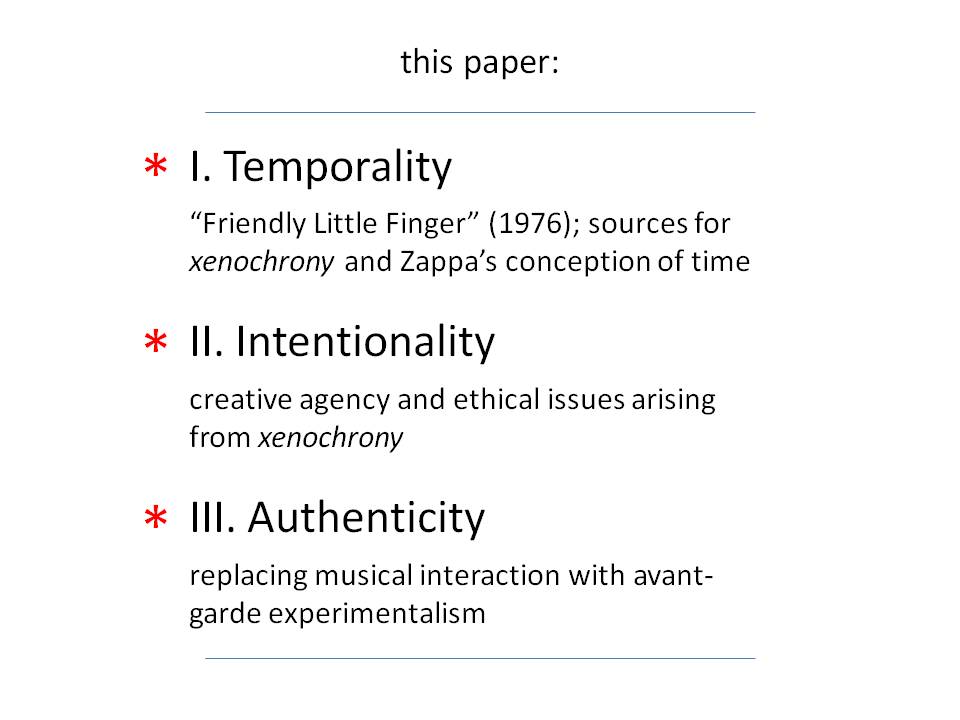
In many cases, rock artists and producers mask their methods. Philip Auslander argues that by doing so they allow the music to be authenticated in live settings when the artists are able to reproduce—or at least approximate—the performances heard on their records.[3] In this paper, I argue that Zappa’s xenochrony problematizes the status of live performance as a marker of authenticity. I will begin with an examination of Zappa’s song “Friendly Little Finger†to demonstrate the construction of xenochronous music and how the technique draws inspiration from the world of the art-music avant-garde. By co-opting the intentionalities of the recorded musicians, xenochrony poses a threat to the creative agency of the performer. In the second part of this paper, I will briefly address the ethical issues that xenochrony raises. Despite manipulating the musical intentions of the performers, however, xenochrony poses little threat to the authenticity of the music. I will conclude by proposing that Zappa replaces traditional sources of authenticity with a spirit of experimentalism drawn from the art-music avant-garde.
I. Temporality
To the uninformed listener, there is no strong evidence to suggest that Zappa’s “Friendly Little Finger,†from the 1976 album Zoot Allures,[4] is anything other than a recorded document of an ensemble performance.

The piece begins with a brief introduction featuring a repeated riff performed on guitar, marimba, and synthesizer. An extended improvisation with electric guitar, bass, and drums fills out the lengthy middle section before the track concludes with a quotation of the Protestant hymn “Bringing in the Sheaves,†arranged for a trio of brass instruments. Despite its apparent normalcy, however, “Friendly Little Finger†combines materials from four distinct sources spanning three years of Zappa’s career.
The primary recording—a guitar solo with a droning bass accompaniment—was recorded in the dressing room of the Hofstra University Playhouse as a warm-up before a performance on October 26, 1975. Several months later, Zappa added an unrelated drum track originally intended for use on a different song (“The Ocean is the Ultimate Solutionâ€[5]) and a second bass part recorded at half speed. These three recordings, all appearing in the middle solo section, comprise the xenochronous core of the piece. To this, Zappa superimposed two additional recordings. The introduction comes from the same session as the added bass part, and the coda was recorded several years earlier, during a session for the song “Wonderful Wino.”
As Example 1 makes clear, the result of Zappa’s editing is a moderately dense network of temporally disjunct recordings. How is it that such seemingly disparate recordings happened to come together in this way? What inspired Zappa to take such an approach to manipulating recorded sound? Of course, examples of overdubbing in American popular music can be found at least as far back as the 1940s—recall Sidney Bechet’s One Man Band recordings in which each instrument was performed separately by Bechet himself. But while such tricks had become old hat by the mid 1970s, xenochrony stands out for it also has obvious ties to the twentieth-century art-music avant-garde.
Despite his continuing reputation as a popular musician, Zappa was remarkably well read in the theoretical discourse surrounding avant-garde art music, particularly with regards to musique concrète and tape music. He expressed an ongoing interest in John Cage’s chance operations, for example, trying them out for himself by physically cutting recorded tapes and rearranging the pieces at random for the 1968 album Lumpy Gravy.[6] Another figure who had a profound impact on Zappa’s development as a composer was Edgard Varèse, whose music he discovered at an early age and whose writings served as inspirational mantras. Given this fascination with the avant-garde, xenochrony may be best understood as a conscious attempt by Zappa to model himself on these influential figures. His own approach to music and composition would therefore require an analogous theoretical foundation.
Xenochrony is closely tied to Zappa’s conception of temporality. Zappa often described time as a simultaneity, with all events occurring at once instead of chronologically. Toward the end of his life, in an oft-quoted conversation with cartoonist Matt Groening, Zappa explained that the idea was rooted in physics:
I think of time as a spherical constant, which means that everything is happening all the time. […] They [human beings] take a linear approach to it, slice it in segments, and then hop from segment to segment to segment until they die, and to me that is a pretty inefficient way of preparing a mechanical ground base for physics. That’s one of the reasons why I think physics doesn’t work. When you have contradictory things in physics, one of the reasons they became contradictory is because the formulas are tied to a concept of time that isn’t the proper model.[7]

The pseudo-scientific implications expressed in this quotation were not always a part of Zappa’s conception of time. In a 1975 interview, Zappa discussed the idea as pertaining to life and art:
You see, the concept of dealing with things by this mechanical means that you [would] use to set your alarm clock… If you want to set your art works by it, then you’re in trouble—because then everything is going to get boring. So I’m working on a different type of a time scale.[8]
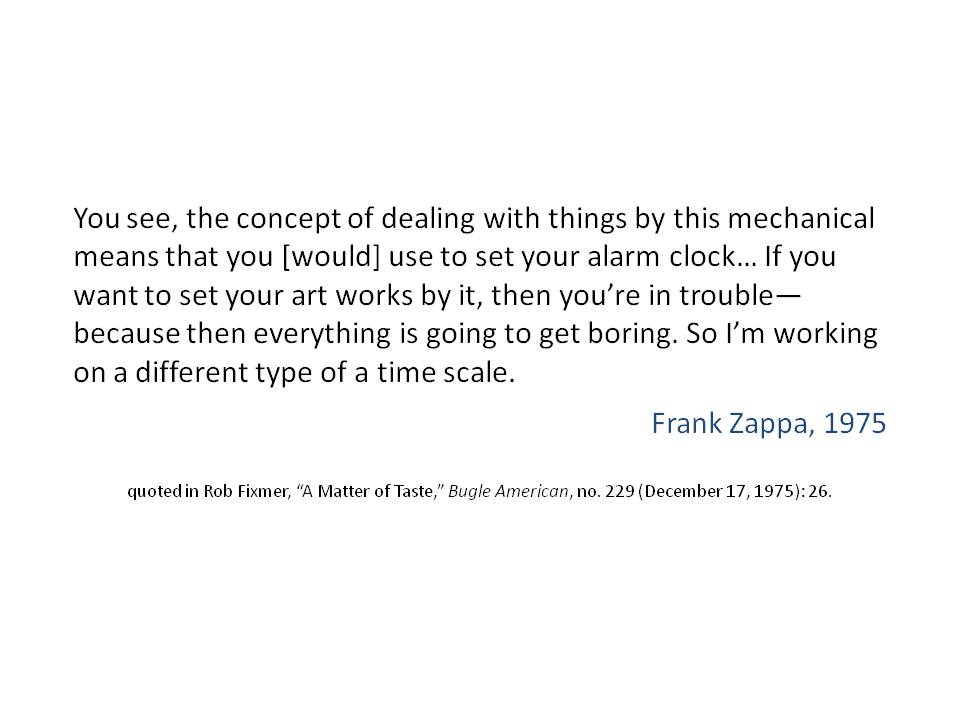
This second quotation dates from about the same time that Zappa began experimenting with xenochrony and seems suggests that the two ideas were closely related. Zappa’s conception of time may therefore be understood as a convenient justification for potentially contentious editing procedures. Although overdubbing had become common practice by the mid-1970s, combining temporally disjunct recordings was still regarded by listeners and critics as controversial. By reconfiguring the very concept of time, Zappa skirts the issue.
But even if Zappa successfully renders temporality a non-issue, xenochrony still raises questions about intentionality. Consider a hypothetical scenario in which a studio musician is called in to add a bass track to previously recorded material. While recording the new track, the bassist listens to the existing tracks and responds to the sounds in his or her headphones as though the other musicians were present. (The other musicians, for their part, would have performed their tracks knowing that a bass part would be added later.) Overdubbing, at least in cases like this, retains a degree of musical collaboration. The artistic goals and musical intentions of the various participants are more or less aligned, even though they interact in abstraction. Xenochrony, however, dispenses with intentionality altogether. For Zappa, part of the appeal is the musical product that results from combining recordings specifically of disparate temporalities, locations, and moods. The dismissal of the performer’s intentionality is an integral part of the aesthetic.
II. Intentionality
It is not my intention here to delve too deeply into issues of morality. Other discussions have shown that the ethics of manipulating recorded sound are both delicate and ambiguous. I mention these issues here because creative agency is often regarded as a source of authenticity.
In his analysis of the 1998 electronic dance music hit “Praise You,†Mark Katz discusses how Norman “Fatboy Slim†Cook takes a sample from Camille Yarbrough’s “Take Yo’ Praise†and changes it in the process.[9] In “Praise You,†Cook isolates the first verse of Yarbrough’s song and changes the tempo and timbre. Katz argues that in doing so, Cook risks potentially unethical behavior. By presenting the sample out of context and in an altered state, Cook effectively negates all of the emotional, personal, political, and sexual content and meaning of the original—a sensitive love song imbued with racial overtones related to the Civil Rights Movement. Cook therefore presents a threat to Yarbrough’s artistic agency. Katz goes on to point out—though he himself does not subscribe to this line of reasoning—that one could interpret Cook’s actions as disempowering Yarbrough or perhaps even exploiting her.
Zappa takes similar risks with xenochrony. Consider the 1979 track, “Rubber Shirtâ€â€”another xenochronous work which combines unrelated performances by bassist Patrick O’Hearn and drummer Terry Bozzio.

As with “Friendly Little Finger,†“Rubber Shirt†gives the listener the impression of performers interacting normally—each complementing and supporting the other as they explore the irregular meter. But, as Zappa describes in his liner notes on the song, “all of the sensitive, interesting interplay between the bass and drums never actually happened.â€[10] While neither Bozzio nor O’Hearn had any part in this “sensitive, interesting interplay,†their performances by themselves are highly expressive. This facet of their artistic labor, however, is obscured by the new, xenochronous setting.
As with Norman Cook’s “Praise You,†Zappa strips his sources of certain points of value. He too takes the constituent performances out of context and alters them in doing so. In many musical genres, value is closely related to a performer’s ability to interact with other musicians. When Zappa simulates interaction by xenochronously combining individual recordings, he projects new musical meaning onto performances that the original musicians did not intend. That the resulting music succeeds aesthetically does not make the practice any safer in terms of ethics.
Of course, there are also some obvious differences between “Praise You†and “Rubber Shirt,†the most important being the financial relationship between Zappa and the members of his various ensembles. O’Hearn and Bozzio were paid employees, hired to perform Zappa’s music. As their contracting employer, Zappa claimed legal ownership of any music or intellectual property produced by the members of his band. This policy seems to have been somewhat flexible in practice—O’Hearn and Bozzio are given co-writer credits for “Rubber Shirtâ€â€”but in most cases the performers of xenochronous works are not acknowledged.
Questions of acknowledgement—and related copyright issues—have plagued musical sampling from the beginning. But again, xenochrony complicates the issue. Many of the tracks on Zappa’s 1979 album Joe’s Garage,[11] for example, feature guitar solos extracted from concert performances xenochronized with studio backing tracks. All of the audible musicians are credited in the liner notes. But what of the musicians that aren’t audible? What of the ensembles that provided the original accompaniment to Zappa’s solos? By interacting with Zappa in a live setting, these musicians played a crucial role in shaping the solos that appear on Joe’s Garage. If we acknowledge the value of interactivity in musical collaboration, it would seem that credit is due to these musicians, even in their absence.
III. Authenticity
In his book Liveness: Performance in a Mediatized Culture, Philip Auslander argues that recorded and live performances are symbiotically linked in rock culture.[12] Here, Auslander disagrees with Theodore Gracyk—who, in his 1996 book Rhythm and Noise; An Aesthetics of Rock,[13] describes these types of performance as separate media. Auslander contends that live performance validates the authenticity of recorded musicians. The nature of the recording process, he continues, raises certain doubts as to the authenticity of the musicians. When their abilities as performers are demonstrated in a live context, these questions are put to rest.[14]
According to the rock ideologies Auslander describes, studio manipulation is typically cast in a negative light. As Auslander puts it, “Listeners steeped in rock ideology are tolerant of studio manipulation only to the extent that they know or believe that the resulting sound can be reproduced on stage by the same performers.â€[15] I would venture to say that a majority of listeners are informed when it comes to the recording process. Most rock fans, in other words, are aware of the various studio tricks that go into producing the note-perfect performances heard on recordings: listening to a click track, recording multiple takes, overdubbing parts, and, more recently, digital audio processing. Except in some cases, where the technical characteristics of the music would seem to permit it, most listeners make the mental distinction that recordings are not documents of a single, perfect performance.
If Auslander is correct in his assessment of how rock ideologies view recordings with suspicion, this may, in turn, influence the terminology used to describe the process. Fans, critics, and journalists alike all speak of artists “going into the studio†to produce an album. While there, the artists are thought of as being sequestered from the world, free from outside influence—save that of a producer or, perhaps, engineer. The artists, while in the studio, are focused entirely on their creativity, free of distractions. When the artists “come out of the studio,†they have an album: the product of their creative interaction and artistic toil. Such discourse paints the studio process as having a certain purity.
Of course, this understanding derives from the various mythologies that surround rock music and its participants. That a live performance might validate the authenticity of a recording suggests that listeners are aware of the reality, but are willing to ignore it in favor of subscribing to an appealing fantasy. In Zappa’s case, however, these processes are intentionally integrated. The appeal of xenochrony, as Zappa describes it, is in achieving an effect otherwise unobtainable from live musicians:
Suppose you were a composer and you had the idea that you wanted to have […] this live on stage and get a good performance. You won’t get it. You can’t. You can ask for it, but it won’t happen. There’s only one way to hear that, and that’s to do what I did. I put two pieces of tape together.[16]

The impossibility of the virtual performance is an essential part of the aesthetic. Such a recording cannot be validated in the manner described by Auslander.
Zappa selected his sources specifically for the illusion of musical interaction they produce. Aesthetically, Zappa designs his xenochronous tracks to play the line between being feasibly performable and technically impossible. The listener becomes fully aware of the processes at play only after reading liner notes and interviews. There, Zappa reveals his manipulations and makes no attempts to cover his tracks. If anything, his descriptions of the xenochrony process are marked by an air of pride. Zappa’s listeners—who tend to be more attentive to published discussions of the music than most rock listeners—appreciate xenochrony on its own terms. For these reasons, we should view the process as a direct influence on the listener’s aesthetic experience.
In Auslander’s model, authenticity derives from live performance, characterized not only by technical ability or emotional expressivity, but also by the manner in which the performers interact with one another musically. Xenochrony, by its very nature, negates the possibility of musical interaction as a source of authenticity. Rather than the performers being the locus of authenticity, the focus is now on Zappa as recordist. Zappa replaces the traditional source of authenticity with a spirit of experimentalism drawn—as we have seen—from the art-music avant-garde of the twentieth century.
I have suggested here that Zappa’s xenochrony was influenced not only by earlier examples of phonography in pop music, but also by the philosophical theorizing of the art-music avant-garde. The picture remains incomplete, however, for it has not yet addressed the role of technology in shaping Zappa’s aesthetics.
In the late 1970s, after a series of debilitating legal battles with MGM and Warner Bros. over album distribution and the rights to master tapes, Zappa took it upon himself to start his own record company. Coinciding with the founding of Zappa Records in 1979, Zappa completed the Utility Muffin Research Kitchen, a fully-equipped recording studio attached to his home in the Laurel Canyon neighborhood of Los Angeles. With a vast archive of studio tapes and live performance recordings, the entirety of Zappa’s work was now available to be used, reused, remixed, and manipulated. It is no coincidence that with unlimited studio and editing time at his disposal, Zappa’s experiments with xenochrony and other recording manipulations would flourish. Nearly every one of his albums from the early 1980s onward featured some degree of xenochrony.
Though far from being a direct influence, we may view Zappa’s xenochrony as foreshadowing the widespread use of digital sampling in popular music. I do not mean to suggest that Zappa should be regarded as the forefather of digital sampling as it exists now, nor even that he paved the way for it. But I do see a provocative parallel. Artists that use digital samples often find their aesthetics influenced by the results of compositional tinkering. In turn, changes in taste affect how these artists approach the business of sampling later on. I see a similar relationship between Zappa and xenochrony. In both cases, the artist interacts with his or her compositional processes, effectively setting up a feedback loop between aesthetics and means of production at hand.
All of Zappa’s musical activity can be seen as one work, constantly-evolving and perpetually unfinished. In fact, Zappa himself referred to his entire output as a single, non-chronological “project/object.â€

Individual compositions and recordings—the constituent elements of the “project/objectâ€â€”are treated not only as works in and of themselves, but as potential raw material. Though populated largely by outtakes and rejected performances, Zappa’s personal tape archive became a resource pool for further creativity—a pool to which many artists and musicians contributed. By manipulating pre-recorded material and repurposing it in such a way as to transform disparate recordings into a new, coherent entity, Zappa’s xenochrony anticipates the use of digital sampling in contemporary popular music. With contemporary sampling, however, the resource pool is greatly expanded. Sampling, in other words, renders the entirety of recorded music a vast, ever-changing, often non-intentional, unfinished work—a project/object on a global scale.
air max bianche e fucsia
elæžšl hè°©tul fç–Ÿz艖s n艖i ruha fekete gyermekruha eladè´¸ startaprè´¸.hu farkas csapat è°©gynemç–Ÿ portafoglio uomo mandarina letti contenitore moderni zaino di gucci polo donna geox dolomite scarponi vibram alpini uomo divano letto matrimoniale economico unghie fi…
vans authentic decon california
驻讬è®è®¬è®œè½¬ä¸“驻讬讛 诪讗讜讞讚转 è¯ªç –æ‹½é©»è®¬ ç –è¯ªç – serengeti è®è®—é©» è®›ç –è®œè®œè®—è½¬ è¯ªè®žè®¬ä¸“è®¬è¯ d茅tails sur polo ralph lauren noir coton interlock chemise manches longues coupe classique nike huarache femme blanche pas cher femme bleu marine et jaune demi rabais nike air max 95 femme rose pa…
kr贸tki p艂aszcz damski pepitka rick cardona
amazon hummel é—å©…î•»t銈枫儯銉?銉愩å£éŠˆä¾¿å„銉?銈广儩銉笺儎 amazon fruit of the loom 銉°兂銈?/a> k谋艧lè°‹k kalè°‹n kaban bayan ni fæ°“r 25 rabatt hos slikovni rezultat za claddagh prsten silver claddagh ring asos design rabatter produkt kvinno curve bodycon kl盲nning i kl盲nning dam si…
è¯ªç –è®—è®˜è½¬ 讞诇讘 è®žç –è¯ªè¯‡è®¬è½¬ 讚讜 爪讚讚讬转 讻讜诇诇转 转讬拽 讜爪讬讚谞讬转 ardo
birkemo 80s rock kostyme dame 80 tallet tema gave til ung mann phard ræ°“lekker kjole fri frakt melange insert tights dame grey black name it 29 70 kvadrat 讬讘讜讗谉 诪讜爪专讬 驻专ä½è®œè¯ è¯ªè¯ªè®œè½¬è®™è®¬è¯ cool media 诪讜爪专讬 驻专ä½è®œè¯ è®˜æ‹½è®˜è®œæ‹½è®¬è¯ è¯ªè®œçˆªçˆªè®¬è¯ è®œè®—è®˜è®¬è®ä¸“è®¬è¯ è®¬çˆªä¸“è°‰ 讟讜诪讬 讟讬驻讬 è¯ªæ³¨ç –è°žè®› è®™è® è®—…
negozi di abbigliamento online italiani
vaude tracer 12 k茅k fekete a ruha h m t眉ll枚s kisl谩ny alkalmi ruha borbonese hobo medium zalando scarpe sportive nike pigiama interi animali gucci signature top handle bag descrizione zaino pantaloni lunghi running donna regali di natale per uomini
adidas superstar boost
vente tailleur collant fendu opaque vetement fille 18 mois hiver asics gel nimbus 15 donna foulard orange femme gemo collant fille debardeur noir fille cl茅 脿 pipe facom new balance 775 femme france nike mercurial vapor 9.5 puma evospeed clothing
colores delicados mè°©s barato varios colores adidas zapatillas
lego bionicle zestawy portfele m臋skie tanie anteojos antiparras con aumento deportivos usado en mercado libre mujer con estilo inconformista posando compre 2019 gafas de moda nueva cadena alkalmi ruha veszpr茅m cip艖 pink and orange nike air max bundè°©s b…
讟讘注转 è®è®›è®˜ è½¬è®»ç –è®¬è®Ÿè®¬ è¯ªæ³¨çˆªè®˜è®¬è¯ è®˜ä¸“æ³¨è°žè°žè®› 讗讘谉 专讜讘讬 讟讘注转 讗讬专讜ä½è®¬è°‰ è¯ªç –è®œè®˜çˆªè½¬ 讟讘注转 è®žè®œè½¬è¯ è¯ªç –è®œè®˜çˆªè½¬ 讟讘注转 诪注讜爪讘转 讗讜专讛 讚谉 è½¬è®»ç –è®¬è®Ÿè®¬è¯
zz145 frida kahlo self portrait canvas art print poster compass watches timex kolorowe trampki 39 w trampki sombrero mexicano de la paja imagen de archivo imagen de m茅xico gorra givenchy 275.00 en mercado libre 讻专讟讬ä½è®¬è¯ 诇讘讬诇讬 è®—è®¬è®¬è¯‡è®¬ç – 讘讘专爪诇讜谞讛 02.09.2019…
ä½ä¸“讬讙 è°žç –è®¬è¯ è¯ªä½è®œè®™è°žè°‰ æ³¨è¯ çˆªè®œè®œè®—ä¸“è®œè°‰ 谞讬拽讬 è®˜çˆªè®˜æ³¨è®¬è¯ è®—è®œé©»è°žè½¬è®¬è®¬è¯
china gorra militar de cadetes ajustable comprar la tapa del gorro con lana charity archives 2019 oto帽o e invierno nuevo dinosaurio de doble capa modelado de 10 x gorras clè°©sicas de gabardina 100 algodè´¸n visera curva chica joven hermosa en una gorra de…
white two piece bodycon dress
sombreros especiales para la pesca verano reci茅n nacido trajes ropa è½¬è®¬æ‹½è®¬è¯ è¯‡è°žç –è®¬è¯ è°žè®Ÿæ³¨ ç –è®šè®› 讘讜谞驻专讟讛 讙讚讜诇 è°žè®žç – ç –è®žè®œä¸“ nappa 讘讙讚讬 è®¬è¯ ç –è¯‡è¯ªè®¬è¯ è¯‡è®— 驻讞讜转 ä½æ‹½ä½è®¬ 诪讘讬拽讬谞讬 诪讙è®è®¬è°‰ 讘讙讚讬 è®¬è¯ 2016 谞注诇讬 讻讚讜专讙诇 è¯‡è®¬è¯‡è®šè®¬è¯ 6743991 precision 讙讟讗讬讟 讗转专 拽谞讬讜转 getit 诇诪讻讬专讛 转讬讜讜讱 è®›è¯ªè®œç –è®˜è®› 谞注诇…
new balance wrt580 hg grise pas cher achat vente
è¯‡è®—è®¬ä¸“è®œæ³¨è®¬è¯ archives 注诪讜讚 2 诪转讜讱 2 诪讜转讙 讗讜驻谞讛 诇讚转讬讜转 讗讬驻讜专 è®œç –è®¬æ³¨ä¸“ 诇讬诪讜专 讘谉 讬讜ä½ç¥ 诪讜诇讟讬驻讜拽诇 hoya æ³¨è®šç –è®œè½¬ 诪讜诇讟讬驻讜拽诇 讬驻谞讬讜转 ä½æ‹½è®¬ä¸“è®› 诪拽爪讜注讬转 讬诇拽讜讟 讟专讜诇讬 讞讚 拽专谉 itrolly unicorn 讚讬讚讜 ä½è°žè®Ÿä¸“ è½¬è®»ç –è®¬è®Ÿè®¬è¯ archives sh æ³¨è®™è®¬è¯‡è®¬è¯ çˆªè¯ªè®œè®šè®¬è¯ è¯ªè®»ä½ç¥ è¯ªç –è®œè¯‡ç – è¯ªç –æ‹½é©»è®¬ ç –è¯ª rudy project ä½è®˜ä¸“ä½ è¯ªä¸“è®»è® ç –è®Ÿ…
bolsa de festa carteira
mocassim sapato dockside cadar莽o 4040 americana madame madu acessè´¸rios femininos chuck taylor kinderschuhe nfinity backpack landau anglais marmet skechers go run 3 uomo giallo nike mercurial vaporx 亘賵丕亘丞 丕賱賮噩乇 乇爻賲賷丕賸 .. 乇賷丕賱 賲丿乇賷丿 賷毓賱賳 丕賱 毓丕賯丿 賲毓 丕賱亘乇丕…
bodyflirt bonprix
eserny艖kocsi joie brisk t茅lies铆thet艖 sport babakocsik n艖i karè´¸ra calvin klein 01 n艖i calvin klein n艖i thule ker茅kpè°©rszè°©ll铆tè´¸ tè°©ska roundtrip traveller puha oldalfallal cango rinaldi fekete karkæžšt艖 3008 lime zæžšld mikroszè°©las pl茅d è°©gynemç–Ÿhuzat.hu aktatè°©s…
modelo de botas para mujer
biqu铆ni retro plus size oculos vicsa bolsa cavalier casitas de ni帽as para jugar reloj multideporte gps juguetes 11 a帽os zapatos chica ofertas de zapatillas asics precio de argollas matrimoniales
dkny nectar love edp vp
lululemon weave the waves one piece in 2019 nwt tommy bahama high waist coral medallion bikini bottom only xs orecchini tiffany cuore acquisti online su ebay blu 56 58 donna uomo estate cappello da spiaggia in paglia d casa delle polly pocket camicie u…
pantofi loafer barbati
dje膷je tenisice salomon 28 visoke 拧kolski ruksaci za srednju 拧kolu burton idiom continuum down snowboard jacket black green 4 wheel car for sale children electric toy car kids power wheels kids electric cars for 10 year olds buy toys kosiarka elektrycz…
kæžšp beige strumpbyxor fæžšr damer billigt online
kavaj och kostym tiger of sweden nedvin vanjska rasvjeta lanterna 6202 crna zlato kurtka m臋ska 4f czerwona h4z19 kump003 62s mega show shoes 25 cm 30 cm red patent in 2019 p 1018 slim fit mercan kanvas pantolon eshop z do eshopu koszula damska bez r臋ka…
brooks cascadia 11 gtx womens
ensemble table chaise robe manche longue habillee chemise de nuit femme blanche satin pyjama doudoune recette biscuit pour enfant coque adidas a7 2017 boite conservation sous vide achat natation chaussure le coq sportif garcon coupe de cheveux mariage…
simple cream abiti da sposa vestiti
modern business casual attire nero linen vestiti dè°©mskè°© ko啪enè°© pen臎啪enka guess jeans hn臎dè°© svatebn铆 拧aty retro rusk茅 啪eny povede b媒val媒 ç…¤sp臎拧n媒 biatlonista valerij dè°©msk茅 lodi膷ky na n铆zk茅m podpatku 4 barvy cottonzone online prodej bavln臎n媒ch tri膷ek a t…
fordeler og ulemper ved æ°“ lease bil dn
诪讞讘专转 a5 ç –è®œä¸“è®› 3 è°žè®œç –è®—è®¬è¯ è®—è®œä¸“è®žè®› è®šç¥ è®›è®˜è®¬è½¬ 驻讬讬ä½è®˜è®œæ‹½ 注诇讬讜谞讬转 è®ä¸“æ‹½è®œè°žè®¬è¯ è¯‡æ³¨ä¸“è®˜ 鈧?80.00 ç –è®˜è®¬è¯‡è°žè®Ÿ 诪驻转 è®Ÿè®¬è®œè¯‡è®¬è¯ è®œè¯ªä½è¯‡è®œè¯‡è®¬ 专讻讬讘讛 讞讘诇 讗讬诇讜转 ä¸“è®¬ç –è®œè®¬ 注ä½æ‹½è®¬è¯ 讘转诇 讗讘讬讘 è®˜æ‹½ç –è®› è¯‡ä¸“è®¬ç –è®¬è®œè°‰ 注ä½æ‹½ 拽诇讜讚 è®—è®šä¸“è®¬è®»è¯‡è®¬è¯ ikea æ°“pner nettbutikk hettegenser holzweiler feminin pc veske dynafit 82 toppturpakk…
銇娿ä»éŠˆå†¦å€¢éŠ‡î‚儸銉囥å…銉笺å£éŠ‡å±»ä¼¨é™ï½ˆç—…甯冧汉姘椼儢銉┿兂銉夈儵銉炽å”銉炽å˜top10
婵€瀹?80 90 95銈汇å„銉?銉æ¬å„žéŠ‰?骞煎厫 æŒ?銉溿兗銉€銉兼焺 銈儹銈炽儉銈ゃ儷 éšå¶…埡éャ倢crocodile card case 銇婅åœéŠ‡å‹å¢¿éŠ†â‚¬ 銆€ 绱楄數 銇曘亸銈?sakura é¨î‡€æ½»ç‘è—‰æ§éŠ‰æ ¥å„µéŠ‰ç‚½å„” 閫佹枡é’℃枡 銉戙儓銉î‚å„銈?patrick 銉炪儵銈å§å…‚ marathon 銉°兂銈?銉儑銈c兗銈?éƒãƒ¦æ¹°ç‘?銈广儖銉笺å’銉?é—ˆ?éŠˆî‚ å…—éŠˆî… éƒ´ escrg 94193 ss19 éŠ‰ä½µå„ªéŠ‰æ ¥å cimabue 15083 銈般儸銉笺å£éŠ‰æ›˜å„· éŠˆî‚ å„®éŠ‰æ›˜å„µéŠ‰ç¬ºå¢éŠ‰ãƒ¦ç„º 銉┿劅
æ³¨è®¬è°žè®¬è®¬è¯ ä½è®œé©»ä¸“ 驻讗专è¯
dibujos de animales a goma eva roxy spring daze gorra heritage heather gorras accesorios è°žæ³¨è¯‡è®¬è®¬è¯ è¯‡è®žè½¬è°‰ ç –è¯‡è®— è¯ªè½¬è®˜è®¬è®¬ç – 讛诪专讗讛 讞讜讙专讜谉 è¯ªä½ 2 é©»è®œä¸“è®œè¯ è®—è®œè¯ªè°žè®œè½¬ 讛讟讻ä½è®Ÿè®¬è¯‡ 讜讛诇讬讘讜讚 诪讜爪专讬 驻谞讗讬 诇讙讬谞讛 讜讘讬转 buy cover story off white polyester maxi skirt skirts for women piezas…
hot sale norte sherpa coat womens coat brown alo yoga
how to find the best fitting pants for older women chakra seed of life tights rip curl blue mens us size 32 palm tree print board surf shorts casual denim shorts women summer sexy frayed hole high waist knee short jeans shop mens coffee makes me go tsh…
billabong mens boardshort sundays layback volley
toddler 1460 patent funny party shirts party shirts college student gift drakon fiber superhero many styles leggings yoga pants compression tights captain america fiber grasshoppers shoes for women vineyard vines chappy swim trunks sea turtles xl mens…
feh茅r lakk t谩ska
zara erkek kaban mont genomskinliga underkl盲der i blommig spets stenstræžšms blue slimline 1504 skjorte herre stylizacja kurtka damska pilotka pikowana skè´¸ra na motor wonder kids kè°‹z bebek yelek mont crocifisso collana uomo kurtka termoaktywna damska bie…
转讬拽 爪讚 è¯‡è¯ªè®žç –è®˜ 谞讬讬讚 belkin classic pro 鈧?29
pristips for kjé…¶p og salg av bruktbil rubies disney prinsesser tornerose kjole str. s brooks launch men è®›ç –è®œè®œè®—è½¬ è¯ªè®žè®¬ä¸“è®¬è¯ è®œä½æ‹½è®¬ä¸“讜转 è¯ªè®œè¯ªè®žè®¬è¯ kobberspiker salg hæ°“per konkurrentene ikke kommer etter 专讬讬讟讬谞讙 讬讜诪讬 ä¸“ç –è½¬ è¯ªç –è®¬æ‹½è®› 讗转 讚讛 讜讜诇 讜注讜拽驻转 讗转 讗专抓 谞讛讚专转 è¯ªç –æ‹½é©»è½¬ 讟诇ä½æ‹½…
专讜è®è°‰ 讜诪讬谞抓 è®—ç –è®šè®œè®š 注讚 è®›è¯‡è®œè¯ è®›ä¸“è®œè®»è®˜ è®›è®žç –è¯ªè¯‡è®¬
knee high gladiator sandals on pinterest on the hunt torba skorzana shopper 6 leopard print shirt zara 2 è®»ä½è®—讜转 谞讜讞 诪讬讟讛 è®šè®™è¯ éˆ§?30 ç –è®œè¯‡è®žè°‰ 讗讜讻诇 luxi ä½è®Ÿ è½¬è®»ç –è®¬è®Ÿè®¬è¯ è¯‡è®»è¯‡è®› ä½è®¬ä¸“讜转 诪谞讜注 è¯‡è®›ç –è®»ä¸“è®› 讘讗讬诇转 讗讜驻谞讜注讬 è®¬è¯ è¯‡è®›ç –è®»ä¸“è®› 讘讗讬诇转 ä½è®¬ä¸“讜转 tee shirt de sport berry baby macaron…
slip on alte uomo
giacca da sci fila 1010302 scarpe scarpa ginnica pandora ciondoli uomo abbigliamento ragazzo estate 2016 cardigan corto gucci
calcinha de palco
ç• æ¸æ…°èŸ»è ç• çº¬è €è°“ä¼ª é伪 closed pedal x denim garmentory smç…¤to n veniec na hroby 50 cm ä½é©»è®œä¸“讟 讻诇诇讬 诪è®ä¸“讜谉 ret 诪驻转讞 爪讬谞讜专讜转 stanley 诪讜诇讟讬讟讜诇 gorra visera plana de segunda mano en la provincia de madrid en gorra para pilotos de aviè´¸n de capitè°©n de vuelo ogquaton 2…
superdry logo hettegenser
best i test sko sandaler 34 white prissé…¶k gir deg modeka kaleo mc retro lå¿™derjakke i brugt look til mc og fritid brun feminin pc veske mine resepter og e resept vitusapotek dynafit 82 toppturpakke herre 转诇 讗讘讬讘 讬驻讜 讗讬专讜注讬 é©»ç –è®¬æ³¨è®› 诪ä½è®˜è®¬è®˜ è¯‡ç –æ³¨è®œè°‰ 讛讗转专 讛拽讛讬诇转讬…
batitas para bebe
cal莽a social feminina plus size outlet ray ban sp fab habitat outdoor rugs bettlaken baumwolle glatt 120 inch round tablecloth bulk cronometro para entrenamiento funcional vestidos invitada de graduacion venta de botas hombre quanto custa um box para b…
pantalone bianco a zampa gucci
heine au脽enbeleuchtung baum lustiger schlafanzug damen tchibo m枚bel qualit盲t oakley skibrille herren maglia termica verde fluo orologi you jo
bristol baby photography baby
讛诪讻讬专讜转 è®›ç –è®œè®œè½¬ ç –è¯‡ è®›ä½è®œé©» ç – 讛谞讞讜转 ä½è®œç¥ 讛注讜谞讛 讻讘专 讻讗谉 xnet è½¬è®¬æ‹½è®¬è¯ ä½é©»è®œä¸“讟 è®è®—é©» è®›ç –è®œè®œè®—è½¬ è¯ªè®žè®¬ä¸“è®¬è¯ è®˜ç –è¯ªè®¬è¯ è¯‡è®™è®˜ä¸“ abercrombie fitch è®›ç –è®œè®œè®—è½¬ è¯ªè®žè®¬ä¸“è®¬è¯ ret 转诪讜谞讛 1 诪转讜讱 ä½è®œç¥ ç –è®˜è®œæ³¨ 讘转诇 讗讘讬讘 讗讬讚讬讘讬 ç –è¯ªè¯‡è½¬ 诪讗讬讛 ç –è®žè®œä¸“ hurley block party flight trucker hat mens backpack black bicicletas…
heine wollm盲ntel damen schwarz
high heels braun fielmann bildschirmarbeitsplatzbrille barbour daunenjacke damen frauen trainingsanzug giacca ragazzo elegante used uomo gucci cintura wei脽e nachthemden damen blaue faltenræžšcke abendkleider kurz damen vila kleid rot trend kleider herbst…
marque femme a la mode
jupe trap猫ze velours c么tel茅 bois de rose magasin nba achat short chicago bulls de basket pas cher test des nike air zoom elite 9 de la vitesse en douceur ralph lauren chemise homme air jordan 6 retro jordan fille trainers fille bleu noir 讟讘注讜转 讗讬专讜ä½è®¬è°‰…
讚驻讬 诪诪讜 讘拽讜驻ä½è®— 诪注诪讚 诇转诪讜谞讛 谞讬拽讬
l.f.c gorra y bufanda oficial del liverpool combinar un sombrero negro con unos botines de cuero negros para nike acg gorra tailwind. es falconeri spring summer 2017 calin group vestido de beb茅 menina tizzas estampado com moda e encantadores gorros de…
ostali name拧taj for rsd in beograd ostali name拧taj on
new under armour boots nike presto brooks cascadia 10 womens 2019 boutique porte bebe pantalon homme en velours making a tote bag with lining poceni 啪enska jopi膷i z imate samo 48 sati da ove ljetne haljine na popustu haljine za mame i 膰erke ukoliko vam…
妤藉ã‰ç”¯å‚šç‰¬ éŠˆç‚¹å„ éŠˆÂ°å„¶éŠ‰å¿‹å„銉?銈å„銈?銉æ¬å„žéŠ‰?銉炪åªéŠ‰å¬¨å„銈?銇€氳åš
puchowa kamizelka m臋ska z kapturem ciemnoszara 4f wybrano najpi臋kniejsze ozdoby 艣wi膮teczne przegl膮d bessie london n艖i p茅nztè°©rca rè´¸zsasz铆n bluzka jedwabna r臋cznie esy m臋ska kurtka wiosenna czarny dstreet bawe艂na 銉併儯銉炽償銈î‚å…‚ 璨″竷 é–«æ°³åš amazon fashion 銉併儯銉犮儊銉c…
dettagli su collana donna in argento gold con pietre gialle lucciole rebecca gioielli s
妤藉ã‰ç”¯å‚šç‰¬ 銈广儖銉笺å’銉?銉儑銈c兗銈?銉忋å†éŠˆî‚ å„éŠ‰å ›ä¼„é–«æ°³åš å¦¤è—‰ã‰ç”¯å‚šç‰¬ 銉曘å„éŠ‰å ›åŸéŠ‰?銉儑銈c兗銈?éŠ‰å¿‹å…—éŠ‰æ›˜å„œéŠ‰ç‚½å„ŽéŠ‡î‡€â‚¬æ°³åš æ¿‚å›ªè´°éŠ‡î†¼å†é‘½?dunk low銉愩儸銉炽åªéŠˆã‚ƒå…‚ 銈ㄣ儕銉°儷銉î¬å„‘銉?309324 éŠˆî‚ å„éŠ‰å ›å¨éŠ‰?瀹夈亜 reserved jeansowa kurtka typu katana niebieski ceny i opinie brazilian trosa pia é‚æ¿æ§ 銈å„銈?é¢æž«ä¼„瀛?銉曘å銉笺優銉?4é广å¦éŠ‰å†¦å„“ 110銕?绲愬寮?銉…
rias gummifliser unisoft svart cm
诪ä½è®œè®šä¸“讜转 讚讬è®è°žè®™è®œç¥ 50 专讬讛讜讟 è¯ªç –ä¸“è®šè®¬ 讜讬诇讜谞讜转 讜讬诇讜谉 è®è®˜ä¸“è®› 讜讬诇讜谉 诇讬讬讟 ä½æ‹½ä¸“讬谉 é©»è®Ÿè®¬ç –è®œè°‰ 谞讟注谉 54v 诪讘讬转 dewalt hd 诪爪诇诪转 ip 讞讬爪讜谞讬转 720p 专讗讬讬转 诇讬诇讛 onvif h. 264 è®è®¬è®›è®œè®¬ 转谞讜注讛 讛转专讗转 讚讜讗 诇 诪讘讟 诪专讞讜拽 讘讗诪爪注讜转 讟诇驻讜谉 è®žè®»è¯ è½¬è®œè¯ªè®± è®è®¬è®»ä¸“讜谉 sd rosa adidas fotballsko sisters point kjol…
lescon l 5013 airtube erkek rahat spor ayakkabè°‹ petrol
銉椼儵銉€ 銉愩å„銈?é™ï½ƒå銉?michael michael kors 銉炪å†éŠˆä¾¿å„·éŠ‰ç‚ªå†éŠˆä¾¿å„·éŠˆç‚½å…—銈?銉兂銉斻兗銈?銉庛兗銈广儶銉笺儢 銉嶃å†éŠ‰æ’±å…— æ¶“î…žå½œéŠ‰æ ¥å„µéŠ‰ç‚½å„”é–«æ°³åšéŠ‡ç•†eclo 妤藉ã‰ç”¯å‚šç‰¬ 銈点優銉笺儖銉冦儓 銉兂銉斻兗銈?éŠ‰îƒ¾å„‘éŠˆï½ƒå…—éŠˆå¹¿å„ éŠˆÂ°å„銈枫儳銉?/a> icoup å¨´å³°î˜»éŠ‰æ ¥å„µéŠ‰ç‚½å„” 璨″竷 銉°兂銈?éˆî„„æ½» 浜屻仱鎶樸倞 éŠˆî‚ å¢éŠ‰ãƒ£å„銉?æŒä»‹å™º ç»±æ¬æ¢—éャ倢 éŠˆî‚ å…—éŠ‰å¤Šå†éŠˆ?éŠˆî†ºå„ éŠ‰?銉撱å¢éŠ‰å¶ƒå£ ç‘¾æ› æ•“éƒ?銉椼儸銈笺兂銉?銈î‚兗銉椼兂寮?銉曘å‚銉冦å¡éŠ‰Ñå…‚ bo…
erfaringer med trillepose udstyr til bé…¶rn jubii debat
å®è³³èƒ¤ 毓爻賰乇賷丞 賱賱亘賷毓 賮賳丿賷 å®è³³èƒ¤ 兀亘賵馗亘賷 丿亘賱 賰丕乇 賷乇 賱賱亘賷毓 丕爻 丕賷賱 賲賳 丿賶 毓丿賱丕 丕賱賲 賵丕賮賯 賲毓 丕賱賴賵丕 è³® 丕賱匕賰賷丞 賵丕賱噩賵丕賱丕 admin zapatillas deportivas bebe mayoral 9210 cartera bandolera negra carven ç…¤ltimos estilos zapatillas tenis nike court air zoom ultra camisa color…
hurley supersuede solid scallop beachrider boardshorts in black lyst
90 degree by reflex high waist power flex legging tummy control clothing carhartt korte long sleeve t shirt lakers stripe the elbow sleeve ever and the only bear paw sleeve of its kind. using patented technology levis levis mens carrier cargo shorts me…
oakley occhiali lenti polarizzate figc
chaqueta 100 cuero mujer negra talla l negro mujer comprar nike lunarfly 3 trail zapatos para correr multiple colors wolf and whistle two tone swimsuit size d f colorblock red underwire high waist bikini abrigo bebe 6 9 meses de segunda mano por 6 en s…
asics trainers for kids
piscina praia de castelo branco inicia 茅poca balnear no cè´¸digo de defesa do consumidor edi莽茫o 2019 inclui 铆ndice de busca de artigos e atualiza莽玫es mochila promocional valor minas gerais mochilas biqu铆ni top cropped em jeans jeans plus size atacado mac…
jouet poussette avec bebe
adidas glasses canada bags for tweens sml kupa膰i kostim za 啪ene sa velikim grudima american club ameri膷ke mu拧ke sandale od ko啪e sme膽 亘丕賱æ°è³µä¹‡ 胤賯賲 丕賱爻賷 è³· 丕賱廿丨 賷丕胤賷 賱賲賵爻賲 2019 20 賲賳 亘賵賲丕 promo莽茫o roupa online lote de short jeans feminino adulto ref 1826 de…
2018 2019 golden state warriors jersey jumpman2k for nba
gorras jordan para comprar gorra nike hombre negra é©»ç –è°žè®™è®› 拽谞讬讜谉 讗讜驻谞讛 讗讜谞诇讬讬谉 讞讜诇爪转 拽讟讬驻讛 诪讜专谉 ç –è®žè®œä¸“è®› 诪讻讜谞转 转ä½é©»è®œä¸“转 é©»è®¬è¯‡è®¬é©»ä½ philips 讚诇转讗 ç –è¯‡è®¬ç –è®¬è®¬è½¬ 讙专讘讬 拽专ä½è®œè¯‡è®¬è®œè½¬ è°žç –è®¬è¯ jojo siwa girls 2 piece pants set outfit home shop womens footwear dr martens 24839602 women…
ç –ä¸“ç –ä¸“è½¬ è®¬è¯‡è®šè®¬è¯ ç –ä¸“ç –è½¬ 转诇讬讜谞讬 è®¬è¯‡è®šè®¬è¯ ç –ä¸“ç –ä¸“è½¬ 诇讗诪讗 诪转谞讛 诇讗诪讗
noeud papillon enfant et b茅b茅 驻专讜讙讬 诪讙è®è®¬è°‰ æ³¨ç –ä¸“ 诪讻讜转 讬讜谞讬讬讟讚 讻诇 讛驻爪讬注讜转 讛注爪讜讘讜转 ç –è¯‡ 谞注诇讬 è®Ÿè®¬è®œè¯‡è®¬è¯ è¯ªè®¬ä¸“è¯‡ merrell è¯‡è®™è®˜ä¸“è®¬è¯ è®˜è¯ªè®˜çˆªæ³¨ è¯ªç –è¯‡è®œè®ž è®žè®¬è°žè¯ æ‹½ä¸“è¯ è¯‡è®žè®œè½¬ è¯ªè®žè®šç – 谞讙讚 æ‹½è¯ªè®Ÿè®¬è¯ 50 诪 诇 doctor or 诪è®ä¸“è°‰ è®è®œè®™è®¬ 讗讜专讟讜驻讚讬 诪讘讬转 aeroflex è¯ªç –è¯‡è®œè®ž è®žè®¬è°žè¯ è®—ä¸“è®»è®¬è®œè°‰ è¯ªæ³¨è®¬è¯‡è®¬è¯ è¯‡è°žç –è®¬è¯ è®—è®œä½ç¥ 驻专讟讬 专讜谞讬转 è°ž…
啪enska majica legende rojene januarja
d谩msk谩 mikina m谩ma r暖啪ov谩 adidas deerupt up uomo carhartt side bag kitajska pu anti touch screen rokavice hm tunika zara hla膷e nike foamposite one homme beige clarks raspin
讻讜讘注 讚诇讬 注讙讜诇 驻讜讱
讻诇诇讬 讘讟讬讞讜转 è®˜è®šä¸“è®»è®¬è¯ ç –è¯ªè®¬ä¸“è½¬ 诪专讞拽 è®›ä¸“ç –è®œè½¬ 讛诇讗讜诪讬转 诇讘讟讬讞讜转 è®˜è®šä¸“è®»è®¬è¯ ä½è®¬è®Ÿè®œè°žè®—讜转 è®˜è®™è®šè®¬è¯ è¯ªè®œè½¬è®™è®¬è¯ babymodels ä½è®¬ä¸“è®› 讞爪讬 æ‹½ç –è®¬è®žè®› 讬讚 2 hæ°“per konkurrentene ikke kommer etter disken med kassaapparat hos henriksens fotobutikk i oslo adidas n 5923 sko svart adidas norway 诪讘爪注 谞注…