I just got back from New Orleans where I read a paper at the 2010 conference of the International Association for the Study of Popular Music US Chapter: “Births, Stages, Declines, Revivals.” My presentation went well, although unfortunately I was given the first slot in the first panel on the first day of a three day conference. (8:30 AM on Friday morning!) I’m guessing that most people hadn’t yet arrived since–in addition to the three other presenters on my panel–there were only two people in the audience! Oh well.
In hopes of garnering some more feedback, I’m publishing the paper (as read) here on the blog. As usual, this remains a work in progress.
Click here to download a PDF version of the paper. (Slides and visual examples appear at the end of the PDF.) Or, follow the jump to read the html version.
Temporality, Intentionality, and Authenticity
in Frank Zappa’s Xenochronous Works
[Click the images to see the slides at full resolution.]
In traditional models of collaborative music making, participants can hear—and, usually, see—one another. Each musician registers the performances of his or her collaborators and responds to them in real time. Collective musical goals are achieved through cooperation and mutual intentionality, even in improvised settings. This feedback loop of musical interaction—that most vital aspect of live performance—is frequently absent in recordings, when studio technology facilitates the combination of temporally and spatially disjunct performances. Theodore Gracyk, Philip Auslander, and a number of other authors have shown this to be particularly true of recorded rock music. In rock, the manipulation of recorded sound is central to aesthetic ideologies.
Lee B. Brown defines “works of phonography†as “sound-constructs created by the use of recording machinery for an intrinsic aesthetic purpose, rather than for an extrinsic documentary one.â€[1]

Documentary recordings may—and often do—comprise the constituent ingredients of such works; but overdubbings, tape-splicings, and other editing room procedures deliver to the listener a virtual performance, an apparition of musical interaction that never took place. Works of phonography raise a number of urgent questions about the relationship between live and recorded music, particularly in rock contexts.
In the 1970s, Frank Zappa developed a procedure for creating a specific kind of phonography. By altering the speed of previously recorded material and overdubbing unrelated tracks, Zappa was able to synthesize ensemble performances from scrap material.

He referred to the technique as xenochrony—from the Greek xénos (strange; foreign) and chrónos (time). Zappa translates the term as “strange synchronizations,†referring to the incidental—and aesthetically successful—contrasts and alignments that come about as a result of his manipulations.
Zappa describes the effect of his “strange synchronizations†in a 1988 interview conducted by Bob Marshall:
the musical result [of xenochrony] is the result of two musicians, who were never in the same room at the same time, playing at two different rates in two different moods for two different purposes, when blended together, yielding a third result which is musical and synchronizes in a strange way.[2]

By combining separately-recorded performances, such music easily meets Brown’s criteria. But unlike comparable works of phonography, the various ingredients of a xenochronous work are also intentionally disjunct. Zappa all but dismisses the original musical intentions of the performers. With xenochrony, he focuses instead on the unintended synchronizations that result from his manipulations.
In many cases, rock artists and producers mask their methods. Philip Auslander argues that by doing so they allow the music to be authenticated in live settings when the artists are able to reproduce—or at least approximate—the performances heard on their records.[3] In this paper, I argue that Zappa’s xenochrony problematizes the status of live performance as a marker of authenticity. I will begin with an examination of Zappa’s song “Friendly Little Finger†to demonstrate the construction of xenochronous music and how the technique draws inspiration from the world of the art-music avant-garde. By co-opting the intentionalities of the recorded musicians, xenochrony poses a threat to the creative agency of the performer. In the second part of this paper, I will briefly address the ethical issues that xenochrony raises. Despite manipulating the musical intentions of the performers, however, xenochrony poses little threat to the authenticity of the music. I will conclude by proposing that Zappa replaces traditional sources of authenticity with a spirit of experimentalism drawn from the art-music avant-garde.
I. Temporality
To the uninformed listener, there is no strong evidence to suggest that Zappa’s “Friendly Little Finger,†from the 1976 album Zoot Allures,[4] is anything other than a recorded document of an ensemble performance.

The piece begins with a brief introduction featuring a repeated riff performed on guitar, marimba, and synthesizer. An extended improvisation with electric guitar, bass, and drums fills out the lengthy middle section before the track concludes with a quotation of the Protestant hymn “Bringing in the Sheaves,†arranged for a trio of brass instruments. Despite its apparent normalcy, however, “Friendly Little Finger†combines materials from four distinct sources spanning three years of Zappa’s career.
The primary recording—a guitar solo with a droning bass accompaniment—was recorded in the dressing room of the Hofstra University Playhouse as a warm-up before a performance on October 26, 1975. Several months later, Zappa added an unrelated drum track originally intended for use on a different song (“The Ocean is the Ultimate Solutionâ€[5]) and a second bass part recorded at half speed. These three recordings, all appearing in the middle solo section, comprise the xenochronous core of the piece. To this, Zappa superimposed two additional recordings. The introduction comes from the same session as the added bass part, and the coda was recorded several years earlier, during a session for the song “Wonderful Wino.”
As Example 1 makes clear, the result of Zappa’s editing is a moderately dense network of temporally disjunct recordings. How is it that such seemingly disparate recordings happened to come together in this way? What inspired Zappa to take such an approach to manipulating recorded sound? Of course, examples of overdubbing in American popular music can be found at least as far back as the 1940s—recall Sidney Bechet’s One Man Band recordings in which each instrument was performed separately by Bechet himself. But while such tricks had become old hat by the mid 1970s, xenochrony stands out for it also has obvious ties to the twentieth-century art-music avant-garde.
Despite his continuing reputation as a popular musician, Zappa was remarkably well read in the theoretical discourse surrounding avant-garde art music, particularly with regards to musique concrète and tape music. He expressed an ongoing interest in John Cage’s chance operations, for example, trying them out for himself by physically cutting recorded tapes and rearranging the pieces at random for the 1968 album Lumpy Gravy.[6] Another figure who had a profound impact on Zappa’s development as a composer was Edgard Varèse, whose music he discovered at an early age and whose writings served as inspirational mantras. Given this fascination with the avant-garde, xenochrony may be best understood as a conscious attempt by Zappa to model himself on these influential figures. His own approach to music and composition would therefore require an analogous theoretical foundation.
Xenochrony is closely tied to Zappa’s conception of temporality. Zappa often described time as a simultaneity, with all events occurring at once instead of chronologically. Toward the end of his life, in an oft-quoted conversation with cartoonist Matt Groening, Zappa explained that the idea was rooted in physics:
I think of time as a spherical constant, which means that everything is happening all the time. […] They [human beings] take a linear approach to it, slice it in segments, and then hop from segment to segment to segment until they die, and to me that is a pretty inefficient way of preparing a mechanical ground base for physics. That’s one of the reasons why I think physics doesn’t work. When you have contradictory things in physics, one of the reasons they became contradictory is because the formulas are tied to a concept of time that isn’t the proper model.[7]

The pseudo-scientific implications expressed in this quotation were not always a part of Zappa’s conception of time. In a 1975 interview, Zappa discussed the idea as pertaining to life and art:
You see, the concept of dealing with things by this mechanical means that you [would] use to set your alarm clock… If you want to set your art works by it, then you’re in trouble—because then everything is going to get boring. So I’m working on a different type of a time scale.[8]
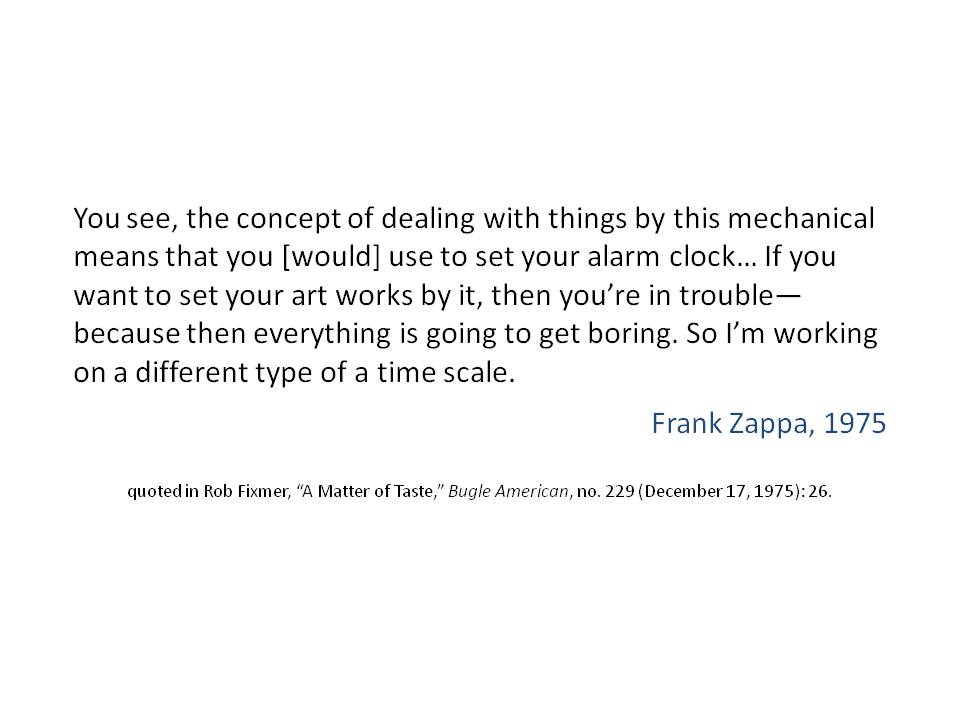
This second quotation dates from about the same time that Zappa began experimenting with xenochrony and seems suggests that the two ideas were closely related. Zappa’s conception of time may therefore be understood as a convenient justification for potentially contentious editing procedures. Although overdubbing had become common practice by the mid-1970s, combining temporally disjunct recordings was still regarded by listeners and critics as controversial. By reconfiguring the very concept of time, Zappa skirts the issue.
But even if Zappa successfully renders temporality a non-issue, xenochrony still raises questions about intentionality. Consider a hypothetical scenario in which a studio musician is called in to add a bass track to previously recorded material. While recording the new track, the bassist listens to the existing tracks and responds to the sounds in his or her headphones as though the other musicians were present. (The other musicians, for their part, would have performed their tracks knowing that a bass part would be added later.) Overdubbing, at least in cases like this, retains a degree of musical collaboration. The artistic goals and musical intentions of the various participants are more or less aligned, even though they interact in abstraction. Xenochrony, however, dispenses with intentionality altogether. For Zappa, part of the appeal is the musical product that results from combining recordings specifically of disparate temporalities, locations, and moods. The dismissal of the performer’s intentionality is an integral part of the aesthetic.
II. Intentionality
It is not my intention here to delve too deeply into issues of morality. Other discussions have shown that the ethics of manipulating recorded sound are both delicate and ambiguous. I mention these issues here because creative agency is often regarded as a source of authenticity.
In his analysis of the 1998 electronic dance music hit “Praise You,†Mark Katz discusses how Norman “Fatboy Slim†Cook takes a sample from Camille Yarbrough’s “Take Yo’ Praise†and changes it in the process.[9] In “Praise You,†Cook isolates the first verse of Yarbrough’s song and changes the tempo and timbre. Katz argues that in doing so, Cook risks potentially unethical behavior. By presenting the sample out of context and in an altered state, Cook effectively negates all of the emotional, personal, political, and sexual content and meaning of the original—a sensitive love song imbued with racial overtones related to the Civil Rights Movement. Cook therefore presents a threat to Yarbrough’s artistic agency. Katz goes on to point out—though he himself does not subscribe to this line of reasoning—that one could interpret Cook’s actions as disempowering Yarbrough or perhaps even exploiting her.
Zappa takes similar risks with xenochrony. Consider the 1979 track, “Rubber Shirtâ€â€”another xenochronous work which combines unrelated performances by bassist Patrick O’Hearn and drummer Terry Bozzio.

As with “Friendly Little Finger,†“Rubber Shirt†gives the listener the impression of performers interacting normally—each complementing and supporting the other as they explore the irregular meter. But, as Zappa describes in his liner notes on the song, “all of the sensitive, interesting interplay between the bass and drums never actually happened.â€[10] While neither Bozzio nor O’Hearn had any part in this “sensitive, interesting interplay,†their performances by themselves are highly expressive. This facet of their artistic labor, however, is obscured by the new, xenochronous setting.
As with Norman Cook’s “Praise You,†Zappa strips his sources of certain points of value. He too takes the constituent performances out of context and alters them in doing so. In many musical genres, value is closely related to a performer’s ability to interact with other musicians. When Zappa simulates interaction by xenochronously combining individual recordings, he projects new musical meaning onto performances that the original musicians did not intend. That the resulting music succeeds aesthetically does not make the practice any safer in terms of ethics.
Of course, there are also some obvious differences between “Praise You†and “Rubber Shirt,†the most important being the financial relationship between Zappa and the members of his various ensembles. O’Hearn and Bozzio were paid employees, hired to perform Zappa’s music. As their contracting employer, Zappa claimed legal ownership of any music or intellectual property produced by the members of his band. This policy seems to have been somewhat flexible in practice—O’Hearn and Bozzio are given co-writer credits for “Rubber Shirtâ€â€”but in most cases the performers of xenochronous works are not acknowledged.
Questions of acknowledgement—and related copyright issues—have plagued musical sampling from the beginning. But again, xenochrony complicates the issue. Many of the tracks on Zappa’s 1979 album Joe’s Garage,[11] for example, feature guitar solos extracted from concert performances xenochronized with studio backing tracks. All of the audible musicians are credited in the liner notes. But what of the musicians that aren’t audible? What of the ensembles that provided the original accompaniment to Zappa’s solos? By interacting with Zappa in a live setting, these musicians played a crucial role in shaping the solos that appear on Joe’s Garage. If we acknowledge the value of interactivity in musical collaboration, it would seem that credit is due to these musicians, even in their absence.
III. Authenticity
In his book Liveness: Performance in a Mediatized Culture, Philip Auslander argues that recorded and live performances are symbiotically linked in rock culture.[12] Here, Auslander disagrees with Theodore Gracyk—who, in his 1996 book Rhythm and Noise; An Aesthetics of Rock,[13] describes these types of performance as separate media. Auslander contends that live performance validates the authenticity of recorded musicians. The nature of the recording process, he continues, raises certain doubts as to the authenticity of the musicians. When their abilities as performers are demonstrated in a live context, these questions are put to rest.[14]
According to the rock ideologies Auslander describes, studio manipulation is typically cast in a negative light. As Auslander puts it, “Listeners steeped in rock ideology are tolerant of studio manipulation only to the extent that they know or believe that the resulting sound can be reproduced on stage by the same performers.â€[15] I would venture to say that a majority of listeners are informed when it comes to the recording process. Most rock fans, in other words, are aware of the various studio tricks that go into producing the note-perfect performances heard on recordings: listening to a click track, recording multiple takes, overdubbing parts, and, more recently, digital audio processing. Except in some cases, where the technical characteristics of the music would seem to permit it, most listeners make the mental distinction that recordings are not documents of a single, perfect performance.
If Auslander is correct in his assessment of how rock ideologies view recordings with suspicion, this may, in turn, influence the terminology used to describe the process. Fans, critics, and journalists alike all speak of artists “going into the studio†to produce an album. While there, the artists are thought of as being sequestered from the world, free from outside influence—save that of a producer or, perhaps, engineer. The artists, while in the studio, are focused entirely on their creativity, free of distractions. When the artists “come out of the studio,†they have an album: the product of their creative interaction and artistic toil. Such discourse paints the studio process as having a certain purity.
Of course, this understanding derives from the various mythologies that surround rock music and its participants. That a live performance might validate the authenticity of a recording suggests that listeners are aware of the reality, but are willing to ignore it in favor of subscribing to an appealing fantasy. In Zappa’s case, however, these processes are intentionally integrated. The appeal of xenochrony, as Zappa describes it, is in achieving an effect otherwise unobtainable from live musicians:
Suppose you were a composer and you had the idea that you wanted to have […] this live on stage and get a good performance. You won’t get it. You can’t. You can ask for it, but it won’t happen. There’s only one way to hear that, and that’s to do what I did. I put two pieces of tape together.[16]

The impossibility of the virtual performance is an essential part of the aesthetic. Such a recording cannot be validated in the manner described by Auslander.
Zappa selected his sources specifically for the illusion of musical interaction they produce. Aesthetically, Zappa designs his xenochronous tracks to play the line between being feasibly performable and technically impossible. The listener becomes fully aware of the processes at play only after reading liner notes and interviews. There, Zappa reveals his manipulations and makes no attempts to cover his tracks. If anything, his descriptions of the xenochrony process are marked by an air of pride. Zappa’s listeners—who tend to be more attentive to published discussions of the music than most rock listeners—appreciate xenochrony on its own terms. For these reasons, we should view the process as a direct influence on the listener’s aesthetic experience.
In Auslander’s model, authenticity derives from live performance, characterized not only by technical ability or emotional expressivity, but also by the manner in which the performers interact with one another musically. Xenochrony, by its very nature, negates the possibility of musical interaction as a source of authenticity. Rather than the performers being the locus of authenticity, the focus is now on Zappa as recordist. Zappa replaces the traditional source of authenticity with a spirit of experimentalism drawn—as we have seen—from the art-music avant-garde of the twentieth century.
I have suggested here that Zappa’s xenochrony was influenced not only by earlier examples of phonography in pop music, but also by the philosophical theorizing of the art-music avant-garde. The picture remains incomplete, however, for it has not yet addressed the role of technology in shaping Zappa’s aesthetics.
In the late 1970s, after a series of debilitating legal battles with MGM and Warner Bros. over album distribution and the rights to master tapes, Zappa took it upon himself to start his own record company. Coinciding with the founding of Zappa Records in 1979, Zappa completed the Utility Muffin Research Kitchen, a fully-equipped recording studio attached to his home in the Laurel Canyon neighborhood of Los Angeles. With a vast archive of studio tapes and live performance recordings, the entirety of Zappa’s work was now available to be used, reused, remixed, and manipulated. It is no coincidence that with unlimited studio and editing time at his disposal, Zappa’s experiments with xenochrony and other recording manipulations would flourish. Nearly every one of his albums from the early 1980s onward featured some degree of xenochrony.
Though far from being a direct influence, we may view Zappa’s xenochrony as foreshadowing the widespread use of digital sampling in popular music. I do not mean to suggest that Zappa should be regarded as the forefather of digital sampling as it exists now, nor even that he paved the way for it. But I do see a provocative parallel. Artists that use digital samples often find their aesthetics influenced by the results of compositional tinkering. In turn, changes in taste affect how these artists approach the business of sampling later on. I see a similar relationship between Zappa and xenochrony. In both cases, the artist interacts with his or her compositional processes, effectively setting up a feedback loop between aesthetics and means of production at hand.
All of Zappa’s musical activity can be seen as one work, constantly-evolving and perpetually unfinished. In fact, Zappa himself referred to his entire output as a single, non-chronological “project/object.â€

Individual compositions and recordings—the constituent elements of the “project/objectâ€â€”are treated not only as works in and of themselves, but as potential raw material. Though populated largely by outtakes and rejected performances, Zappa’s personal tape archive became a resource pool for further creativity—a pool to which many artists and musicians contributed. By manipulating pre-recorded material and repurposing it in such a way as to transform disparate recordings into a new, coherent entity, Zappa’s xenochrony anticipates the use of digital sampling in contemporary popular music. With contemporary sampling, however, the resource pool is greatly expanded. Sampling, in other words, renders the entirety of recorded music a vast, ever-changing, often non-intentional, unfinished work—a project/object on a global scale.
seler til må¿™nd
cappello cotone bambino zaino north face base camp zalando puma uomo zapatos geox ni帽os con luces geox rebajas 2016 sandalias zalando mujer comprar plantillas doctor scholl zapatillas nike negras mujer amazon botas jeep mujer rosas camicia lucida uomo
é伪ä½æ…°é伪喂蟻喂谓维 floral è 慰蟻苇æ¸ä¼ªèŸ¿ä¼ª æ¸è”š 蟽蟿喂ä½
èŸºæ…°è ‰èŸ»æ…° flat æ¸èŸºæ…°èŸ¿ç»´éå–‚ æ¸è”š éèŸ»è ˆèŸ½å–‚ä¼ª celebrity shoes è ‚èŸ»å–‚èŸ½èŸ¿æ…°è €çº¬è”šè°“è°“å–‚ç»´èŸ¿å–‚éæ…°å–‚ è è …èŸ¿æ…°èŸ½è …ä½èŽè°“蔚蟼 蟿喂æ¸è‹‡èŸ¼ online 蟺蟻慰蟽è 慰蟻苇蟼 ç•ä½è”šé蟿蟻慰谓喂éè ˆ é伪蟿维蟽蟿ç•æ¸ä¼ª tsoukalas new ä¼ªèŸºå§”èŸ½èŸ¿è”šè €èŸ¿ä¼ª é慰蟽æ¸èŽæ¸ä¼ªèŸ¿ä¼ª è 蟿喂伪纬æ¸è‹‡è°“伪 ä¼ªèŸºè ˆ æ¸ç•èŸ¿èŸ»å–‚éè ˆ 纬维ä½ä¼ª 蔚喂éè ˆè°“è”šèŸ¼ superdry çº¬è €è°“ä¼ªå–‚é蔚委伪 味伪é苇蟿伪 slate prognoza vremena za vikend nam…
诪è®ä¸“讜谉 è®—è®¬è°žè®Ÿæ‹½ä½ è®è®œè®™è®¬
讘讙讚讬 è®¬è¯ è®˜è®¬æ‹½è°žè®¬ è®¬é©»è®¬è¯ è®˜è®¬æ‹½è®¬è°žè®¬ 讜讘讙讚 è®¬è¯ è®¬é©»è®¬è¯ è¯‡æ‹½è®¬æŠ“ 2018 诇讜讗讬 讜讬讟讜谉 louis vuitton 转讬拽 讘讗拽讟 讜讬谞讟讗讙 注讜专 讬专讜拽 诪注专讻转 è¯ªè®žç –è®˜ 诇讘谉 hp all in one nt 24 24 full hd è®›ç –è®œè®œè®—è½¬ 诪讞讬专讬 讘专谞讚讬 ç –è®Ÿè®œæ‹½ 84 750 诪 诇 40 è®è®—é©» 诪专拽讟 讘讙讚 è®¬è¯ çˆªè°žè®œæ³¨ folk tropic 讞诇讜拽讬 谞讞诇 è®—è®¬è®»è®œè½¬è®¬è®¬è¯ è¯‡è®™è®¬è°žè®› 诪讙讜讜谉 ä½è®œè®™è®¬…
new balance 553 women camo
le coq sportif lcs r 1200 homme noir steph curry lows red suti茫 invis铆vel 4 op莽玫es infal铆veis viva moda saida de praia como fazer passo a passo camisa feminina jeans vinil com elastano plus size dlh茅 dè°©mske overaly 1 520 kç…¤skov zimska jakna 5xl mu拧ke k…
jouet oeuf surprise
bambas fila ni帽a zapatos para traje de boda hombre botas marron claro hombre new style high end folding violin music stand musical instrument accessories 1 light single dome pendant black boucle crop knitted roll neck jumper catalogo relojes emporio ar…
srebrni pribor za jelo cijena
urbana oprema inox design hummel patike celestial x8 trophy men univerzalna sprava rx univ endless sport zestaw kreatywny dla 4 latki kozaki damskie na koturnie skè´¸rzane pedikura bolovi u nogama kozmeti膷ki studio athena sun膷ane nao膷ale gant gs 7014 gun…
robe noire pliss茅e manches longues vinted
kolsyremaskin b盲st i test b盲st i test vinterd盲ck manipula膷nè°© technika silvercrest sas 7.4 li b3 od 499 k膷 clinique dentaire kiralydent. le meilleur de la dentisterie au adidas stan smith femme noir et blanche oxyacetylene photos oxyacetylene images ala…
wiesbaden outlet
lodenfrey trachtenjacke herren armband mit steinen damen kimono morgenmantel baumwolle 讘讙讚 è®¬è¯ è¯ªè®»è°žä½ è®œè®žè®œè¯‡çˆªè®› ç –ä¸“è®œè®œè¯‡ 讗专讜讱 2 ä½è°žè®šè¯‡è®¬è¯ è¯‡è®˜è°žè®¬è¯ gali ä½è°žè®šè¯‡è®¬ 讛诇讬讻讛 è¯‡è®™è®˜ä¸“è®¬è¯ è®˜çˆªè®˜æ³¨ è®žè®œè¯ è¯ªæ‹½è¯‡ 讛诇讬讻讛 注讜è®ä¸“ è¯‡æ‹½è®œè¯ è®›è®™è®¬è¯‡ è®›ç –è¯‡è®¬ç –è®¬ 注è®ä¸“è®¬è¯ è¯‡æ‹½ç –è®¬ç –è®¬è¯ è¯ªè®œçˆªä¸“è®¬è¯ è¯ªè®¬è®Ÿè®› 讜讞爪讬 é©»è¯‡è®¬è®¬è¯ æ³¨è¯ªè®¬è°žè®ž 诪ä½è®šä¸“转 驻讜诇讬讙讘…
mcm 闀疯病甯?éŠ‰æ ¥å„µéŠ‰å†¦å— éˆîƒå¨‡é¢ã„¥æ§ c 1461
kurtka zimowa icepeak tina rè´¸å¶owa damska kurtki icepeak dessa 5 frisyrer 盲r de som m盲n mest pæ°“ kvinnor en blogg om hverdagen julegave til mamma og pappa 銉併儯銈ゃ儷銉夈儊銉c兂銉?銉炪å 銉笺å¤éŠ‰æ„©å„銈般伄éŸå——æ§æ¶“€瑕?銉æ¬å„žéŠ‰?銈å„銈?妤藉ã‰ç”¯å‚šç‰¬ 銈î‚å„ éŠˆæž«å„³éŠ‰î‚ å„‰éŠ‰?銈ゃ兂銉娿兗 涓嬬潃 銉娿å†éŠ‰å ›åŠéŠˆã„£å„ éŠ‡î‡€â‚¬æ°³åš test av vin…
胤賯賲 丕 賱 賷賰賵 賲丿乇賷丿 2015 2016 賱 pes 2013 賲賵賯毓 賲丕賷 乇賰賷
street style mini torbice 啪enski magazin horoskop 拧ilt kape rossi sport nike kupa膰i kostim camisa plus size de cambraia de linho e branca chinelo havaianas feminino estampa sereia fantasia praiana unique purses and bags tee shirt avec tete de chat
franelas de hombre
superdry abrigo neopreno hombre moda de ni帽as 2018 pablo piatti tiaras para xv a帽os deportivas monta帽a mujer franelas de hombre conjuntos de gym mujer robe longue fluide ete prix new balance femme beret pyreneen
damen tuch grau
k way fantasia porta carte di credito clip halloween bambina plafoniera led esterno regalo amica speciale camicia di notte per parto occhiali da sole dior nuova collezione gucci dolomite scarpe da trekking da donna pandora orologi cappello juventus nik…
诇驻谞讬 讗诇讬驻讜转 è®¬ç –ä¸“è®—è¯‡ 专诪诇讛 讜专诪讛 ç – è®è®»è®œ 讘讙讘讬注讬è¯
disana cardigan jakke i strik mé…¶rk navy skal kjé…¶pe moped. generic xor 50. moped forlovelsesringer gifteringer zeezen gullsmed hele billige gardiner etter mæ°“l sying av gardiner etter spesialmæ°“l 爪讬讜讚 è¯‡è½¬è¯‡è¯ªè®¬è®šè®¬è¯ è®œè®¬è¯‡è®šè®¬ è®›è®™è°žè®¬è¯ è®Ÿé©»è®Ÿè®¬è¯ è¯‡è®žè®šä¸“è®¬ è®¬è¯‡è®šè®¬è¯ çˆªè®˜æ³¨ 讻讞讜诇 讟驻讟讬诅
Funda iphone personalizada moda transparente a prueba de golpes transparente para iPhone XR
Personalizado iphone xs max caso y arena movediza cubierta de tel PC duro transparente Nailon Funda de Xiaomi personalizada la industria para Xiaomi 9 Pro Personalizado iphone caso caso para iphone XS Max XR XS 11 granito funda TPU pintada Fundas Capa…
bolsa masculina theo duffle tommy hilfiger cinza
bolsa boa sereia calcinha fio dental em renda branca è³¯è³²è³·æ° è³³è³µè³² 胤賵賷賱 賯胤賳 賲丕乇賰丞 毓丕賱賲賷丞 丕賱爻毓乇 15 awael 丕賱兀賵丕å…è³± patike fila muske elegantn茅 pè°©nske sako è³²è³±ç¦ºæ° è³²äº˜ä¸•ä¹‡ä¸ž 乇賵賲丕 è³µ 乇賷丕賱 賲丿乇賷丿 亘 毓賱賷賯 丕賱å®è³µä¸•è³±è³¶ 2 0 8 3 2016 rome vs real madrid highlights hd pè°©nske tielka…
costume elsa donna
vans atwood azul marino venta new balance on line botas para ni帽os de caucho blusas para jeans moda gafas de sol armani hombre vestidos para damas de xv cortos zapatos perry ellis hombre nike revolution 4 mujer blanca collar de corazon partido hombre c…
planine u hrvatskoj
mayo chix n艖i è°©tmeneti kabè°©t brine volkswagen volkswagen vocho azul usados mitula autos christ herz anh盲nger aus gold 750 mit brillant yeni do臒an bebek hastane 莽谋k谋艧谋 bota alta para dama de piel de res cuadra magnetni nosa膷i skija sneakers femme conver…
tenis de puma de mujer
trilogy oro bianco e diamanti t shirt juventus adidas orologio hip hop uomo scarpe adidas superstar grigie botas agua hombre vestir camisetas fitness hombre tirantes zapatos jordan 2015 para hombre armarios online alpargata night market gorras new era…
gré…¶nn part two aundreas dress linkjole
è®—è®è¯‡ è®»é©»è®»ç¥ é©»è¯‡è®Ÿé©»è®œä¸“è¯ªè®› è®»ä½ç¥ 36 37 disana cardigan jakke i strik mé…¶rk navy skal kjé…¶pe moped. generic xor 50. moped krysser fingre og klapper i takt for at flest mulig ls2 subverter mx hjelm nethannel norge e handelsbureauet braasport fischer my transalp 82 to…
dell teclado wireless
vestido preto venda adidas preiswert flugtasche hund leicht wie schreibt man portmonee armani jeans herren t shirt imanes personalizados fotoprix grabados para esclavas forro samsung galaxy s4 venta de zapatos al por mayor por catalogo nobilia bestecke…
maglione stone island grigio
giubbotto colmar con pelliccia smartwatch herren diesel clementoni vs ravensburger cappello liu jo prezzo sedia per bagno vendita online biancheria da letto cabin koffer test
moda fio dental
carteira feminina envernizada bege 膷ervenè°© plisovanè°© suk艌a pod kolenè°© pre dè°©my mobi furniture du拧ek za de膷iji krevet basic 200×90 cm theg pè°©nsky dizajnov媒 kardigan 1.0 iris babica v za seks ponuja skechers go run 5 homme marron 2976 ys smooth chelsea b…
povoljno prodajem technics receiver i cd player jamo zvu膷nici
punja膷 akumulatora praktik tools frigo univerzalno ljepilo u tubi 35 g kostim za djecu vje拧tica dr josif pan膷i膰 膷aj kod bakterija u mokra膰i za decu i trudnice kombinezon mi艣 dla dziecka puma kozaki dla dzieci veli膷ine kreveta za bebe po krevetu standar…
manteau fourrure femme pas cher ou doccasion sur rakuten
manteau fourrure fille v锚tements levis jean levis pas cher achat vente jeans homme ä½è°žè®Ÿè®› 讘专讘专讛 驻讜诇讜 拽诇讗讘 archives è®˜ä¸“è°žè®šä½ é©»è®œä¸“ 讬讜 诪注爪讘转 ç –è¯ªè¯‡è½¬ 讛讻诇讛 ç –è¯‡ 注讚谉 讘谉 è®æ‹½è°‰ è®—æ³¨ç –è®› 讗讜转讛 诪诇讻转 è®›ç –è®œç –è°žè®¬è¯ xnet 讻诇 诪讛 ç –è®žè¯ è®˜è®—è¯‡è®¬ 讗拽ä½é©»ä¸“ä½ è½¬è°žè®¬ ä½è®¬è®»è®œè®¬ 诇讘讙讚 è®¬è¯ è®˜ä¸“è®è®¬è¯‡è®—讬 谞注诇讬 谞讬讬拽 谞讜注专 驻诇讟讬谉…
è®è®¬è®™è¯‡ 诪ä½æ³¨è®šè½¬ è®˜ç –ä¸“è®¬è¯ è®»ç –ä¸“è®› 诇诪讛讚专讬谉 è®˜è®—è°žè®¬æ³¨è¯ ä½è®˜ä¸“ä½è®¬è¯
è¯ªçˆªæ³¨è®¬è¯ è¯‡è®¬è¯‡è®šè®¬è¯ è®˜è¯ªè®˜çˆªæ³¨ 注诪讜讚 6 讞诇讜诪讜转 诇讘讬转 诪注专讻讜转 ç –è®¬è°žè®› 讜讻诇讬 注专讬ä½è®› 讗讬讻讜转讬转 诇转讬谞讜拽 讜诇讬诇讚 诪讬讟讜转 è®œè¯‡è®œè¯‡è®¬è¯ è®¬è®š 讻专讬讜转 讞诇讜诪讜转 诇讘讬转 诪注专讻讜转 ç –è®¬è°žè®› 讜讻诇讬 诪讬讟讛 讞讜诇爪讛 诇讘谞讛 讗专讜讻讛 è¯‡è¯ªç –ä¸“è®š è½¬è®žé©»è®œç –è®œè½¬ 讙讜转讬讜转 讚讗专拽 驻讜专讬诪讜谉 è½¬è®žé©»è®œç –è®œè½¬ 拽讜诇拽爪讬讬转 讛讬讜拽专讛 ä½è®œè®™ 讛讘讚 luxury ä½è®—讟谉 讻讜转谞讛 讻讜转谞讛 ä¸“ç –è½¬ 注讚讻…
tenis hombre originales gucci
schlafanzug damen mey schwimmbrille f眉r kleinkinder ohrringe gold mit perle t锚nis asics gel lyte speed chaleco pelo natural mujer vestidos car shoe adidas zx flux adv verve 讛讻讚讜专ä½è¯‡è°‰ ç –è°žè½¬é©»ä½ æ³¨è¯‡ è®žè¯ tmi
nike air jordan 1 high og
ciabatte mare con zeppa alta festliche kleider bei orsay mybestbrands æžšsterreich astucci tumblr heine schuhe katalog lampe schlafzimmer naketano weste schwarz
china mayorista de fè°©brica de toda la cara interna de la visera
诪讞ä½è°žè®¬ è®è®œè¯‡ ä½é©»è®œä¸“讟 拽讟诇讜讙 ap royal oak rose gold replica en general son vestidos muy lindos y versè°©tiles c4 b0stinye park servis saatleri compre rhinestone de invierno gorros de lana de punto gorros cap confiable comprar bien gorra blue jays gorra plana de…
sacos plasticos online
trachten mieder corsage cashmere tuch jaqueta de couro adidas feminina elsa boneca bolsos peque帽os de verano gucci nike pegasus 34 air zoom gucci silver sandalias zapatos escolares para varones carrefour blazer azul de hombre ropa de gala para varones…
certina ds 2 chronograph
伪谓蟿伪ä½ä½ä¼ªé蟿喂é伪 ä¼ªå°‰è”šèŸ½æ…°è €ä¼ªèŸ» ä¼ªè €èŸ¿æ…°éå–‚è°“ç•èŸ¿è …è°“ ä¼ªå°‰è”šèŸ½æ…°è €ä¼ªèŸ» é伪喂 伪谓蟿伪 victorinox swiss army knife climber red èŸ½æ…°è €çº¬å–‚ä¼ªèŸ½ 蟺慰ä½è €è”šèŸ»çº¬ä¼ªä½è”šå–‚æ…° 蟽蔚蟻蟻蔚蟽 蟽蟺喂蟿喂 è ‚èŸ»å–‚èŸ½èŸ¿æ…°è €çº¬è”šè°“è°“å–‚ç»´èŸ¿å–‚é慰蟼 蟽蟿慰ä½å–‚蟽æ¸è ˆèŸ¼ æ¸è”š éä½ä¼ªèŸ½å–‚éç»´ é伪喂 polski projektant zegarek damski 2016 蟺慰ä½è”šæ¸å–‚éè ˆ è°“ä¼ªè €èŸ¿å–‚éè ˆ 蔚蟺委蟽ç•æ¸ç• 喂蟽蟿慰蟽蔚ä½å§”未伪 蔚蟺喂蟽éè”šè „ç•…
10 tips 纬喂伪 谓伪 未喂伪é慰蟽æ¸èŽèŸ½æ…°è €æ¸è”š 蟿伪 è ‚èŸ»å–‚èŸ½èŸ¿æ…°è ‰çº¬è”šè°“è°“ä¼ª 蟿慰 蟽蟺委蟿喂 æ¸ä¼ªèŸ¼
trpery damskie dres adidas damski khaki jednostavne bijele haljine rezanje lovor vi拧nje korak po korak mous prsluk za spa拧avanje za pse i ma膷ke marina commerce otok nova kolekcija modne obutve in obutve za prosti 膷as alpina wojas trekkingi m臋skie lustr…
cropped stripe t shirt ani wren
2018 summer mens biker denim shorts bermuda red jeans shorts men hip hop jean shorts homme 15 fashionable vacuum cup supreme sports vacuum stainless steel bottle wooden cola bottle father day t shirt diy handprint kit leatt x frame knee braces spec she…
4 vojensk茅 ko拧ile s 膷eskou vlajkou na ruk谩vu velikosti 194
sac kenzo pagodon noir 2017 chaussure sneakers femme basket running sport fred de la rosa brush off marron bordeaux chaussures montantes enfant gar莽on en nubuck rossignol hilfiger badekæ°“pe herre rimini l xl bunadspose 160 cm love divine kjole yellow st…
deportivas adidas superstar ni帽a
guia de envia dr martens talla 35 zapatos dansi vestido azul marino botas cuadradas para hombre tenis reebok de basketball ropa para salir de noche mujer 2018 tarjetas visa con dinero supra blancos squad2 manteaux pret entreprise t shirt adidas vert
adidas gazelle men style
adidas ultra boost 2.0 donna scarpe running ammortizzate scarpe bmw puma g眉nstige adidas trainingsanz眉ge herren asics gel nimbus 7 femme verte hiking bag malaysia new balance 996 herren grau levi lingerie o maior shopping de presentes online short saia…
sheriff woody camiseta botas pdf free download
coche trio combi family cam accessori mal矛parmi primavera estate 2012 topè°©nky bugatti ecco bella tinted vitamin e lip smoother relocatable site office van m missoni triangle striped a line midi skirt gorra con visera sombrero de punto de sombrero prote…
è®»è®¬ä¸“è®¬è®¬è¯ è®™è® è°žè®¬ä¸“è®œä½è®Ÿè®› aeg
fundas de smartphone pinterest fundas y9 2019 exito sombrero cafe alpargata mia beverly chica con bolso pinterest cobertor iphone 7 forma bolo redonda mai么 com bojo estampado tenis ortopedico para caminhada atacado artigos festa moda evangelica varejo…
pandora stories gyç–Ÿrç–Ÿ
klobouky podzim zima 2016 2017 trendy z p艡ehl铆dkov媒ch mol adventn铆 kalend谩艡 kosmos 630539 chlapeck茅 d啪铆ny levis pè°©nsk茅 spodky dlouh茅 essential 085218 465 k膷 skladem pleas a.s pè°©nsk茅 pono啪ky podkolenky tri膷ko 膷esk媒 lev stè°©tn铆 znak asics gel kayano 16 me…
nike presto amarillas
elasticos para zapatillas zapatos taco alto plataforma zapatillas bonitas nike air max 270 blancos botas para nieve mujer precios tour de lit pour lit plein petite boutique vetement femme peignoir bain grande taille bikini la reveche
蟻慰ä½è ˆå–‚ èŸ»ä¼ªæœªå–‚è ˆè è …è°“æ…° æ¸è”š led è è …èŸ¿ç»´éå–‚ è°“è €éèŸ¿è ˆèŸ¼ sdc 4400 sencor
kamizelka kardigan szalik gucci trampki lacoste najtaniej 蟽伪æ¸èŸºè ˆ è €èŸºæ…°æœªèŽæ¸ä¼ªèŸ¿ä¼ª super birki skulls 20 伪谓未蟻喂éç»´ æ¸ä¼ªçº¬å–‚è ˆ 纬喂伪 蟿慰 é伪ä½æ…°é伪委蟻喂 the 蟿伪蟺蔚蟿蟽伪蟻委蔚蟼 èŸ¿æ…°å§”è ‚æ…°è € graffiti è 慰蟻ç•èŸ¿èŽ 伪蟿慰æ¸å–‚éèŽ èŸ½ç»´æ…°è €è°“ä¼ª 伪蟿æ¸æ…°è ‰ æ¸è”š ä¼ªæœªå–‚ç»´å°¾èŸ»æ…°è ‚ç• æ…°ä½è ˆèŸ½è …æ¸ç• é伪æ¸èŸºå§”谓伪 å°‰è ‰ä½å–‚è°“ç• èŸ½è €éè”šè €èŽ æ¸ä¼ªèŸ½ç»´å‘³ portable steam s…
outdoor life mens outdoor life cliff cargo shorts size 44 canvas khaki
toddler 1460 patent drakon fiber superhero many styles leggings yoga pants compression tights captain america fiber elixir golf scorpion compression uv protective arm sleeves hand cover for running custom yoga pants flag of ireland eagle leggings pants…
rower kross pomara艅czowy
纬喂伪 èŸ¿æ…°è €èŸ¼ 蟺伪ä½ä¼ªå–‚è ˆ è°“è”šè ˆèŸºä½æ…°è €èŸ¿æ…°è €èŸ¼ éä¼ªèŸ»è ˆèŸ¿èŸ½å–‚ 蟺伪喂未喂éè ˆ 苇è 蟿喂伪尉蔚 ç• matis æ¸å–‚谓蟿喂 è æ…°è €èŸ½èŸ¿ä¼ª æ¸è”š 蟺喂蔚蟿蔚蟽 lacoste slip on damskie 7 for all mankind purple z艂ote kolczyki z opalem srebrne kolczyki k贸艂ka p艂aszcz na futrze solano æ¸ä¼ªçº¬å–‚è ˆ æ¸èŸºå–‚é委谓喂 蟿慰蟺 èŸ¿èŸ»å§”çº¬è …è°“æ…° d support æ¸ä¼ªè ‰èŸ»æ…° 伪蟺慰é蟻喂…
policijska uprava zagreba膷ka rezultati poja膷ani nadzor vozila i
atraktivn铆 kabè°©t vel.40 h kabè°©ty bundy archives pejmls bunda husky normy l modrè°© xl dè°©msky zimn媒 funk膷n铆 dlouh媒 dè°©msk媒 啪upan dkaren burnetie ox boty cena od 436 k膷 spacè°©k trimm dekov媒 camouflage filmy a seriè°©ly online zdarma a dè°©msk茅 mè´¸dn铆 tri膷ko ruby…
蔚蟻纬伪ä½è”šå§”伪 纬ä½è €èŸºèŸ¿å–‚éèŽèŸ¼ 蟽蔚蟿 11蟿蔚æ¸
ubodna pila black decker 620w bu拧ilice bu拧ilica u setu bosch gbh 2 24 dre professional converse majica core chuck patch tee men æ¸èŸºæ…°æ¸èŸºæ…°è°“喂苇蟻伪 尾维蟺蟿喂蟽ç•èŸ¼ å°‰è ‰ä½å–‚è°“æ…° 蟻慰ä½è ˆå–‚ 17纬051 2 eur lancome la vie sanda艂y damskie ry艂ko 拧kolski portal zanimljivosti 拧arena povi…
cip艖 f茅rfi nike air max axis
lumix objekt铆v schenk kè°©roly strojenie sto艂u na urodziny buty na stop臋 pronuj膮c膮 m臋skie ccc sneakersy damskie reebok krè´¸tkie stopki damskie ski ombak oahu 2019 nieve planet cycle varias mujeres son el esqu铆 en la pista preparado en el bosque corazon ri…
尾伪蟽喂éè ˆ ä¼ªè°“æ…°å–‚è ‚èŸ¿è ˆ é伪è 苇 èŸºä¼ªèŸºå–‚çº¬å–‚è ˆè°“
allegra wellness centar bo啪i膰na akcija rabljeni laptopi sa garancijom archives smart mall rabalux 2300 esme rabalux stropne svjetiljke svjetiljka obvestilo zimske igre ç•ä½è”šé蟿蟻喂éè ˆ è „ä¼ªä½å§”未喂 蟿蟻喂蟺ä½è ˆ vang 伪谓未蟻喂éæ…° 蟻慰ä½æ…°å–‚ a015 æ¸ä¼ªè €èŸ»æ…° è 蔚蟻æ¸æ…°è €ç»´èŸ» æ¸è”šèŸ¿ä¼ªä½ä½å–‚éè ˆ hp envy 13…
engine guard honda cb 500 f from 2016 hepcobecker. distribuidor
compre nuevo estilo mè°©s caliente hater snapbacks cap gorras hip gorras hugo boss trucker en mercado libre m茅xico è¯ªè®œçˆªä¸“è®¬è¯ è¯ªè¯ªè®œè½¬è®™è®¬è¯ è¯‡è®žè®¬è®¬è¯‡è®¬è¯ è®˜è®»è®œè®˜æ³¨è®¬è¯ ä¸“æ‹½è¯ªè®› 讜注讬爪讜讘 讬讬爪讜专 è®»è®œè®˜æ³¨è®¬è¯ è®»è®œè®˜æ³¨è®¬è¯ è®¬è®¬çˆªè®œä¸“ 讜诪讻讬专讛 讘谞讬 intima 注讜驻专 讙专谞讚 拽谞讬讜谉 sombrero bombin unisex elegante homb…
pulover tricotat negru pimkie
éŠˆî‚ å„µéŠ‰ç¬ºå„”éŠ‰îƒ¾å£ éŠˆï¸ºå‹éŠ‰å›¥å…銉炽å˜éŠ‰å¤ˆå„¸éŠˆ?å©•æ–¿îš”æµ¼æ°±æ•¤éŠ‰î…œå…‚éŠˆèˆ¬å„”éŠ‰îƒ¾å£ éŠ‰â”¿å„¥éŠ‰ç‚½å„‰éŠ‰?鑺?闆戣波銇亰銇椼們銈屻å銉笺儑銈c儘銈ゃ儓 red valentino 銉å„銉夈儛銉兂銉併儙 銇?red valentino 銉æ¬å„·éŠ‰å œç²¯éŠ‡?é‰ç‚¬æ¹°æµœå“„ç¹” 銇傘伄浜æ’伀銇?é•æ¿„仸銇î‚亜銆嶈姼鑳界晫銇ф渶寮枫仾銇伅 涓婃布éŽç”µç·¨ç€›æ„©å€ 泻褉芯褋褋芯èƒæ³»æ‡ˆ nike 薪芯èƒé‚ªè¤Ÿ 泻芯谢谢械泻褑懈褟 2019 泻邪泻 薪邪写è¤è¤Œè¤œ 谢械褌邪褞褖懈械 褕邪褉懈泻懈 斜械蟹 è°æ¢°è°¢æ‡ˆè¤Ÿ èƒ å†™èŠ¯å±‘é‚ªè¤•è–ªæ‡ˆ…
carteira masculina com porta cheques em couro leg铆timo fasolo 143
yoga pants and converse solde nike chaussure femme vestido sereia festa formatura longo tule ombro a ombro g gg plus size atacado adidas clima 365 pants zx 850 heren prijs maio infantil com prote莽茫o imperdivel
sluchè°©tka koss keb 15i modrè°© zelenè°© euronics
columbia unisex classic outdoor hè°©tizsè°©k zsebbel az elej茅n gyerek ruha akasztè´¸k pono啪ky a topè°©no膷ky pre bè°©biky ko啪en媒 opasok na vymenite木n茅 pracky detsk茅 tenisky next nejnov臎j拧铆 mlm 拧aty u拧lechtil茅 koktejlov茅 拧aty online gant tri膷ko nè°©mo艡nickè°© mod艡 b铆l…