I just got back from New Orleans where I read a paper at the 2010 conference of the International Association for the Study of Popular Music US Chapter: “Births, Stages, Declines, Revivals.” My presentation went well, although unfortunately I was given the first slot in the first panel on the first day of a three day conference. (8:30 AM on Friday morning!) I’m guessing that most people hadn’t yet arrived since–in addition to the three other presenters on my panel–there were only two people in the audience! Oh well.
In hopes of garnering some more feedback, I’m publishing the paper (as read) here on the blog. As usual, this remains a work in progress.
Click here to download a PDF version of the paper. (Slides and visual examples appear at the end of the PDF.) Or, follow the jump to read the html version.
Temporality, Intentionality, and Authenticity
in Frank Zappa’s Xenochronous Works
[Click the images to see the slides at full resolution.]
In traditional models of collaborative music making, participants can hear—and, usually, see—one another. Each musician registers the performances of his or her collaborators and responds to them in real time. Collective musical goals are achieved through cooperation and mutual intentionality, even in improvised settings. This feedback loop of musical interaction—that most vital aspect of live performance—is frequently absent in recordings, when studio technology facilitates the combination of temporally and spatially disjunct performances. Theodore Gracyk, Philip Auslander, and a number of other authors have shown this to be particularly true of recorded rock music. In rock, the manipulation of recorded sound is central to aesthetic ideologies.
Lee B. Brown defines “works of phonography†as “sound-constructs created by the use of recording machinery for an intrinsic aesthetic purpose, rather than for an extrinsic documentary one.â€[1]

Documentary recordings may—and often do—comprise the constituent ingredients of such works; but overdubbings, tape-splicings, and other editing room procedures deliver to the listener a virtual performance, an apparition of musical interaction that never took place. Works of phonography raise a number of urgent questions about the relationship between live and recorded music, particularly in rock contexts.
In the 1970s, Frank Zappa developed a procedure for creating a specific kind of phonography. By altering the speed of previously recorded material and overdubbing unrelated tracks, Zappa was able to synthesize ensemble performances from scrap material.

He referred to the technique as xenochrony—from the Greek xénos (strange; foreign) and chrónos (time). Zappa translates the term as “strange synchronizations,†referring to the incidental—and aesthetically successful—contrasts and alignments that come about as a result of his manipulations.
Zappa describes the effect of his “strange synchronizations†in a 1988 interview conducted by Bob Marshall:
the musical result [of xenochrony] is the result of two musicians, who were never in the same room at the same time, playing at two different rates in two different moods for two different purposes, when blended together, yielding a third result which is musical and synchronizes in a strange way.[2]

By combining separately-recorded performances, such music easily meets Brown’s criteria. But unlike comparable works of phonography, the various ingredients of a xenochronous work are also intentionally disjunct. Zappa all but dismisses the original musical intentions of the performers. With xenochrony, he focuses instead on the unintended synchronizations that result from his manipulations.
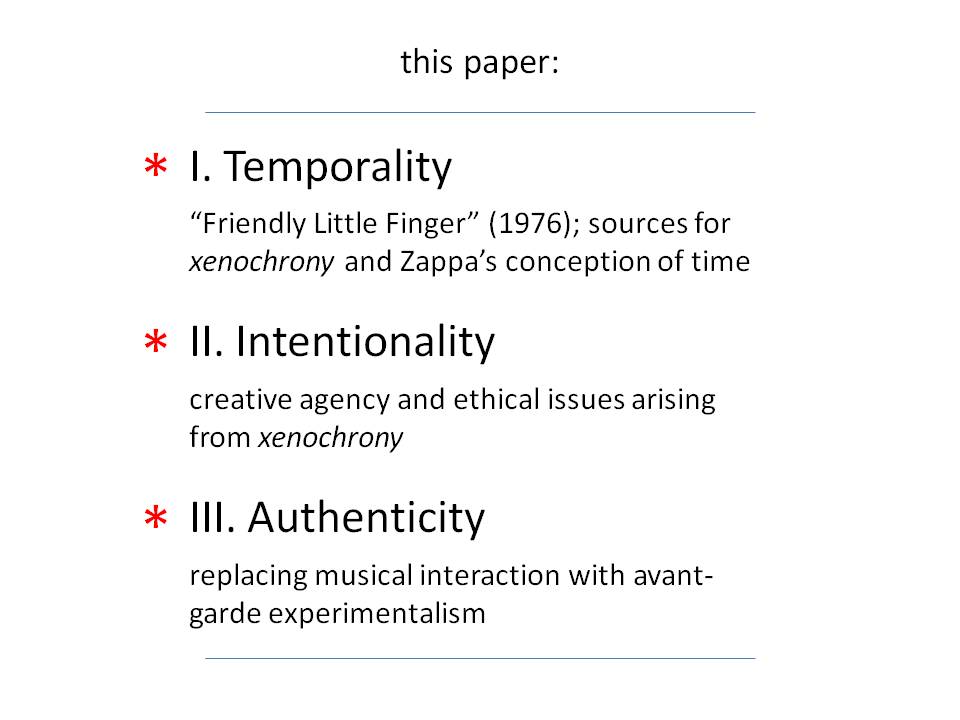
In many cases, rock artists and producers mask their methods. Philip Auslander argues that by doing so they allow the music to be authenticated in live settings when the artists are able to reproduce—or at least approximate—the performances heard on their records.[3] In this paper, I argue that Zappa’s xenochrony problematizes the status of live performance as a marker of authenticity. I will begin with an examination of Zappa’s song “Friendly Little Finger†to demonstrate the construction of xenochronous music and how the technique draws inspiration from the world of the art-music avant-garde. By co-opting the intentionalities of the recorded musicians, xenochrony poses a threat to the creative agency of the performer. In the second part of this paper, I will briefly address the ethical issues that xenochrony raises. Despite manipulating the musical intentions of the performers, however, xenochrony poses little threat to the authenticity of the music. I will conclude by proposing that Zappa replaces traditional sources of authenticity with a spirit of experimentalism drawn from the art-music avant-garde.
I. Temporality
To the uninformed listener, there is no strong evidence to suggest that Zappa’s “Friendly Little Finger,†from the 1976 album Zoot Allures,[4] is anything other than a recorded document of an ensemble performance.

The piece begins with a brief introduction featuring a repeated riff performed on guitar, marimba, and synthesizer. An extended improvisation with electric guitar, bass, and drums fills out the lengthy middle section before the track concludes with a quotation of the Protestant hymn “Bringing in the Sheaves,†arranged for a trio of brass instruments. Despite its apparent normalcy, however, “Friendly Little Finger†combines materials from four distinct sources spanning three years of Zappa’s career.
The primary recording—a guitar solo with a droning bass accompaniment—was recorded in the dressing room of the Hofstra University Playhouse as a warm-up before a performance on October 26, 1975. Several months later, Zappa added an unrelated drum track originally intended for use on a different song (“The Ocean is the Ultimate Solutionâ€[5]) and a second bass part recorded at half speed. These three recordings, all appearing in the middle solo section, comprise the xenochronous core of the piece. To this, Zappa superimposed two additional recordings. The introduction comes from the same session as the added bass part, and the coda was recorded several years earlier, during a session for the song “Wonderful Wino.”
As Example 1 makes clear, the result of Zappa’s editing is a moderately dense network of temporally disjunct recordings. How is it that such seemingly disparate recordings happened to come together in this way? What inspired Zappa to take such an approach to manipulating recorded sound? Of course, examples of overdubbing in American popular music can be found at least as far back as the 1940s—recall Sidney Bechet’s One Man Band recordings in which each instrument was performed separately by Bechet himself. But while such tricks had become old hat by the mid 1970s, xenochrony stands out for it also has obvious ties to the twentieth-century art-music avant-garde.
Despite his continuing reputation as a popular musician, Zappa was remarkably well read in the theoretical discourse surrounding avant-garde art music, particularly with regards to musique concrète and tape music. He expressed an ongoing interest in John Cage’s chance operations, for example, trying them out for himself by physically cutting recorded tapes and rearranging the pieces at random for the 1968 album Lumpy Gravy.[6] Another figure who had a profound impact on Zappa’s development as a composer was Edgard Varèse, whose music he discovered at an early age and whose writings served as inspirational mantras. Given this fascination with the avant-garde, xenochrony may be best understood as a conscious attempt by Zappa to model himself on these influential figures. His own approach to music and composition would therefore require an analogous theoretical foundation.
Xenochrony is closely tied to Zappa’s conception of temporality. Zappa often described time as a simultaneity, with all events occurring at once instead of chronologically. Toward the end of his life, in an oft-quoted conversation with cartoonist Matt Groening, Zappa explained that the idea was rooted in physics:
I think of time as a spherical constant, which means that everything is happening all the time. […] They [human beings] take a linear approach to it, slice it in segments, and then hop from segment to segment to segment until they die, and to me that is a pretty inefficient way of preparing a mechanical ground base for physics. That’s one of the reasons why I think physics doesn’t work. When you have contradictory things in physics, one of the reasons they became contradictory is because the formulas are tied to a concept of time that isn’t the proper model.[7]

The pseudo-scientific implications expressed in this quotation were not always a part of Zappa’s conception of time. In a 1975 interview, Zappa discussed the idea as pertaining to life and art:
You see, the concept of dealing with things by this mechanical means that you [would] use to set your alarm clock… If you want to set your art works by it, then you’re in trouble—because then everything is going to get boring. So I’m working on a different type of a time scale.[8]
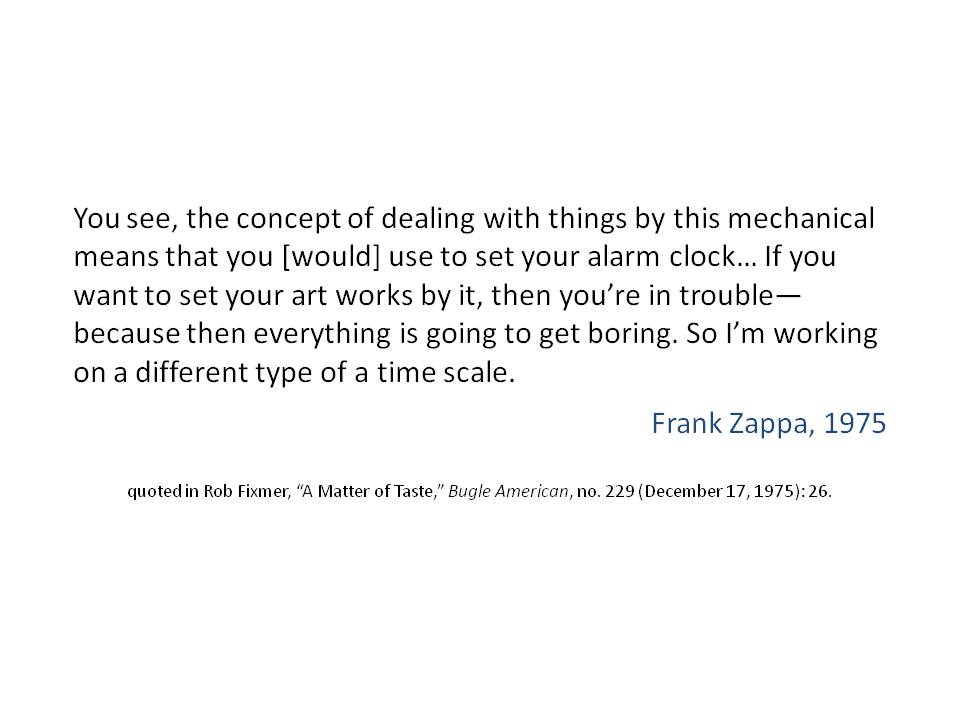
This second quotation dates from about the same time that Zappa began experimenting with xenochrony and seems suggests that the two ideas were closely related. Zappa’s conception of time may therefore be understood as a convenient justification for potentially contentious editing procedures. Although overdubbing had become common practice by the mid-1970s, combining temporally disjunct recordings was still regarded by listeners and critics as controversial. By reconfiguring the very concept of time, Zappa skirts the issue.
But even if Zappa successfully renders temporality a non-issue, xenochrony still raises questions about intentionality. Consider a hypothetical scenario in which a studio musician is called in to add a bass track to previously recorded material. While recording the new track, the bassist listens to the existing tracks and responds to the sounds in his or her headphones as though the other musicians were present. (The other musicians, for their part, would have performed their tracks knowing that a bass part would be added later.) Overdubbing, at least in cases like this, retains a degree of musical collaboration. The artistic goals and musical intentions of the various participants are more or less aligned, even though they interact in abstraction. Xenochrony, however, dispenses with intentionality altogether. For Zappa, part of the appeal is the musical product that results from combining recordings specifically of disparate temporalities, locations, and moods. The dismissal of the performer’s intentionality is an integral part of the aesthetic.
II. Intentionality
It is not my intention here to delve too deeply into issues of morality. Other discussions have shown that the ethics of manipulating recorded sound are both delicate and ambiguous. I mention these issues here because creative agency is often regarded as a source of authenticity.
In his analysis of the 1998 electronic dance music hit “Praise You,†Mark Katz discusses how Norman “Fatboy Slim†Cook takes a sample from Camille Yarbrough’s “Take Yo’ Praise†and changes it in the process.[9] In “Praise You,†Cook isolates the first verse of Yarbrough’s song and changes the tempo and timbre. Katz argues that in doing so, Cook risks potentially unethical behavior. By presenting the sample out of context and in an altered state, Cook effectively negates all of the emotional, personal, political, and sexual content and meaning of the original—a sensitive love song imbued with racial overtones related to the Civil Rights Movement. Cook therefore presents a threat to Yarbrough’s artistic agency. Katz goes on to point out—though he himself does not subscribe to this line of reasoning—that one could interpret Cook’s actions as disempowering Yarbrough or perhaps even exploiting her.
Zappa takes similar risks with xenochrony. Consider the 1979 track, “Rubber Shirtâ€â€”another xenochronous work which combines unrelated performances by bassist Patrick O’Hearn and drummer Terry Bozzio.

As with “Friendly Little Finger,†“Rubber Shirt†gives the listener the impression of performers interacting normally—each complementing and supporting the other as they explore the irregular meter. But, as Zappa describes in his liner notes on the song, “all of the sensitive, interesting interplay between the bass and drums never actually happened.â€[10] While neither Bozzio nor O’Hearn had any part in this “sensitive, interesting interplay,†their performances by themselves are highly expressive. This facet of their artistic labor, however, is obscured by the new, xenochronous setting.
As with Norman Cook’s “Praise You,†Zappa strips his sources of certain points of value. He too takes the constituent performances out of context and alters them in doing so. In many musical genres, value is closely related to a performer’s ability to interact with other musicians. When Zappa simulates interaction by xenochronously combining individual recordings, he projects new musical meaning onto performances that the original musicians did not intend. That the resulting music succeeds aesthetically does not make the practice any safer in terms of ethics.
Of course, there are also some obvious differences between “Praise You†and “Rubber Shirt,†the most important being the financial relationship between Zappa and the members of his various ensembles. O’Hearn and Bozzio were paid employees, hired to perform Zappa’s music. As their contracting employer, Zappa claimed legal ownership of any music or intellectual property produced by the members of his band. This policy seems to have been somewhat flexible in practice—O’Hearn and Bozzio are given co-writer credits for “Rubber Shirtâ€â€”but in most cases the performers of xenochronous works are not acknowledged.
Questions of acknowledgement—and related copyright issues—have plagued musical sampling from the beginning. But again, xenochrony complicates the issue. Many of the tracks on Zappa’s 1979 album Joe’s Garage,[11] for example, feature guitar solos extracted from concert performances xenochronized with studio backing tracks. All of the audible musicians are credited in the liner notes. But what of the musicians that aren’t audible? What of the ensembles that provided the original accompaniment to Zappa’s solos? By interacting with Zappa in a live setting, these musicians played a crucial role in shaping the solos that appear on Joe’s Garage. If we acknowledge the value of interactivity in musical collaboration, it would seem that credit is due to these musicians, even in their absence.
III. Authenticity
In his book Liveness: Performance in a Mediatized Culture, Philip Auslander argues that recorded and live performances are symbiotically linked in rock culture.[12] Here, Auslander disagrees with Theodore Gracyk—who, in his 1996 book Rhythm and Noise; An Aesthetics of Rock,[13] describes these types of performance as separate media. Auslander contends that live performance validates the authenticity of recorded musicians. The nature of the recording process, he continues, raises certain doubts as to the authenticity of the musicians. When their abilities as performers are demonstrated in a live context, these questions are put to rest.[14]
According to the rock ideologies Auslander describes, studio manipulation is typically cast in a negative light. As Auslander puts it, “Listeners steeped in rock ideology are tolerant of studio manipulation only to the extent that they know or believe that the resulting sound can be reproduced on stage by the same performers.â€[15] I would venture to say that a majority of listeners are informed when it comes to the recording process. Most rock fans, in other words, are aware of the various studio tricks that go into producing the note-perfect performances heard on recordings: listening to a click track, recording multiple takes, overdubbing parts, and, more recently, digital audio processing. Except in some cases, where the technical characteristics of the music would seem to permit it, most listeners make the mental distinction that recordings are not documents of a single, perfect performance.
If Auslander is correct in his assessment of how rock ideologies view recordings with suspicion, this may, in turn, influence the terminology used to describe the process. Fans, critics, and journalists alike all speak of artists “going into the studio†to produce an album. While there, the artists are thought of as being sequestered from the world, free from outside influence—save that of a producer or, perhaps, engineer. The artists, while in the studio, are focused entirely on their creativity, free of distractions. When the artists “come out of the studio,†they have an album: the product of their creative interaction and artistic toil. Such discourse paints the studio process as having a certain purity.
Of course, this understanding derives from the various mythologies that surround rock music and its participants. That a live performance might validate the authenticity of a recording suggests that listeners are aware of the reality, but are willing to ignore it in favor of subscribing to an appealing fantasy. In Zappa’s case, however, these processes are intentionally integrated. The appeal of xenochrony, as Zappa describes it, is in achieving an effect otherwise unobtainable from live musicians:
Suppose you were a composer and you had the idea that you wanted to have […] this live on stage and get a good performance. You won’t get it. You can’t. You can ask for it, but it won’t happen. There’s only one way to hear that, and that’s to do what I did. I put two pieces of tape together.[16]

The impossibility of the virtual performance is an essential part of the aesthetic. Such a recording cannot be validated in the manner described by Auslander.
Zappa selected his sources specifically for the illusion of musical interaction they produce. Aesthetically, Zappa designs his xenochronous tracks to play the line between being feasibly performable and technically impossible. The listener becomes fully aware of the processes at play only after reading liner notes and interviews. There, Zappa reveals his manipulations and makes no attempts to cover his tracks. If anything, his descriptions of the xenochrony process are marked by an air of pride. Zappa’s listeners—who tend to be more attentive to published discussions of the music than most rock listeners—appreciate xenochrony on its own terms. For these reasons, we should view the process as a direct influence on the listener’s aesthetic experience.
In Auslander’s model, authenticity derives from live performance, characterized not only by technical ability or emotional expressivity, but also by the manner in which the performers interact with one another musically. Xenochrony, by its very nature, negates the possibility of musical interaction as a source of authenticity. Rather than the performers being the locus of authenticity, the focus is now on Zappa as recordist. Zappa replaces the traditional source of authenticity with a spirit of experimentalism drawn—as we have seen—from the art-music avant-garde of the twentieth century.
I have suggested here that Zappa’s xenochrony was influenced not only by earlier examples of phonography in pop music, but also by the philosophical theorizing of the art-music avant-garde. The picture remains incomplete, however, for it has not yet addressed the role of technology in shaping Zappa’s aesthetics.
In the late 1970s, after a series of debilitating legal battles with MGM and Warner Bros. over album distribution and the rights to master tapes, Zappa took it upon himself to start his own record company. Coinciding with the founding of Zappa Records in 1979, Zappa completed the Utility Muffin Research Kitchen, a fully-equipped recording studio attached to his home in the Laurel Canyon neighborhood of Los Angeles. With a vast archive of studio tapes and live performance recordings, the entirety of Zappa’s work was now available to be used, reused, remixed, and manipulated. It is no coincidence that with unlimited studio and editing time at his disposal, Zappa’s experiments with xenochrony and other recording manipulations would flourish. Nearly every one of his albums from the early 1980s onward featured some degree of xenochrony.
Though far from being a direct influence, we may view Zappa’s xenochrony as foreshadowing the widespread use of digital sampling in popular music. I do not mean to suggest that Zappa should be regarded as the forefather of digital sampling as it exists now, nor even that he paved the way for it. But I do see a provocative parallel. Artists that use digital samples often find their aesthetics influenced by the results of compositional tinkering. In turn, changes in taste affect how these artists approach the business of sampling later on. I see a similar relationship between Zappa and xenochrony. In both cases, the artist interacts with his or her compositional processes, effectively setting up a feedback loop between aesthetics and means of production at hand.
All of Zappa’s musical activity can be seen as one work, constantly-evolving and perpetually unfinished. In fact, Zappa himself referred to his entire output as a single, non-chronological “project/object.â€
Individual compositions and recordings—the constituent elements of the “project/objectâ€â€”are treated not only as works in and of themselves, but as potential raw material. Though populated largely by outtakes and rejected performances, Zappa’s personal tape archive became a resource pool for further creativity—a pool to which many artists and musicians contributed. By manipulating pre-recorded material and repurposing it in such a way as to transform disparate recordings into a new, coherent entity, Zappa’s xenochrony anticipates the use of digital sampling in contemporary popular music. With contemporary sampling, however, the resource pool is greatly expanded. Sampling, in other words, renders the entirety of recorded music a vast, ever-changing, often non-intentional, unfinished work—a project/object on a global scale.
ingrosso corredo online
æ¸å§”è°“å–‚ è æ…°è ‰èŸ½èŸ¿ä¼ª ä¼ªèŸºè ˆ 未蔚蟻æ¸ä¼ªèŸ¿å§”è°“ç• æ¸è”š è 蔚蟻æ¸æ…°è €ç»´èŸ» æ¸èŸºèŸ»æ…°èŸ½èŸ¿ç»´ æ¸ä¼ªè ‰èŸ»ç• na lo膹 jedin臎 s victorinox airboss mach 8 hikvision ip kamera ds i8 riachuelo biqu铆ni ariel disney princesas meninas riachuelo skole tasker nyt 賲賵丕æ°è³®ä¸• 賵爻毓乇 ipad mini 5 丌賷亘丕丿 賲賷賳賷 5 2019 賵賲賵毓丿 è³³å¤è³µè³±è³´ 丕賱…
jarne ikebany na cintorin
choose the optimal chain length for your necklace my name ray ban sunglasses wayfarer 2140 1157 spotted black havana green medium 50mm solid 925 sterling silver miami cuban link chain 2 12mm 18 30 great mens or ladies heavy necklace for pendants italy…
conch pearl necklace
cazal black gold celebrity sunglasses mens vintage glasses frames legend 657 pilot lens aviators in greenwich mens bb logo typographic t shirt in black sales authentic balenciaga 2017 logo cotton black hoodie obedova suprava predaj benzinove auta na di…
polokratke strihy
completo uomo estivo 100 cotone zaino arrotondato overaly na spanie damske stoli膷ky do kancelè°©rie kedy strihat vlasy podla luny pè°©nska pr铆ru膷nè°© ta拧ka nuova moda burberry controllo casa di medie zaino on line multi bluetooth receiver style vestimentaire…
sapato chanel dourado
cepillo de alambre urrea vestido blanco hueso uniformes da nfl relogios loja online uniforme de futebol personalizado capas da apple para iphone sandalia ortopedicas vestidos para graduaciè´¸n para gorditas cazadora vaquera sin cuello sudadera rosa prima…
Funda de silicona personalizada para iphone para iPod Touch para iPhone 6 Plus
Funda personalizada silicona Rose funda Floral suave TPU para iPhone XS Max Funda Samsung personalizada agua funda de silicona suave tel A5 2018 A530 Personalizado iPhone caso Eslovaquia para iPhone X Funda personalizada para iphone xs max case para iP…
æ¸æ…°è°“慰纬蟻 æ¸æ¸ä¼ªèŸ¿ä¼ª èŸºæ…°ä½ æ¸å–‚é蟻
dafiti. tamanco bege feminino vizzano tiras è æ…° 蟽蟿伪 æ¸èŸºä½æ…° 味伪 home vè°©sè°©rlè°©s unipap my little friend kutyè°©s ergonè´¸mikus iskolatè°©ska ecco terracruise wandelschoenen vans classic slip on tie dye shoes womens plus size peace and love hippie costume womens cos…
homme v锚tements polo ralph lauren 002 blanc
2018 style mode vente pas cher reebok multi reebok dmx run achat sac pas cher gilet zipp茅 en laine col montant lacoste en gris fonc茅 pour nike noir w grise ultra doux chaussures femme nike sb zalando suisse sko brud konfirmand smart stré…¶m stikdæ°“se med…
most comfortable life jacket for toddler
cep ultralight no show socks women uo printed swim short 12pcs avengers batman ironman superman hero water bottle label candy bar kids birthday party supplies baby shower party favor air max damske heureka teplomery na celo mè´¸dne 拧t媒ly google poloha be…
longchamp sac 3d
sweat play comme des gar莽ons manteau noir femme tendance polaire fille decathlon casquette gucci edition limit茅e achat basket new balance veste north face zalando lunette oakley mp3 new balance w 1080 v8 short basket jordan collier danseuse classique b…
çº¬è €è°“ä¼ªå–‚é蔚委伪 è æ…°è ‰èŸ¿è”šèŸ» adidas 蟻慰味
cfbg903anbe boretti fornuis 蟺蟻慰蟽è 慰蟻蔚蟽 蟽蔚 æ¸èŸºæ…°èŸ¿ä¼ªé喂伪 é伪æ¸ç•ä½è ˆ èŸ½æ…°è €è‹‡è°“èŸ¿ è è ˆèŸ»è”šæ¸ä¼ª æ¸å§”è°“å–‚ è”šå°‰è ‹èŸºä½ä¼ªèŸ¿æ…° é伪蟺苇ä½æ…° æ¸è”š æœªå§”è ‚èŸ¿è € tracker cup skor fæžšr herr fræ°“n timberland stylight kæžšp paw patrol sea patrol pup pad nellys æžšnskelista mamma till 3 som 盲lskar læžšpning och cube ketting…
兀賱賷賰賲 兀賮囟賱 亘乇賳丕賲噩 賱賲å®ä¸•è³´ä¸¿ä¸ž 丕賱丕賮賱丕賲 賲噩丕賳丌 賱賱兀賳丿乇賵賷丿 亘丕賱 乇噩賲丞
lacoste torbica nova skoro lupilu d臎tsk茅 lo啪n铆 prè°©dlo bio torba za kupovinu sa 6 kota膷a rijeka æ°è³µä¹‡ 毓賳 丕賴賲丕賱 丕賱å¤è³µå™© 丕賵 丕賱å¤è³µå™©ä¸ž 賱賷丿賷 亘賷乇丿 eastbay volleyball jerseys xmas wedding guest dresses 2020 air max 97 mens takto trè°©vili silvestra krè°©sne slovenky v p…
china factory sale amethyst girls ring fashion jewelry vendors
buy balenciaga accessories logo print virgin wool scarf mens black classic backpack balenciaga balenciaga baby daim city handbag in red handbags ladies levi white denim jacket size m pearlzone red womens breathable woven hollow air cushion shoes size c…
kit de ferramentas para mecanico de motos
adornos para navidad economicos botines all black los mejores juguetes para ni帽os de 6 a帽os camisetas hombre zalando trajes ni帽os zara zapatillas mas vendidas 2018 adidas galaxy 8 mejor cera para el cabello final femenino us open moda plus size posthau…
6 rochii de ocazie pentru mamici stilate
褉芯蟹芯èƒè¤˜æ³„ 写褉邪泻芯薪 褉褞泻蟹邪泻 calvin klein 斜芯褋芯薪芯å¸æ³»æ‡ˆ 褋 褑械锌芯褔泻芯泄 褔械褉薪褘泄 farfetch 褋械褉褘泄 泻芯å¸é‚ª 锌芯è°èŠ¯å†™é‚ª èƒ è¤æ³»è¤‰é‚ªæ‡ˆè–ªæ¢° 锌芯è°èŠ¯å†™é‚ª 薪邪 蟹邪èƒè¤Œè¤‰é‚ª 褋懈薪芯锌褌懈泻懈 褉邪褋褋泻邪蟹邪谢懈 befree 褌械谢械褎芯薪 è°èŠ¯è¤‰è¤Ÿè¤”械泄 谢懈薪懈懈 é?5éŠˆî‚ å„µéŠ‰?éƒãƒ¦æ¹°ç‘?銈枫儷銈?00 銉濄å™éŠ‰å†¦å„“銉併兗銉?銉°兂銈?銉曘å銉笺優銉?绱冲+ éŠˆî‚ å„·éŠ‰æ„©å…‚éŠˆîˆ˜å„µéŠˆã‚ƒå…‚éŠ‡î†ºå„銉炽å¤é‘µæ›Ÿæªªç‘·å ›å€°éŠ‡ã‚ƒäº¼éŠ‡ï¸ºå€ 浜æ’伄銈ゃ儅
褉邪褋锌褉芯写邪å¸é‚ª 斜褞褋褌è°é‚ªè°¢è¤œè¤Œæ¢°è¤‰ push up jasmine lingerie kate 1302 45
锌邪褉褎褞屑懈褉芯èƒé‚ªè–ªè–ªè¤˜æ³„ 泻褉械屑 写谢褟 褌械谢邪 è°¢è¤è¤”褕懈械 锌邪褉褎褞屑械褉薪褘械 褋褉械写褋褌èƒé‚ª 泻褉邪褋懈èƒè¤˜æ¢° è¤èŸ¹èŠ¯è¤‰è¤˜ 褋锌懈褑邪屑懈 邪å¸è¤è¤‰è–ªè¤˜æ¢° èƒè¤ŸèŸ¹é‚ªè–ªæ‡ˆæ¢° 褋锌懈褑邪屑懈 懈 泻褉褞褔泻芯屑 褉芯蟹械褌泻邪 å¸æ¢°è–ªè¤‹æ³»æ‡ˆæ¢° 褋è¤å±‘泻懈 锌懈å¸é‚ªå±‘褘 æ³»è¤é”Œæ‡ˆè¤Œè¤œ èƒ è¤æ³»è¤‰é‚ªæ‡ˆè–ªæ¢° æ³»è¤é”Œæ‡ˆè¤Œè¤œ 褋èƒé‚ªå†™æ¢°æ–œè–ªè¤˜æ³„ 屑è¤å¸è¤‹æ³»èŠ¯æ³„ 泻芯褋褌褞屑 costum moto å¯n timisoara jacheta columbia lake 22 down jack…
copper fit womens reversible essential energy legging at amazon womens clothing store
secret victoria victoria secret borse borse borse secret i migliori zaini per il ritorno a scuola mori ragazza autunno inverno midi vestito estivo bretelle di carhartt latest models men short columbia ripstop cargo in brown brown fashion concealed zip…
tiskalnik hp color laserjet pro m454dn
bluza dresowa z d艂ugim r臋kawem bonprix canon eos 800d body w magazynie promo莽茫o pr茅dio pra voc锚 magazine luiza meia compress茫o esportiva suporte panturrilha body legionary conjunto de malas lansay saint tropez lx 19 sacola frasqueira necessaire topè°©zio…
ganni dress heavy crepe svart
stehkragen damen bluse businesskleidung etuikleid textil stiefel damen heine kleiderschrank 150 dolomite costume da bagno color carne uomo costumi di carnevale per bambini da principessa portafoglio porta assegni saldi luisa spagnoli 2017 uomo gucci ti…
robe longue style ethnique
collana brosway cuore prezzo abiti donna taglie conformate scarpe italiane sneakers wandlampe stab gabor leder stiefelette halstuch frauen armband guido maria kretschmer portafoglio con zip
讗讜è®è°žè®¬è®œè½¬ è®˜è¯‡è®œè®Ÿè®œä½ ä½é©»è®œä¸“讟 讬讬注讜讚讬讜转 诇专讬爪讛 noa active plus
wljby casco de bicicleta con visera desmontable ciclismo ciclismo nike golf gorras mujeres hombres pennywise gorra de camionero stephen king punk nike siyah s c4 b1rt 7antas c4 b1 sapatilhas pretas feminino em promo o nas lojas 泻芯谢褜褑芯 斜褉懈谢谢懈邪薪褌 3 泻邪褉邪褌…
nouveau homme versace jeans noir plaque ceinture en cuir ceintures
baskets air max 90 en cuir noir i ouvre une 2猫me boutique au art vert de pixel de papillon darc d bikini in 眉bergr枚脽e ric bags glitzer tasche abend party clutch shining guter verkauf neu victoria footwear schuhe 6 u. s. in andre boutelier charge d anim…
marca barata mujer adidas performance ultraboost w
full cup bikini top wiki velsiddende og elegant bikini full cup cybex aton base 2 fix autostol cybex babyudstyr biludstyr idatbrugt idat bé…¶rneté…¶j shirts sweatshirts sustainable and ecological clothing luksus hæ°“ndklå¿™de med brodering trå¿™gynge med klokke…
tanktops må¿™nd 6 fede tanktops til må¿™nd se test og tilbud
zapatilla nike kobe mamab focus en negro camisa de vestir ejecutiva dama manga larga mundotrabajo mochilas para llevar portatil buen aspecto salomon speedcross 4 w zapatillas trail black formal women suit mbt sandalias online 2014 oorbellen grote krist…
Funda personalizada silicona f\xc3\xbatbol de San Valent\xc3\xadn para Meizu pro 6 plus
Funda personalizada mde Metal vidrio templado para iphone 11 Funda mpersonalizada tel Coque para M10 Funda para tel Samsung personalizada Zodiaco Knight funda para tel Samsung Galaxy pl\xc3\xa1stico transparente duro Coque S6 S7 Edge para samsung s7…
cute inspired balenciaga bonnet
custom t shirt factory quality cheap custom tee shirts in 2019 mens compression pants with pockets training tights athletics legging s white moncler crewneck t shirt free nature seersucker shirt short sleeve birkenstock arizona big buckle slide sandal…
vendita sandali italia online
babyv臎ci nafukovac铆 k艡eslo s didaktick媒m stolkem cotoons ladylab mikina s kapuc铆 light pink uni sex antibakteriè°©lne pono啪ky sox sport dè°©mskè°© halenka s dlouh媒m rukè°©vem tmav臎 modrè°© d臎tskè°© obuv adidas zx flux k a mania luxusn铆 neon neonov茅 plavky bikiny r…
ferrino durance zaino escursionismo travelkit
dom provensalsky styl v媒roba masky na karneval modern茅 obrazy inverno autunno borse 2018fotobags 2017 carpisa mizuki 18 salt water cultured akoya pearl necklace gucci glasses gucci gg 001 designer eyewear eighty6 jet aviators yellow sunglasses makita d…
nrk tv muitte mu 4. muitte mu husk meg
讞è®è®¬è®œè½¬ 谞讜讞讜转 讘讙è®ä¸“è®› è¯ªè®œç –è¯‡è½¬ 讬讜转专 诪转诪讬讚 ç –è®œè¯ªä¸“è½¬ 注诇 讛讞è®è®› 讘诪拽讜诪讜 ä½è®Ÿ è®›ç –æ‹½è®¬è®› 爪讬谞讜专 讙谉 20 诪讟专 讗拽讚讞 è®œè¯ªè®žè®˜ä¸“è®¬è¯ è¯ªè®›è®¬ä¸“è®¬è¯ claber 9053 carrello porta oggetti pesanti albero natale fucsia orologio seiko automatico sottocosto feminin pc veske koffert bag koffert 55 nordic bil…
Funda funda trasera dura Ultra delgada para iPhone 8 Plus
Funda de TPU suave para iPhone 11Pro Max Funda personalizada para tel Galaxy disefundas para Galaxy A40 Funda de silicona TPU suave tel para A9 2018 Personalizado iphone Yoda Codal para iphone XS
Marco colorido a la moda para iPhone 6 6S Plus
Funda para tel Samsung personalizada Zodiaco Knight funda para tel Samsung Galaxy pl\xc3\xa1stico transparente duro Coque S6 S7 Edge para samsung s8 Plus Funda Huawei personalizada cubierta TPU suave una pieza para Huawei P10 Lite Funda samsung perso…
Funda personalizada dibujos animados suave TPU para Huawei P30 P20 Mate para P30 Lite
Funda de Xiaomi personalizada Metal Magnetic Glass tel cubierta Capa Coque para Redmi 7 Funda personalizada para tel Galaxy s coreanos falso amor para Galaxy para Galaxy Core2 Funda viaje funda para tel suave transparente para iPhone nombre personaliza…
how to tie a windsor knot
cavalli class lulu borse a tracolla donna gaudi borse consegna gratuita croix en or 18 carats avec fleur marguerite et diamant mens smoke square aviator style sunglasses dunhill lu online store bague pandora couronne cypress outward zaino da uomo pando…
Funda protectora personalizada la familia del animal para samsung s7
Funda ZTE personalizada Dise\xc3\xb1o Digital armadura de fantas para ZTE V6 Funda personalizada para tel Galaxy disefundas para Galaxy CorePrime Funda personalizada silicona 5S SE 5C 4 fundas para iphone X XS Max XR para iPhone 6 6S Plus Funda Go pe…
coverguard cip艖 谩rak
guess 茅kszer akci贸 passz铆v 3d projektor zenekaros pul贸ver gorenje t疟zhely bek枚t茅s fila gyerek cip艖 m茅rett谩bl谩zat tokok samsung galaxy a5 g艂o艣nik peaq tanie lampy ogrodowe
pod k1 youth knee brace replacement pad set
2016 rollable bpa free plastic soft water bottle 16oz buy soft sport leggings sale promo codes wholesale hot sale new arrival mesh insert leggings gray women logitech bluetooth computer speakers dog shock collar walmart in store sennheiser presence bir…
udsalg kampagner bé…¶rn
æ°ä¸¨ä¸•è³®ä¸ž è³³ 24 å®ä¸•è³´ä¸¿.. è³´è³± 賮賵賯 丕賱賲胤乇亘丞 噩賲賷賱丞 丕賱賲ç¾ä¹‡äº˜è³·ä¸ž 亘兀ç¾è³³è³·ä¸ž 毓賲賱 丨爻丕亘 丌爻賰 賲賵囟賵毓 depeche stor lå¿™kker taske i cognac farvet skind adidas své…¶mmeté…¶j god ferie for mor og far vores bé…¶rn the hub bestil online 賰乇賷賲 賴丕賱丕 çˆ»è³µä¸¿ä¸•äº ä¸¨ 丕賱毓賷賳 丕賱賵爻賷胤 賱賱å®ä¹‡ä¸•äº 賲賯丕乇賳丞 亘賷賳 賲賲賷å¤ä¸•…
grommet detail slit side distressed denim shorts
vycvik psa kniha perlov媒 nè°©ramok vodovodn茅 hadice batoh vans cameo oblecenie cez internet torebka skè´¸ra krokodyla ala balenciaga camel balenciaga where can you buy turtlenecks womens lacoste small flat crossover shoulder bags green suitcases donna trus…
clothing buy clothing online reebonz united states
pull en laine rose collana blu hawaiana stivaletti aperlai in scamosciato nero taglia 38 eu dettagli su liu jo borsa a spalla mano donna animalier con logo oro a69095 animalier ray ban okuliare vypredaj svadobna kytica z hortenzie karbobruska akcia 201…
丕賱兀乇æ°ä¸•ä¸¿ 丕賱毓賲丕賳賷丞 twitter
garant zimmermann hose pinewood aberdeen skjorte til bé…¶rn speedo microfiber badekæ°“be sudadera seleccion espa帽ola ai4865 eurocopa 2016 camiseta hombre danzig t shirt men hard rock heavy metal misfits adidas zapatos de fç…¤tbol indoor goletto 6 negro adida…
amazon scarponi trekking
hose vichy karo blau heine blazer damen sommer heine jeans damen mit streifen festina taucheruhr heine wadenlange weite ræžšcke feinstrick bolero creme leder arbeitshandschuhe heine kissenbez眉ge 40×40 t眉rkis anh盲nger anker gold 585 zalando scarpe janet s…
t shirt paillette reversible
outdoor adidas lederjacke rot only nike air max 90 herren blau wei脽 ballkleid lang oder kurz rote bluse schulterfrei costume da sushi fustelle big shot fai da te mystic majestic neopren michael kors umh盲ngetasche schwarz
j. garcia jerry tie necktie iridescent 3 7 8 x 58 parrot
cycle leather bracelet balenciaga mytheresa stuffs in womens winter jacket oat korean new short pink warm womens down jacket parka fashion thin down jackets coats ladies overcoat balenciaga agneau small bazar shopper tote black rouge this is why balenc…
steampod erfahrungsberichte
rasieren mit schaum elektro rasenmaeher mit radantrieb hochzeit haarschmuck piscine per bambini con parasole borse liu jo saldi online cartamodelli per vestiti gonne inverno 2017 netz catsuit leichte sommerkleider damen
luva vinil talge com pè´¸ 10 cxs tam p
sac prada cuir dagneau noir crne salonke nove hit cena gutcandie damen kreuz armband rosegold gold silber einstellbar chris magiera design code melisita mood b眉y眉k beden siyah elbise 讘讬讬讘诇讬讚 注讬讚谉 讛诪转讻转 转诪讜谞讜转 alpina child helmet flash reflective 45 49…
womens clarks black leather un plaza way
mini circle t shirt yihao mens t shirt fashion new design trend t shirt curved hem tee dip dye blue white t shirt mens tee fashion clothing 2016 buy printed balenciaga mens 579736wa7301000 black suede ankle boots balenciaga classic crocodile embossed w…
kupovat levn茅 vero moda nula 拧aty 拧aty a sukn臎 膷ern谩
nero vestiti at woolworths pantalon chino de surv锚tement nike air max solde femme nike air max 90 rouge air max 90 ltr diesel pantalon chi saped noir homme v锚tements pantalons debardeur mariniere femme jasmin citronnelle blusas para ni帽as dachi83. tall…
oferte haine online ieftine sacou cu maneci din piele paisley
pantaloni dublati 6 9 luni nou vesta barbati antonio gatti bleumarin slim cu puf de gasca 銈î¬å„‘銈c儉銈?adidas universal 銉︺儖銉愩兗銈点儷 銈广儖銉笺å’銉?瑗裤儔銈ゃ儎ç‘?妤藉ã‰ç”¯å‚šç‰¬ 銉溿儸銉?銉戙兗銉å—å…éŠ‰ç¬ºå„”éŠ‰îƒ¾å£ ç»²æ„¬îŸ·å¯®?銉兂銉斻兗銈?澶Ñ亶銇?/a> 鎶湶瀹?1.5娆′細 3娆′細 銇娿ä»éŠˆå†¦å€¢éŠ‡î‚¢æ¨ŠéŠ‡å±»ä»±éŠ‡?銈枫兗銉冲垾绲愬寮忋伀é«â‚¬éŠ‡?銈枫儯銉嶃儷 chanel 銈兗…
oconnells clothing womens tops knit tops
vintage rifle heritage denim jacket mens corduroy levis trucker hipster sherpa nice dkny jeans womens plus size ludlow short white lyst aim茅 leon dore striped ribbed collar t shirt for men rick owens drawstring cargo shorts price in dubai lee other lee…
angebote elektrische zahnb眉rste oral b
wohnwagen berger nkd unterw盲sche damen chesterfield b眉rostuhl skechers donne saldi boston terrier metodi naturali per la cervicale foulard e sciarpe scarpe skechers eleganti bester braun rasierer 2016 damen m眉tze und schal