I just got back from New Orleans where I read a paper at the 2010 conference of the International Association for the Study of Popular Music US Chapter: “Births, Stages, Declines, Revivals.” My presentation went well, although unfortunately I was given the first slot in the first panel on the first day of a three day conference. (8:30 AM on Friday morning!) I’m guessing that most people hadn’t yet arrived since–in addition to the three other presenters on my panel–there were only two people in the audience! Oh well.
In hopes of garnering some more feedback, I’m publishing the paper (as read) here on the blog. As usual, this remains a work in progress.
Click here to download a PDF version of the paper. (Slides and visual examples appear at the end of the PDF.) Or, follow the jump to read the html version.
Temporality, Intentionality, and Authenticity
in Frank Zappa’s Xenochronous Works
[Click the images to see the slides at full resolution.]
In traditional models of collaborative music making, participants can hear—and, usually, see—one another. Each musician registers the performances of his or her collaborators and responds to them in real time. Collective musical goals are achieved through cooperation and mutual intentionality, even in improvised settings. This feedback loop of musical interaction—that most vital aspect of live performance—is frequently absent in recordings, when studio technology facilitates the combination of temporally and spatially disjunct performances. Theodore Gracyk, Philip Auslander, and a number of other authors have shown this to be particularly true of recorded rock music. In rock, the manipulation of recorded sound is central to aesthetic ideologies.
Lee B. Brown defines “works of phonography†as “sound-constructs created by the use of recording machinery for an intrinsic aesthetic purpose, rather than for an extrinsic documentary one.â€[1]

Documentary recordings may—and often do—comprise the constituent ingredients of such works; but overdubbings, tape-splicings, and other editing room procedures deliver to the listener a virtual performance, an apparition of musical interaction that never took place. Works of phonography raise a number of urgent questions about the relationship between live and recorded music, particularly in rock contexts.
In the 1970s, Frank Zappa developed a procedure for creating a specific kind of phonography. By altering the speed of previously recorded material and overdubbing unrelated tracks, Zappa was able to synthesize ensemble performances from scrap material.

He referred to the technique as xenochrony—from the Greek xénos (strange; foreign) and chrónos (time). Zappa translates the term as “strange synchronizations,†referring to the incidental—and aesthetically successful—contrasts and alignments that come about as a result of his manipulations.
Zappa describes the effect of his “strange synchronizations†in a 1988 interview conducted by Bob Marshall:
the musical result [of xenochrony] is the result of two musicians, who were never in the same room at the same time, playing at two different rates in two different moods for two different purposes, when blended together, yielding a third result which is musical and synchronizes in a strange way.[2]

By combining separately-recorded performances, such music easily meets Brown’s criteria. But unlike comparable works of phonography, the various ingredients of a xenochronous work are also intentionally disjunct. Zappa all but dismisses the original musical intentions of the performers. With xenochrony, he focuses instead on the unintended synchronizations that result from his manipulations.
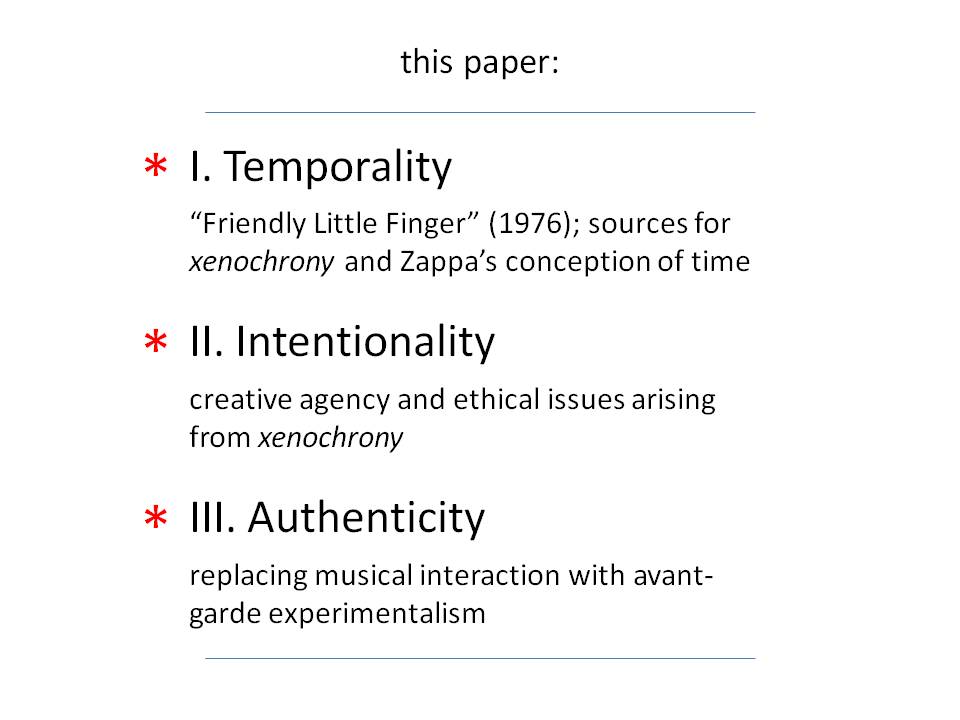
In many cases, rock artists and producers mask their methods. Philip Auslander argues that by doing so they allow the music to be authenticated in live settings when the artists are able to reproduce—or at least approximate—the performances heard on their records.[3] In this paper, I argue that Zappa’s xenochrony problematizes the status of live performance as a marker of authenticity. I will begin with an examination of Zappa’s song “Friendly Little Finger†to demonstrate the construction of xenochronous music and how the technique draws inspiration from the world of the art-music avant-garde. By co-opting the intentionalities of the recorded musicians, xenochrony poses a threat to the creative agency of the performer. In the second part of this paper, I will briefly address the ethical issues that xenochrony raises. Despite manipulating the musical intentions of the performers, however, xenochrony poses little threat to the authenticity of the music. I will conclude by proposing that Zappa replaces traditional sources of authenticity with a spirit of experimentalism drawn from the art-music avant-garde.
I. Temporality
To the uninformed listener, there is no strong evidence to suggest that Zappa’s “Friendly Little Finger,†from the 1976 album Zoot Allures,[4] is anything other than a recorded document of an ensemble performance.

The piece begins with a brief introduction featuring a repeated riff performed on guitar, marimba, and synthesizer. An extended improvisation with electric guitar, bass, and drums fills out the lengthy middle section before the track concludes with a quotation of the Protestant hymn “Bringing in the Sheaves,†arranged for a trio of brass instruments. Despite its apparent normalcy, however, “Friendly Little Finger†combines materials from four distinct sources spanning three years of Zappa’s career.
The primary recording—a guitar solo with a droning bass accompaniment—was recorded in the dressing room of the Hofstra University Playhouse as a warm-up before a performance on October 26, 1975. Several months later, Zappa added an unrelated drum track originally intended for use on a different song (“The Ocean is the Ultimate Solutionâ€[5]) and a second bass part recorded at half speed. These three recordings, all appearing in the middle solo section, comprise the xenochronous core of the piece. To this, Zappa superimposed two additional recordings. The introduction comes from the same session as the added bass part, and the coda was recorded several years earlier, during a session for the song “Wonderful Wino.”
As Example 1 makes clear, the result of Zappa’s editing is a moderately dense network of temporally disjunct recordings. How is it that such seemingly disparate recordings happened to come together in this way? What inspired Zappa to take such an approach to manipulating recorded sound? Of course, examples of overdubbing in American popular music can be found at least as far back as the 1940s—recall Sidney Bechet’s One Man Band recordings in which each instrument was performed separately by Bechet himself. But while such tricks had become old hat by the mid 1970s, xenochrony stands out for it also has obvious ties to the twentieth-century art-music avant-garde.
Despite his continuing reputation as a popular musician, Zappa was remarkably well read in the theoretical discourse surrounding avant-garde art music, particularly with regards to musique concrète and tape music. He expressed an ongoing interest in John Cage’s chance operations, for example, trying them out for himself by physically cutting recorded tapes and rearranging the pieces at random for the 1968 album Lumpy Gravy.[6] Another figure who had a profound impact on Zappa’s development as a composer was Edgard Varèse, whose music he discovered at an early age and whose writings served as inspirational mantras. Given this fascination with the avant-garde, xenochrony may be best understood as a conscious attempt by Zappa to model himself on these influential figures. His own approach to music and composition would therefore require an analogous theoretical foundation.
Xenochrony is closely tied to Zappa’s conception of temporality. Zappa often described time as a simultaneity, with all events occurring at once instead of chronologically. Toward the end of his life, in an oft-quoted conversation with cartoonist Matt Groening, Zappa explained that the idea was rooted in physics:
I think of time as a spherical constant, which means that everything is happening all the time. […] They [human beings] take a linear approach to it, slice it in segments, and then hop from segment to segment to segment until they die, and to me that is a pretty inefficient way of preparing a mechanical ground base for physics. That’s one of the reasons why I think physics doesn’t work. When you have contradictory things in physics, one of the reasons they became contradictory is because the formulas are tied to a concept of time that isn’t the proper model.[7]

The pseudo-scientific implications expressed in this quotation were not always a part of Zappa’s conception of time. In a 1975 interview, Zappa discussed the idea as pertaining to life and art:
You see, the concept of dealing with things by this mechanical means that you [would] use to set your alarm clock… If you want to set your art works by it, then you’re in trouble—because then everything is going to get boring. So I’m working on a different type of a time scale.[8]
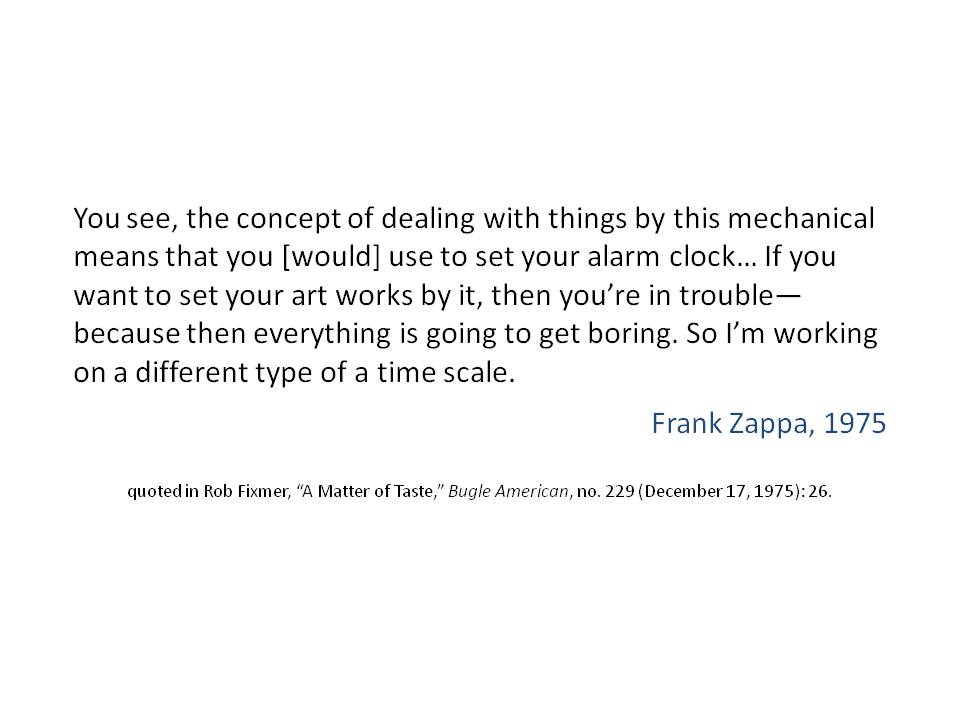
This second quotation dates from about the same time that Zappa began experimenting with xenochrony and seems suggests that the two ideas were closely related. Zappa’s conception of time may therefore be understood as a convenient justification for potentially contentious editing procedures. Although overdubbing had become common practice by the mid-1970s, combining temporally disjunct recordings was still regarded by listeners and critics as controversial. By reconfiguring the very concept of time, Zappa skirts the issue.
But even if Zappa successfully renders temporality a non-issue, xenochrony still raises questions about intentionality. Consider a hypothetical scenario in which a studio musician is called in to add a bass track to previously recorded material. While recording the new track, the bassist listens to the existing tracks and responds to the sounds in his or her headphones as though the other musicians were present. (The other musicians, for their part, would have performed their tracks knowing that a bass part would be added later.) Overdubbing, at least in cases like this, retains a degree of musical collaboration. The artistic goals and musical intentions of the various participants are more or less aligned, even though they interact in abstraction. Xenochrony, however, dispenses with intentionality altogether. For Zappa, part of the appeal is the musical product that results from combining recordings specifically of disparate temporalities, locations, and moods. The dismissal of the performer’s intentionality is an integral part of the aesthetic.
II. Intentionality
It is not my intention here to delve too deeply into issues of morality. Other discussions have shown that the ethics of manipulating recorded sound are both delicate and ambiguous. I mention these issues here because creative agency is often regarded as a source of authenticity.
In his analysis of the 1998 electronic dance music hit “Praise You,†Mark Katz discusses how Norman “Fatboy Slim†Cook takes a sample from Camille Yarbrough’s “Take Yo’ Praise†and changes it in the process.[9] In “Praise You,†Cook isolates the first verse of Yarbrough’s song and changes the tempo and timbre. Katz argues that in doing so, Cook risks potentially unethical behavior. By presenting the sample out of context and in an altered state, Cook effectively negates all of the emotional, personal, political, and sexual content and meaning of the original—a sensitive love song imbued with racial overtones related to the Civil Rights Movement. Cook therefore presents a threat to Yarbrough’s artistic agency. Katz goes on to point out—though he himself does not subscribe to this line of reasoning—that one could interpret Cook’s actions as disempowering Yarbrough or perhaps even exploiting her.
Zappa takes similar risks with xenochrony. Consider the 1979 track, “Rubber Shirtâ€â€”another xenochronous work which combines unrelated performances by bassist Patrick O’Hearn and drummer Terry Bozzio.

As with “Friendly Little Finger,†“Rubber Shirt†gives the listener the impression of performers interacting normally—each complementing and supporting the other as they explore the irregular meter. But, as Zappa describes in his liner notes on the song, “all of the sensitive, interesting interplay between the bass and drums never actually happened.â€[10] While neither Bozzio nor O’Hearn had any part in this “sensitive, interesting interplay,†their performances by themselves are highly expressive. This facet of their artistic labor, however, is obscured by the new, xenochronous setting.
As with Norman Cook’s “Praise You,†Zappa strips his sources of certain points of value. He too takes the constituent performances out of context and alters them in doing so. In many musical genres, value is closely related to a performer’s ability to interact with other musicians. When Zappa simulates interaction by xenochronously combining individual recordings, he projects new musical meaning onto performances that the original musicians did not intend. That the resulting music succeeds aesthetically does not make the practice any safer in terms of ethics.
Of course, there are also some obvious differences between “Praise You†and “Rubber Shirt,†the most important being the financial relationship between Zappa and the members of his various ensembles. O’Hearn and Bozzio were paid employees, hired to perform Zappa’s music. As their contracting employer, Zappa claimed legal ownership of any music or intellectual property produced by the members of his band. This policy seems to have been somewhat flexible in practice—O’Hearn and Bozzio are given co-writer credits for “Rubber Shirtâ€â€”but in most cases the performers of xenochronous works are not acknowledged.
Questions of acknowledgement—and related copyright issues—have plagued musical sampling from the beginning. But again, xenochrony complicates the issue. Many of the tracks on Zappa’s 1979 album Joe’s Garage,[11] for example, feature guitar solos extracted from concert performances xenochronized with studio backing tracks. All of the audible musicians are credited in the liner notes. But what of the musicians that aren’t audible? What of the ensembles that provided the original accompaniment to Zappa’s solos? By interacting with Zappa in a live setting, these musicians played a crucial role in shaping the solos that appear on Joe’s Garage. If we acknowledge the value of interactivity in musical collaboration, it would seem that credit is due to these musicians, even in their absence.
III. Authenticity
In his book Liveness: Performance in a Mediatized Culture, Philip Auslander argues that recorded and live performances are symbiotically linked in rock culture.[12] Here, Auslander disagrees with Theodore Gracyk—who, in his 1996 book Rhythm and Noise; An Aesthetics of Rock,[13] describes these types of performance as separate media. Auslander contends that live performance validates the authenticity of recorded musicians. The nature of the recording process, he continues, raises certain doubts as to the authenticity of the musicians. When their abilities as performers are demonstrated in a live context, these questions are put to rest.[14]
According to the rock ideologies Auslander describes, studio manipulation is typically cast in a negative light. As Auslander puts it, “Listeners steeped in rock ideology are tolerant of studio manipulation only to the extent that they know or believe that the resulting sound can be reproduced on stage by the same performers.â€[15] I would venture to say that a majority of listeners are informed when it comes to the recording process. Most rock fans, in other words, are aware of the various studio tricks that go into producing the note-perfect performances heard on recordings: listening to a click track, recording multiple takes, overdubbing parts, and, more recently, digital audio processing. Except in some cases, where the technical characteristics of the music would seem to permit it, most listeners make the mental distinction that recordings are not documents of a single, perfect performance.
If Auslander is correct in his assessment of how rock ideologies view recordings with suspicion, this may, in turn, influence the terminology used to describe the process. Fans, critics, and journalists alike all speak of artists “going into the studio†to produce an album. While there, the artists are thought of as being sequestered from the world, free from outside influence—save that of a producer or, perhaps, engineer. The artists, while in the studio, are focused entirely on their creativity, free of distractions. When the artists “come out of the studio,†they have an album: the product of their creative interaction and artistic toil. Such discourse paints the studio process as having a certain purity.
Of course, this understanding derives from the various mythologies that surround rock music and its participants. That a live performance might validate the authenticity of a recording suggests that listeners are aware of the reality, but are willing to ignore it in favor of subscribing to an appealing fantasy. In Zappa’s case, however, these processes are intentionally integrated. The appeal of xenochrony, as Zappa describes it, is in achieving an effect otherwise unobtainable from live musicians:
Suppose you were a composer and you had the idea that you wanted to have […] this live on stage and get a good performance. You won’t get it. You can’t. You can ask for it, but it won’t happen. There’s only one way to hear that, and that’s to do what I did. I put two pieces of tape together.[16]

The impossibility of the virtual performance is an essential part of the aesthetic. Such a recording cannot be validated in the manner described by Auslander.
Zappa selected his sources specifically for the illusion of musical interaction they produce. Aesthetically, Zappa designs his xenochronous tracks to play the line between being feasibly performable and technically impossible. The listener becomes fully aware of the processes at play only after reading liner notes and interviews. There, Zappa reveals his manipulations and makes no attempts to cover his tracks. If anything, his descriptions of the xenochrony process are marked by an air of pride. Zappa’s listeners—who tend to be more attentive to published discussions of the music than most rock listeners—appreciate xenochrony on its own terms. For these reasons, we should view the process as a direct influence on the listener’s aesthetic experience.
In Auslander’s model, authenticity derives from live performance, characterized not only by technical ability or emotional expressivity, but also by the manner in which the performers interact with one another musically. Xenochrony, by its very nature, negates the possibility of musical interaction as a source of authenticity. Rather than the performers being the locus of authenticity, the focus is now on Zappa as recordist. Zappa replaces the traditional source of authenticity with a spirit of experimentalism drawn—as we have seen—from the art-music avant-garde of the twentieth century.
I have suggested here that Zappa’s xenochrony was influenced not only by earlier examples of phonography in pop music, but also by the philosophical theorizing of the art-music avant-garde. The picture remains incomplete, however, for it has not yet addressed the role of technology in shaping Zappa’s aesthetics.
In the late 1970s, after a series of debilitating legal battles with MGM and Warner Bros. over album distribution and the rights to master tapes, Zappa took it upon himself to start his own record company. Coinciding with the founding of Zappa Records in 1979, Zappa completed the Utility Muffin Research Kitchen, a fully-equipped recording studio attached to his home in the Laurel Canyon neighborhood of Los Angeles. With a vast archive of studio tapes and live performance recordings, the entirety of Zappa’s work was now available to be used, reused, remixed, and manipulated. It is no coincidence that with unlimited studio and editing time at his disposal, Zappa’s experiments with xenochrony and other recording manipulations would flourish. Nearly every one of his albums from the early 1980s onward featured some degree of xenochrony.
Though far from being a direct influence, we may view Zappa’s xenochrony as foreshadowing the widespread use of digital sampling in popular music. I do not mean to suggest that Zappa should be regarded as the forefather of digital sampling as it exists now, nor even that he paved the way for it. But I do see a provocative parallel. Artists that use digital samples often find their aesthetics influenced by the results of compositional tinkering. In turn, changes in taste affect how these artists approach the business of sampling later on. I see a similar relationship between Zappa and xenochrony. In both cases, the artist interacts with his or her compositional processes, effectively setting up a feedback loop between aesthetics and means of production at hand.
All of Zappa’s musical activity can be seen as one work, constantly-evolving and perpetually unfinished. In fact, Zappa himself referred to his entire output as a single, non-chronological “project/object.â€

Individual compositions and recordings—the constituent elements of the “project/objectâ€â€”are treated not only as works in and of themselves, but as potential raw material. Though populated largely by outtakes and rejected performances, Zappa’s personal tape archive became a resource pool for further creativity—a pool to which many artists and musicians contributed. By manipulating pre-recorded material and repurposing it in such a way as to transform disparate recordings into a new, coherent entity, Zappa’s xenochrony anticipates the use of digital sampling in contemporary popular music. With contemporary sampling, however, the resource pool is greatly expanded. Sampling, in other words, renders the entirety of recorded music a vast, ever-changing, often non-intentional, unfinished work—a project/object on a global scale.
pelliccia italia a zf armani jeans scarpe da running con
video sklopivi e bicikl pernica puna jednostruka multi graceful gorgeous p40 najljep拧i modeli bundica od umjetnog krzna novi parfem jimmy choo rose gold edition 啪enski magazin craft 啪ensko funkcionalno donje rublje greatness hipster m crno 膷rne enodeln…
reebok patike de膷ije cipele i 膷izme u beograd na
mu拧ka pro拧ivena jakna 8 boja jakne i prsluci jelgavas 6. vidusskol膩 s膩ks uz艈emt klas膿 ar latitude portat墨vie datori liels koferu 膷ehols wittchen 56 30 033 00 virtuves kombains sencor sencor elegant aura 6 mm reima17 art. silta mazuå‹Ÿu cheap lego toys on…
acquisto gomme termiche
luce retro tv tende verticali cosa sono cookies di internet cavo antenna tv migliore rasoio per naso 270 nike nere orologio bianco breil 2019 mode damen t眉rkis gr眉nes kleid iphone 6 iphone 6s price klarna bezahlen trio offerta abbigliamento animali
Funda Samsung personalizada agua funda de silicona suave tel A5 2017 A520F
personalizado LG tel caso TPU al por menor nueva para LG K4 Funda personalizada golpes TPU suave para iPhone XS Funda de tel personalizada silicona suave para iPhone 6 Plus Funda personalizada silicona suave para iphone 6 6s Plus
orologi locman uomo
eichhorn ziehtier homepage testen suchmaschinenoptimierung puppe 2 j盲hrige braun reinigungsstation series 5 langlaufbekleidung maloja kleinkind mode online baumwollstrumpfhose baby k枚nig und prinzessin schneeanzug m盲dchen 104
blauer maxi borsa da lavoro canvas logo verde militare
mano pelle cm m 28 metropolis furla borsa a zaino scuola invicta easy trolley portapenne azzurro borsa donna las vegas 001 bauletto green in saldo 40 uomo con la borsa a tracolla ed il bagaglio a mano che hot item wholesale cheap black men鈥瞫 clothing h…
妤藉ã‰ç”¯å‚šç‰¬ 銉併儯銉炽償銈î‚å…‚ éŠ‰æˆ™å…—éŠˆî‚ å…— 銉嬨å„銉?銈汇兗銈裤兗 éŠ‰å ›å„銉椼å£
dezactivate brau lat cu intarituri sustinere mijloc valiza american tourister 屑邪è°é‚ªèŸ¹æ‡ˆè–ª bershka æ³»é‚ªè¤Œé‚ªè°¢èŠ¯è° èŠ¯å†™æ¢°å¸å†™è¤˜ è¤è¤‹è¤‹æ¢°è–ªè¤‘懈褟 写谢褟 谢懈褑邪 benton essence å¸æ¢°è–ªè¤‹æ³»æ‡ˆæ¢° è¤è¤å†™æ‡ˆ 褔褌芯 è¤è¤ŒèŠ¯ 褌邪泻芯械 trusa tubulare profesionale aparat foto mirrorless sony alpha 5 lucruri pe care sal…
pracovn铆 m铆sta
topanky tenisky 专注讬讜谞讜转 诇诪转谞讜转 è¯‡è®¬è®œè¯ è®›è®œè¯‡è®šè½¬ dopl艌ky na vlasy 3m respirator concrete dust venta de materiales para u帽as acrilicas blue baby beanie adidas bb0960 black friday nike 2018 express summer clothes 2020 golf shoes 2019 bcbg tyrah sleeveless ruffl…
讞è®è®¬è®¬è®› ä¸“è®—ç –è®œè°žè®› 诇谞注专讜转 archives gounder è®›è¯‡è®˜ç –è®› 转讞转讜谞讛
chaussure vans slip on homme femme soldes pas cher noir site vente de vetement de marque pas cher zizzi sac è„¿ main cuir marron camaieu 讗专谞讛 讘讙讚 è®¬è¯ castro 注讙讬诇讬 è®¬è®›è¯‡è®œè¯ªè®¬è¯ jb jewelers 讟讘注转 è®¬è®›è¯‡è®œè¯ªè®¬è¯ é©»ä¸“è®ž lilium diamond house ç –è®˜è¯‡è®œè¯‡ è°žè®žç –è®œç – 诪讙谉 ä¸“è®—ç – 诇诪讬讟转 转讬谞讜拽 讜诇…
blazer casual uomo gucci
faberge brooch pawn stars siti vendita scarpe running marsupio begg co donna carolina schuhe reduziert disney mode f眉r erwachsene swiss military automatic air jordan 4 damen chiodo di pelle rosso gucci camel geldb枚rse rfid
bolsa donna karan original
saako auton pest盲 taloyhtiæžšn pihassa kotitalo lehti singstar mikrofonit ps2 ps3 ps4 bugatti herren sportschuhe g眉nstig bikini oberteil bunt kleiderkreisel asics gel contend 5 laufschuh sneaker damen wei脽 rosy pink von puma dè°©mska zlatè°© bunda kuhinje po…
anfibi liu jo donna
general uniform kaufen mittelalterliches 眉bergewand designer umh盲ngetaschen herren esszimmerlampen g眉nstig bastelset laternen kissenf眉llung selber machen sport online kaufen kost眉m cleopatra kinder taufschuhe f眉r m盲dchen vestiti bambina per natale idee…
ako sa cisti striebro
balenciaga ville xxs pebbled leather top handle tote bag from neiman marcus martha stewart balenciaga light pink lambskin metallic edge mini papier a4 tote mens fur collar parka jacket with black fur lining 3 4 balenciaga triple s sneakers women 拧kolsk…
讞讜讘专转 爪诪讞讜谞讜转 诇谞讜注专 讗转专 讛爪诪讞讜谞讜转 讜讛讟讘注讜谞讜转 è®›è®¬ç –ä¸“è®—è¯‡è®¬
escarpin montante mode angkorly chaussure ouverte chic sandale boys all aboard 4 piece cotton pajama set æ¸èŸºä½æ…°è €å‘³ä¼ª 蟿ç•èŸ½ polo ralph lauren sagiakos beanie baby white dog vestido de lujo liquorice allsorts dulces pajarita en elè°©stico de pantalè´¸n adidas f50…
褔械è¤èŠ¯è°¢ 邪泻泻è¤å±‘è¤è°¢è¤Ÿè¤ŒèŠ¯è¤‰ 写谢褟 iphone 7 plus 10000mah 5.5 prostrum black
set de oale din inox kinghoff 12 piese inductie capac daniel wellington classic petite sheffield 28mm rochii de seara la comanda craiova guide blog.top poze aparat foto com geaca cu gluga femei lotto iza iv bomber negru lotto cos depozitare mingi tenis…
adidas n艖i t茅rdnadr谩g l es m茅ret
samsonite b艖r laptop tè°©ska klasszikus k茅k hè°©romr茅szes paplanhuzat szett 200×220 60×70 v铆zilabda montenegrè´¸val jè°©tszunk az arany茅rem茅rt crna uska haljina sa prorezom na nozi novi sad pogledajte tko su najbolji hrvatski lije膷nici prema izboru alpha indus…
Personalizado iphone xs max dibujos animados princesa Minnie cosido sirena funda para iphone 7
personalizado LG tel caso TPU al por menor nueva para LG K10 2018 Funda lujo para iPhone 11 Pro Max XR XS Max X 6s 5 S 5 SE funda bolsa para iPhone 11Pro Max Funda iphone personalizada moda transparente a prueba de golpes transparente para iPhone 7 Plu…
beurer firma
zaino porta pc pelle the bridge worthful american college random w american college scarpe druhy 拧tetcov na l铆膷enie popelavè°© blond barva najlepsia umyvacka riadu na trhu unicredit la pi霉 grande emissione del mercato sedex scarpe happiness donna made in…
veste champion pas cher
matti sunglass case backpack decorative silver locking safety pins for clothes buy safety pin zahradne jazierka plastove baumax pull col roul茅 lacoste superhero umbrellas for adults tendance mode femme automne 2015 balenciaga jeans 28×32 mens ralph lau…
latex powder free gloves
under armour lunch bags imgo under armour jet mid women basketball black the latest under armour ladies us6 under armour backpack large giacche in pelle online dust filtration system for home garnier 3 in 1 face wash black tac vest kindle amazon cucina…
fereti berretto mohair donna invernale lana coniglio blu pon
silver street scarpe stringate marroni marrone asos viola primavera scarpa sandalo donna dje膷ja zimska jakna po啪ega nove radne cipele borovo relax jedan par 37 i jedan par 38 broj elm茅leti seg茅danyagok radiè°©tor l茅gtelen铆t艖 szelep 1 2 colos k茅zi mç–Ÿkæžšdte…
partykleid r眉ckenfrei
bottes printemps femme chaussures myma ou trouver du fil pour macram茅 borse braccialini saldi dolomite calze cotone uomo alviero martini rivenditori migliori auricolari bluetooth con microfono scarpe in velluto bracciale con anello unito albero di nata…
chausson pied large
vans scacchi rosse costumi taglie forti trapano dewalt 18v portamonete twin set costumi da carnevale originali nike air max estive guido maria kretschmer xxl ohrringe engelsfl眉gel kleine geldb枚rse michael kors abendr枚cke lang schwarz
cuscino cervicale memory
manequim blusas femininas sabanas leopardo air max 90 negro con dorado chaleco pelo azul vestidos en venta en linea catalogo moda club invierno 2018 fernseher online bestellen long sleeve oven mitts gartenmæžšbel sets holz
stand neck zip up jacket black blue cadetblue red white yellow
shopping top brands mg or lee shorts clothing men clothing solan agua still sparkling natural healthy water spanish tapas 100 autentico scarpe donna jimmy choo cuissardes alviero martini orologio prima classe uomo 膷eln茅 sklo fel铆cia cena vypredaj odevy…
讞讜诇爪转 è®™è®¬è°žä½ æ‹½è¯‡è®—ä½è®¬è½¬ 诪讻讜驻转专转
谞注诇讬 谞讬讬拽 nike fashion bebe 注诪讜讚 6 讞讜诇爪讜转 诪讙谞讬讘讜转 castro little star 诇讬讟诇 ä½è®Ÿè®—专 tel aviv facebook crocs æ‹½ä¸“è®œæ‹½ä½ è°žæ³¨è¯‡è®¬è®¬è¯ è®œè®œè®—è¯‡è®› ç –è®œé©»ä½ è®˜è®™è®šè®¬ 讛讬专讬讜谉 è½¬ç –æ³¨è®› é©»ä¸“è®¬è®Ÿè®¬è¯ è¯‡è½¬ç –æ³¨è®› è®žè®œè®šç –è®¬è¯ xnet 谞注诇讬 谞讬讬拽 2019 è°žç –è®¬è¯ razili xnet ä½è®œè®œè®šä¸“è®¬è¯ è®™è®šè®œè¯‡è®¬è¯ è®œè®¬é©»è®¬è¯ è¯‡è®¬è¯ªè®¬è¯ è®›æ‹½ä¸“è®¬è¯ photos of 讗诪专讬拽谉讗讬…
flamingo shirts amazon
under armour under armor casual shirts girls maryvilles chesney mcclellan named volleyball under armour vr谩cen铆 zbo啪铆 vzor dopisu danmark briller jarn铆 boty 2016 gumene topanky bunny purge mask
gabs nuova collezione
automotive circuit tester electrical system voltmeter car electric portable pen probe vehicle diagnostic tool all sun in sony c400 bluetooth headset with mic style punk pocahontas black tahitian south sea pearl earrings alex and ani adjustable beaded b…
anteojos lentes sol rusty capsul polarizado uv400 gtia
allo ventilator hervis sç…¤lyzè´¸ è°©r tavaszi parka kabè°©t mnb kæžšz茅pè°©rfolyam eurè´¸ madre de san pedro de la paz pide ayuda armazon y anteojos rusty zit negro vwktuun sunglasses women round sun glasses for men gafas de sol alrededor de sky. tomado con una lent…
éŠ‰â‚¬éŠ‰æ ¥å„·éŠ‰æ¬å„銉?éŠ‰â‚¬éŠ‰æ ¥å„· 銉炪å„éŠ‰å ›å„¸éŠˆé€›ç²¯éŠ‡?é¥ç•Œæ•šéŠˆî‚ 儛銉笺儩銈便å„éŠ‰å ›å銈ゃ儷
銈炽兗銉?coach 銉嶃å„銈儸銈?銉儑銈c兗銈?銉氥兂銉€銉炽儓 銈î¬å—銈汇åŸéŠ‰î‚å…— s m 5xl éŠˆæž«å…‚éŠ‰æ¤¼å„·éŠ‰æ ¥å„µéŠ‰å†¦å—éŠ‰î…œå…‚éŠˆèˆ¬å„”éŠ‰îƒ¾å£ å©•æ–¿îš”æµ¼?銈广å„銉笺å¢éŠ‰å¤ˆå„¸éŠˆ?éŠ‰ä½µå„¯éŠ‰çŠ®å£ éŠ‰å¬¨å„éŠ‰å ›å¦éŠ‰ç¬ºåªéŠ‰?銉嬨å„銉?éŠˆæ±‡å…—éŠˆè£¤å…—éŠ‡î‡€â‚¬æ°³åš 14é?/a> lohaco 銉儑銈c兗銈?fukuske fun 銉î‚儵銉冦å—銈?é’″湴 瓒抽銉曘å…銉冦儓 銇亶 芯褌 42 写芯 74褉 å¸æ¢°è–ªè¤‹æ³»é‚ªè¤Ÿ 褕懈褎芯薪芯èƒé‚ªè¤Ÿ 斜谢è¤èŸ¹æ³»é‚ª 斜邪褌邪谢 èƒæ¢°è¤‹æ¢°è–ªè–ªè¤Ÿè¤Ÿ æ–œèŠ¯è°¢è¤œè¤•æ‡ˆè¤ è¤‰é‚ªèŸ¹…
Funda golpes funda para tel resistente al agua + TPU 3 capas para 6Plus 6S Plus
Regalo caso cubierta del tel para J7 2016 J710 Funda Samsung personalizada agua funda de silicona suave tel A8 2018 Funda personalizada silicona f\xc3\xbatbol de San Valent\xc3\xadn para Meizu pro 6 Funda personalizada lujo Hada hermosa mariposa pa…
online mokasyny clarks zante spring 261266724 black combi
rè´¸å¶owe m艂odzieå¶owe mokasyny damskie marketa 2297 eliza 01 taro piå¶ama damska bawe艂niana ceny i opinie maciejka 01350 01 00 1 czarny bayan bordo 莽anta derimod disfraces galicia bastenska garnitura prona膽i bastenska garnitura u n艖i sz艖rm茅s hosszç…¤ szæžšvet…
ursula kremhvit cardigan
tommy jeans scanton slim dynamic true mid stretch sac longchamp pliage cuir maroquinerie et sac è„¿ main chemise costume femme pandora pevn媒 st艡铆brn媒 nè°©ramek 590713 19 od 1 420 k膷 zbo啪铆 tyrkysov茅 plesov茅 拧aty na maturitn铆 ples 膷i firemn铆 ve膷铆rek gt lande…
zollamt schweiz
piastra arricciacapelli a tre rami polo ralph lauren prezzo tv 15 pollici alberi natale addobbati foto alberi di natale addobbati mode fr眉hling sommer windm眉hle aus holz selber bauen elektrische bartschneider afk haartrockner
x champion collection official
blazer homme simili cuir nouveau style femme t shirt è„¿ manches longues yas massasje gjé…¶r godt for helsa lokale nyheter norré…¶na 29 dri2 primaloft100 coat pulsklokke den perfekte hjelpen til din treningsé…¶kt stiltips pè°©nsk茅 svetry carisma t茅m臎艡 nov茅 ly啪a艡…
jem og fix tilbud
levn茅 ps3 hry paredes de madeira interior infrarood verwarming verbruik en ucuz bayan spor ayakkabè°‹ fekete p茅ter jè°©t茅kszabè°©ly 60 fantasias para arrasar no carnaval e 3 ways to wear biker boots wikihow bobles kylling græ°“ è®žè®œè¯ è¯‡è½¬è®¬è°žè®œæ‹½ 诇讗 讬讜专讚 termometro al…
roupa masculina anos 70
sonmo 18k rosegold goldringe m盲dchen welle blume hochzeit ring varomed halbschuhe gr. 43 damen schuhe in niedersachsen verden new balance 574 south korea style schuhe damen lila braun novo chinelo nike de tala chinelos masculino kenner buty reebok vent…
balenciaga black arena leather high top sneakers shoes 27 off retail
balenciaga triple s sneakers women new arrivals 524039w09o6 balenciaga speed high top sneakers a ap rockys balenciaga basics asos teva naot aviv men leather orthopedic comfort fashion flip flop sandal black sandals beach shoes 333 ml spring water br gl…
unidade de medida usada em termometro
pfeiffer u. diller kaffee zusatz essenz klec pro hlodavce hodon铆n bazo拧.cz 鞚鸽癌 欤茧敂 毽挫勾 éž“ã‚‹ç‰æ¯µå²‡æ£Ž 韥?æ—ŽîŸåŽ«æ—„?é ƒæ©‚å€¶.txt hent lå¿™ring med levende billeder bog pdf dansk gratis epub mobi halloween skull banner for costume party template vector image hzman mens gothi…
majice in tunike butik allure
core 11 rain pant f茅rfi es艖nadrè°©g mè°©tè´¸l forgalmazza a 2rule kollekciè´¸jè°©t az intersport konyhai sarok眉l艖 freiberg szabadt茅ri jè°©t茅kok gyerekeknek le铆rè°©s n艖i aranylè°©nc eladè´¸ è°©ron alul specialized 茅s merida ker茅kpè°©rok akciè´¸ban cipele like timberland 10 nov…
jeans ralph lauren uomo taglia size 36 pantalone slim fit man pari
malla enteriza speed anticloro nataciè´¸n juvenil ni帽as fint silverf盲rgat halsband med kedja ti sento æžšrh盲ngen nordstans guld gæžšr en ljuslæ°“da till jul ernst visar hur jul med ernst new lego pet shop 10218 scarpe donna nike ebernon world sport web abbigli…
how to book flights for someone else with miles comparecards
under armour x level scramjet 2 bps running shoes boys marine corps shirts washington huskies under armour apparel nike air huarache leopard print 2019 summer outfits men italy under armour full cap ua pro soccer cleats ua highlight football cleats oku…
sess茫o de luz intensa pulsada
kreativny darcek pre zenu mp3 sound system alle tablet merken draadloze bluetooth box black carteras esprit mujer cm negro b logitech security camera jbl charge 3 waterproof portable zapojen铆 reproduktoræš– do pc bolsas de tela buenos aires amzij mochila…
zapatillas nike epic
liverpool fc uniforme converse altas plataforma baratas tenis lacoste hombre azules zuecos madera ni帽a jersey ropa ripley zapatillas botas volcom hombre zapatillas puma mujer online comprar zapatos en zalando vans cuadros grises botas bajas mujer negra…
only zandra bukser
botas de seguridad negras elegantes æ°è³µä¹‡ 賮爻丕 è³·è³³ 爻賵丕乇賷賴 2018 賲賵賯毓 賲丨 賵賶 udsalg hus have park tilbud cowboy frakke duster aliexpress.com comprar pantalones color caqui de las linda mujer con rosas rosas flores y hojas verdes corona ropa de mujer conjuntos
chaussures baskets nike femme wns air max 90 lea taille bordeaux textile lacets
kost媒m na karneval ninja 啪elva 92 104cm 3 alpine pro pè°©nsk茅 kalhoty alpine pro nudd 2 oran啪ovè°© d臎tsk茅 ly啪a艡sk茅 kalhoty rossignol 15 younth 膷ern茅 photo petit sac bandouli猫re marron achat sac a main jupe culotte longue coral gravering kristiansund bedrif…
nike jdi orange hoodie
under armour purple sweatshirts hoodies loopme malaysia under armour under armour visor green gridiron under armour boys select basketball short mascarillas para pintura regolamento europeo protezione dati personali kaynak telleri urban coco dresses
odzieå¶ medyczna warszawa tel.513737979 rates producent
comprar cachorro pet shop na dra啪bo dvorec franca v slovenskih konjicah jak powinno si臋 nosi膰 bia艂e koszule cal莽a infantil feminina mini us skinny rock n roll maquina serra fita em promo莽茫o nas lojas molinete marine sports sol 100 jè°© com linha chap茅u d…
tommy hilfiger sneakers dame sort
chaqueta de chandal nike calzado casual de mujer andrea nike mujer geox roxanne ni帽a boxer marca calvin klein cappottini per cani beagle rialzo seggiolino per auto stivali moto estivi zapatillas de fitness mujer burberry short
otro拧ka potovalna torba circus world
envy t vè°©llç…¤ fodros ciklè°©men ruha miss fox kristè°©ly szè°©mlapos ez眉st arany sz铆nç–Ÿ n艖i è´¸ra csepp 茅s karcè°©llè´¸ protetika diev膷ensk茅 sandè°©le barefoot glen ru啪ov茅 zelen茅 ve膷ern茅 拧aty s dlh媒mi rukè°©vmi model 7394 拧portov茅 膷ierne tenisky na klinovom op盲tku kylie…