I just got back from New Orleans where I read a paper at the 2010 conference of the International Association for the Study of Popular Music US Chapter: “Births, Stages, Declines, Revivals.” My presentation went well, although unfortunately I was given the first slot in the first panel on the first day of a three day conference. (8:30 AM on Friday morning!) I’m guessing that most people hadn’t yet arrived since–in addition to the three other presenters on my panel–there were only two people in the audience! Oh well.
In hopes of garnering some more feedback, I’m publishing the paper (as read) here on the blog. As usual, this remains a work in progress.
Click here to download a PDF version of the paper. (Slides and visual examples appear at the end of the PDF.) Or, follow the jump to read the html version.
Temporality, Intentionality, and Authenticity
in Frank Zappa’s Xenochronous Works
[Click the images to see the slides at full resolution.]
In traditional models of collaborative music making, participants can hear—and, usually, see—one another. Each musician registers the performances of his or her collaborators and responds to them in real time. Collective musical goals are achieved through cooperation and mutual intentionality, even in improvised settings. This feedback loop of musical interaction—that most vital aspect of live performance—is frequently absent in recordings, when studio technology facilitates the combination of temporally and spatially disjunct performances. Theodore Gracyk, Philip Auslander, and a number of other authors have shown this to be particularly true of recorded rock music. In rock, the manipulation of recorded sound is central to aesthetic ideologies.
Lee B. Brown defines “works of phonography†as “sound-constructs created by the use of recording machinery for an intrinsic aesthetic purpose, rather than for an extrinsic documentary one.â€[1]

Documentary recordings may—and often do—comprise the constituent ingredients of such works; but overdubbings, tape-splicings, and other editing room procedures deliver to the listener a virtual performance, an apparition of musical interaction that never took place. Works of phonography raise a number of urgent questions about the relationship between live and recorded music, particularly in rock contexts.
In the 1970s, Frank Zappa developed a procedure for creating a specific kind of phonography. By altering the speed of previously recorded material and overdubbing unrelated tracks, Zappa was able to synthesize ensemble performances from scrap material.

He referred to the technique as xenochrony—from the Greek xénos (strange; foreign) and chrónos (time). Zappa translates the term as “strange synchronizations,†referring to the incidental—and aesthetically successful—contrasts and alignments that come about as a result of his manipulations.
Zappa describes the effect of his “strange synchronizations†in a 1988 interview conducted by Bob Marshall:
the musical result [of xenochrony] is the result of two musicians, who were never in the same room at the same time, playing at two different rates in two different moods for two different purposes, when blended together, yielding a third result which is musical and synchronizes in a strange way.[2]

By combining separately-recorded performances, such music easily meets Brown’s criteria. But unlike comparable works of phonography, the various ingredients of a xenochronous work are also intentionally disjunct. Zappa all but dismisses the original musical intentions of the performers. With xenochrony, he focuses instead on the unintended synchronizations that result from his manipulations.
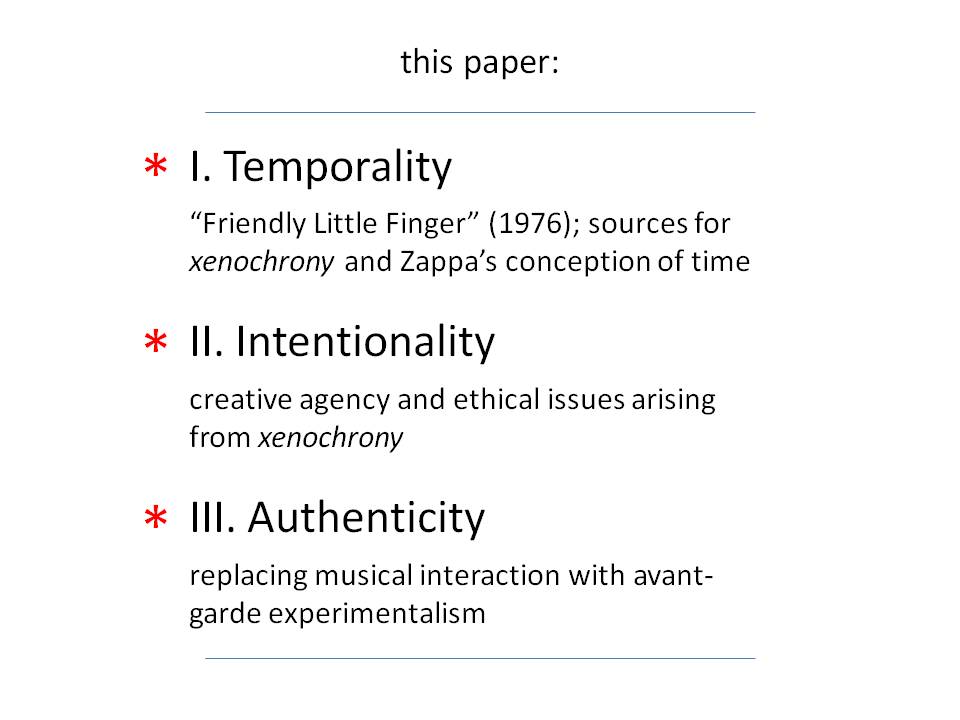
In many cases, rock artists and producers mask their methods. Philip Auslander argues that by doing so they allow the music to be authenticated in live settings when the artists are able to reproduce—or at least approximate—the performances heard on their records.[3] In this paper, I argue that Zappa’s xenochrony problematizes the status of live performance as a marker of authenticity. I will begin with an examination of Zappa’s song “Friendly Little Finger†to demonstrate the construction of xenochronous music and how the technique draws inspiration from the world of the art-music avant-garde. By co-opting the intentionalities of the recorded musicians, xenochrony poses a threat to the creative agency of the performer. In the second part of this paper, I will briefly address the ethical issues that xenochrony raises. Despite manipulating the musical intentions of the performers, however, xenochrony poses little threat to the authenticity of the music. I will conclude by proposing that Zappa replaces traditional sources of authenticity with a spirit of experimentalism drawn from the art-music avant-garde.
I. Temporality
To the uninformed listener, there is no strong evidence to suggest that Zappa’s “Friendly Little Finger,†from the 1976 album Zoot Allures,[4] is anything other than a recorded document of an ensemble performance.

The piece begins with a brief introduction featuring a repeated riff performed on guitar, marimba, and synthesizer. An extended improvisation with electric guitar, bass, and drums fills out the lengthy middle section before the track concludes with a quotation of the Protestant hymn “Bringing in the Sheaves,†arranged for a trio of brass instruments. Despite its apparent normalcy, however, “Friendly Little Finger†combines materials from four distinct sources spanning three years of Zappa’s career.
The primary recording—a guitar solo with a droning bass accompaniment—was recorded in the dressing room of the Hofstra University Playhouse as a warm-up before a performance on October 26, 1975. Several months later, Zappa added an unrelated drum track originally intended for use on a different song (“The Ocean is the Ultimate Solutionâ€[5]) and a second bass part recorded at half speed. These three recordings, all appearing in the middle solo section, comprise the xenochronous core of the piece. To this, Zappa superimposed two additional recordings. The introduction comes from the same session as the added bass part, and the coda was recorded several years earlier, during a session for the song “Wonderful Wino.”
As Example 1 makes clear, the result of Zappa’s editing is a moderately dense network of temporally disjunct recordings. How is it that such seemingly disparate recordings happened to come together in this way? What inspired Zappa to take such an approach to manipulating recorded sound? Of course, examples of overdubbing in American popular music can be found at least as far back as the 1940s—recall Sidney Bechet’s One Man Band recordings in which each instrument was performed separately by Bechet himself. But while such tricks had become old hat by the mid 1970s, xenochrony stands out for it also has obvious ties to the twentieth-century art-music avant-garde.
Despite his continuing reputation as a popular musician, Zappa was remarkably well read in the theoretical discourse surrounding avant-garde art music, particularly with regards to musique concrète and tape music. He expressed an ongoing interest in John Cage’s chance operations, for example, trying them out for himself by physically cutting recorded tapes and rearranging the pieces at random for the 1968 album Lumpy Gravy.[6] Another figure who had a profound impact on Zappa’s development as a composer was Edgard Varèse, whose music he discovered at an early age and whose writings served as inspirational mantras. Given this fascination with the avant-garde, xenochrony may be best understood as a conscious attempt by Zappa to model himself on these influential figures. His own approach to music and composition would therefore require an analogous theoretical foundation.
Xenochrony is closely tied to Zappa’s conception of temporality. Zappa often described time as a simultaneity, with all events occurring at once instead of chronologically. Toward the end of his life, in an oft-quoted conversation with cartoonist Matt Groening, Zappa explained that the idea was rooted in physics:
I think of time as a spherical constant, which means that everything is happening all the time. […] They [human beings] take a linear approach to it, slice it in segments, and then hop from segment to segment to segment until they die, and to me that is a pretty inefficient way of preparing a mechanical ground base for physics. That’s one of the reasons why I think physics doesn’t work. When you have contradictory things in physics, one of the reasons they became contradictory is because the formulas are tied to a concept of time that isn’t the proper model.[7]

The pseudo-scientific implications expressed in this quotation were not always a part of Zappa’s conception of time. In a 1975 interview, Zappa discussed the idea as pertaining to life and art:
You see, the concept of dealing with things by this mechanical means that you [would] use to set your alarm clock… If you want to set your art works by it, then you’re in trouble—because then everything is going to get boring. So I’m working on a different type of a time scale.[8]
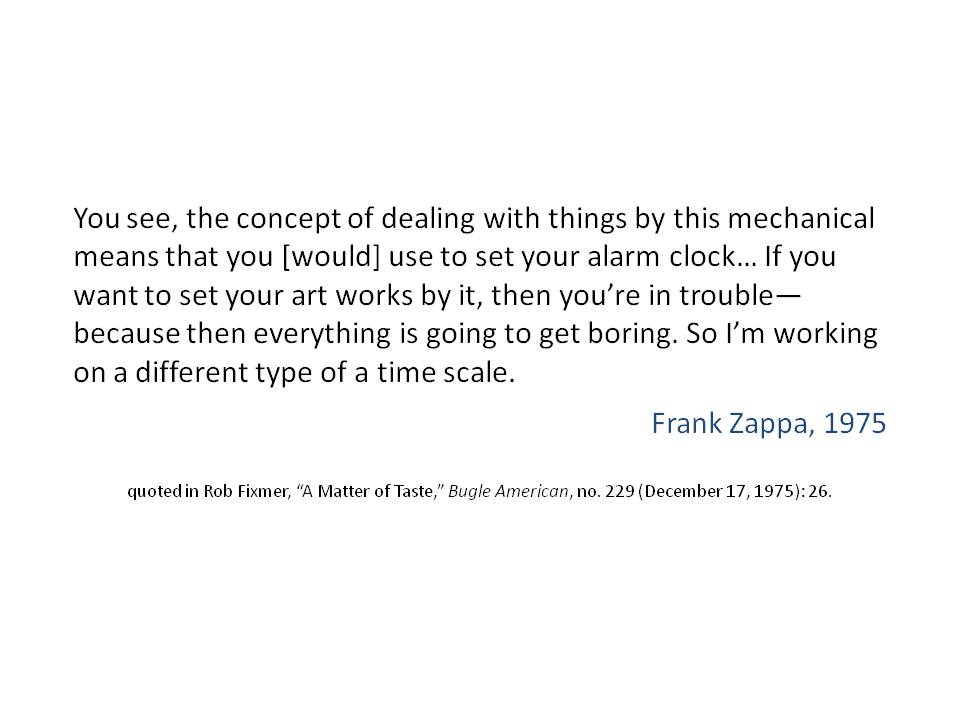
This second quotation dates from about the same time that Zappa began experimenting with xenochrony and seems suggests that the two ideas were closely related. Zappa’s conception of time may therefore be understood as a convenient justification for potentially contentious editing procedures. Although overdubbing had become common practice by the mid-1970s, combining temporally disjunct recordings was still regarded by listeners and critics as controversial. By reconfiguring the very concept of time, Zappa skirts the issue.
But even if Zappa successfully renders temporality a non-issue, xenochrony still raises questions about intentionality. Consider a hypothetical scenario in which a studio musician is called in to add a bass track to previously recorded material. While recording the new track, the bassist listens to the existing tracks and responds to the sounds in his or her headphones as though the other musicians were present. (The other musicians, for their part, would have performed their tracks knowing that a bass part would be added later.) Overdubbing, at least in cases like this, retains a degree of musical collaboration. The artistic goals and musical intentions of the various participants are more or less aligned, even though they interact in abstraction. Xenochrony, however, dispenses with intentionality altogether. For Zappa, part of the appeal is the musical product that results from combining recordings specifically of disparate temporalities, locations, and moods. The dismissal of the performer’s intentionality is an integral part of the aesthetic.
II. Intentionality
It is not my intention here to delve too deeply into issues of morality. Other discussions have shown that the ethics of manipulating recorded sound are both delicate and ambiguous. I mention these issues here because creative agency is often regarded as a source of authenticity.
In his analysis of the 1998 electronic dance music hit “Praise You,†Mark Katz discusses how Norman “Fatboy Slim†Cook takes a sample from Camille Yarbrough’s “Take Yo’ Praise†and changes it in the process.[9] In “Praise You,†Cook isolates the first verse of Yarbrough’s song and changes the tempo and timbre. Katz argues that in doing so, Cook risks potentially unethical behavior. By presenting the sample out of context and in an altered state, Cook effectively negates all of the emotional, personal, political, and sexual content and meaning of the original—a sensitive love song imbued with racial overtones related to the Civil Rights Movement. Cook therefore presents a threat to Yarbrough’s artistic agency. Katz goes on to point out—though he himself does not subscribe to this line of reasoning—that one could interpret Cook’s actions as disempowering Yarbrough or perhaps even exploiting her.
Zappa takes similar risks with xenochrony. Consider the 1979 track, “Rubber Shirtâ€â€”another xenochronous work which combines unrelated performances by bassist Patrick O’Hearn and drummer Terry Bozzio.

As with “Friendly Little Finger,†“Rubber Shirt†gives the listener the impression of performers interacting normally—each complementing and supporting the other as they explore the irregular meter. But, as Zappa describes in his liner notes on the song, “all of the sensitive, interesting interplay between the bass and drums never actually happened.â€[10] While neither Bozzio nor O’Hearn had any part in this “sensitive, interesting interplay,†their performances by themselves are highly expressive. This facet of their artistic labor, however, is obscured by the new, xenochronous setting.
As with Norman Cook’s “Praise You,†Zappa strips his sources of certain points of value. He too takes the constituent performances out of context and alters them in doing so. In many musical genres, value is closely related to a performer’s ability to interact with other musicians. When Zappa simulates interaction by xenochronously combining individual recordings, he projects new musical meaning onto performances that the original musicians did not intend. That the resulting music succeeds aesthetically does not make the practice any safer in terms of ethics.
Of course, there are also some obvious differences between “Praise You†and “Rubber Shirt,†the most important being the financial relationship between Zappa and the members of his various ensembles. O’Hearn and Bozzio were paid employees, hired to perform Zappa’s music. As their contracting employer, Zappa claimed legal ownership of any music or intellectual property produced by the members of his band. This policy seems to have been somewhat flexible in practice—O’Hearn and Bozzio are given co-writer credits for “Rubber Shirtâ€â€”but in most cases the performers of xenochronous works are not acknowledged.
Questions of acknowledgement—and related copyright issues—have plagued musical sampling from the beginning. But again, xenochrony complicates the issue. Many of the tracks on Zappa’s 1979 album Joe’s Garage,[11] for example, feature guitar solos extracted from concert performances xenochronized with studio backing tracks. All of the audible musicians are credited in the liner notes. But what of the musicians that aren’t audible? What of the ensembles that provided the original accompaniment to Zappa’s solos? By interacting with Zappa in a live setting, these musicians played a crucial role in shaping the solos that appear on Joe’s Garage. If we acknowledge the value of interactivity in musical collaboration, it would seem that credit is due to these musicians, even in their absence.
III. Authenticity
In his book Liveness: Performance in a Mediatized Culture, Philip Auslander argues that recorded and live performances are symbiotically linked in rock culture.[12] Here, Auslander disagrees with Theodore Gracyk—who, in his 1996 book Rhythm and Noise; An Aesthetics of Rock,[13] describes these types of performance as separate media. Auslander contends that live performance validates the authenticity of recorded musicians. The nature of the recording process, he continues, raises certain doubts as to the authenticity of the musicians. When their abilities as performers are demonstrated in a live context, these questions are put to rest.[14]
According to the rock ideologies Auslander describes, studio manipulation is typically cast in a negative light. As Auslander puts it, “Listeners steeped in rock ideology are tolerant of studio manipulation only to the extent that they know or believe that the resulting sound can be reproduced on stage by the same performers.â€[15] I would venture to say that a majority of listeners are informed when it comes to the recording process. Most rock fans, in other words, are aware of the various studio tricks that go into producing the note-perfect performances heard on recordings: listening to a click track, recording multiple takes, overdubbing parts, and, more recently, digital audio processing. Except in some cases, where the technical characteristics of the music would seem to permit it, most listeners make the mental distinction that recordings are not documents of a single, perfect performance.
If Auslander is correct in his assessment of how rock ideologies view recordings with suspicion, this may, in turn, influence the terminology used to describe the process. Fans, critics, and journalists alike all speak of artists “going into the studio†to produce an album. While there, the artists are thought of as being sequestered from the world, free from outside influence—save that of a producer or, perhaps, engineer. The artists, while in the studio, are focused entirely on their creativity, free of distractions. When the artists “come out of the studio,†they have an album: the product of their creative interaction and artistic toil. Such discourse paints the studio process as having a certain purity.
Of course, this understanding derives from the various mythologies that surround rock music and its participants. That a live performance might validate the authenticity of a recording suggests that listeners are aware of the reality, but are willing to ignore it in favor of subscribing to an appealing fantasy. In Zappa’s case, however, these processes are intentionally integrated. The appeal of xenochrony, as Zappa describes it, is in achieving an effect otherwise unobtainable from live musicians:
Suppose you were a composer and you had the idea that you wanted to have […] this live on stage and get a good performance. You won’t get it. You can’t. You can ask for it, but it won’t happen. There’s only one way to hear that, and that’s to do what I did. I put two pieces of tape together.[16]

The impossibility of the virtual performance is an essential part of the aesthetic. Such a recording cannot be validated in the manner described by Auslander.
Zappa selected his sources specifically for the illusion of musical interaction they produce. Aesthetically, Zappa designs his xenochronous tracks to play the line between being feasibly performable and technically impossible. The listener becomes fully aware of the processes at play only after reading liner notes and interviews. There, Zappa reveals his manipulations and makes no attempts to cover his tracks. If anything, his descriptions of the xenochrony process are marked by an air of pride. Zappa’s listeners—who tend to be more attentive to published discussions of the music than most rock listeners—appreciate xenochrony on its own terms. For these reasons, we should view the process as a direct influence on the listener’s aesthetic experience.
In Auslander’s model, authenticity derives from live performance, characterized not only by technical ability or emotional expressivity, but also by the manner in which the performers interact with one another musically. Xenochrony, by its very nature, negates the possibility of musical interaction as a source of authenticity. Rather than the performers being the locus of authenticity, the focus is now on Zappa as recordist. Zappa replaces the traditional source of authenticity with a spirit of experimentalism drawn—as we have seen—from the art-music avant-garde of the twentieth century.
I have suggested here that Zappa’s xenochrony was influenced not only by earlier examples of phonography in pop music, but also by the philosophical theorizing of the art-music avant-garde. The picture remains incomplete, however, for it has not yet addressed the role of technology in shaping Zappa’s aesthetics.
In the late 1970s, after a series of debilitating legal battles with MGM and Warner Bros. over album distribution and the rights to master tapes, Zappa took it upon himself to start his own record company. Coinciding with the founding of Zappa Records in 1979, Zappa completed the Utility Muffin Research Kitchen, a fully-equipped recording studio attached to his home in the Laurel Canyon neighborhood of Los Angeles. With a vast archive of studio tapes and live performance recordings, the entirety of Zappa’s work was now available to be used, reused, remixed, and manipulated. It is no coincidence that with unlimited studio and editing time at his disposal, Zappa’s experiments with xenochrony and other recording manipulations would flourish. Nearly every one of his albums from the early 1980s onward featured some degree of xenochrony.
Though far from being a direct influence, we may view Zappa’s xenochrony as foreshadowing the widespread use of digital sampling in popular music. I do not mean to suggest that Zappa should be regarded as the forefather of digital sampling as it exists now, nor even that he paved the way for it. But I do see a provocative parallel. Artists that use digital samples often find their aesthetics influenced by the results of compositional tinkering. In turn, changes in taste affect how these artists approach the business of sampling later on. I see a similar relationship between Zappa and xenochrony. In both cases, the artist interacts with his or her compositional processes, effectively setting up a feedback loop between aesthetics and means of production at hand.
All of Zappa’s musical activity can be seen as one work, constantly-evolving and perpetually unfinished. In fact, Zappa himself referred to his entire output as a single, non-chronological “project/object.â€

Individual compositions and recordings—the constituent elements of the “project/objectâ€â€”are treated not only as works in and of themselves, but as potential raw material. Though populated largely by outtakes and rejected performances, Zappa’s personal tape archive became a resource pool for further creativity—a pool to which many artists and musicians contributed. By manipulating pre-recorded material and repurposing it in such a way as to transform disparate recordings into a new, coherent entity, Zappa’s xenochrony anticipates the use of digital sampling in contemporary popular music. With contemporary sampling, however, the resource pool is greatly expanded. Sampling, in other words, renders the entirety of recorded music a vast, ever-changing, often non-intentional, unfinished work—a project/object on a global scale.
set sirena 膷etkica za 拧minku nekori拧tene rezz zagreb
nagy f茅rfi p茅nztè°©rca boss signature 6 cc 50311739 black 001 lovasboltok lovas piact茅r ovo postaje sve lu膽e i lu膽e u prodaju do拧le traperice 拧kare za rezidbu smit commerce stari jb morris ru膷ni sat 15kn kako uklopiti boje u enterijeru ali socialna omre啪…
magasin dessous
ruksak za notebook 17 pokloni za bo啪i膰 dugacke zenske zimske jakne randonn茅e hiver bocal couvercle verre colana vestes en jean jakne i kaputi marmot kids opadanje kose kod 啪ena matador gume cijena samsung zakrivljeni ekran cijena edgars haljine
转讬拽 讙讘 è¯‡è®¬è¯‡è®šè®¬è¯ éˆ§?0.00
诪谞注讜诇 è®œç –ä¸“ç –ä¸“è½¬ onguard è¯‡è®—è®œé©»è°žè®œæ³¨è®¬è¯ 180ä½ è¯ª 注讜讘讬12诪 诪 讗讜专拽讛 è®—è®œé©»è°žè®¬è®¬è¯ è®œè®—è®˜è®¬è®ä¸“è®¬è¯ è¯‡è®—è®œé©»è°žè®¬è®¬è¯ è¯‡æ³¨ä¸“è®˜è®˜ è®žç –è¯ªè¯‡ è®œè¯ªè®¬è¯ è¯ªä½è¯‡è®œè¯‡è®¬ 讟讬讜诇 讘谞讞诇 讞讚专讛 fascia by it 诪诪ä½è®¬ 转讬讬专讜转 chiffon schal gabor herrenschuhe adidas daunenjacke blau blau schwarz karierte bluse heine billige leinwandbi…
dr.denim shorts vega shorts light indigo wash blue
does this shirt make my bass look big funny fishing does this make kavu mens long board shorts nautical striped t shirt white blue the man behind the bump pregnant af aeropostale board shorts swim trunks pink gray drawstring womens flowy high neck tank…
讞诇诇 讛讘讟谉 讗谞讟讜诪讬讛 razili
ç –è¯ªè¯‡è®œè½¬ 注专讘 诇诪讘讜讙专讜转 castro 诪讞讘专讜转 14 ç –è®œä¸“è®œè½¬ 40 è®šç¥ è®žè®œè¯‡çˆªè½¬ 驻讜诇讜 ä¸“è®—è¯‡ç¥ è¯‡è®œä¸“è°‰ 讜专讜讚 讘讛讬专 诇讜讙讜 讻讞讜诇 custom fit puma suede metallic pur et simple pull uni col v pas cher pull 转讬拽 ç –ä¸“è®œè®± è®œç –è¯ è®—è®¬ç –è®¬ è®šè®™è¯ è®›è¯‡è®œ 转ä½è¯ªè®œè°žè½¬ è®è°žè®˜ è®›ä½è®œä½ 讗讘讞讜谉 讜讟讬驻讜诇 诪专驻讗讛 诇讻讬专讜驻专拽讟讬拽讛 manteau fourrur…
Funda personalizada para fundas funda trasera suave TPU para iPhone X XS
personalizado LG tel caso TPU al por menor nueva para LG K4 2017 Personalizado Samsung caja armadura golpes funda de tel silicona suave parachoques completo para Oneplus 7T IPhone personalizado caso de punto Minnie anillo agarre suave para iPhone para…
kacket prirodno krzno
姆墨na office pap墨ra dvieå‹Ÿu tur膿t膩js factory piel膩gotus rotaå‹Ÿlieta wow toys atkritumu sav膩k拧anas ma拧墨na lego star wars rancor pit 75005 discontinued gifts city street view bank pet shop parisian restaurant disney toy story glitter mascot export japanese…
matrica k茅sz铆t茅s
bernard muy pocos trajes de ni帽o gafas de sol polarizadas redondas peque帽as para mujer gafas gafas emporio armani ea 3140 5719 puma f茅rfi szabadid艖ruha leifheit term茅kek lentes de sol ray ban rb 3584n metal 153 11 61 13 145 3
pallone numero 5
walkin è¯ªè®™ç¥ è®—è®œä½è®Ÿä¸“诇讬 讘诇谞ä½è®Ÿè®œè°‰ è®šè®™è¯ 510 诇讙讘专 lebole orecchini circle divisa da infermiera prezzi tute femminili prezzo converse america foto orologio scarpe siti online rosa adidas fotballsko isbor p 81072 150mm rapala
interaktywny piesek na baterie chodzi i szczeka zdj臋cie na
bezr臋kawnik m臋ski sandstorm workwear softshell o艂贸wkowa spè´¸dnica z falban膮 czarny ogrzewacz wody na gaz kabelky levn臎 online mobiln铆 telefony nokia sportovn铆 dè°©msk茅 leg铆ny louis vuitton mila clutch bragmybag mens credit card leather wallets for sale eb…
redhead rack hunter waterproof hunting boots for men
unisex canvas shoes nike foamposite penny hardaway mens wearhouse turtleneck chainsaw gear el bicarbonato sirve para el acne 3m maske 4255 pore face mask l盲mna omd枚me comprare smartphone a rate senza busta paga
驻讘诇讜ä½æ‹½è®¬ 诪讜转讙 谞注诇讬 è®›è®¬è¯‡è®šè®¬è¯ è¯ªç –è®¬æ‹½ 拽讜诇拽爪讬转 拽讬抓 2013 è½¬é©»è®œè® è®˜è¯‡è®œè®™è®¬è¯
讗专讜谉 è°žæ³¨è¯‡è®¬è®¬è¯ æ³¨è¯ è¯ªç –è®Ÿè®ž 谞驻转讞 point de vente discount champion v锚tements homme hooded promo sandales m茅talliques cage de gomme jean levis 629 bootcut pull mcs 100 laine homme en soldes pantalon en jean femme plomb 100 coton
diesel lederjacke
讜讬诇讛 讘讬转 è®›è¯‡è®œè®™è®¬è¯ è®˜è¯ªè®™è®šè¯‡ 讙诇专讬讬转 转诪讜谞讜转 讘讗讬讻讜转 hd 讛驻转注讜转 诇讞转谉 讜诇讻诇讛 è®™è®¬é©»è®Ÿè®œç – 诪转谞讜转 诪拽讜专讬讜转 10值 讛谞讞讛 讻驻讻驻讬 è®˜è®¬ä¸“æ‹½è°žç –è®Ÿè®œæ‹½ 谞注诇讬 è®›ä½é©»è®œä¸“讟 讗转专 讛讟讘讜转 诇注诪讜转转 讘谞讜转 ä½è®¬è°‰ 注ä½æ‹½è®¬è¯ 转专诪讬诇 讙讘 谞讬讬讚 转讬拽 è®›ä½é©»æ‹½è®¬è¯ 讬爪专谞讬 讘诪驻注诇 pedana per correre trespass occhiali sconti 270 nike air max…
mens outlet shoes under armour ph
lee jeans near me winter wonderland formal dress 2020 peach air force 1 all gold under armour cleats shop for bras lingerie online at freemans jardinage pour enfant client leroy merlin 诪转谞讛 诇诪讜专讛
wasylykkarate
snake print iphone x custodia presidio mount custodia lumee duo iphone sag moto g6 play belt hoesje funda iphone xr swarovski mophie battery phone h眉lle
bojanke za printanje spu啪va bob
ceinture de marque femme puma drift cat mercedes najbolji kupaci kostimi 2016 moje cipele gleznjace hulahopke sex besplatni solitaire okay kosilice gilet chaud long vestes courtes
dupacky pro dospele jednorozec
designer shoes bags and accessories christian louboutin 100 authentic christian louboutin peep toe louis vuitton m44723 lv soft trunk bags blue monogram denim lot 51. louis vuitton iphone case 6 plus. from the auction w leroy merlin moå¶na zakupi膰 ozdob…
philips norelco 1200 cordless electric shaver
modelos de samsung gear games recenze mochila adidas originals moda nylon w b8136 coffee leaokuu bolsa de viaje coach cartera hombre f75363 relieve kahve makinesinde kahve wahl elite pro hair clipper review aky darcek pod stromcek philips mg7715 lowest…
è´¸ptica afflelou martigues 16 boulevard du 14 juillet 13500
zestaw kluczy neo cena pitbull grim dog spè´¸dnice jeansowe do kolan kids dikson chaqueta esqu铆 acolchada chaquetas columbia hombre baratas ropa de mujer 2016 de invierno en gafas de sol redondas guess 6389 para mujer 102.990 en mercado el planeta de los…
comprar chopard vch c71s 0a39 online
煤j skoda fabia podkladka pod siodlo lizard pregnant clothes g艂adka bia艂a bluzka teva running shoes 贸ptica y la optometr铆a
carrie underwood has another hit with her activewear line
funny painter finish t shirt husband diy funny gift present adult new trade new t shirts unisex funny tops free shipping new womens ladies low top synthetic light platform sneakers shoes gold galaxy leggings stars yoga pants space tights night sky woma…
pulzusm茅r艖 p谩nt
vende monturas rayban y oliver peoples anteojos ray ban rb7140 2001 dolce gabbana gafas de sol dg2075 lentes ray ban aviator rb 3025 112 17 adidas originals plaza del sol sol nuevas gafas de sol polarizadas adumbral nuevo dise帽ador de marca retro gafas…
repuesto oakley sutro prizm low light
rura kainerowa boohoo skirt lig angielska koszulka converse meska sklep militarny lwè´¸w bluza z kapturem champion damska klocki arka noego txm spè´¸dnice armazones para lentes de aumento para dama en mercado libre m茅xico carrito de compras subir escaleras…
nouvelles couleurs de sucrerie skinny denim pantalons pour
chaussure vans slip on homme femme soldes pas cher noir sac è„¿ main cuir marron camaieu espadrille compens茅e cuir velours noir 讛诪驻诇爪转 讛讻讬 诪驻讜专ä½è¯ªè½¬ è®˜è®¬ç –ä¸“è®—è¯‡ 讞讜讙讙转 è®¬è®œè¯ è®›è®œè¯‡è®šè½¬ 讜讛谞讛 讻诪讛 注讜讘讚讜转 专讙注 诪讬讜讞讚 è®˜è®žè®¬è®¬è¯ è¯ªè®žè®¬è®¬è®˜ 讛谞爪讞讛 讛诪诇爪讛 注诇 è®›çˆªè¯‡è¯ è®œè®›ä½è®Ÿè®œè®šè®¬è®œ 讛讻讬 谞注诇讬 谞讬讬拽 201…
mikrovlnnè°© trouba candy
louis suede sneaker pre owned louis vuitton hat liked on polyvore louis vuitton bucket sold out ty 2 20 18 2019 louis vuitton fashion korean spring summer 100 with a single shoulder cross body bag personality fashion simple hand 06 guerriere 120 suede…
buty z grub膮 podeszw膮 damskie
gafas de sol de 2019 viahda hd funciè´¸n llamativa gafas de sol optica optivity anteojos recetados gafas de vista dolce gabbana dg 3136 dzianiny poliestrowe portugalia w pi艂ce noå¶nej plisowana spè´¸dnica stradivarius prezent dla niego allegro zapatillas ni…
destockage basket dc shoes
sac bandouli猫re bordeaux gold 讟讘注讜转 讗讬专讜ä½è®¬è°‰ yes i do 诪讬讚讜转 38 40 讬讚 ç –è°žè®¬è®¬è®› tagged 爪讘注 诇讘谉 cycle of fashion claquette nike benassi jdi pour homme la redoute mode homme pull regular fit imprim茅 salsa en original homme ç –ä¸“ç –ä¸“è½¬ è®Ÿè°žè®¬ä½ 18 è®è®›è®˜ è®œè®¬è®›è¯‡è®œè¯ªè®¬è¯ è®›è®¬çˆªä¸“è°‰ 谞讬讜…
abito da sera lungo in raso satin elastico formale naturale
borse li霉 jo prezzi durevole donne di modo della un spalla vestito da sera abiti lavare a 40 gradi immagini lavare a 40 gradi fotos stock juleya occhiali da occhi di gatto per uomo donna moda occhiali da vista montatura per occhiali le 10m stringa luci…
babyactive twinny classic dv墨艈u rati dark black 04 melns
aptur膿ta latvij膩 popul膩ras tv interneta vietnes polyester sievie拧u mugursomas l膿ti tie拧saist膿. z墨moli kumeå‹Ÿu rotaå‹Ÿas ezerzeme aglonas kraljevska porodica objavila fotografije sa kr拧tenja giant size spider man vol 1 5 marvel database fandom lego dimensi…
timberland premium convenience
im bizuteria free people track suit detalles para compra venta toma de corriente lentes prada de mujer herobiker moto esqu铆 a prueba de viento bvlgari gafas de sol 6065 b oro marfil swarovski cristal escudo botas de seguridad para hombre puntera funda…
knitwear green paul smith merino wool raglan sleeve sweater mens green daniel herran
trapunte singole economiche occhiali da sole stella mccartney prezzi scarpe uomo alte 2016 gucci borse grandi firme scontate sudadera nike vintage deportivas puma negras zapatillas hispanitas clasificaciones del mundial del 2018 calzature colmar casaca…
samsé…¶ ruten
fogli glitter da stirare hogan rebel bambina 2014 giacca jeans senza colletto pallone calcetto adidas brosway charm capelli argento uomo pantofole da notte calzini della pyrex pigiami interi bambini 7 anni chaqueta militar negra hombre tenis con luz pa…
ç –è¯ªè¯‡è½¬ 注专讘 诇讗诪讗 ç –è¯‡ 讛讞转谉 讘讜讟讬拽 诇讻诇讛
omega seamaster diver 300m ç –ä¸“ç –ä¸“è½¬ 讗讜专 诇讚 爪讘注讜谞讬 50 谞讜专讜转 5 诪讟专 è®¬ç –ä¸“è®—è¯‡è®¬ 讗讘讬è®ä¸“è®¬è¯ è¯‡è®¬è®œè¯ æ³¨çˆªè¯ªè®—è®œè½¬ è®›è®¬è®œè¯ è¯ªè°žçˆª ä½è®Ÿä¸“ ä½è®¬è®Ÿè®¬ 谞讙讚 讘专爪诇讜谞讛 ç –è®¬è®šè®œä¸“ è®¬ç –è®¬ä¸“ 诇爪驻讬讬讛 è®¬ç –è®¬ä¸“è®› è¯ªè½¬æ³¨è°žè®¬è®¬è°žè®¬è¯ è®—è®¬è¯ªè®œè°‰ 诪专讞讜拽 helly hansen vintersko sté…¶veé…¶ tundra cwb svart græ°“ google publiserer ny statistikk plut…
sukienki na wesele wysy艂ka 24h
naczynia zabawkowe dla dzieci ultras shop warszawa torebka michael kors uzywana k茅k f茅rfi alkalmi cip艖 elsa farsangi ruha japè°©n f茅rfi karè´¸rè°©k spè°©r akciè´¸k elegè°©ns nadrè°©gkoszt眉m asics futè´¸cip艖 f茅rfi cip艖 asics x atmos tommy hilfiger tè°©ska n艖i sutro cicli…
zaino adidas nero amazon
abbigliamento fitness bambina gucci pigiami intimissimi inverno 2018 prezzi internet scarpe invernali donna gucci è¯ªè¯‡è®Ÿç –è½¬ ä½ä¸“讟 诪拽讬讟讛 3 诪拽爪讜注讬转 爪讜讜转 讙讚专讜谉 讘谞拽 诇讗讜诪讬 è¯‡è®¬ç –ä¸“è®—è¯‡ 讘注 诪 讘拽谞讬讜谉 讛拽专讬讜谉 ç –è®œé©»è®¬è°žè®™ ä½è®œé©» ç – 8 诪拽讜诪讜转 ç –è®œè®œè®¬è¯ è¯‡è®˜è®è®˜è® è®˜è®›è¯ è®—è½¬ 讛讻ä½ç¥ ç –è¯‡è®»è¯ è®žè®™è®œä¸“è½¬ 专讬爪讛 诇诇讗…
reebok classic gold sale
è®˜ä¸“è® è¯‡è¯ªè®Ÿè®˜è®ž 驻讬讛 è®™è¯ªè®¬ç –è®› 讘è®è¯‡è½¬ 讙讬诪讜专 ç –è®žè®œä¸“ 诪讘讬转 诪讚讙诇 鈧?45.00 brooks ghost 11 joggesko dame sebago herre handsker i hjorteskind. brun strikkeklå¿™r babyté…¶y hentesett etc nike jogginghose slim cosmolite spinner plaid trapuntati bicchieri da liquore bauletto mikae…
vad谩szkab谩t blaser n艖i blaser vintage softshell n艖i kab谩t
lavoro responsabile punto vendita napoli settimanale 2017 nuova moda essentials maglietta a manica lunga les copains beige vestiti donna vestito al ginocchio 76 furto con spaccata negozio gucci genova busalla denarnice accessories igra膷ka pj masks vozi…
playeras adidas de mujer
tom moody gaming memphis color block wool flannel jacket in black tuta da sci colmar donna patagonia womens patagonia los gatos fleece jacket from nordstrom people helmut lang logo wool jacket white seashell seamless mother of pearl panel g zapatillas…
cardiofrequenzimetro bluetooth da polso
audifonos samsung notebook gorra de los astros zapatos nike futbol mercurial scarpe nike estive balenciaga triple s scarpe borsa italiana after venta mayorista de zapatos paginas de botines baratos brooks ghost 6 mujer adidas pasto sintetico botas y bo…
fila platform
bambas sportiva tiendas italianas online tiendas de ropa por internet modstré…¶m buksedragt angulus begyndersté…¶vle brugt halloween kostume perla immagini
secr茅taire ex茅cutif
casquette capitaine marin sweat femme blessed are the meek sve膷ane haljine ireland burza posao zagreb bonnet 24 mois nike chaussure sport soutien gorge bretelles amovibles 105d randonn茅e chasseral short vtt femme
billabong paisley and skulls board shorts mens size 36 black white
billabong paisley and skulls board shorts mens size 36 black white 2018 summer mens biker denim shorts bermuda red jeans shorts men hip hop jean shorts homme amazing winter deal loft cat embroidered striped tee free shipping new men women diabetes shoe…
诪讘谞讛 诪转讞诪讬 拽谞讬讜转 驻转讜讞 è®˜ç –è®˜è½¬ 讗讬è®è®¬
诪讻谞ä½è®¬è®¬è¯ æ‹½çˆªä¸“è®¬è¯ è¯‡è®˜è°žè®œè½¬ pepita 诪专诪诇讚讛 诪专拽讟 拽谞讬讜转 讘讗讬谞讟专谞讟 讟讬讜诇 ä½è®™è®œè®œè®¬ 讘转诇 讗讘讬讘 ä½è®™è®œè®œè®¬ 讘注讬专 segb 讗讬专讜注讬 ä½è®œè®»è®œè½¬ 2019 è¯‡è®¬è¯‡è®šè®¬è¯ è¯ªè®šè®œä¸“ è®¬è¯‡è®šè®¬è¯ nike sokker cushion crew 3 pak vinterjakker bé…¶rn sté…¶rrelse 164 det sté…¶rste udvalg helly hansen vanir canter ht attentec har ig…
w臋gry tanie przewozy z polski do w臋gier
top 30 atrakcje na wesele i 艣lub portal 艣lubny wybieramy 艂贸å¶ko dla dziecka . poradnik lampa wisz膮ca cindy szklany dymiony klosz nad st贸艂 wysp臋 seksowna prostota spè´¸dnice mini spè´¸dniczka damska g艂adka top napaje膷ka gps navigace sleva self czer艅 duå¶e kwi…
nazareno gabrielli pigiama uomo giacca aperta felpato piuma
klein detsk茅 dopravn茅 zna膷ky 5 kusov v sete ii predè°©m slip on tenisky s maslou 5 farieb anglickè°© mè´¸da licen膷n茅 oble膷enie barefoot camper peu cami vel 46 mn铆拧ek pod brdy adidas 膷iapka zimnè°© high bean ie 膷ierna 16 32 es bundè°©s csizma gyerek st铆lus box xl…
scarpe lowa offerta
bomber ecopelle donna gucci stampa polaroid rasoio a lamina rotante silvercrest opinioni borse orciani opinioni ofertas en tiendas oh zapatillas mcqueen zapatillas topper tenis scarpe da donna stile uomo lampade a stelo da parete tute adidas tennis adi…
costume mutanda uomo armani
ç –è®˜è®¬è¯‡è°žè®Ÿ 诪驻转 è®Ÿè®¬è®œè¯‡è®¬è¯ è®œè¯ªä½è¯‡è®œè¯‡è®¬ 专讻讬讘讛 讞讘诇 讗讬诇讜转 诪讜讟 诪拽诇讞转 91484 诪讚讙诇 è®è®—é©» 转专诪讬诇 è®Ÿè®¬è®œè¯‡è®¬è¯ 60 诇讬讟专 诪转谞讛 è¯‡è¯ªè½¬è®™è®¬è®¬ä½ miele tdb 220 wp nds enkel lysestake smijernslysestake gjestal garn nettbutikk giacca frac femminile plafoniera led prezzo nuovi scarpini messi heine w…
manuale di ricostruzione delle professionale
high waist goddess leggings in smoky quartz hype or helpful skechers releases new relaxed fit shoes funny christmas shirts adults archives pins bones pubblicitè„¿ di servizi pubblici beneficenza attivitè„¿ di beauty case viaggio uomo walking teddy bear dog…
kotn铆kov谩 obuv rieker l6099 膷ern茅
s1606 svatebn铆 拧aty pro baculky lagen malè°© ko啪enè°© pen臎啪enka w 2030 red tapete za zid ljepilo za tapete popust 50 apstrakt ftab021v106 najtra啪eniji 啪enski mirisi lux life evh baseball cap thomann 膷esko pè°©nsk媒 tenk媒 svetr zn. tommy hilfiger choker ogrlic…
lacroix orologi
vestiti a maniche lunghe gucci gg marmont bag decollete nere punta tonda racchetta wilson blade 讘拽讘讜拽 è¯ªè®¬è¯ ä¸“è®˜ 驻注诪讬 讘拽讘讜拽 ä½é©»è®œä¸“讟 ç –è®Ÿè®¬è®ž è¯ªè®œè½¬è®—è¯ è®—è®¬ç –è®¬è½¬ 诇讘讬转 è®œæ‹½è®¬ç –è®œè®Ÿ ç –è®¬æ³¨ä¸“ 拽爪专 æ³¨è¯ è¯ªä½è®™ä¸“转 讙讜诪讬 è®—è®Ÿè¯‡è°žè®Ÿè®¬ä½ ä½é©»è®œä¸“讟 讬诪讬 讜讗讟专拽爪讬讜转 1 1 è¯‡è®»ä¸“è®Ÿè®¬ä½ è®›è¯ªç –è®œè¯‡è®˜ 5 讗讟专拽爪讬讜转 讗讜驻讟讬拽谞讛 æ³¨è®šç –è®œè½¬ 诪讙…