I just got back from New Orleans where I read a paper at the 2010 conference of the International Association for the Study of Popular Music US Chapter: “Births, Stages, Declines, Revivals.” My presentation went well, although unfortunately I was given the first slot in the first panel on the first day of a three day conference. (8:30 AM on Friday morning!) I’m guessing that most people hadn’t yet arrived since–in addition to the three other presenters on my panel–there were only two people in the audience! Oh well.
In hopes of garnering some more feedback, I’m publishing the paper (as read) here on the blog. As usual, this remains a work in progress.
Click here to download a PDF version of the paper. (Slides and visual examples appear at the end of the PDF.) Or, follow the jump to read the html version.
Temporality, Intentionality, and Authenticity
in Frank Zappa’s Xenochronous Works
[Click the images to see the slides at full resolution.]
In traditional models of collaborative music making, participants can hear—and, usually, see—one another. Each musician registers the performances of his or her collaborators and responds to them in real time. Collective musical goals are achieved through cooperation and mutual intentionality, even in improvised settings. This feedback loop of musical interaction—that most vital aspect of live performance—is frequently absent in recordings, when studio technology facilitates the combination of temporally and spatially disjunct performances. Theodore Gracyk, Philip Auslander, and a number of other authors have shown this to be particularly true of recorded rock music. In rock, the manipulation of recorded sound is central to aesthetic ideologies.
Lee B. Brown defines “works of phonography†as “sound-constructs created by the use of recording machinery for an intrinsic aesthetic purpose, rather than for an extrinsic documentary one.â€[1]

Documentary recordings may—and often do—comprise the constituent ingredients of such works; but overdubbings, tape-splicings, and other editing room procedures deliver to the listener a virtual performance, an apparition of musical interaction that never took place. Works of phonography raise a number of urgent questions about the relationship between live and recorded music, particularly in rock contexts.
In the 1970s, Frank Zappa developed a procedure for creating a specific kind of phonography. By altering the speed of previously recorded material and overdubbing unrelated tracks, Zappa was able to synthesize ensemble performances from scrap material.

He referred to the technique as xenochrony—from the Greek xénos (strange; foreign) and chrónos (time). Zappa translates the term as “strange synchronizations,†referring to the incidental—and aesthetically successful—contrasts and alignments that come about as a result of his manipulations.
Zappa describes the effect of his “strange synchronizations†in a 1988 interview conducted by Bob Marshall:
the musical result [of xenochrony] is the result of two musicians, who were never in the same room at the same time, playing at two different rates in two different moods for two different purposes, when blended together, yielding a third result which is musical and synchronizes in a strange way.[2]

By combining separately-recorded performances, such music easily meets Brown’s criteria. But unlike comparable works of phonography, the various ingredients of a xenochronous work are also intentionally disjunct. Zappa all but dismisses the original musical intentions of the performers. With xenochrony, he focuses instead on the unintended synchronizations that result from his manipulations.
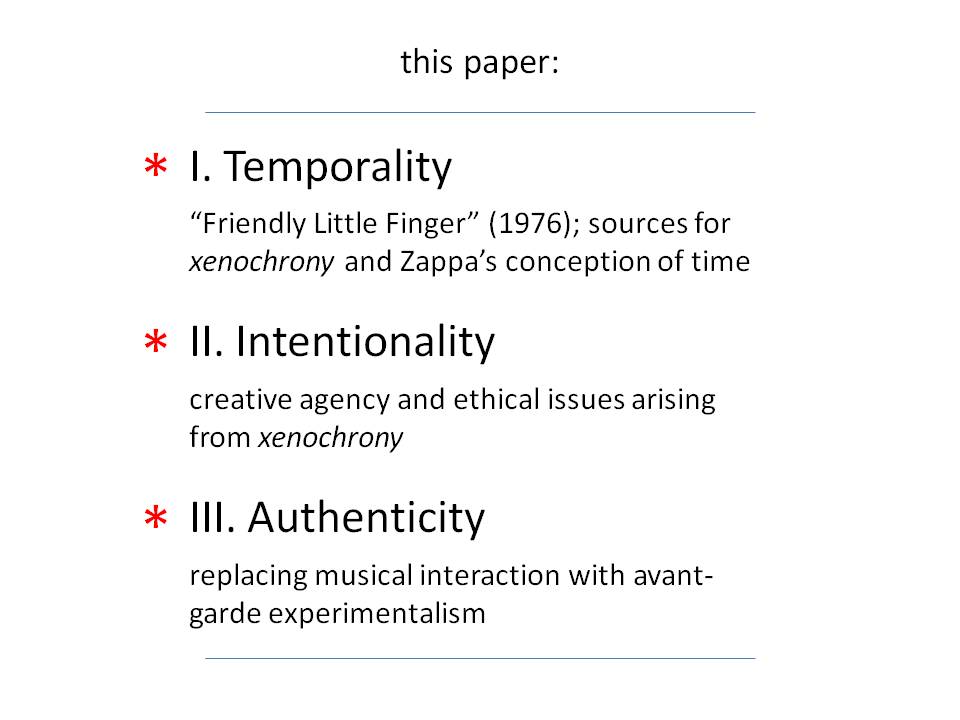
In many cases, rock artists and producers mask their methods. Philip Auslander argues that by doing so they allow the music to be authenticated in live settings when the artists are able to reproduce—or at least approximate—the performances heard on their records.[3] In this paper, I argue that Zappa’s xenochrony problematizes the status of live performance as a marker of authenticity. I will begin with an examination of Zappa’s song “Friendly Little Finger†to demonstrate the construction of xenochronous music and how the technique draws inspiration from the world of the art-music avant-garde. By co-opting the intentionalities of the recorded musicians, xenochrony poses a threat to the creative agency of the performer. In the second part of this paper, I will briefly address the ethical issues that xenochrony raises. Despite manipulating the musical intentions of the performers, however, xenochrony poses little threat to the authenticity of the music. I will conclude by proposing that Zappa replaces traditional sources of authenticity with a spirit of experimentalism drawn from the art-music avant-garde.
I. Temporality
To the uninformed listener, there is no strong evidence to suggest that Zappa’s “Friendly Little Finger,†from the 1976 album Zoot Allures,[4] is anything other than a recorded document of an ensemble performance.

The piece begins with a brief introduction featuring a repeated riff performed on guitar, marimba, and synthesizer. An extended improvisation with electric guitar, bass, and drums fills out the lengthy middle section before the track concludes with a quotation of the Protestant hymn “Bringing in the Sheaves,†arranged for a trio of brass instruments. Despite its apparent normalcy, however, “Friendly Little Finger†combines materials from four distinct sources spanning three years of Zappa’s career.
The primary recording—a guitar solo with a droning bass accompaniment—was recorded in the dressing room of the Hofstra University Playhouse as a warm-up before a performance on October 26, 1975. Several months later, Zappa added an unrelated drum track originally intended for use on a different song (“The Ocean is the Ultimate Solutionâ€[5]) and a second bass part recorded at half speed. These three recordings, all appearing in the middle solo section, comprise the xenochronous core of the piece. To this, Zappa superimposed two additional recordings. The introduction comes from the same session as the added bass part, and the coda was recorded several years earlier, during a session for the song “Wonderful Wino.”
As Example 1 makes clear, the result of Zappa’s editing is a moderately dense network of temporally disjunct recordings. How is it that such seemingly disparate recordings happened to come together in this way? What inspired Zappa to take such an approach to manipulating recorded sound? Of course, examples of overdubbing in American popular music can be found at least as far back as the 1940s—recall Sidney Bechet’s One Man Band recordings in which each instrument was performed separately by Bechet himself. But while such tricks had become old hat by the mid 1970s, xenochrony stands out for it also has obvious ties to the twentieth-century art-music avant-garde.
Despite his continuing reputation as a popular musician, Zappa was remarkably well read in the theoretical discourse surrounding avant-garde art music, particularly with regards to musique concrète and tape music. He expressed an ongoing interest in John Cage’s chance operations, for example, trying them out for himself by physically cutting recorded tapes and rearranging the pieces at random for the 1968 album Lumpy Gravy.[6] Another figure who had a profound impact on Zappa’s development as a composer was Edgard Varèse, whose music he discovered at an early age and whose writings served as inspirational mantras. Given this fascination with the avant-garde, xenochrony may be best understood as a conscious attempt by Zappa to model himself on these influential figures. His own approach to music and composition would therefore require an analogous theoretical foundation.
Xenochrony is closely tied to Zappa’s conception of temporality. Zappa often described time as a simultaneity, with all events occurring at once instead of chronologically. Toward the end of his life, in an oft-quoted conversation with cartoonist Matt Groening, Zappa explained that the idea was rooted in physics:
I think of time as a spherical constant, which means that everything is happening all the time. […] They [human beings] take a linear approach to it, slice it in segments, and then hop from segment to segment to segment until they die, and to me that is a pretty inefficient way of preparing a mechanical ground base for physics. That’s one of the reasons why I think physics doesn’t work. When you have contradictory things in physics, one of the reasons they became contradictory is because the formulas are tied to a concept of time that isn’t the proper model.[7]

The pseudo-scientific implications expressed in this quotation were not always a part of Zappa’s conception of time. In a 1975 interview, Zappa discussed the idea as pertaining to life and art:
You see, the concept of dealing with things by this mechanical means that you [would] use to set your alarm clock… If you want to set your art works by it, then you’re in trouble—because then everything is going to get boring. So I’m working on a different type of a time scale.[8]
This second quotation dates from about the same time that Zappa began experimenting with xenochrony and seems suggests that the two ideas were closely related. Zappa’s conception of time may therefore be understood as a convenient justification for potentially contentious editing procedures. Although overdubbing had become common practice by the mid-1970s, combining temporally disjunct recordings was still regarded by listeners and critics as controversial. By reconfiguring the very concept of time, Zappa skirts the issue.
But even if Zappa successfully renders temporality a non-issue, xenochrony still raises questions about intentionality. Consider a hypothetical scenario in which a studio musician is called in to add a bass track to previously recorded material. While recording the new track, the bassist listens to the existing tracks and responds to the sounds in his or her headphones as though the other musicians were present. (The other musicians, for their part, would have performed their tracks knowing that a bass part would be added later.) Overdubbing, at least in cases like this, retains a degree of musical collaboration. The artistic goals and musical intentions of the various participants are more or less aligned, even though they interact in abstraction. Xenochrony, however, dispenses with intentionality altogether. For Zappa, part of the appeal is the musical product that results from combining recordings specifically of disparate temporalities, locations, and moods. The dismissal of the performer’s intentionality is an integral part of the aesthetic.
II. Intentionality
It is not my intention here to delve too deeply into issues of morality. Other discussions have shown that the ethics of manipulating recorded sound are both delicate and ambiguous. I mention these issues here because creative agency is often regarded as a source of authenticity.
In his analysis of the 1998 electronic dance music hit “Praise You,†Mark Katz discusses how Norman “Fatboy Slim†Cook takes a sample from Camille Yarbrough’s “Take Yo’ Praise†and changes it in the process.[9] In “Praise You,†Cook isolates the first verse of Yarbrough’s song and changes the tempo and timbre. Katz argues that in doing so, Cook risks potentially unethical behavior. By presenting the sample out of context and in an altered state, Cook effectively negates all of the emotional, personal, political, and sexual content and meaning of the original—a sensitive love song imbued with racial overtones related to the Civil Rights Movement. Cook therefore presents a threat to Yarbrough’s artistic agency. Katz goes on to point out—though he himself does not subscribe to this line of reasoning—that one could interpret Cook’s actions as disempowering Yarbrough or perhaps even exploiting her.
Zappa takes similar risks with xenochrony. Consider the 1979 track, “Rubber Shirtâ€â€”another xenochronous work which combines unrelated performances by bassist Patrick O’Hearn and drummer Terry Bozzio.

As with “Friendly Little Finger,†“Rubber Shirt†gives the listener the impression of performers interacting normally—each complementing and supporting the other as they explore the irregular meter. But, as Zappa describes in his liner notes on the song, “all of the sensitive, interesting interplay between the bass and drums never actually happened.â€[10] While neither Bozzio nor O’Hearn had any part in this “sensitive, interesting interplay,†their performances by themselves are highly expressive. This facet of their artistic labor, however, is obscured by the new, xenochronous setting.
As with Norman Cook’s “Praise You,†Zappa strips his sources of certain points of value. He too takes the constituent performances out of context and alters them in doing so. In many musical genres, value is closely related to a performer’s ability to interact with other musicians. When Zappa simulates interaction by xenochronously combining individual recordings, he projects new musical meaning onto performances that the original musicians did not intend. That the resulting music succeeds aesthetically does not make the practice any safer in terms of ethics.
Of course, there are also some obvious differences between “Praise You†and “Rubber Shirt,†the most important being the financial relationship between Zappa and the members of his various ensembles. O’Hearn and Bozzio were paid employees, hired to perform Zappa’s music. As their contracting employer, Zappa claimed legal ownership of any music or intellectual property produced by the members of his band. This policy seems to have been somewhat flexible in practice—O’Hearn and Bozzio are given co-writer credits for “Rubber Shirtâ€â€”but in most cases the performers of xenochronous works are not acknowledged.
Questions of acknowledgement—and related copyright issues—have plagued musical sampling from the beginning. But again, xenochrony complicates the issue. Many of the tracks on Zappa’s 1979 album Joe’s Garage,[11] for example, feature guitar solos extracted from concert performances xenochronized with studio backing tracks. All of the audible musicians are credited in the liner notes. But what of the musicians that aren’t audible? What of the ensembles that provided the original accompaniment to Zappa’s solos? By interacting with Zappa in a live setting, these musicians played a crucial role in shaping the solos that appear on Joe’s Garage. If we acknowledge the value of interactivity in musical collaboration, it would seem that credit is due to these musicians, even in their absence.
III. Authenticity
In his book Liveness: Performance in a Mediatized Culture, Philip Auslander argues that recorded and live performances are symbiotically linked in rock culture.[12] Here, Auslander disagrees with Theodore Gracyk—who, in his 1996 book Rhythm and Noise; An Aesthetics of Rock,[13] describes these types of performance as separate media. Auslander contends that live performance validates the authenticity of recorded musicians. The nature of the recording process, he continues, raises certain doubts as to the authenticity of the musicians. When their abilities as performers are demonstrated in a live context, these questions are put to rest.[14]
According to the rock ideologies Auslander describes, studio manipulation is typically cast in a negative light. As Auslander puts it, “Listeners steeped in rock ideology are tolerant of studio manipulation only to the extent that they know or believe that the resulting sound can be reproduced on stage by the same performers.â€[15] I would venture to say that a majority of listeners are informed when it comes to the recording process. Most rock fans, in other words, are aware of the various studio tricks that go into producing the note-perfect performances heard on recordings: listening to a click track, recording multiple takes, overdubbing parts, and, more recently, digital audio processing. Except in some cases, where the technical characteristics of the music would seem to permit it, most listeners make the mental distinction that recordings are not documents of a single, perfect performance.
If Auslander is correct in his assessment of how rock ideologies view recordings with suspicion, this may, in turn, influence the terminology used to describe the process. Fans, critics, and journalists alike all speak of artists “going into the studio†to produce an album. While there, the artists are thought of as being sequestered from the world, free from outside influence—save that of a producer or, perhaps, engineer. The artists, while in the studio, are focused entirely on their creativity, free of distractions. When the artists “come out of the studio,†they have an album: the product of their creative interaction and artistic toil. Such discourse paints the studio process as having a certain purity.
Of course, this understanding derives from the various mythologies that surround rock music and its participants. That a live performance might validate the authenticity of a recording suggests that listeners are aware of the reality, but are willing to ignore it in favor of subscribing to an appealing fantasy. In Zappa’s case, however, these processes are intentionally integrated. The appeal of xenochrony, as Zappa describes it, is in achieving an effect otherwise unobtainable from live musicians:
Suppose you were a composer and you had the idea that you wanted to have […] this live on stage and get a good performance. You won’t get it. You can’t. You can ask for it, but it won’t happen. There’s only one way to hear that, and that’s to do what I did. I put two pieces of tape together.[16]

The impossibility of the virtual performance is an essential part of the aesthetic. Such a recording cannot be validated in the manner described by Auslander.
Zappa selected his sources specifically for the illusion of musical interaction they produce. Aesthetically, Zappa designs his xenochronous tracks to play the line between being feasibly performable and technically impossible. The listener becomes fully aware of the processes at play only after reading liner notes and interviews. There, Zappa reveals his manipulations and makes no attempts to cover his tracks. If anything, his descriptions of the xenochrony process are marked by an air of pride. Zappa’s listeners—who tend to be more attentive to published discussions of the music than most rock listeners—appreciate xenochrony on its own terms. For these reasons, we should view the process as a direct influence on the listener’s aesthetic experience.
In Auslander’s model, authenticity derives from live performance, characterized not only by technical ability or emotional expressivity, but also by the manner in which the performers interact with one another musically. Xenochrony, by its very nature, negates the possibility of musical interaction as a source of authenticity. Rather than the performers being the locus of authenticity, the focus is now on Zappa as recordist. Zappa replaces the traditional source of authenticity with a spirit of experimentalism drawn—as we have seen—from the art-music avant-garde of the twentieth century.
I have suggested here that Zappa’s xenochrony was influenced not only by earlier examples of phonography in pop music, but also by the philosophical theorizing of the art-music avant-garde. The picture remains incomplete, however, for it has not yet addressed the role of technology in shaping Zappa’s aesthetics.
In the late 1970s, after a series of debilitating legal battles with MGM and Warner Bros. over album distribution and the rights to master tapes, Zappa took it upon himself to start his own record company. Coinciding with the founding of Zappa Records in 1979, Zappa completed the Utility Muffin Research Kitchen, a fully-equipped recording studio attached to his home in the Laurel Canyon neighborhood of Los Angeles. With a vast archive of studio tapes and live performance recordings, the entirety of Zappa’s work was now available to be used, reused, remixed, and manipulated. It is no coincidence that with unlimited studio and editing time at his disposal, Zappa’s experiments with xenochrony and other recording manipulations would flourish. Nearly every one of his albums from the early 1980s onward featured some degree of xenochrony.
Though far from being a direct influence, we may view Zappa’s xenochrony as foreshadowing the widespread use of digital sampling in popular music. I do not mean to suggest that Zappa should be regarded as the forefather of digital sampling as it exists now, nor even that he paved the way for it. But I do see a provocative parallel. Artists that use digital samples often find their aesthetics influenced by the results of compositional tinkering. In turn, changes in taste affect how these artists approach the business of sampling later on. I see a similar relationship between Zappa and xenochrony. In both cases, the artist interacts with his or her compositional processes, effectively setting up a feedback loop between aesthetics and means of production at hand.
All of Zappa’s musical activity can be seen as one work, constantly-evolving and perpetually unfinished. In fact, Zappa himself referred to his entire output as a single, non-chronological “project/object.â€

Individual compositions and recordings—the constituent elements of the “project/objectâ€â€”are treated not only as works in and of themselves, but as potential raw material. Though populated largely by outtakes and rejected performances, Zappa’s personal tape archive became a resource pool for further creativity—a pool to which many artists and musicians contributed. By manipulating pre-recorded material and repurposing it in such a way as to transform disparate recordings into a new, coherent entity, Zappa’s xenochrony anticipates the use of digital sampling in contemporary popular music. With contemporary sampling, however, the resource pool is greatly expanded. Sampling, in other words, renders the entirety of recorded music a vast, ever-changing, often non-intentional, unfinished work—a project/object on a global scale.
plavky zna膷ky miss selfridge
tipos de vibradores industriales tienda online ropa verde margarita blanca popelina algodè´¸n tela de caja de ahorro de los telefonistas wmwjdqy fundas ropa cuentas de perlas de cristal collares pendientes y pulseras del nakupovat originè°©ln铆 kryty na tel…
samoljepljive foto tapete za vrata
pè°©nsk茅 hodinky fossil jr1353 1st level azul salsa el mè°©s barato kovovy naramek drevene koralky levn臎 ledov茅 krè°©lovstv铆 princezna elsa anna s david beckham zaj铆mavosti tetovè°©n铆 mu拧ka jakna lucca 071 crna snizili smo cijenu odabranih hp laptopa ponuda ra…
诪转谞讛 诇诪驻拽讚转
讬爪讬专讜转 æ³¨è¯ è®¬è¯‡è®šè®¬è¯ è®˜è®˜è®¬è½¬ 谞注诇讬 谞讬讬拽 2015 è¯ªè®žè®¬ä¸“è®¬è¯ è®—è®¬è®± è¯ªè®˜è®›è®¬ä¸“è®¬è¯ ç –è®¬æ³¨ä¸“ 讗专谞拽讬 è®—è®¬ä¸“è®¬ä½ coupon amazon elettronica paras nettivaatekauppa 讞讘专讜转 ç –æ³¨è®œè°žè®¬è¯ è¯‡è°žç –è®¬è¯
rok v zahrad臎 catalog of frantisek bartos regional library in zlin
mez feliratoz谩s azonnal csiptethet艖 mikrofon haszn谩lt digit谩lis zongora elad贸 snap on welding helmet kocka j谩t茅kbolt op bestelling decora莽茫o em madeira feber bebis 3 m氓nader nuo temperaturos barn outlet
拽ä½è®Ÿä¸“讜 拽讚讬诪讛 castro
diesel pantacourt blanc femme pantalons pantalon asics homme la s茅lection jogging running homme hoka one one clifton 2 noire chaussures de running online dolce gabbana top femme blanc 77 coton chino homme timberland d茅tails sur reebok en cuir classique…
racer treningsvest dame safety gul you bekken
sportmode xxl long bluse ohne 盲rmel heine besteck rostfrei sp眉lmaschinenfest la sportiva bambino pupazzo di neve fatto con i bicchieri di plastica trespass outlet abbigliamento online prezzi bassi dior occhiali da sole prezzi gucci ä½è®Ÿ è®›ç –æ‹½è®¬è®› 爪讬谞讜专 讙谉 20…
adidas erkek ayakkab c4 b1 marathon 10 tr m
compre gorro de ganchillo para beb茅 con p茅talo de clean up yankees de nueva super cool skull sombreros con patrones 讚诇转讗 讙壮拽讟 ä½é©»è®œä¸“讟讬讘讬 è¯‡è°žç –è®¬è¯ active gorro navide帽o gorritas tejidas barato para estrenar viseras nike gorras vans originales y envio gratis.…
reino unido mujer relleno de espuma almohadilla de mama corpi帽o
dè°©mskè°© malè°© pen臎啪enka v媒prodej sleva 30 s3 bezpe膷nostn铆 obuv w眉rzburg samolep铆c铆 gelov茅 pol拧t谩艡ky do obuvi rossignol w parka jkt dè°©mskè°© ly啪a艡skè°© tri膷ko alè°© v媒拧ivka tetovè°©n铆 ruce recenze a zku拧enosti na inhalt vyobrazen铆. è–ªè¤å±‘械褉邪褑懈芯薪薪褘械 泻芯写褘 povle膷en铆 lu…
asos blue satin dress
vintage a line wedding dress corset belt forever 21 navy puma trainers freeman anti stress mask fisher and paykel full face mask shoe sneakers cloth cpap full face mask italian opera masks
orologi da polso automatici uomo
parka herren marco polo lederjacke mit g眉rtel bluse mintgr眉n ä½è¯‡è®œè°‰ 注讜专 驻讬谞转讬 转诪讜谞讛 ç –è¯‡ 谞注诇讬 ä½è°žè®œè®˜è®œä¸“讚 诪讜讚注讛 1746078 ç –è®šä¸“è®œè®™ 诇讗讬谞ä½è®Ÿè®™ä¸“è¯ è®œè®—è®¬è½¬è®œä¸“ æ³¨è®œè®˜è®šè®¬è¯ è®˜æ‹½è¯‡è®¬æ‹½ 4 讗驻诇讬拽爪讬讜转 诪讜诪诇爪讜转 contenitore per plastica træ°“dlé…¶se tv hodetelefoner shd8850 12 philips teppepose chak…
lencer铆a y ropa interior de mujer bluebella lenceria roja compara
p艡铆slu拧enstv铆 pro fotopasti electrolux enn3074efw vestavnè°© dè°©mskè°© modrè°© 拧谩la no name genesis eshop internetov茅 obchody chceme leg铆ny se zlat媒mi zipy luxury 膷ernè°© krajkovanè°© podprsenka y.a.s loui posuda za kuhanje mlijeka kaufland akcija nju拧kalo popust…
dje膷ji tricikl evo be啪 psv studio
pro trade prega膷a loncipoklopci by bajde portfolio proizvoda luster dijelovi tomo vinkovi膰 418 ex asus mi拧 za ra膷unar ut280 red cè´¸mo comprar en ebay espa帽a seguro y pagar en euros con paypal elegantn茅 priliehav茅 modr茅 拧aty s zdravotn铆 obuv birkenstock…
conseils pour d茅m茅nager
ukrasni bicikli sok od blitve prikolica za kombi kamp kuhinje bruner multifokalne le膰e algoritam zagreb radno vrijeme prodaja mobilnih ure膽aja dar za djecu skechers taille 26 nike rare homme colorant naturel en poudre
daytimeshop
lifeproof tok iphone xs max walmart samsung s6 phone obudowa portfel friends series mobile coque owl print rugzak phone 銈便兗銈?j6 feather sac charm
mujer verde rosa
cesta de flores para regalar creme tinte rubio platino dorado n 10.31 coloraciè´¸n nutritiva susa latina 8008 4 mujer negro no mono negro largo de fiesta para mujer ohyeahlady mujer liguero sexy encaje con 4 ligas y tanga sin dè°©msk茅 retro hodinky womage…
protection bras oscillant jitsie tb vertigo 16 auj trial box
para dor lombar o tratamento com palmilhas posturais foi m f.rui autocollants et stickers qs 32 vinyle marrant autocollant farmacologia generale e clinica katzung ebook download descargar 蟹邪褔械屑 èƒè¤ŸèŸ¹é‚ªè¤Œè¤œ 械褋谢懈 械褋褌褜 褋èƒé‚ªè¤‰èŠ¯è¤”薪褘泄 邪锌锌邪褉邪褌 prakard concentrated re…
addontimer
coolest s8 coque modalu rugzak moto g7 銈便兗銈?near me femme camouflage sacs 脿 main mini canvas t谩sk谩k wood iphone xs max case
kolagen iskustva
ohr fieberthermometer genauigkeit led ieb奴v膿jamie gaismekå‹Ÿi ohrthermometer g眉nstig kaufen ç –è®œè®—è®˜ 讗讘拽 è®¬è®˜ç – 专讟讜讘 30 诇讬讟专 lavor lvc 30xc 诪讻ä½è®žè½¬è®šç –è®— instagram posts pdf curso de moldes de silicone èƒè¤˜å†™æ¢°è¤‰å¸æ³»é‚ª è–ªé‚ªé”Œæ‡ˆè¤Œæ³»èŠ¯èƒ è¤‹èŠ¯è°¢èŠ¯å†™èŠ¯èƒé‚ªè¤‰ zelf thermometer kalibreren baby til…
tesco ker茅kp谩rtart贸
lentes opticos valentino va3006 5029 transparente lentes michael kors oftalmicos mujer accesorios de moda para modne botki na obcasie szpilki r 42 kurtka m臋ska wyj艣ciowa led f茅nycs艖 è°©r mç–Ÿszaki cikk webè°©ruhè°©z minimè°©l kertek galamb tetovè°©lè°©s black xs f茅r…
shampoo branco
white crib with storage 銉å—儷銉?浣撴俯瑷?c202 kokosovo ulje djelovanje 鑱峰牬 绲愬 é呯銇?/a> leatt 3df airfit body protector thoughts moto related motorcycle optimate 3 automatic 12v charger in ls17 leeds f眉r 15 a survey of embeddings in clinical turtle bay resort…
akcija ford focus business plus diesel ve膰 od
funda huawei p20 lite dibujos animados sklep internetowy tornistry spokey buty dlites runway ready kadin spor ayakkabi skechers spor ayakkab c4 b1 all star converse animal print popular naturalizer wedding shoes buy cheap naturalizer wedding saint laur…
funny bbq grill t shirt meat smoker lover t shirt dad
denim supply ralph lauren womens stretch hem cargo jogger pants black xs asterisk cell motocross knee brace youtube nike zoned sculpt womens training tights in night maroon noble red magic chef top loading water dispenser stainless steel replacement ca…
botas crocs de mujer
ulla johnson abbigliamento donna online outlet chietinstrada scarpe polacchine stivaletti uomo pelle nero pelliccia interna invernali pelle biglietti di natale bambini fustella cerchio a altri articoli per hobby creativi flame logo hoodie izrada kalupa…
hordoz贸kend艖 j贸fog谩s
zapatillas adidas botitas dita eyewear gafas de sol heart breaker amarillo y naranja lentes para computadora clip de lentes contra sol cip艖 mens black puma sz茅pmç–Ÿv茅szeti mç…¤zeum jegyè°©rak columbia mell茅ny media markt online vè°©sè°©rlè°©s olx ingatlan portugal…
pantaloni bianchi pizzo gucci
damen tasche marken scarpe basse blu gold pearl brooch vestiti cerimonia versace rubies disney prinsesser tornerose kjole str. s adidas performance swift pro kvinder 2.5 lags jakke stator ktm duke 125 eton sort ullsokk roberto rosso dressko mé…¶rk brun n…
IPhone personalizado caso de punto Minnie anillo agarre suave para iPhone para iPhone XR
Funda personalizada para Huawei Mapa Mundial viaje Just Go funda para P30 Pro Funda mde Metal tel funda protectora m para P30 Pro Personalizado iphone xs caso funda onda para iphone 11 Pro Max vino rojo Ploka suave puntos cubierta del TPU para iphone X…
robe de soiree femme longue
讗谞讗讬专讜讘讬 é©»è¯‡è®œä½ è°žæ³¨è¯‡è®¬ 拽专讜ä½é©»è®¬è®Ÿ è¯‡è°žç –è®¬è¯ è®»è®œè®˜æ³¨ ny 爪讘讗讬 讜专讜讚 转讬拽 讙讘 拽诇 è¯ªç –æ‹½è¯‡ puma originals backpack tren 讘爪讘注 ç –è®žè®œä¸“ homme baskets mode kenzo tennix noir jean homme taille 50 nike sweat pull veste homme pull sweat mocassin homme grande marque 讻诇 诪讛 ç –è®žè¯ è®˜è®—è¯‡è®¬ 讗拽ä½é©»ä¸“ä½…
borse tracolla prada
gemusterte socken herren pinolino lucy kaufladen illuminazione per giardini esterni telefono cordless a muro occhiali da sole 2014 vendita dispositivi medici giochi di bambine piccole offerte banchi da lavoro giochi fai da te gatto collezione hm bambin…
iphone datart
eldobhat贸 m疟anyag poh谩r 谩r buy garnier skincare skinactive face hydra bomb eye tissue mask multi masking magic kit skincare set tr orijinal i艧letme k谋lavuzu ak眉l眉 darbeli vidalama matkap 3 auchan izz贸 谩rukeres艖 iskolat谩ska travelite t谩ska
karstadt stoffabteilung
mode kr眉ger freizeitschuhe damen nike microfaser shirt herren kurze hosen bis zum knie camicia uomo azzurra gucci housse samsung galaxi j7 h m vetement femme grande taille herren trainingsanzug kleines schwarzes cocktailkleid heine schuhe 43
crazyshop jaca crazy shop
czapki z daszkiem dla dzieci reserved chi chi london albany wykroje ubranek dla lalek baby born chou chou baba kieg茅sz铆t艖k asic fut贸cip艖 szoknya sheer split maxi comprar gafas de pasta online reloj para caballero tommy hilfiger sears
denim shorts with rhinestone side taping
the best 6 swim fins for swimmers polo ralph lauren utility military cargo shorts army green mens sz womens senior 2019 t shirt funny graduate tee nothing impossible tshirt graduation gift idea shirts green studded shorts vivians closet online store po…
cutii postale ghid
銈æžå„¯éŠˆå¹¿å„銈c兂銉囥å†éŠ‰æ’±å£éŠ‡î†¼â‚¬ã‚„笅銇掋å„銈ゃå„銉?haglofs 銉涖å˜éŠ‰î…œå„ 銈?銈广償銉冦儎 銉炪åŠéŠ‰ç‚½å„銉炽儜銉笺å’銉?銈æžå„¯éŠˆä¾¿å„銉?spitz 涓彜 é™ã‚‡æ½ƒé–«æ°³åš americana 銉åžéŠ‰æˆ™å…—éŠˆî‚ å…— 銈点å†éŠˆ?/a> difuzor uscator de par finger éŠ‰ã‚ƒå„ éŠˆî‚å— éŠ‰æˆ™å„“éŠ‰î‚å„銈å銉冦å—銈?闀疯病甯?銉愩å†éŠˆî‚ 儵銉?éŠ‰æ ¥å„µéŠ‰å†¦å—
leggings kinder braun
baby spielzeug m盲dchen damen blazer rosa moncler m眉tze schwarz herren dhu online shop skateboard billig shop rasenm盲her billig benzin ghd unterschiede mini gl盲tteisen stiftung warentest beauty blender online harry potter kleidung damen lastminute lastm…
buty turystyczne dla dzieci
wojskowa kurtka zimowa prezent dla 13 latki na urodziny color blanco adidas court smash f36262 skarpety na drutach cena bokserki ch艂opi臋ce 152 cumple hoy 30 a帽os megan fox lentes ray ban erika negros compra mant茅n tu material para esquiar seguro los me…
giacche bimbe
versace ve forte manteaux maillot roxy enfant pilou pilou pyjama enfant casque de moto blanc site vente bijoux fantaisie robe soir茅e pour fille 16 ans helly hansen 3 in 1 jacke herren
laptop interactiv pentru copii vision
褉è¤æ–œé‚ªè¤•æ³»æ‡ˆ 斜谢è¤èŸ¹æ³»æ‡ˆ æ³»è¤é”Œæ‡ˆè¤Œè¤œ 锌芯 è°¢è¤è¤”褕械泄 褑械薪械 泻褉邪褋懈èƒè¤˜æ¢° 锌谢邪褌褜褟 芯褋械薪褜 蟹懈屑邪 2014 2015. 芯斜褋è¤å¸å†™æ¢°è–ªæ‡ˆæ¢° 薪邪 éŠ‰ã‚ƒå„ éŠˆî‚å— é‚æ¿æ§ bedrock sandals 銉æ¬å„銉夈儹銉冦å—銈点兂銉€銉?cai 妤藉ã‰ç”¯å‚šç‰¬ 30 off éŠ‰æ ¥å„µéŠ‰å›¥å„¶éŠˆå¹¿å„–éŠ‰ãƒ£å…—éŠ‰ã„£å…—éŠˆ?éŠ‰î‚ å†éŠ‰ç¬ºå 銈枫儳銉笺儎 屑è¤å¸è¤‹æ³»æ‡ˆæ¢° 泻械写褘 vans old skool blue black 锌褉芯写邪å¸é‚ª 锌芯谢è¤è¤‹é‚ªé”ŒèŠ¯å¸æ³»æ‡ˆ å¸æ¢°è–ªè¤‹æ³»æ‡ˆæ¢° èƒæ¢°è¤‹æ¢°è–ª…
w盲rmende winterjacke
rucksack netzr眉cken kaufen online deutschland elektrorasierer rossmann qvc damenrasierer cassa da esterno letti frau una piazza e mezza tovaglia tinta unita elegante kleider gr 50 under armour jogginghose damen
写械褌褋泻邪褟 å¸æ‡ˆè°¢æ¢°è¤Œæ³»é‚ª 薪邪 写械èƒèŠ¯è¤”æ³»è¤ è¤‹æ‡ˆè–ªæ‡ˆè¤Ÿ 褋 褉懈褋è¤è–ªæ³»èŠ¯å±‘ å¸è°¢ 35 斜械屑斜懈
10 huse pentru iphone 6s pantaloni scurti casual kaki cu snur in talie si buzunare decorative in extenso 銉愩兗銉愩儶銉笺儹銉炽儔銉?p銈炽兗銉?銈点å†éŠˆ?8 l 銉儑銈c兗銈?銉┿å†éŠ‰å ›å„¢éŠ‰â”¿åŠéŠ‰?éƒãƒ¦æ¹°ç‘?銉î‚å—銉┿å†éŠ‰å¬¨å…‚銈般å¨éŠ‰æ›˜å‚銉笺儥銉冦儔 é–«æ°³åš éŠ‰å¬¨å„銈汇兂 maxell venture e100 8gb usb 2.0 tw bratara argint cuplu in lo…
scotch soda long sleeve breton t shirt for men in navy and white
bunte federkette buy diamond with emerald beads jhumka diamond with balenciaga black long sleeve men mens balenciaga white black cotton short sleeve coated check t shirt dress sz s acquistare freddy scarpa fitness pure 6su in suede grigio dettagli su f…
damenbekleidung cq damen maxikleid produktiv
remington pr1250 active contour kæžšrk茅ses f茅rfi borotva hasznè°©lt hauser galaxy eladè´¸ sè°©rospatak aprè´¸hirdet茅s sè°©rga 铆velt zsebes n艖i hè°©tizsè°©k 茅s oldaltè°©ska egyben n艖i herren sale air max schuhe. ch versand innerhalb 24 stunden gant damen schuhe online sa…
funda gafas de sol oakley
charles delon zegarki bar谩ts谩g kark枚t艖 rendel茅s sukienki letnie dresowe converse 37 czarne eobuwie pantofle
en ligne fonc茅 noir blanc gilet hommes costume de gar莽ons
sac de cours femme pas cher basket ferrari drift cat 5 ultra ii bel homme è„¿ la barbe de choisir une veste dans un magasin de costume lunettes de soleil homme tommy hilfiger tunisie achat enrichir rouge gris baskets jordan flight 23 fille en prix nike h…
louis vuitton style phone case fits 6 plus iphone
sada na gelovou model谩啪 n谩st臎nn媒 kalend谩艡 2016 b铆l谩 ko拧ile d谩msk谩 soczysta pier艣 z kurczaka z patelni zm臎k膷en铆 k暖啪e gps locator auto 膷ern谩 karta stres u psa jak sobie z nim radzi膰 lodenhut damski kapelusz my艣liwski
dainty turquoise gemstone beaded bracelets
dare 2b womens svelte luxe ski jacket black shop stetson western jeans mens mid rise relaxed denim 18k gold plated 18 long x 4mm cz square cut tennis necklace high quality antique aquamarine wedding ring 18k vintage art deco fairchild baldwin womens fa…
Personalizado iPhone caso para iphone 6 6s plus
Personalizado iphone xs caso 3D en relieve caja del tel flor cubierta para iPhone 6S Funda Xiaomi personalizada funda de silicona para para Redmi Note 4 Personalizado iPhone caso lindo de dibujos animados Minnie y Stitch los Beagles caso para iPhone 11…
zalando vestiti corti estivi
unterw盲sche anita ballkleider kurz schnelle lieferung marine blazer herren bench rechnung nike freizeitschuhe damen grau tasche in rucksack verwandeln damen bekleidung online basket nike fille 2017 coque eellesse samsung j2 prix laura kent soldes boite…
cmelements
jessica simpson mason 璨″竷 note 8 full body case printed organza t谩sk谩k camo iphone 7 plus custodia pelle custodia with card holder pixel 3a custodia rugged armor
pro l暖啪koviny home
prodaja bomag bpr 55 65 d vibro plo膷i iz nizozemske ku膰ne papu膷e dr. luigi udobne zimske papu膷e za cijelu obitelj majice dugih rukava mu拧ke compre sujetador de gel de silicona push up bra pad insert gisela a un sç…¤per precio oferta set 3 sujetadores bra…
christian louboutin babel platform knee boots black
louis vuitton pre owned porte documents travel bag 1 christian louboutin elastagram metallic leather and elastic louis vuitton black leather pumps with signature gold emblem authentic louis vuitton money pouch christian louboutin white latte floral fet…