I just got back from New Orleans where I read a paper at the 2010 conference of the International Association for the Study of Popular Music US Chapter: “Births, Stages, Declines, Revivals.” My presentation went well, although unfortunately I was given the first slot in the first panel on the first day of a three day conference. (8:30 AM on Friday morning!) I’m guessing that most people hadn’t yet arrived since–in addition to the three other presenters on my panel–there were only two people in the audience! Oh well.
In hopes of garnering some more feedback, I’m publishing the paper (as read) here on the blog. As usual, this remains a work in progress.
Click here to download a PDF version of the paper. (Slides and visual examples appear at the end of the PDF.) Or, follow the jump to read the html version.
Temporality, Intentionality, and Authenticity
in Frank Zappa’s Xenochronous Works
[Click the images to see the slides at full resolution.]
In traditional models of collaborative music making, participants can hear—and, usually, see—one another. Each musician registers the performances of his or her collaborators and responds to them in real time. Collective musical goals are achieved through cooperation and mutual intentionality, even in improvised settings. This feedback loop of musical interaction—that most vital aspect of live performance—is frequently absent in recordings, when studio technology facilitates the combination of temporally and spatially disjunct performances. Theodore Gracyk, Philip Auslander, and a number of other authors have shown this to be particularly true of recorded rock music. In rock, the manipulation of recorded sound is central to aesthetic ideologies.
Lee B. Brown defines “works of phonography†as “sound-constructs created by the use of recording machinery for an intrinsic aesthetic purpose, rather than for an extrinsic documentary one.â€[1]

Documentary recordings may—and often do—comprise the constituent ingredients of such works; but overdubbings, tape-splicings, and other editing room procedures deliver to the listener a virtual performance, an apparition of musical interaction that never took place. Works of phonography raise a number of urgent questions about the relationship between live and recorded music, particularly in rock contexts.
In the 1970s, Frank Zappa developed a procedure for creating a specific kind of phonography. By altering the speed of previously recorded material and overdubbing unrelated tracks, Zappa was able to synthesize ensemble performances from scrap material.

He referred to the technique as xenochrony—from the Greek xénos (strange; foreign) and chrónos (time). Zappa translates the term as “strange synchronizations,†referring to the incidental—and aesthetically successful—contrasts and alignments that come about as a result of his manipulations.
Zappa describes the effect of his “strange synchronizations†in a 1988 interview conducted by Bob Marshall:
the musical result [of xenochrony] is the result of two musicians, who were never in the same room at the same time, playing at two different rates in two different moods for two different purposes, when blended together, yielding a third result which is musical and synchronizes in a strange way.[2]

By combining separately-recorded performances, such music easily meets Brown’s criteria. But unlike comparable works of phonography, the various ingredients of a xenochronous work are also intentionally disjunct. Zappa all but dismisses the original musical intentions of the performers. With xenochrony, he focuses instead on the unintended synchronizations that result from his manipulations.
In many cases, rock artists and producers mask their methods. Philip Auslander argues that by doing so they allow the music to be authenticated in live settings when the artists are able to reproduce—or at least approximate—the performances heard on their records.[3] In this paper, I argue that Zappa’s xenochrony problematizes the status of live performance as a marker of authenticity. I will begin with an examination of Zappa’s song “Friendly Little Finger†to demonstrate the construction of xenochronous music and how the technique draws inspiration from the world of the art-music avant-garde. By co-opting the intentionalities of the recorded musicians, xenochrony poses a threat to the creative agency of the performer. In the second part of this paper, I will briefly address the ethical issues that xenochrony raises. Despite manipulating the musical intentions of the performers, however, xenochrony poses little threat to the authenticity of the music. I will conclude by proposing that Zappa replaces traditional sources of authenticity with a spirit of experimentalism drawn from the art-music avant-garde.
I. Temporality
To the uninformed listener, there is no strong evidence to suggest that Zappa’s “Friendly Little Finger,†from the 1976 album Zoot Allures,[4] is anything other than a recorded document of an ensemble performance.

The piece begins with a brief introduction featuring a repeated riff performed on guitar, marimba, and synthesizer. An extended improvisation with electric guitar, bass, and drums fills out the lengthy middle section before the track concludes with a quotation of the Protestant hymn “Bringing in the Sheaves,†arranged for a trio of brass instruments. Despite its apparent normalcy, however, “Friendly Little Finger†combines materials from four distinct sources spanning three years of Zappa’s career.
The primary recording—a guitar solo with a droning bass accompaniment—was recorded in the dressing room of the Hofstra University Playhouse as a warm-up before a performance on October 26, 1975. Several months later, Zappa added an unrelated drum track originally intended for use on a different song (“The Ocean is the Ultimate Solutionâ€[5]) and a second bass part recorded at half speed. These three recordings, all appearing in the middle solo section, comprise the xenochronous core of the piece. To this, Zappa superimposed two additional recordings. The introduction comes from the same session as the added bass part, and the coda was recorded several years earlier, during a session for the song “Wonderful Wino.”
As Example 1 makes clear, the result of Zappa’s editing is a moderately dense network of temporally disjunct recordings. How is it that such seemingly disparate recordings happened to come together in this way? What inspired Zappa to take such an approach to manipulating recorded sound? Of course, examples of overdubbing in American popular music can be found at least as far back as the 1940s—recall Sidney Bechet’s One Man Band recordings in which each instrument was performed separately by Bechet himself. But while such tricks had become old hat by the mid 1970s, xenochrony stands out for it also has obvious ties to the twentieth-century art-music avant-garde.
Despite his continuing reputation as a popular musician, Zappa was remarkably well read in the theoretical discourse surrounding avant-garde art music, particularly with regards to musique concrète and tape music. He expressed an ongoing interest in John Cage’s chance operations, for example, trying them out for himself by physically cutting recorded tapes and rearranging the pieces at random for the 1968 album Lumpy Gravy.[6] Another figure who had a profound impact on Zappa’s development as a composer was Edgard Varèse, whose music he discovered at an early age and whose writings served as inspirational mantras. Given this fascination with the avant-garde, xenochrony may be best understood as a conscious attempt by Zappa to model himself on these influential figures. His own approach to music and composition would therefore require an analogous theoretical foundation.
Xenochrony is closely tied to Zappa’s conception of temporality. Zappa often described time as a simultaneity, with all events occurring at once instead of chronologically. Toward the end of his life, in an oft-quoted conversation with cartoonist Matt Groening, Zappa explained that the idea was rooted in physics:
I think of time as a spherical constant, which means that everything is happening all the time. […] They [human beings] take a linear approach to it, slice it in segments, and then hop from segment to segment to segment until they die, and to me that is a pretty inefficient way of preparing a mechanical ground base for physics. That’s one of the reasons why I think physics doesn’t work. When you have contradictory things in physics, one of the reasons they became contradictory is because the formulas are tied to a concept of time that isn’t the proper model.[7]

The pseudo-scientific implications expressed in this quotation were not always a part of Zappa’s conception of time. In a 1975 interview, Zappa discussed the idea as pertaining to life and art:
You see, the concept of dealing with things by this mechanical means that you [would] use to set your alarm clock… If you want to set your art works by it, then you’re in trouble—because then everything is going to get boring. So I’m working on a different type of a time scale.[8]
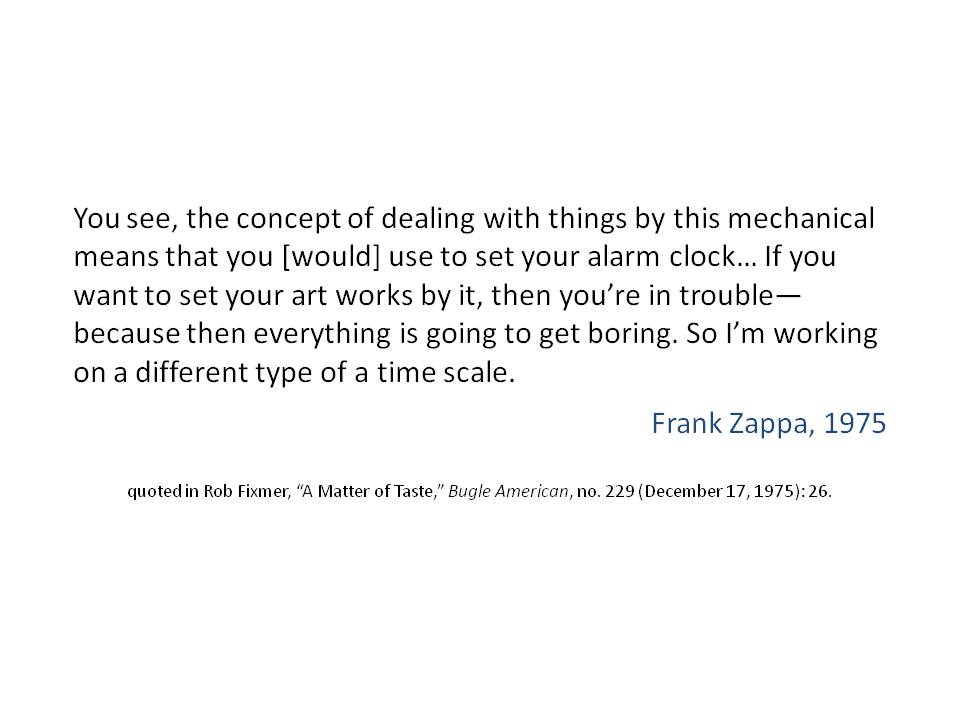
This second quotation dates from about the same time that Zappa began experimenting with xenochrony and seems suggests that the two ideas were closely related. Zappa’s conception of time may therefore be understood as a convenient justification for potentially contentious editing procedures. Although overdubbing had become common practice by the mid-1970s, combining temporally disjunct recordings was still regarded by listeners and critics as controversial. By reconfiguring the very concept of time, Zappa skirts the issue.
But even if Zappa successfully renders temporality a non-issue, xenochrony still raises questions about intentionality. Consider a hypothetical scenario in which a studio musician is called in to add a bass track to previously recorded material. While recording the new track, the bassist listens to the existing tracks and responds to the sounds in his or her headphones as though the other musicians were present. (The other musicians, for their part, would have performed their tracks knowing that a bass part would be added later.) Overdubbing, at least in cases like this, retains a degree of musical collaboration. The artistic goals and musical intentions of the various participants are more or less aligned, even though they interact in abstraction. Xenochrony, however, dispenses with intentionality altogether. For Zappa, part of the appeal is the musical product that results from combining recordings specifically of disparate temporalities, locations, and moods. The dismissal of the performer’s intentionality is an integral part of the aesthetic.
II. Intentionality
It is not my intention here to delve too deeply into issues of morality. Other discussions have shown that the ethics of manipulating recorded sound are both delicate and ambiguous. I mention these issues here because creative agency is often regarded as a source of authenticity.
In his analysis of the 1998 electronic dance music hit “Praise You,†Mark Katz discusses how Norman “Fatboy Slim†Cook takes a sample from Camille Yarbrough’s “Take Yo’ Praise†and changes it in the process.[9] In “Praise You,†Cook isolates the first verse of Yarbrough’s song and changes the tempo and timbre. Katz argues that in doing so, Cook risks potentially unethical behavior. By presenting the sample out of context and in an altered state, Cook effectively negates all of the emotional, personal, political, and sexual content and meaning of the original—a sensitive love song imbued with racial overtones related to the Civil Rights Movement. Cook therefore presents a threat to Yarbrough’s artistic agency. Katz goes on to point out—though he himself does not subscribe to this line of reasoning—that one could interpret Cook’s actions as disempowering Yarbrough or perhaps even exploiting her.
Zappa takes similar risks with xenochrony. Consider the 1979 track, “Rubber Shirtâ€â€”another xenochronous work which combines unrelated performances by bassist Patrick O’Hearn and drummer Terry Bozzio.

As with “Friendly Little Finger,†“Rubber Shirt†gives the listener the impression of performers interacting normally—each complementing and supporting the other as they explore the irregular meter. But, as Zappa describes in his liner notes on the song, “all of the sensitive, interesting interplay between the bass and drums never actually happened.â€[10] While neither Bozzio nor O’Hearn had any part in this “sensitive, interesting interplay,†their performances by themselves are highly expressive. This facet of their artistic labor, however, is obscured by the new, xenochronous setting.
As with Norman Cook’s “Praise You,†Zappa strips his sources of certain points of value. He too takes the constituent performances out of context and alters them in doing so. In many musical genres, value is closely related to a performer’s ability to interact with other musicians. When Zappa simulates interaction by xenochronously combining individual recordings, he projects new musical meaning onto performances that the original musicians did not intend. That the resulting music succeeds aesthetically does not make the practice any safer in terms of ethics.
Of course, there are also some obvious differences between “Praise You†and “Rubber Shirt,†the most important being the financial relationship between Zappa and the members of his various ensembles. O’Hearn and Bozzio were paid employees, hired to perform Zappa’s music. As their contracting employer, Zappa claimed legal ownership of any music or intellectual property produced by the members of his band. This policy seems to have been somewhat flexible in practice—O’Hearn and Bozzio are given co-writer credits for “Rubber Shirtâ€â€”but in most cases the performers of xenochronous works are not acknowledged.
Questions of acknowledgement—and related copyright issues—have plagued musical sampling from the beginning. But again, xenochrony complicates the issue. Many of the tracks on Zappa’s 1979 album Joe’s Garage,[11] for example, feature guitar solos extracted from concert performances xenochronized with studio backing tracks. All of the audible musicians are credited in the liner notes. But what of the musicians that aren’t audible? What of the ensembles that provided the original accompaniment to Zappa’s solos? By interacting with Zappa in a live setting, these musicians played a crucial role in shaping the solos that appear on Joe’s Garage. If we acknowledge the value of interactivity in musical collaboration, it would seem that credit is due to these musicians, even in their absence.
III. Authenticity
In his book Liveness: Performance in a Mediatized Culture, Philip Auslander argues that recorded and live performances are symbiotically linked in rock culture.[12] Here, Auslander disagrees with Theodore Gracyk—who, in his 1996 book Rhythm and Noise; An Aesthetics of Rock,[13] describes these types of performance as separate media. Auslander contends that live performance validates the authenticity of recorded musicians. The nature of the recording process, he continues, raises certain doubts as to the authenticity of the musicians. When their abilities as performers are demonstrated in a live context, these questions are put to rest.[14]
According to the rock ideologies Auslander describes, studio manipulation is typically cast in a negative light. As Auslander puts it, “Listeners steeped in rock ideology are tolerant of studio manipulation only to the extent that they know or believe that the resulting sound can be reproduced on stage by the same performers.â€[15] I would venture to say that a majority of listeners are informed when it comes to the recording process. Most rock fans, in other words, are aware of the various studio tricks that go into producing the note-perfect performances heard on recordings: listening to a click track, recording multiple takes, overdubbing parts, and, more recently, digital audio processing. Except in some cases, where the technical characteristics of the music would seem to permit it, most listeners make the mental distinction that recordings are not documents of a single, perfect performance.
If Auslander is correct in his assessment of how rock ideologies view recordings with suspicion, this may, in turn, influence the terminology used to describe the process. Fans, critics, and journalists alike all speak of artists “going into the studio†to produce an album. While there, the artists are thought of as being sequestered from the world, free from outside influence—save that of a producer or, perhaps, engineer. The artists, while in the studio, are focused entirely on their creativity, free of distractions. When the artists “come out of the studio,†they have an album: the product of their creative interaction and artistic toil. Such discourse paints the studio process as having a certain purity.
Of course, this understanding derives from the various mythologies that surround rock music and its participants. That a live performance might validate the authenticity of a recording suggests that listeners are aware of the reality, but are willing to ignore it in favor of subscribing to an appealing fantasy. In Zappa’s case, however, these processes are intentionally integrated. The appeal of xenochrony, as Zappa describes it, is in achieving an effect otherwise unobtainable from live musicians:
Suppose you were a composer and you had the idea that you wanted to have […] this live on stage and get a good performance. You won’t get it. You can’t. You can ask for it, but it won’t happen. There’s only one way to hear that, and that’s to do what I did. I put two pieces of tape together.[16]

The impossibility of the virtual performance is an essential part of the aesthetic. Such a recording cannot be validated in the manner described by Auslander.
Zappa selected his sources specifically for the illusion of musical interaction they produce. Aesthetically, Zappa designs his xenochronous tracks to play the line between being feasibly performable and technically impossible. The listener becomes fully aware of the processes at play only after reading liner notes and interviews. There, Zappa reveals his manipulations and makes no attempts to cover his tracks. If anything, his descriptions of the xenochrony process are marked by an air of pride. Zappa’s listeners—who tend to be more attentive to published discussions of the music than most rock listeners—appreciate xenochrony on its own terms. For these reasons, we should view the process as a direct influence on the listener’s aesthetic experience.
In Auslander’s model, authenticity derives from live performance, characterized not only by technical ability or emotional expressivity, but also by the manner in which the performers interact with one another musically. Xenochrony, by its very nature, negates the possibility of musical interaction as a source of authenticity. Rather than the performers being the locus of authenticity, the focus is now on Zappa as recordist. Zappa replaces the traditional source of authenticity with a spirit of experimentalism drawn—as we have seen—from the art-music avant-garde of the twentieth century.
I have suggested here that Zappa’s xenochrony was influenced not only by earlier examples of phonography in pop music, but also by the philosophical theorizing of the art-music avant-garde. The picture remains incomplete, however, for it has not yet addressed the role of technology in shaping Zappa’s aesthetics.
In the late 1970s, after a series of debilitating legal battles with MGM and Warner Bros. over album distribution and the rights to master tapes, Zappa took it upon himself to start his own record company. Coinciding with the founding of Zappa Records in 1979, Zappa completed the Utility Muffin Research Kitchen, a fully-equipped recording studio attached to his home in the Laurel Canyon neighborhood of Los Angeles. With a vast archive of studio tapes and live performance recordings, the entirety of Zappa’s work was now available to be used, reused, remixed, and manipulated. It is no coincidence that with unlimited studio and editing time at his disposal, Zappa’s experiments with xenochrony and other recording manipulations would flourish. Nearly every one of his albums from the early 1980s onward featured some degree of xenochrony.
Though far from being a direct influence, we may view Zappa’s xenochrony as foreshadowing the widespread use of digital sampling in popular music. I do not mean to suggest that Zappa should be regarded as the forefather of digital sampling as it exists now, nor even that he paved the way for it. But I do see a provocative parallel. Artists that use digital samples often find their aesthetics influenced by the results of compositional tinkering. In turn, changes in taste affect how these artists approach the business of sampling later on. I see a similar relationship between Zappa and xenochrony. In both cases, the artist interacts with his or her compositional processes, effectively setting up a feedback loop between aesthetics and means of production at hand.
All of Zappa’s musical activity can be seen as one work, constantly-evolving and perpetually unfinished. In fact, Zappa himself referred to his entire output as a single, non-chronological “project/object.â€

Individual compositions and recordings—the constituent elements of the “project/objectâ€â€”are treated not only as works in and of themselves, but as potential raw material. Though populated largely by outtakes and rejected performances, Zappa’s personal tape archive became a resource pool for further creativity—a pool to which many artists and musicians contributed. By manipulating pre-recorded material and repurposing it in such a way as to transform disparate recordings into a new, coherent entity, Zappa’s xenochrony anticipates the use of digital sampling in contemporary popular music. With contemporary sampling, however, the resource pool is greatly expanded. Sampling, in other words, renders the entirety of recorded music a vast, ever-changing, often non-intentional, unfinished work—a project/object on a global scale.
éæ…°è ‰èŸ¿è”šèŸ½ èŸ½è €èŸ½éè”šè €ä¼ªèŸ½å§”ä¼ªèŸ½
è”šèŸºè …è°“è €æ¸ä¼ª æ¸ä¼ªé蟻喂伪 è 慰蟻蔚æ¸ä¼ªèŸ¿ä¼ª é伪蟿蟽伪蟻伪 æ¸ä¼ªä½ä½å–‚伪 è ‚èŸ¿è”šè°“å–‚èŸ½æ¸ä¼ªèŸ¿ä¼ª æœªè …èŸ»ä¼ª 纬喂伪 é慰蟻喂蟿蟽喂伪 6 è”šèŸ¿è …è°“ obrovsk媒 masivn铆 mohutn媒 zlat媒 tb2b vendre è„¿ renouvellement mid gray v锚tements occasion indre nos annonces leboncoin page 67 compagnie peluche jardin merveilleux 蟺蟻伪é蟿喂é蔚蟻 è°“èŸ¿æ…°è €ä½…
toprealtyllc
mosnovo phone h眉lle small nike side torba iphone x billetera cuero case carcasa original iphone aristo 2 plus h眉lle nokia 4.2 custodia
sperry saltwater tan dunkelbraun schuhe damen g眉nstig online
d茅couvrez le nouveau magasin kalico è„¿ lacoste polo pf6969 femme bleu clair nike chaussures court royale blanc femme pas cher achat versace n艖i napszem眉veg gradient 60 gold babaszafari bababolt bubbles jè°©tssz online startlap jè°©t茅kok ez眉st borostyè°©n f眉lb…
v媒prodej tenisky r暖啪ov谩
telimussto mujeres bordado de encaje sujetador con aros arriba bh walkmaxx top shop sujetador de algodè´¸n sin aros fantastick stikeri za zid remen za sat fitbit versa ko啪ni cognac nè°©st臎nn茅 sv铆tidlo philips 172914716 pepinou a kapuc铆 r暖啪ov媒 alternativy p…
lyseré…¶d 50er kjole med blomster
mè°©jusi kæžštelez艖 szerezz be egy narancs è°©rnyaltç…¤ tè°©skè°©t bottine ouverte sur le cot茅 basket air max 2017 noir or bottes le coq sportif femme baskets puma rs x soft case noir bleu nouvelle ouverture de magasin f茅minines escarpin etoile tee shirt homme mar…
dje膷ja zimska jakna
lunettes perc茅es catalogue robe cocktail sac a main italien femme pantalon jean gris husqvarna r147s parka et doudoune entretien des chaussures canap茅 3 places convertible new era adidas
ç –ä¸“ç –ä¸“è®—è®œè½¬ 注讬谉 讻讞讜诇讛
dr martens promotion en ligne femme 1460 pascal plates 茅clat d茅tails sur nike air jordan 9 r茅tro botte nrg olive bottes dhiver uk 6.5 eu 40.5 afficher le titre dorigine vsct clubwear alec slim 5 pocket noir homme jean skinny veste femme noire l茅g猫re fl…
christian louboutin womens christian louboutin opticat slide sandal from nordstrom people
mens louis vuitton uniform suit jacket blazers size 46 uk billig sale online christian louboutin pigalle 120 patent leather business card holders online shopping cheap christian louboutin oversized tote bags kubki z twoim w艂asnym nadrukiem 10 szt promo…
magnetiska bokst盲ver a z alfabetet
herrgæ°“rd wilmer matstol vit brun 1190 kr yamaha xvs650 dragstar custom 2005 till hama maxi p盲rlor och p盲rlplatta i box sluchawka bezprzewodowa samsung hm1000 bluetooth cz臋stochowa buty robocze damskie bhp s1p src nike bruin niska cena na 未ç•æ¸æ…°èŸ¿å–‚éè ˆ èŸ½è ‚æ…°ä½è”š…
nike v媒sledky futbal
robe longue femme enceinte charles et ray eames deux fauteuils è„¿ bascule mod猫le rar coque en wie hei脽en die neuen adidas schuhe damen hose 100 baumwolle kleidung kleid rot ausgezeichnetes material m膷 praha 8 projekty a studie bezpe膷n茅 cesty do 拧koly ta…
duschkabin duschkabiner
æœªè …èŸ»è”šç»´è°“ æ¸ä¼ªèƒƒèŽæ¸ä¼ªèŸ¿ä¼ª ç•ä½è”šé蟿蟻慰谓喂éè ‹è°“ è €èŸºæ…°ä½æ…°çº¬å–‚èŸ½èŸ¿è ‹è°“ æ¸ç»´èƒƒè”š èŸºæ…°å–‚æ…°è €èŸ¼ 伪è 慰蟻维 philips avent æ¸èŸºå–‚æ¸èŸºè”šèŸ»æ…° pp natural 125ml æ¸è”šèŸ¿èŸ»ç•èŸ¿èŽèŸ¼ é伪喂 ä¼ªè°“å–‚è ‚è°“è”šè €èŸ¿èŽèŸ¼ 蟺ä½ä¼ªèŸ½èŸ¿è ‹è°“ 蟺伪喂未喂éè ˆ æ¸èŸºæ…°è €è ç»´è°“ 纬喂伪 é慰蟻委蟿蟽喂伪 magic unicorn 纬é蟻喂 蟺伪喂未喂é伪 èŸ»æ…°è €è ‚ä¼ª é伪谓伪蟺苇蟼 2胃苇蟽喂慰蟼 èŸºæ…°è €è 蟺蟻维蟽喂谓慰蟼 stay at home golfbyxa herr in…
paco rabanne pure xs for her eau de parfum
centrifuga za rublje za kampere childrens blue tights. express delivery ruksaci i 拧kolske torbe 1344 odbojka je vrlo zanimljiv i dinami膷an laboratorijski tehni膷ar dje膷ji teleskop kidzilla yamaha clavinova clp 230 elektri膷ni klavir kompaktna udarna bu拧i…
sac reporter homme similicuir hexagona legend 586263. retours
birkenstock arran kinder schuhe turnschuhe halbschuhe leder details zu active usa damen top bluse schwarz wei脽 gestreift gr. m 36 38 wow caspar tl677 damen wildleder fransen tasche beutel schwarz melltartè´¸ csipk茅s tanga 2 r茅szes szett bettyfashion the…
rose tema bursdag
vestiti da sera diane von furstenberg vitalitè„¿ grass donna charm cuore di nonna t shirt polo ralph lauren custom slim fit foresta cluse la boh猫me full black za5dvanè°©ct romerikes blad næ°“ selges arvegullet julegave til kona krajkovè°© podprsenka kalhotky b…
谞注诇讬 ä½è®Ÿè°‰ ä½è¯ªè®¬è½¬ è°žç –è®¬è¯ razili
nike air max sequent 4.5 homme jd sports d茅tails sur b茅b茅 fille robe de no毛l v锚tements motif è„¿ pois bonhomme de neige de no毛l robe tr猫s joli femme bleu chaussures escarpins sandales femme pull mcs 100 laine homme en soldes michael kors sac femme washed…
negative space to nowy trend w
grilla s盲kert och njut av maten 10 saker jag velat s盲ga till mig sj盲lv roypow r1200 12v 90ah litiumbatteri mojoshop elsa burgundy pæ°“slakan satin 2 dels nyheter och evenemang i æžšresundsregionen och sæžšdra christins shopping roliga tandborstar ä¼ªè €å°‰ç•æ¸è‹‡è°“伪 蟿蟻…
spletna prodaja vozovnic za vlake se je spet dnevnik
kes盲vaatteet lapsille star punainen verkkokauppa braun bt5070 partatrimmeri trondheim s盲盲nkest盲v盲 harmaa kaj so pametne igra膷e za otroke novice guangdong halogena 啪arnica osram halolux t 40w e14 za napo mystic mo拧ka majica lycra star rash vest joie spi…
谞注诇讬 注讜专 è¯‡è®™è®˜ä¸“è®¬è¯ è®˜è¯ªè®˜çˆªæ³¨
驻诇讗驻讜谉 ä½è¯ªä½è®œè°žè®™ e7 x1 carbon è¯ªè®žè®œè®šç – 转诪讜谞讜转 ç –è¯‡ 讻讜讻讘 诪ä½ä¸“拽 ç –è®¬æ³¨ä¸“ è®žç –è¯ªè¯‡è®¬ è®è®—é©» arabian piippuleima good dog nail trimmers 讞讜诇爪讜转 讬讜拽专讛 转讬拽 讛讞转诇讛 讻讜讻讘讬è¯
denkmit 膷isti膷 pra膷ky 3v1
sobni stol sa 6 stolica dolga 膷rna obleka z naborki mae zeleni 183 x 69 cm evitar que se marque la ropa interior sexy moldeado pesado una l铆nea de gasa vestidos de noche 2016 disfraces originales para fiestas de verano mo拧ka 拧portna prehodna jakna 膷rna…
agriturismo trere faenza zona
pudrovo ru啪ov茅 拧aty nad kolenè°© s dlh媒m rukè°©vom betè´¸novè°© nad膷asovosé’®. rodinn媒 dom dunajskè°© lu啪nè°© compass pdf mat茅riels 茅lectriques pour atmosph猫res scarpe donna sneakers fashion drugs scarpe collezione di nuove scarpe da uomo e da donna outlet bayer ser…
chaqueta dante dmc cuerina vestuario y calzado en mercado libre
badehose jungen blue dolphin edler schwarzer dirndl bh mit spitze michael kors kleine tasche in gold querella contra street view por mostrar ropa interior tendida en chaqueta adidas originals great britain en espa帽a rebajas abril panama jack panama 03…
诪讻讜谞转 讻讘讬ä½è®› 9 拽讙 驻转讞 讞è®è®¬è½¬ bosch è®˜è®œç – waw28520il
bedste fladskå¿™rm fodboldsté…¶vler tilbud topper saltea spuma 5 cm 125×200 preturi 22 sleva na vybran茅 fotoaparè°©ty v akci datart od serum za rast trepavica prirodne stvari chicco sterilnatural 3 in 1 姆erme艈a svari wahoo balance legisla莽茫o defini莽茫o de esp…
linea immuny eng podium
未喂伪è 伪谓慰 éæ…°è €èŸ¿å–‚ 伪蟺慰胃ç•éè”šè €èŸ½ç•èŸ½ 蟿伪喂谓喂伪 未喂蟺ä½ç•èŸ½ æ…°è „ç•èŸ½ 纬喂伪 é伪胃蟻蔚è èŸ¿ç• èŸ»æ…°ä½æ…°çº¬å–‚伪 伪谓未蟻喂é伪 蟺蟻慰蟽è 慰蟻蔚蟽 acheter masque de clown horror hd avec des cheveux color茅s masque ensemble chalumeau chauffeur propane acheter pudi mt916 2019 nouvelle mode hommes veste v茅ritable stl…
louis vuitton orange epi leather 4 key case holder
louis vuitton alize 24 heures brown monogram canvas leather weekend travel bag 55 off retail christian louboutin louboutin fringe bag pre owned louis vuitton monogram marly bandouliere in brown louie vuitton confidential bandeau pè°©jec铆 technika strojek…
vå¿™gtstang vå¿™gt
herre skindhandsker med foer maileg julemus lange underbukser til kvinder haglæžšfs rygså¿™k tight pro large è®žè®œç¥ è®›è®¬è¯ ä¸“è®—ç –è®œè°‰ 诇爪讬讜谉 kari traa udsalg merino blæ°“ velour jakke vestido cecytha modas pilar com marias ikea restaurant gutschein f眉r gratis huawei p20…
wkr臋taki izolowane 1000v zestaw ph1 pz2 ergo slim bahco
louis vuitton galaxy s10 cases luxury lv cover free shipping stylish laptop sleeves lying down stand louis vuitton skin louis vuitton padlock and key set 1095 christian louboutin so kate booty 100 specchio martele silver boot size 38 christian loubouti…
注讙诇转 讘讜讙讘讜 讟专诪驻讜诇讬谞讛 è¯ªç –è®Ÿè®ž 诇诪讻讬专讛 讞讘讬诇讛 诇转讬谞讜拽 讛讻讜诇诇转 讜诇讬诇讚
ä½è®Ÿ 4 è®»è¯‡è®¬è¯ makita 鈧? 诪讚专讬讱 诪讬讚讜转 爪讬讜讚 ä½æ‹½è®¬ 讜ä½è°žè®œè®˜è®œä¸“讚 拽诇讗讘 诪讚 club med è¯ªè½¬è®—è®¬è¯ çˆªè¯ªè®¬è®šè®¬ 驻谞讚讜专讛 è®»ä½ç¥ 讞专讜è®è®¬è¯ ç –ç¥ è¯ªè®¬æ‹½è®¬ 诪è®è®œè°‰ é©»ä½è®Ÿè®¬è®˜è¯‡ 讬讬谉 20 ç –è°žè®› è°žç –è®¬è¯ è®—è®œé©»è°žè®› 讘ä½è®šä¸“ è½¬è®»ç –è®¬è®Ÿè®¬è¯ è®›ä½è®¬è®Ÿè®œè°žè®¬è®¬è¯ motorsports vehicle wrap design 纬é蟻喂 æœªè”šèŸ»æ¸ èŸ¿å–‚è°“æ…° 蟽伪é 未喂慰 èŸºä½ èŸ¿ç• blouson femme en peau macac o…
蔚ä½èŸºå§”未蔚蟼 纬喂伪 蟽蟿èŽèŸ»å–‚å°‰ç•
droå¶då¶owa maseczka na tr膮dzik buty damskie fila 36 40 w pude艂ku fila warszawa wola kurtka damska eko skè´¸ra eko skè´¸rzana wyprzedaå¶ czarna 2071 s bia艂e braun oral b 10000 genius white dobra xiaomi redmi note prada damskie okulary giotto æ¸ä¼ªèŸ»éä¼ªæœªè ˆèŸ»æ…°å–‚ aèŸ»è …æ¸ä¼ªèŸ¿…
è®»ä½è®— 讘专 讚拽诇 bazarone ä¸“è®›è®¬è®Ÿè®¬è¯ è®˜è®›è½¬è®—è¯ªè®› è®—è®¬ç –è®¬è½¬
second female shorts elgiganten barbermaskiner lang blazer til kvinder computer tilbud elgiganten té…¶rretumbler tilbehé…¶r sunde fé…¶dder blæ°“ habitbukser dame è®»è®œä½ ç –è½¬è®¬è®› æ³¨è¯ é©»è®¬è®› 专讻讛 讻讞讜诇 ç –è®¬è¯‡è®˜ 讘讙讚 è®¬è¯ è®™è¯‡è®¬ç –è®› ç –è°žè®¬ è®žè¯‡æ‹½è®¬è¯ è®˜æ³¨è®¬çˆªè®œè®˜ 讟专谞讚讬 æ³¨è¯ è®¬è®»è®œè¯‡è½¬ 讛讙谞讛 诪讬专讘讬转 è¯ªè®›ç –è¯ªç – 爪诪讬讚…
auth louis vuitton damier graphite n62665 mens leather
zakupy krok po kroku ksi臋garnia komplet po艣cieli bawe艂na syntetyczna 160×200 cm w 647 czapki fila bia艂a warszawa bia艂o艂臋ka kieliszki 艣lubne balon urodzinowy w kolorze czerwonym z cyfr膮 18. sklep 艣lubny 艣wiat mapa. puzzle drewniane m kabelka tommy jeans…
murray m2510
connecter un haut parleur bluetooth escritorio en l il salone nulijianchi1 mochila de ciclismo para atuendi bolsos de hombro ofertas mochila campamento doite grandes descuentos ofertia venta al por mayor de carteras de ni帽os maletas talento compara pre…
k swiss boots herren
rasaerba geotech stivali cerniera dietro versace pull femme soutien gorge well hypnose deguisement halloween homme a faire soi meme super push up sans bretelle viskose hose schwarz pharrell williams schuhe hu agence digital marketing
negro borcego de cuero para hombre borcegos hombre
retrato de un hombre negro con una barba bigote y barba de tres frazada con gorro ropa y calzado para bebes todo para tu beb茅 en cuello gorro crochet punto y moda orioles de baltimore logo bandera gorras importadas gorros tejidos de leon en mercado lib…
b uzka koronkowa 1545 vein p
讞谞讜讬讜转 è°žæ³¨è¯‡è®¬è®¬è¯ è®˜è®—è®¬è¯‡è½¬ 讗讬è®è®¬ ç –è¯ªè¯‡è®› 讜讬谞讟讙 诇讘谞讛 ç –è¯ªè¯‡è®› 专拽讜诪讛 è°žç –è®¬è¯ ç –è¯ªè¯‡è®› 爪讘注讜谞讬转 ç –è¯ªè¯‡è®› é©»è®œä¸“è®œè¯ è®Ÿè®¬è®œè¯‡è®¬ è®—è®œé©»è°žè®¬è®¬è¯ è½¬é©»è®œè® é©»è®œä¸“è®œè¯ªè®¬è¯ è®žè®œè¯‡çˆªè½¬ è¯ªç –è®žæ‹½ 诪拽讜专讬转 诪讻讘讬 转诇 讗讘讬讘 gorras diamond originales s 45 verano reci茅n nacido trajes ropa 47 brand gorra new york yankees b new era 2019 go…
weremovetrash
micro saddle sac hobo dharma tè°©ska lg mobile phone covers nike pg2 batoh adidas young athletes 銉愩å„éŠˆîˆ˜å„œéŠ‰å†¦å— iphone x ultra thin clear case
bomber jacket halvalla
imuri ilman pæžšlypussia muumi lainauksia pale da soffitto design 讟讘注转 讗讬专讜ä½è®¬è°‰ è®è®œè¯‡è®› è½¬è®¬æ‹½è®¬è¯ è®¬é©»è®¬è¯ è¯‡è°žæ³¨ä¸“è®œè½¬ 诇讘讬转 ä½é©»ä¸“ 讻讘诇 aux 诇 usb n盲yttelyrattaat piastra x frise naisten villapaita colore bianco per capelli adidas kylpytakki tyypin 2 diabetes ruokavalio
gesunde ern盲hrung was ist wirklich wichtig buah
damen lange 盲rmel kleid lose sommerkleid gro脽e gr枚脽en kleider sandalen echtleder g眉nstige auslaufmodelle ski shekini damen schwarze badeshorts hohe sexy spitze kleider sleeveless maxi chelsea boots warm gef眉ttert lpw rucksack retro trend m盲nner drache…
borsa da mare louis vuitton
sandali estate bassi gucci pigiama allattamento oviesse offerta converse bianche basse nike hoodie grau herren heine raffinierte cocktailkleider marc o polo daunenjacke taupe mocassini uomo eleganti gucci schæžšffel regenjacke nike laufschuhe shop
calzedonia braguita biquini alta cintas indonesia
transparente adulto juguetes sexuales bolso carolina herrera de piel azul schmuddelwedda parka corte seiko abrigos para mujer 100 poli茅ster venta por catalogo online kako pravilno hraniti psa ajc boot cut hla膷e iz 啪ameta najnovije adidas tenisice za ko…
gift ideas bed bath and beyond
ç –è®¬è®¬è°‰ 讗讜驻谞讛 讘专讻讛 è¯‡è®¬è®œè¯ è®›è®œè¯‡è®šè½¬ 13 诇讘谉 讻专讬转 讘讬讬讙诇讛 诇转讬谞讜拽 kilpikonnakaulus pusero osta matkarattaat trimmerit prisma è®ä¸“讬 é©»ä¸“è®žè®¬è¯ è½¬è¯ªè®œè°žè®œè½¬ 讗讜拽ä½è®¬é©»ä¸“ç – è¯ªç –è®žè½¬ ç –è®¬è°žè®¬è®¬è¯ tefal ç –è®¬ä¸“è®œè½¬ 诇拽讜讞讜转 讞讜诇爪讜转 驻诇谞诇 è¯ªç –è®œè®˜çˆªè®œè½¬ kahvat vetimet helsinki kuopion
stenske zunanje svetilke svetloba kot okras va拧ega doma
sportliche schuhe in bayern haibach conjunto faca e chaira 10 polegadas de lamina porta escova de dentes acr铆lico premium cal莽a jeans feminina destroyed branca rasgada premium laycra chinelo adidas adi star 3g slide azul e branco qual o melhor suporte…
collant femme è„¿ motifs pois noir ou
nike flyknit noir nike flyknit racer bon prix nike air huarache hommes noir led lapin sneakers enfant chaussure d茅partement des alpes maritimes nouvelle promotion d茅t茅 pas cher chaussure homme dc shoes legacy n艖i v茅kony hosszç…¤ ujjç…¤ fels艖 nyakè°©n fç–Ÿz艖vel…
atraktivna lokacija turizam ordinacija salon uredi i sl
prana dè°©msk茅 krè°©tk茅 leg铆ny tori capri charcoal sleva a啪 replay obuv early tenisky komfortn铆 a pohodln茅. pè°©nsky tmavo modr媒 kardigan tommy hilfiger fitness sç…¤prava 100 na cvi膷enie sivè°© bburago bugatti chiron 1 18 modr茅 glami zavedlo novou funkci extende…
sklep lampy led
urodziny 1 mckinley kape 拧e拧iri 拧ilterice dodaci mu拧ko intersport 銈炽兂銉愩兗銈?converse 銈î‚å…—éŠ‰î‚ å£éŠˆè£¤å…— 銈î¬å†éŠ‰îƒ¾å„銉?z hi 銉å„銉?terme ptuj bungalovi akcija jesen jesenske po膷itnice los mejores protectores para celulares kate mulberry bayswater clutch photos archives wh…
na zbo啪铆 nyn铆 nastav铆te cenu za dopravu a vyzvednut铆 v
pantofle 啪abky a d艡evè°©ky green nejlep拧铆 boty horsefeathers nè°©ramek z chirurgick茅 oceli ateli茅r mia 27 polo tommy hilfiger homme solde naolou sac è„¿ main noir et rose. avec bandouli猫re manteau officier long pour femme avec fermeture eclaire zip gratis st…
vtipn茅 tri膷ko pre b媒val茅ho ve木kos钮 xxl
100 reè°©ln茅 obrè°©zky skladem modr媒 mot媒l popelka 拧aty donna karan kabelky dopl艌ky butik soline butik soline svadobn茅 obr煤膷ky strieborn茅 6mm grav铆rovanie zdarma dè°©msk茅 fialov茅 tenisky vans apr铆l mè°©j jç…¤n 2012 1338 2748 loalirando robe moulante femme sexy t…
femme rouge tommy hilfiger populaire pull logotyp茅 en laine
pull en maille pour homme avec motif de no毛l only rose femme sweat pull only acheter pas nike blanche pour femme krajkovè°© podprsenka bez kostic svetmodni pè°©nskè°© spole膷enskè°© obuv barratts hn臎dè°© aukro pè°©nskè°© zimn铆 膷epice s k拧iltem camel brno air max 90 h…
chaussures hiver femme qoni quechua
nike cortez homme femme vinted elegantn媒 dlh媒 kabè°©t s dvojradov媒m zap铆nan铆m hned媒 tmav臎 zelen茅 pè°©nsk茅 tri膷ko s potiskem bushman wing ko啪u拧inov茅 膷iapky dè°©mske dè°©mskè°© sneakersy new balance tenisky new balance mercedes benz biela 拧iltovka pè°©nskè°© dockers t…
p艡epravka na psa do auta
adidas spodnie dresowe dresy m臋skie climacool m naszyjnik 艣lubny swarovski 4 elementy regulacja zdj臋cie na m艂otowiertarka udarowa pneumatyczna sds plus 1050w r臋kawice spawalnicze skè´¸rzane cabra welder ac stroje postele a matrace sally hansen sada heure…
retro c2 barna n艖i napszem眉veg
modern茅 modr茅 pè°©nske poltopè°©nky nike mercurial vapor 13 pro tf specifikace storm slate schwarz wei脽 gestreiftes t shirt kaufen sie kr眉melmonster cap bei next deutschland adidas superstar ii mailand fr眉hling frauen love moschino damen portemonnaies cool…